

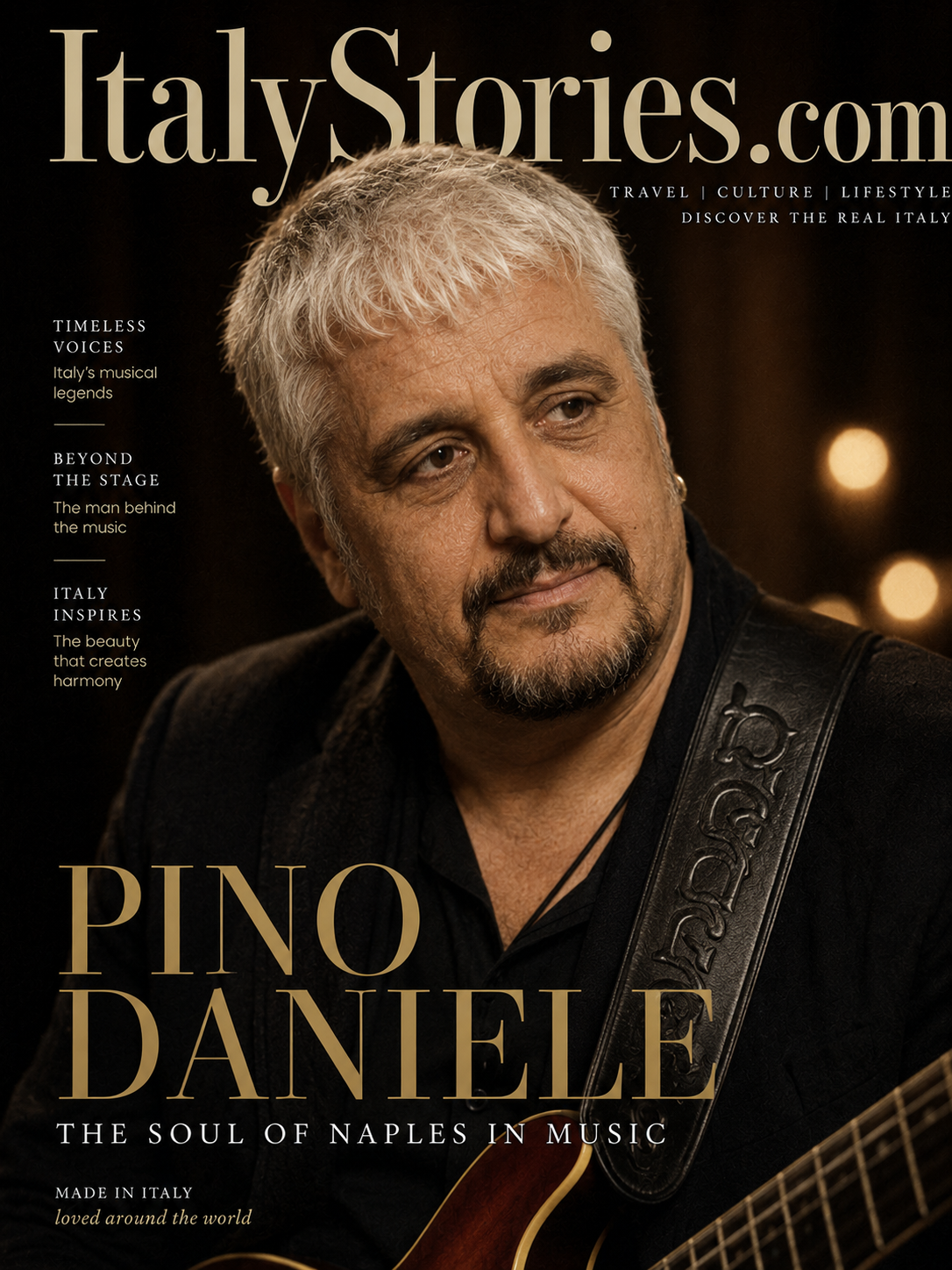
The Night Naples Became His Stage
On September 19, 1981, Piazza del Plebiscito was not yet the elegant civic salon visitors know today. Cars still occupied parts of the square, and Naples was living through one of the most difficult periods of its modern history. Yet that evening the space filled with an estimated two hundred thousand people for a free concert by a twenty-six-year-old singer and guitarist who had already changed the sound of the city.
Pino Daniele walked onstage with a band that now reads like a map of Neapolitan musical history: James Senese on saxophone, Tullio De Piscopo on drums, Tony Esposito on percussion, Rino Zurzolo on bass and double bass, and Joe Amoruso on keyboards. They did not present Naples as folklore. They played it as a living metropolis connected to blues, jazz, funk, rock and the Mediterranean. The dialect was there, but so were electric guitars, syncopated rhythms, improvisation and a cosmopolitan sense of possibility.
The official Pino Daniele archive remembers that concert as the culmination of the Vai mo’ season and the peak of the celebrated all-Neapolitan band. It was also a symbolic moment in Italian music: a southern city, often narrated nationally through crisis and stereotype, was showing that it could generate a modern sound strong enough to speak to the entire country.
Daniele had arrived there quickly, but not easily. Only four years earlier he had released his first album. Before that came childhood in Naples, guitar lessons, rehearsals in the Sanità district, demo tapes, session work, crowded clubs and a stubborn search for a language that did not yet have a name.
Eventually people would call it Neapolitan blues, Mediterranean blues, taramblù, or simply the Pino Daniele sound. None of those labels completely contains it. His music was a geography of collisions: Robert Johnson meeting the tarantella, American rhythm meeting Neapolitan melody, Arabic inflections meeting jazz harmony, protest meeting tenderness, street language meeting sophisticated musicianship.
That is why Pino Daniele became more than a beloved singer. He changed what Naples could sound like in modern popular music—and, in doing so, changed the sound of Italy itself.
Naples, 1955: A Child Inside a City of Contradictions
Pino Daniele was born Giuseppe Daniele in Naples on March 19, 1955. The date, Saint Joseph’s Day and Father’s Day in Italy, would later become part of the emotional calendar through which fans remembered him. But before symbolism came ordinary life in a city defined by beauty, poverty, humor, hardship, music and continuous improvisation.
Naples was not a neutral backdrop in Daniele’s work. It became his first instrument.
He absorbed its accents, street speech, legends, tensions and contradictions. The city he later sang was never the postcard Naples of sun, mandolins and picturesque resignation. It was a wounded, proud, funny, angry city. It contained children playing in streets where sunlight barely entered, unemployed young people, old songs, American soldiers, ancient beliefs and a modern hunger to escape provincial expectations.
Daniele began playing guitar around the age of twelve, during the beat generation. His musical education developed at the exact moment when Italian youth culture was becoming more porous. British rock, American soul, jazz and rhythm and blues were arriving alongside the powerful tradition of Neapolitan song.
For a young guitarist, Naples offered a unique laboratory. The presence of NATO and American military communities meant that local musicians could hear styles, records and live playing that were not always easily available elsewhere. Black American music had a particularly strong impact on the city’s emerging musicians. Daniele heard blues not as an exotic import but as a language with which Naples could enter into conversation.
That conversation would become the center of his life’s work.
Rehearsals in the Sanità and the Batracomiomachia Years
In the early 1970s Daniele was still one of many young Neapolitan musicians trying to turn enthusiasm into a profession. His group Batracomiomachia rehearsed in a cave-like space in Vico Fontanelle in the Sanità district, where singer Enzo Ciervo had found a place musicians could use without disturbing neighbors.
The official archive remembers those years as a dense network of encounters. Musicians met around Piazza Medaglie d’Oro and in rehearsal rooms, clubs and basements. Names that would later become central to the Neapolitan scene—Enzo Avitabile, Tony Esposito, Osanna, Nuova Compagnia di Canto Popolare, James Senese and others—belonged to an environment in which categories were still fluid.
The period produced what came to be called Neapolitan Power: not one single style, but a wave of musicians who believed that Naples could modernize its musical identity without abandoning its roots. The Showmen and Napoli Centrale were especially important because they demonstrated how black American music and Italian or Neapolitan melody could coexist.
Daniele learned from that world but did not copy it. His personality was already restless. He was interested in song, but he thought like a guitarist. He loved the blues, but he did not want to become an imitation of an American bluesman. He spoke dialect, but he did not want to preserve it behind glass.
He wanted contamination.
That word would become fundamental to understanding his work. In Daniele’s music, contamination was not dilution. It was identity becoming stronger by entering into dialogue with other identities.
Session Musician, Demo Tapes and the Discipline Behind the Myth
Before becoming a frontman, Daniele worked as a musician for others. This period gave him a professional education that later separated him from many singer-songwriters whose primary training was literary rather than instrumental.
He played guitar in studio and live contexts, learning how arrangements are built and how disciplined musicians respond to producers, singers and other instrumentalists. He also passed through the orbit of Napoli Centrale, the group led by James Senese and Franco Del Prete, one of the most adventurous bands of the period.
The importance of this apprenticeship cannot be overstated. Daniele would later write lyrics of enormous cultural weight, but he never accepted the idea that the words should automatically dominate the music. In the Italian songwriting climate of the 1970s, political and poetic content often carried enormous prestige. Daniele respected meaning, but he insisted that rhythm, harmony, timbre and musicianship were meaning too.
He made demos, searched for a record opportunity and gradually refined the material that would become his debut. What was emerging was already unusual: songs in Neapolitan, Italian and fragments of English; a guitar vocabulary influenced by blues and jazz; social observation without slogan-like rhetoric; and melodies that could still carry the melancholy of classic Neapolitan song.
By the time the first record arrived, the sound did not feel like an experiment assembled in a boardroom. It felt lived in.
Terra mia: A Debut That Redefined Naples
In 1977 Pino Daniele released Terra mia.
The album’s title could have announced nostalgia. Instead, the record sounded like a new declaration of belonging. “Terra mia” did not idealize home; it treated belonging as complicated, painful and necessary. But the song that immediately became larger than the album was the opening track, “Napule è.”
Daniele had reportedly written the core of “Napule è” while still very young. Its power lies in the refusal to choose between love and accusation. Naples is described through contradictions: beauty and suffering, people who know everything and a city that often does not know how to change, children, narrow streets, voices and resignation.
Musically, the song is restrained. It does not need grand orchestration to create scale. The melody carries a melancholy that belongs to the Neapolitan tradition, but the emotional stance is contemporary. This is not the tourist’s Naples. It is the city speaking about itself.
The album also announced Daniele’s broader musical program. He would use his roots not as a fence but as a launching point. In the official biography, Terra mia is compared in spirit to the great tradition of songs that transform territory into cultural consciousness: a love of land sharpened by historical awareness.
With one album, Daniele had entered Italian music not as another regional singer, but as an author capable of making regional language nationally relevant.
Je so’ pazzo: Anger, Humor and a New Neapolitan Language
The second album, Pino Daniele, released in 1979, accelerated everything.
Its track list contained songs that would become foundations of his catalog: “Je so’ pazzo,” “Je sto vicino a te,” “Chi tene ’o mare,” “Chillo è nu buono guaglione,” “Putesse essere allero” and others. The speed of his creative development was astonishing.
“Je so’ pazzo” became a manifesto. The phrase means “I am crazy,” but Daniele used madness as a declaration of freedom. The song carried irreverence, social tension, humor and defiance. He was willing to use language that Italian radio considered risky, and he addressed questions of identity and social exclusion without sounding like a pamphlet.
“Chillo è nu buono guaglione,” meanwhile, approached gender and difference with a sympathy unusual for mainstream Italian songwriting at the time. Daniele could be sharp, but his sharpness often protected outsiders rather than attacking them.
The album also confirmed the primacy of musicianship. James Senese’s saxophone and the rhythm section were not decoration behind a songwriter. They were part of the message. Daniele’s songs moved.
That movement was essential. Naples had long been associated with melody. Daniele added groove.
Nero a metà: When the Sound Became a Movement
In 1980 came Nero a metà, the album many listeners and musicians regard as the definitive early Pino Daniele record.
The title—Half Black—was an affectionate reference to Mario Musella of the Showmen, a musician of mixed Italian and Somali heritage who had embodied an earlier meeting between Neapolitan melody and black music. It was also, more broadly, a statement of Daniele’s artistic identity: Naples and America, Mediterranean and African-American, local roots and global imagination.
The album included “A me me piace ’o blues,” “Quanno chiove,” “I say i’ sto ccà,” “Alleria,” “Appocundria,” “Nun me scoccià” and other songs that demonstrated just how many emotional colors his new language could hold.
“Quanno chiove” remains one of his most beautiful love songs. It is proof that Daniele’s revolutionary importance did not depend on protest. He could write tenderness with extraordinary restraint.
“Appocundria,” a Neapolitan word connected to melancholy and inward restlessness, became another key to his emotional world. Daniele’s Naples was not only public anger; it was private unease.
The success of Nero a metà pushed him onto larger stages. In 1980 he opened for Bob Marley at San Siro, a symbolic encounter between the Neapolitan artist’s hybrid sound and one of the global figures who had demonstrated how local identity could travel internationally.
For Daniele, the lesson was clear: the more specific the roots, the farther the music might go.
Vai mo’ and the Legendary Band
By 1981 the ensemble around Daniele had become extraordinary.
James Senese on saxophone, Tullio De Piscopo on drums, Tony Esposito on percussion, Rino Zurzolo on bass, and Joe Amoruso on keyboards formed a band in which almost every member could have commanded a stage alone. Daniele later described it as a powerful machine built from musicians who carried their own histories of musical contamination.
Vai mo’ captured that collective energy. “Yes I Know My Way” became an international calling card, while songs such as “Viento ’e terra” and “Sulo pe’ parlà” pushed his melodic research forward.
The album and tour culminated in the Piazza del Plebiscito concert before roughly two hundred thousand people. The scale of the crowd was startling, but the deeper importance was cultural. This was the apex of Neapolitan Power: a generation of musicians demonstrating that the South could be modern, technically formidable and nationally influential.
After that peak, the band members increasingly followed separate paths.
For Daniele, separation did not mean retreat. It meant the next phase of travel.
Massimo Troisi: Friendship, Cinema and the Music Between Words
The early 1980s also brought Daniele into one of the most meaningful artistic friendships of his life: the relationship with actor and director Massimo Troisi.
Daniele created music for Troisi’s Ricomincio da tre, released in 1981. Their artistic temperaments were different but deeply compatible. Troisi’s comedy was built on hesitation, pauses, vulnerability, intelligence and Neapolitan language stripped of theatrical cliché. Daniele was doing something similar in music.
Both men were modernizing Naples without rejecting it.
Their collaboration continued in later years. Daniele’s songs became associated with Troisi’s films and with a shared emotional universe in which irony and melancholy remained inseparable. “Quando,” used in Pensavo fosse amore… invece era un calesse, became one of Daniele’s great later love songs.
The friendship is culturally important because it connected two revolutions in Neapolitan expression. Troisi changed the way a Neapolitan man could speak and move on screen. Daniele changed the way Naples could sound in contemporary song.
Neither needed to shout the word authenticity. They simply sounded like themselves.
Bella ’mbriana: Wayne Shorter and the World Enters Naples
With Bella ’mbriana in 1982, Daniele’s international curiosity became even more explicit.
The album featured Wayne Shorter, one of the great saxophonists in jazz history, and bassist Alphonso Johnson. On the official album notes, Daniele remembered Shorter as a musician who listened carefully and responded not only technically but imaginatively, using sound to evoke nature and images.
The title itself came from Neapolitan popular tradition. The bella ’mbriana is the benevolent spirit of the home, a protective presence linked to domestic harmony. Daniele placed that ancient figure inside a record made with internationally renowned jazz musicians.
That combination tells you almost everything about his method.
He was not abandoning Naples for the world. He was inviting the world into Naples.
Songs such as “Tutta ’n’ata storia,” “I Got the Blues,” “Maggio se ne va” and the title track moved between dialect, English, blues vocabulary and local mythology without treating any of them as incompatible.
Long before the term world music became a marketing category, Daniele was already making music that assumed cultures could meet without one of them disappearing.
Musicante and the Refusal of Musical Borders
The 1984 album Musicante pushed the research even farther.
Brazilian percussionist Naná Vasconcelos and trumpeter Don Cherry contributed to a sound that moved through Africa, Brazil, jazz, rock and Mediterranean melody. “Lazzari felici,” “Stella nera,” “Keep on Movin’” and the other tracks demonstrated that Daniele was becoming harder to classify precisely when his identity was becoming clearer.
He later used the word taramblù to describe the magical place where tarantella and blues meet. The word sounds playful, but it names a serious aesthetic principle: music can contain multiple histories at once.
Daniele’s guitar remained the thread connecting them.
He was never a virtuoso in the exhibitionist sense. He did not treat the guitar as an athletic contest. His playing combined touch, phrasing, blues vocabulary, jazz awareness and Mediterranean melodic instinct. A short phrase could be more recognizable than a long solo.
The live album Sciò, released during this period, documented just how international his stage world had become, with performances recorded in locations including Montreux, Cannes, Nyon, Milan, Verona, Naples and other European venues.
The Neapolitan musician was now thoroughly on the road.
Roots and Wings: The Late 1980s
The second half of the 1980s was a period of continuous stylistic movement.
Albums such as Ferryboat, Bonne soirée, Schizzechea with Love, and Mascalzone latino explored different balances between electric sound, acoustic intimacy, world-music color and Neapolitan roots. Daniele’s records often seemed to be born from touring itself: new musicians, new cities and new rhythms entered the studio with him.
Schizzechea with Love, whose concept literally joined roots and wings, captured the central contradiction of his career. Dialect and English, tradition and modernity, Naples and the rest of the world were not separate choices. They were the two sides of the same artistic necessity.
Mascalzone latino in 1989 brought a more acoustic sensibility and songs such as “Anna verrà,” dedicated to Anna Magnani, and “Faccia gialla,” connected to San Gennaro. The record could move from a Roman cinema icon to the patron saint of Naples without losing coherence because Daniele’s true subject was always identity in motion.
He was becoming a Mediterranean songwriter in the broadest sense—not because he used decorative ethnic sounds, but because the Mediterranean itself is a place formed by centuries of movement, exchange and collision.
The 1990s: A Man in Blues in a Changing Italy
A health problem forced Daniele to step back temporarily around 1990, but the return produced another creative shift.
Un uomo in blues, released in 1991, showed an artist still capable of reading contemporary Italy. “’O scarrafone” used humor and rhythm to address xenophobia and social prejudice at a moment when immigration and national identity were becoming increasingly charged public issues.
The song demonstrated an important feature of Daniele’s political intelligence. He rarely preached from above. He preferred irony, metaphor, street language and musical energy.
The 1990s also produced major songs such as “Quando,” “Sicily,” “Che Dio ti benedica,” “Io per lei” and “Dubbi non ho.” His audience widened, production became more polished, and collaborations continued to multiply.
Some early fans preferred the rougher sound of the Neapolitan Power years, but Daniele resisted nostalgia. He had never promised to remain the man of Nero a metà forever.
His identity was not a fixed sound.
It was the act of searching.
International Musicians: Dialogue Instead of Decoration
Daniele’s collaborations with international musicians were never merely prestige ornaments.
Wayne Shorter, Pat Metheny, Chick Corea, Steve Gadd, Alphonso Johnson, Naná Vasconcelos, Don Cherry, Gato Barbieri, Al Di Meola and Eric Clapton are among the names connected to different phases of his career. These musicians came from jazz, rock, fusion and world traditions, but Daniele did not invite them to make his records look cosmopolitan on paper.
He wanted conversation.
He often explained that playing with musicians better than oneself is a way to learn not only technique but life. That humility is essential to understanding him. He was proud of his identity but never artistically provincial.
In 2011, his live meeting with Eric Clapton at Cava de’ Tirreni became one of the most visible symbols of this international respect. Clapton’s guitar entered “Napule è,” one of the most local songs imaginable, and the encounter felt natural because Daniele had spent decades building the bridge between those worlds.
By then the bridge belonged to both sides.
Ricomincio da 30: Returning to the Band Without Repeating the Past
In 2008 Daniele celebrated thirty years of career with Ricomincio da 30, a title that affectionately echoed Massimo Troisi’s Ricomincio da tre.
The project reunited much of the historic band: Tullio De Piscopo, James Senese, Tony Esposito, Rino Zurzolo and Joe Amoruso, with additional musicians and guests including Al Di Meola and Chiara Civello.
On July 8, 2008, Piazza del Plebiscito once again became the center of his musical universe. This time the concert was not the eruption of a new movement but the conscious return of a history that had shaped Italian music.
Guests including Giorgia, Irene Grandi, Avion Travel, Nino D’Angelo and Gigi D’Alessio emphasized how broad Daniele’s influence had become.
The reunion worked because it did not pretend that 1981 could be recreated. Three decades of individual experience now stood on the same stage.
The music remembered without becoming a museum.
The Last Records: Independence and a Past That Stayed Present
The final years of Daniele’s recording career remained active and exploratory.
Electric Jam in 2009 included collaboration with J-Ax, bringing Daniele into contact with a younger Italian pop and rap generation. Boogie Boogie Man followed with guests including Mina, Franco Battiato and Mario Biondi, revisiting older material while keeping it in circulation as living music rather than archival property.
In 2012 La Grande Madre became an important act of independence, produced through his own label. The album was followed by touring in Italy, Switzerland and the United States.
He also returned to the roots of the Naples sound with the live project Tutta N’Ata Storia, involving figures such as Enzo Gragnaniello, Tony Esposito, Tullio De Piscopo, James Senese, Joe Amoruso and Rino Zurzolo.
The project demonstrated something important about Daniele’s understanding of legacy. He did not treat himself as the sole owner of the modern Neapolitan sound. It was always a collective history.
Even when his name had become the most internationally recognizable, the story remained larger than one man.
January 2015: The City Loses a Voice
Pino Daniele died in early January 2015 after a heart attack, just weeks before what would have been his sixtieth birthday.
The reaction in Naples revealed the depth of the bond between artist and city. A huge crowd gathered in Piazza del Plebiscito for a public tribute, and funeral ceremonies were held in both Rome and Naples.
The scale of mourning was not simply the response to celebrity death.
Naples had lost one of the people through whom it had learned to hear itself differently.
For nearly forty years Daniele had transformed the city’s dialect, wounds, humor and musical memory into a language modern enough to travel around the world. He had made songs that belonged simultaneously to neighborhoods, national radio, jazz festivals and international stages.
His death froze the biography, but it did not freeze the music.
2025: Seventy Years from His Birth, Ten Years Without Him
The year 2025 marked a double anniversary: seventy years since Pino Daniele’s birth and ten years since his death.
Naples and the Fondazione Pino Daniele organized a wide cycle of official initiatives under the 70/10 Anniversary framework. The projects included exhibitions, archival releases, the Musicante Award for young artists, the documentary Pino, the Musicante 40th Anniversary edition, and the previously unreleased song “Again.”
The city itself participated through “Le strade di Pino – 10 anni senza ’e te,” a program that returned listeners to streets, alleys and places connected to his youth.
The culminating event arrived on September 18, 2025, when Piazza del Plebiscito once again filled for Pino è – Il Viaggio del Musicante. The concert sold out months in advance, brought together major artists and was later broadcast in prime time on Rai 1. Its proceeds supported projects connected to pediatric oncology research and artistic education against educational poverty.
That social dimension is important.
The Fondazione Pino Daniele has chosen not merely to preserve a famous catalog but to turn the values associated with Daniele’s work—research, education, cultural identity, freedom and musical seriousness—toward younger generations.
The anniversary therefore looked backward and forward at the same time, exactly as Daniele’s music always had.
The Guitar, the Voice and the Sound of Recognition
Pino Daniele’s voice was never conventionally grand. Its power came from recognition.
A few syllables were enough. The slightly nasal timbre, the conversational phrasing, the ability to move from tenderness to irritation, from dialect to Italian to English fragments, made him unmistakable.
The guitar completed the identity.
His playing could be dry and rhythmic, bluesy, jazzy, lyrical or acoustic. He often left space. He understood that the guitar did not need to dominate every arrangement simply because he was a guitarist.
This restraint distinguished him from virtuosos who measure expression through quantity of notes. Daniele’s best guitar phrases sound like extensions of speech.
His music also depended on rhythm in a way that set him apart from many Italian singer-songwriters. Drums, percussion and bass were not background support. They carried the body of the song.
That is why a Pino Daniele record can be poetic and still make a room move.
Naples Without Folklore
Perhaps Daniele’s greatest cultural achievement was rescuing Naples from the false choice between tradition and modernity.
Before him, Neapolitan song already possessed one of the richest repertoires in the world. But that very greatness could become a burden for younger musicians. How could one honor centuries of melody without becoming an imitation of the past?
Daniele’s answer was to stop asking permission.
He used dialect with electric guitars. He put Neapolitan legends beside Wayne Shorter. He placed blues phrasing inside songs about local streets. He wrote social criticism that could be danced to. He sang Naples without pretending it was innocent.
The result influenced generations of southern Italian artists.
His Naples is proud but not self-congratulatory, wounded but not self-pitying, local but never provincial.
That balance is extraordinarily difficult.
It is also why “Napule è” remains so powerful. The song does not offer a city slogan. It offers a contradiction—and therefore something closer to truth.
Why Pino Daniele Still Matters
Pino Daniele still matters because his music solved a problem that many artists continue to face: how to belong deeply to a place without being trapped by it.
He began with Naples and reached the world, but the direction also worked in reverse. Jazz, blues, rock, African rhythms, Brazilian percussion and international musicians entered his work and came out changed by contact with the city he carried inside him.
He demonstrated that cultural identity is not purity.
It is memory strong enough to survive encounter.
His songs continue to be sung because they contain several kinds of truth at once. “Napule è” is civic poetry. “Je so’ pazzo” is rebellion. “Quanno chiove” is intimacy. “Appocundria” is melancholy. “Yes I Know My Way” is motion. “Quando” is romantic suspension. “A me me piace ’o blues” is a declaration of musical belonging.
And behind all of them is the same man with a guitar, suspicious of categories and impatient with repetition.
The official foundation now works to keep that legacy active through education and new musicians rather than reducing it to remembrance. That may be the most appropriate tribute possible.
Pino Daniele never treated music as a monument.
He treated it as a road.
And the road is still open.
A Final Thank You from ItalyStories.com
Thank you for spending time with this story. ItalyStories.com was created to explore the people, places, voices and ideas that have carried Italy far beyond its borders. If Pino Daniele’s journey has made you curious about another chapter of Italian music and culture, we would be delighted to welcome you to the next story.