

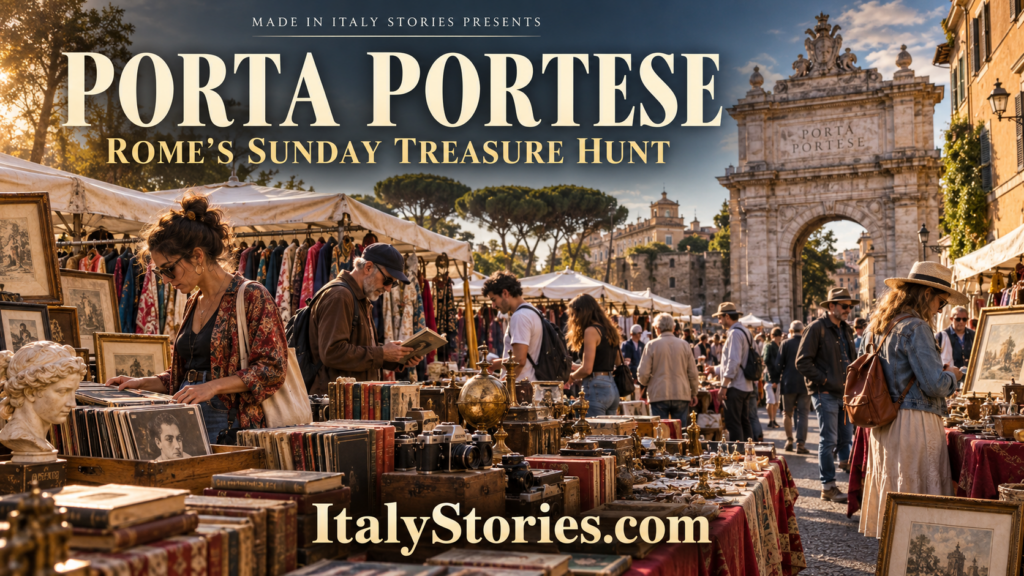
Rome changes its voice on Sunday morning. The traffic softens, metal shutters rise more slowly, and the aroma of coffee escapes from neighborhood bars where the first customers lean against the counter. Yet around Porta Portese, on the southern edge of Trastevere, the city is already wide awake. Vans arrive before sunrise, tables unfold along the streets, boxes are opened, clothes are hung from improvised rails, and thousands of objects begin another chapter in their unpredictable lives.
By the time the morning light reaches the old city gate, Porta Portese has become much more than a market. It is a temporary city within Rome: noisy, crowded, colorful, contradictory and wonderfully alive. Voices overlap in different languages. Vendors call out their prices. Experienced collectors inspect old books with patient attention, while curious visitors move from one stall to another without knowing exactly what they are looking for.
That uncertainty is part of the magic. You do not simply go to Porta Portese to buy something. You go to see what the market has decided to reveal.
On any given Sunday, its stalls may contain a forgotten family photograph, a vinyl record from the golden age of Italian music, a military jacket, a set of silver teaspoons, an old camera, a typewriter, a brass lamp, a ceramic plate, a religious medal, a stack of movie magazines or a postcard sent from Rome half a century ago. Every object carries traces of a previous home, a vanished fashion, a private celebration or an ordinary life.
Porta Portese is not polished, predictable or carefully arranged. It can be chaotic and overwhelming. Some sections are filled with inexpensive clothing and modern merchandise, while others preserve the atmosphere of a traditional flea market. Treasures do not present themselves elegantly. They hide beneath piles, inside dusty boxes and behind objects that seem completely unremarkable.
This is precisely why the market remains one of Rome’s most fascinating Sunday traditions.
A Market Born from Necessity
The story of Porta Portese is closely connected to the difficult years surrounding the end of the Second World War. The market began to take shape around 1945, when Rome was recovering from occupation, shortages and economic uncertainty. Families needed essential goods, but regular commercial networks could not always provide them. Buying, selling, exchanging and repairing used objects became part of everyday survival.
The new market continued a culture of informal commerce and bartering that had previously flourished in other parts of the city, including the area around Campo de’ Fiori. At Porta Portese, people could sell what they no longer needed and search for what they could not find elsewhere. Furniture, clothing, household tools, bicycle parts and personal belongings circulated from one family to another.
In those years, second-hand objects were not collected because they were fashionable or nostalgic. They were purchased because they were useful. A coat could be altered and worn again. A damaged chair could be repaired. A mechanical component could keep a bicycle or radio functioning. Nothing was thrown away before every possible use had been exhausted.
This practical attitude belonged to a wider Italian tradition of ingenuity. The culture of repair, reuse and adaptation shaped homes, workshops and communities throughout the country. It was connected to scarcity, but also to craftsmanship and respect for materials. Shoemakers, tailors, carpenters, mechanics and other artisans possessed the knowledge required to transform old things into useful things.
Porta Portese became a stage for this resourceful Rome. Its history is therefore not simply the history of shopping. It is a story of resilience, popular economy and urban survival.
As the Italian economic miracle transformed the country during the 1950s and 1960s, the character of the market changed. More consumer goods entered Roman homes, fashions moved faster, and families began replacing objects that earlier generations would have repaired. The discarded possessions of a modernizing society flowed into Porta Portese, where they found new owners.
Radios, record players, cameras, kitchen utensils, clothing and furniture became witnesses to Italy’s social transformation. Even today, walking through the market can feel like exploring the material memory of the twentieth century.
The Gate That Gave the Market Its Name
The name comes from Porta Portese, the monumental gate standing near the beginning of Via Portuense. Built in the seventeenth century as part of the Janiculum defensive walls, it replaced the more ancient Porta Portuensis, once connected to the Roman road leading toward the ports on the Tiber and the Tyrrhenian coast.
The location was never accidental. This part of Rome had long been associated with travel, transportation and commerce. Goods arrived along the river and the roads connecting the city to the surrounding countryside. Nearby warehouses, workshops and river activities made the district a natural meeting place for merchants, workers and travelers.
The gate still provides a powerful visual entrance to the Sunday market. It stands above the movement of people and merchandise like a dignified observer, linking papal Rome to postwar Rome and the historic city to its restless contemporary life.
From the gate, the market spreads through a large area that includes Via Portuense, Via Ettore Rolli and the streets around Piazza Ippolito Nievo. The boundaries can feel uncertain because the stalls, crowds and side routes create a constantly changing urban maze.
Porta Portese also occupies an important cultural border. Trastevere lies nearby with its medieval lanes, churches, trattorias and evening crowds. Across and beyond the Tiber are Testaccio, the former industrial and working-class district, and the neighborhoods that developed along the historic roads leaving Rome. These places have different identities, but they share a strong connection to Roman popular life.
A visit to the market can therefore become the starting point for a wider journey through the city. From Porta Portese, it is possible to explore the alleys of Trastevere, the Basilica of Santa Cecilia, Santa Maria in Trastevere, San Francesco a Ripa, the Janiculum Hill, Tiber Island, the Jewish Ghetto and the traditional food culture of Testaccio.
Yet the market itself remains a destination, not merely an attraction to pass through.
The Art of Getting Lost
There is no perfect route through Porta Portese. Maps can help visitors understand its scale, but strict itineraries often work against the spirit of the place. The pleasure comes from following a table of old books, turning toward a row of lamps, noticing a box of photographs and suddenly discovering that half an hour has disappeared.
The best approach is to arrive early, when the air is cooler and the stalls are still being arranged. Serious collectors often appear during the first hours because they know that the most interesting pieces can disappear quickly. Later in the morning, the market becomes increasingly crowded, and the experience changes from quiet observation to full immersion in Roman street life.
Some visitors come with a precise objective. They are searching for antique prints, vintage clothing, old coins, watches, records or spare parts. Others arrive without a list and allow curiosity to guide them. Both approaches can work, but Porta Portese rewards patience more than speed.
The antiques and collectibles are not concentrated equally throughout the market. Long stretches may offer modern clothes, shoes, bags and household products. Then, almost unexpectedly, a small group of stalls may present exactly the atmosphere people imagine when they hear the words “Roman flea market”: boxes of postcards, shelves of ceramics, old frames, yellowed books and objects whose original purpose is difficult to identify.
This mixture can surprise visitors expecting a romantic open-air antiques fair. Porta Portese is a working market, not a museum arranged for tourists. Its imperfections are part of its identity. It reflects changing patterns of migration, consumption, fashion and commerce in contemporary Rome.
The market that exists today is not identical to the one remembered by Romans who visited it decades ago. Some lament the growing presence of inexpensive mass-produced goods and the disappearance of specialized dealers. Others appreciate its multicultural energy and the fact that it remains accessible to people with very different budgets.
Both views contain some truth. Porta Portese is constantly changing because Rome is constantly changing.
Bargaining as a Conversation
At Porta Portese, prices are not always final. Bargaining is part of the experience, especially when dealing with used objects, vintage pieces or multiple purchases. However, successful negotiation depends on respect.
A conversation may begin with a simple question: “Quanto costa?” If the price seems high, a buyer can make a reasonable counteroffer. The objective is not to humiliate the seller or demonstrate cleverness. It is to find a price that allows both sides to feel satisfied.
Observing how Romans negotiate can be almost as entertaining as searching the stalls. Humor, theatrical disappointment and friendly persistence often become part of the exchange. A vendor may insist that an object is rare. A buyer may point to a scratch, a missing piece or the fact that they are purchasing several items. Eventually, after gestures and calculations, a deal may be reached.
Cash remains useful, particularly for smaller transactions, although payment methods vary among sellers. Visitors should carry manageable amounts rather than displaying large quantities of money. As in every busy market and crowded tourist area, attention to personal belongings is essential.
A small bag worn securely in front of the body is more practical than an open backpack. Phones and wallets should not be left in easy-to-reach pockets. These precautions should not create anxiety; they are simply part of moving sensibly through a dense urban crowd.
The most important rule is to examine an object carefully before buying it. Old does not automatically mean valuable, and a persuasive story is not proof of authenticity. Anyone considering an expensive antique, designer garment, watch, piece of jewelry or collectible should rely on knowledge rather than enthusiasm.
For most visitors, however, the greatest pleasure lies in inexpensive discoveries: a book in Italian, a vintage kitchen tool, a record, a small print or a postcard that captures an unexpected corner of the country.
Rome Preserved in Ordinary Objects
The famous monuments of Rome tell the history of emperors, popes, architects and artists. Porta Portese tells a different history. It preserves the lives of people whose names rarely appear in guidebooks.
A family album may show a summer holiday in Ostia. A postcard may carry a message sent from Naples, Florence or Venice. A recipe book may contain handwritten notes from a Roman kitchen. A school textbook may preserve the signature of a child who grew up during the economic boom. A record may recall the music played at a wedding, in a neighborhood bar or inside a Fiat traveling along the roads of Lazio.
These objects are modest, but they allow the past to feel intimate. History becomes something that was held, worn, repaired and loved.
This is one reason Porta Portese has attracted filmmakers, writers, poets and songwriters. Its world belongs naturally to the tradition of Italian Neorealism, which found drama and dignity in streets, courtyards, bicycles, markets and ordinary people. The popular Rome associated with Vittorio De Sica, Pier Paolo Pasolini and Mario Monicelli survives here not as a frozen cinematic set, but as an evolving urban language.
Claudio Baglioni transformed Porta Portese into a musical image familiar to generations of Italians. His song evokes the market as a place of chance encounters and unpredictable discoveries. The idea remains perfectly accurate: at Porta Portese, you may begin by looking for an object and end by finding a memory.
The market also reveals Rome’s talent for absorbing different cultures. Vendors and customers come from many countries, and the merchandise reflects global routes of trade and migration. Italian military coats hang beside international fabrics. Roman prints share tables with foreign coins. Traditional household objects appear beside electronics and contemporary fashion.
This mixture is not separate from the identity of the city. Rome has always grown by receiving people, languages, beliefs and goods from elsewhere. Porta Portese continues that ancient habit in an everyday and sometimes chaotic form.
The Sunday Ritual
For many Romans, Porta Portese is not an occasional tourist attraction but a ritual. It belongs to Sunday morning in the same way as breakfast at the neighborhood bar, a walk through Trastevere or a long family lunch.
The ritual begins early. A quick espresso and cornetto provide the necessary energy, although some Romans prefer a savory slice of pizza rossa. Then comes the slow walk between the stalls, interrupted by conversations, discoveries and negotiations.
The market appeals to different generations for different reasons. Older visitors may search for tools, replacement parts or objects connected to their youth. Younger shoppers come for vintage fashion, vinyl records, analog cameras and furniture that can be restored or reimagined. Collectors look for specific editions and rare pieces. Tourists search for souvenirs with more personality than those sold near the major monuments.
Environmental awareness has also given second-hand markets a new relevance. Buying used clothing, furniture and household objects can reduce waste and extend the life of materials. What began as a necessity in postwar Rome now speaks to contemporary concerns about sustainability and excessive consumption.
Yet Porta Portese is not a fashionable invention created for the circular economy. It practiced reuse decades before the concept acquired a modern name. Its stalls remind visitors that objects do not have to become waste simply because their first owner no longer wants them.
In this sense, the market represents both an old tradition and a possible vision of the future.
What to Look For
The variety of merchandise can be enormous. Clothing occupies a significant part of the market, ranging from inexpensive modern items to military jackets, leather coats and genuine vintage garments. Careful inspection is necessary, as quality varies greatly.
Book lovers may find novels, art catalogues, dictionaries, school texts, comics and magazines. Most are naturally in Italian, making them especially interesting to language learners or visitors searching for an authentic cultural souvenir.
Record collectors should be prepared to browse patiently through boxes. Italian popular music, opera, classical recordings and international albums may all appear together. Condition matters, so both the vinyl and its sleeve should be examined.
Old photographs and postcards are among the market’s most evocative objects. They offer images of Italian cities, seaside resorts, villages, religious celebrations, military service and family life. Even when the people in the photographs are unknown, their clothes, gestures and surroundings tell stories.
Visitors may also encounter ceramics, cutlery, devotional objects, toys, clocks, furniture, paintings, prints, costume jewelry, cameras, telephones and mechanical tools. Not every item is antique, and not every antique is valuable. The reward is often emotional rather than financial.
A modest object can become precious because it recalls a grandparent’s home, a childhood tradition or a journey through Italy.
Beyond the Market
When the stalls begin to close, Porta Portese offers several directions for continuing the day. Trastevere invites visitors into a network of lanes, small squares and historic churches. The neighborhood is famous for restaurants and nightlife, but its quieter streets still reveal workshops, courtyards and traces of working-class Rome.
Santa Cecilia in Trastevere preserves layers of history beneath its elegant architecture, while Santa Maria in Trastevere remains one of the neighborhood’s great spiritual and artistic landmarks. San Francesco a Ripa contains Gian Lorenzo Bernini’s moving sculpture of the Blessed Ludovica Albertoni.
Those seeking a panoramic view can climb toward the Janiculum Hill and the Fontana dell’Acqua Paola. Crossing the Tiber leads toward Tiber Island, the Jewish Ghetto and the archaeological heart of Rome. In the opposite direction, Testaccio offers a different experience shaped by markets, traditional Roman cuisine, industrial archaeology and the history of the former slaughterhouse.
These connections make Porta Portese an ideal internal doorway into the wider story of Rome. The market touches architecture, cinema, music, migration, craftsmanship, food, fashion and neighborhood identity. It connects the monumental city to the lived city.
A Market That Refuses to Stand Still
It is tempting to describe Porta Portese as a surviving fragment of old Rome, but that would only be partly true. The market has never remained unchanged. It was born from crisis, expanded during reconstruction, absorbed the products of the economic boom and adapted to globalization.
Its disorder is a form of historical continuity.
Every Sunday, objects arrive from apartments, storage rooms, workshops and private collections. Some are useful, some beautiful and some almost impossible to explain. They wait briefly beneath canvas roofs before being carried into another home or packed away again.
The market exists only for a few hours, yet it contains several centuries of Rome. The seventeenth-century gate watches over postwar traditions, twentieth-century design, contemporary street fashion and objects whose origins may be much older.
Porta Portese does not offer the controlled beauty of a museum or the theatrical perfection of Rome’s most famous squares. Its beauty is accidental. It appears in the morning light falling across a stack of books, in the conversation between a vendor and a collector, in the scratched surface of an old camera or in the discovery of a photograph that has somehow survived.
Come early. Walk slowly. Look beneath the obvious things. Ask questions. Listen to the voices around you. Accept that you may not find what you expected.
At Porta Portese, the real treasure is not always the object you carry home. Sometimes it is the feeling of having entered a Rome that is still lived rather than displayed—a city of markets, neighborhoods, memories and traditions that continues to reinvent itself every Sunday morning.
Follow ItalyStories.com to discover more Italian cities, hidden places, unforgettable people and traditions that reveal the real soul of Italy.