

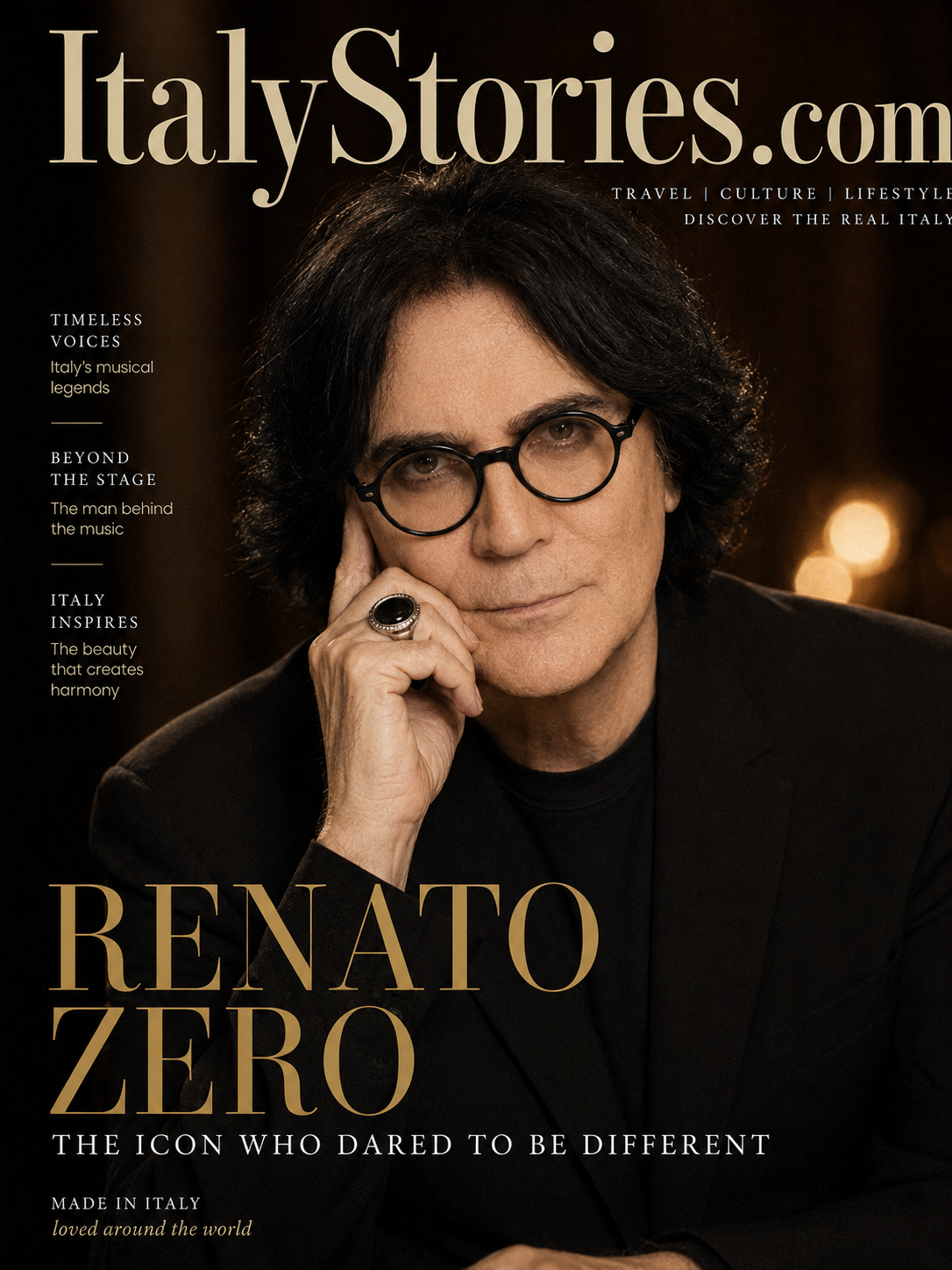
The Night the Outcasts Became the Majority
Long before Italian pop learned to speak comfortably about identity, difference, loneliness and self-invention, Renato Zero was already walking onto stages dressed like a vision from another planet.
The costumes were spectacular, but they were never the whole point. Feathers, glitter, makeup, capes, theatrical silhouettes and deliberately ambiguous gestures could attract the eye, yet the songs kept people there. Under the spectacle was a singer who understood something fundamental about those who felt misplaced: the boy who thought he was too strange, the woman who had been told to accept less, the lonely person in a crowded city, the fan who needed someone onstage to say that being different did not mean being wrong.
By the late 1970s, the audiences had become enormous. They were given a name that would become one of the most famous fan identities in Italian music: the Sorcini. The relationship between Zero and those listeners was unlike the traditional distance between star and public. He did not present himself as the perfect person they should admire from below. He often presented himself as one of them – excessive, vulnerable, judged, theatrical, wounded, stubbornly alive.
That bond became the real foundation of a career lasting more than half a century. Renato Zero would write and perform hundreds of songs, move from provocation to mature reflection, survive periods when critics and the market seemed ready to dismiss him, return stronger than expected, create his own artistic universe, and become one of the great public figures of Italian popular culture.
The strange young man from Rome did not simply become accepted. He created a kingdom in which what had once been called strange became a source of belonging.
Rome Before Zero: Renato Fiacchini and the Hunger for the Stage
Renato Zero was born Renato Fiacchini in Rome on September 30, 1950. His artistic story is inseparable from the city. Rome gave him theatricality, street language, irreverence, melancholy, spectacle and the instinct to transform daily life into performance.
He grew up in the postwar capital during years of rapid social and cultural change. Italy was entering the economic boom, television was reorganizing popular imagination, American and British music were arriving with increasing force, and Roman nightlife was becoming a laboratory for new attitudes. The city contained Catholic respectability, cinematic glamour, working-class neighborhoods, international tourists, intellectual circles and a growing youth culture all at once.
Renato was drawn early toward performance. He studied dance and frequented the places where young musicians, dancers and future celebrities met. In the 1960s he became part of the Roman club scene surrounding venues such as the Piper, one of the symbolic homes of the Italian beat generation. There he crossed paths with artists who would become central to Italian music, including the Bertè sisters, Loredana Bertè and Mia Martini.
Those years were an apprenticeship in more than music. They taught him how clothes communicate, how movement changes the meaning of a song, how a room reacts to provocation, and how an artist can create attention before the audience knows exactly what it is seeing.
He also worked as a dancer in television variety productions after encounters with figures such as choreographer Don Lurio. He appeared in theatrical and screen projects, including the Italian production of the musical Hair in 1969, and worked as an extra in Federico Fellini’s Satyricon. None of these experiences made him famous, but together they taught him something that later became essential: a singer could be actor, dancer, storyteller, costume, voice and character at the same time.
The Name “Zero”: Turning an Insult into an Identity
The stage name Renato Zero became one of the most effective acts of self-invention in Italian entertainment. Various biographical accounts have linked the name to the idea of having been treated as a nobody – a zero – and to the young performer’s determination to convert that judgment into a signature.
Whether every anecdotal detail about the origin is exact matters less than what the name came to mean. Zero was emptiness turned into possibility. It was self-deprecation made powerful. It announced that an identity rejected by ordinary categories could become memorable precisely because it refused them.
The name also worked visually and conceptually. Renato Zero was not simply Renato Fiacchini with a professional surname. “Zero” became a world. Albums, tours, fan communities, businesses and theatrical projects would later build on that vocabulary: Zerofobia, Zerolandia, EroZero, ZeroNoveTour, Zerosettanta, Zero a Zero, L’OraZero.
Few Italian artists have turned a stage name into such a complete mythology. The word became flexible enough to express vulnerability, irony, ambition and rebirth. What began as apparent nothingness became one of the strongest brands of personal identity in Italian music.
The First Records: Learning How to Put the Theatre on Vinyl
Before the breakthrough, there was frustration. Renato Zero’s early recording career did not immediately reproduce the force of his live personality.
His first album, No! Mamma, no!, arrived in 1973, followed by Invenzioni in 1974. These records contained the beginnings of the themes and theatrical instincts that would later define him, but the public had not yet fully discovered the character.
This mismatch between live presence and recording identity is common in artists whose power depends partly on visual language. A record cannot show a gesture, a costume change or the charged silence before a performer turns toward the audience. Zero had to learn how to make the theatricality survive without the theatre.
The answer was not simply to make the music louder or stranger. It was to write songs with characters, emotional conflicts and memorable images strong enough to create their own stage inside the listener’s mind.
By the middle of the decade, that transformation was taking place. The artist who had seemed too difficult to classify was beginning to understand that classification itself could be his subject.
Trapezio: The Balance Begins to Hold
The 1976 album Trapezio marked an important step toward the Renato Zero the wider public would recognize.
The title was perfectly chosen. A trapeze artist survives through balance, risk and the willingness to move above an empty space. Zero’s career at that moment required the same qualities. He was balancing pop melody with theatrical performance, provocation with tenderness, mass entertainment with themes that Italian television and radio did not always address comfortably.
The album contained songs that revealed growing confidence and emotional range. “Il cielo,” which would become one of the essential pieces of his repertoire, already showed that beneath the costumes was a songwriter capable of broad, almost spiritual reflection. Other songs examined isolation, desire, fantasy and the roles people play in order to survive.
Zero was discovering the structure that would carry him through his great period: entertain first, then reveal the wound underneath.
The public was ready.
Zerofobia: The Explosion of 1977
With Zerofobia in 1977, Renato Zero moved from fascinating outsider to major star.
The title turned fear of Zero into an attraction. Instead of asking audiences to tolerate him, he challenged them to confront the discomfort he created. The strategy was theatrical, but it also reflected the social climate of the decade. Italy was living through political violence, generational conflict, changing sexual codes and deep uncertainty. Young people were questioning authority, family structures and inherited identities.
Zero did not offer a political program. He offered a stage on which difference could become visible.
“Mi vendo” became one of the defining songs of the period. The title – I sell myself – was provocative, ironic and perfectly suited to the marketplace of celebrity, desire and identity. Onstage, the song became a performance of self-commodification in which the artist seemed to offer everything while still controlling the transaction.
“Morire qui,” another enduring song, revealed the emotional seriousness behind the image. Zero could move from camp theatricality to desperation without abandoning credibility. That ability prevented his persona from becoming a novelty act.
Zerofobia also became a theatrical show, reinforcing the idea that album and stage were parts of the same work. Rai archives later remembered the period as one in which Zero mixed songwriting, theatre and provocation in a way that transformed Italian television performance.
The spectacle was no longer hiding the songwriter. It was carrying him.
Zerolandia: Creating a Country for the Sorcini
In 1978 came Zerolandia, the album and the idea that completed the first great mythology of Renato Zero.
By now the public had a name: Sorcini. The origin of the term is part of the folklore surrounding the artist, but its cultural significance is clear. The fans did not remain an anonymous audience. They became citizens of an imagined community.
Zerolandia was a country for people who had not always found a place elsewhere.
The album included “Il triangolo,” one of Zero’s most famous and mischievous songs. The subject – a romantic and sexual triangle – was handled with theatrical humor rather than moral panic. In late-1970s Italy, the song’s playful ambiguity was itself culturally significant. Zero could put taboo-adjacent material into mainstream entertainment without turning it into a lecture.
“La favola mia” reinforced the autobiographical dimension of the persona. Zero’s life and stage character were becoming inseparable in the public imagination. The costumes, songs and fan culture fed one another.
At concerts, the relationship became almost ritualistic. Zero addressed the audience directly, argued with it, thanked it, teased it and treated it as a participant rather than decoration.
This was one of his major innovations. Long before modern fan communities built identities online, Renato Zero had created an emotional nation around a performer.
1979: EroZero, “Il carrozzone” and a Star at Full Power
EroZero in 1979 arrived at the height of the first Zero phenomenon.
The album’s title played again with identity: I was Zero. The phrasing suggested both self-assertion and the possibility that identity could change from one moment to the next.
“Il carrozzone” became one of the great songs of his career. Written by Piero Pintucci and Franca Evangelisti, it uses the image of a travelling show as a metaphor for life, death and the endless movement of spectacle. The song is grand without being hollow, melancholy without becoming static.
For a performer who had built his career through theatrical excess, the image of the travelling show was especially powerful. The stage is magnificent, but it moves on. Applause ends. Costumes are removed. People disappear. The next city waits.
That same year Zero appeared in the film Ciao Nì!, extending his public universe into cinema. His label and production identity around Zerolandia also strengthened, giving him greater control over the machinery surrounding the music.
The artist who had once struggled for recognition was now building institutions around himself.
Tregua and “Amico”: Friendship as an Anthem
In 1980 Renato Zero released Tregua, an album whose title – Truce – suggested a pause after years of acceleration.
Its most enduring song became “Amico.” Composed with Dario Baldan Bembo and Franca Evangelisti, it turned friendship into something larger than casual companionship. Zero sings friendship with the seriousness other artists reserve for romantic love.
That emphasis was deeply connected to his audience. The Sorcini had always been addressed as companions in a shared struggle for acceptance. “Amico” could therefore work both as a private dedication and as a public statement of loyalty.
The song became a classic and remained central to his concerts for decades. Its power comes partly from simplicity. Friendship is presented as shelter, recognition and resistance against isolation.
Tregua also contained songs such as “Potrebbe essere Dio,” which showed Zero’s willingness to move into philosophical and spiritual territory. The provocative young performer was expanding rather than abandoning his questions.
The costumes remained, but the moral and emotional world was growing larger.
The Voice: Theatre, Fragility and the Roman Accent of Emotion
Renato Zero’s voice has never been valued primarily as a display of technical perfection. Its greatness lies in interpretation.
He can whisper, plead, accuse, joke, declaim and suddenly open into a broad melodic phrase. The sound is recognizably Roman in emotional temperature even when the diction becomes theatrical. There is directness in it, a willingness to sound imperfect if imperfection serves the line.
This is particularly effective because his songs are often inhabited by characters. Zero does not merely sing lyrics; he acts them. A line may begin as confession and end as confrontation.
His phrasing also carries an unusual mixture of vulnerability and command. He can sound wounded without sounding passive. He can appear extravagant while singing something emotionally naked.
That tension is the essence of his voice: the mask and the person underneath are audible at the same time.
The Early 1980s: Success, Saturation and the Risk of Becoming a Symbol of Yesterday
After the extraordinary momentum of the late 1970s, the early 1980s brought a more complicated phase.
Albums including Artide Antartide, Via Tagliamento 1965/1970, Calore and Leoni si nasce continued his prolific output, but the cultural climate was changing. Italian pop entered a different visual and commercial era. New stars emerged. The extravagant glam theatricality that had once seemed radical risked being treated as a relic of the previous decade.
Zero faced one of the hardest problems in any long career: what happens when the world begins imitating surfaces that once made you unique, while simultaneously deciding that you belong to the past?
His response was inconsistent at times, as artistic transitions often are. Some records connected more strongly than others. The mass attention of the Zerolandia years cooled.
But the Sorcini stayed.
This loyalty matters because it gave Zero something more valuable than temporary fashion. Even when mainstream enthusiasm weakened, he retained a committed audience willing to follow him through uncertainty.
That audience would later make the comeback possible.
Voyeur and the End of the Wilderness
The 1989 album Voyeur signaled that Renato Zero was beginning to recover artistic and commercial momentum.
The title itself suggested observation: the artist looking at society, and perhaps society looking again at him.
By the end of the 1980s, Zero had outlived the idea that he could be explained only through costumes. The public was older. He was older. The songs increasingly foregrounded the mature interpreter.
The transformation was not an abandonment of the old Zero. It was a redistribution of emphasis.
The provocation remained in the worldview, but it no longer needed feathers to announce itself.
Sanremo 1991: “Spalle al muro” and the Return Nobody Expected
The Sanremo Music Festival of 1991 became one of the crucial turning points of Zero’s career.
He arrived with “Spalle al muro,” written by Mariella Nava. The title means Back Against the Wall, and it could hardly have been more appropriate.
The song confronted aging, vulnerability and the fear of being discarded. For a performer whose public image had once depended so heavily on youth, transformation and visual shock, the subject carried obvious biographical resonance.
Zero performed it not as a defeated figure but as someone willing to make decline itself visible.
The song finished second, but the ranking was less important than the effect. The festival reminded Italy that Renato Zero was not a nostalgic curiosity. He was an interpreter capable of giving emotional weight to adult themes.
What had been imagined by some as an ending became a reopening.
The mature phase of Renato Zero had begun.
Fonopoli: The Dream of Giving Young People a Place
The 1990s also brought one of Zero’s most ambitious cultural ideas: Fonopoli.
The project was conceived as a space dedicated to music, culture, training and opportunities for young people. It reflected a theme present throughout his career: those without access need more than sympathy; they need places in which they can develop.
Fonopoli became an association and an enduring part of Zero’s public mission, even though the original grand physical vision faced practical difficulties and was never realized exactly as first imagined.
The idea remains revealing. Zero had spent his youth trying to enter spaces controlled by others. As an established artist, he wanted to create a space where younger people would not have to beg for permission in the same way.
This instinct toward mentorship and social inclusion was not separate from the music. It grew from the same emotional territory that had produced songs for the lonely, marginalized and underestimated.
The Imperfect Years and “I migliori anni della nostra vita”
Albums such as L’imperfetto in 1994 and Sulle tracce dell’imperfetto in 1995 deepened Renato Zero’s mature identity.
The word “imperfect” could almost serve as a summary of his artistic philosophy. Zero had never built a mythology of flawless normality. He built one in which flaws could become character.
In 1995 he recorded “I migliori anni della nostra vita,” written by Maurizio Fabrizio and Guido Morra. Zero did not write the song, but his interpretation made it inseparable from him.
The melody is broad and almost cinematic. The lyric imagines two people protecting their bond against a disappointing outside world. In Zero’s voice, the song became larger than romantic nostalgia. It sounded like a promise between artist and audience.
The title – The Best Years of Our Lives – also fitted his relationship with fans who had followed him from youth into middle age. Concert audiences could sing it while thinking not only of partners but of decades shared through music.
It became one of his standard closing songs and one of the definitive anthems of the mature Zero.
Amore dopo amore: 1998 and a Second Commercial Peak
In 1998 Renato Zero released Amore dopo amore, one of the most successful albums of his later career.
The record contained “Cercami,” “L’impossibile vivere,” “Dimmi chi dorme accanto a me,” “Figaro” and “La grande assente,” dedicated to his friend Mia Martini, who had died in 1995.
“Cercami” became particularly important. The word means Search for me. Once again Zero found a title that could carry an entire emotional relationship in a single imperative.
The success of the album and its tour demonstrated something that had seemed unlikely during the difficult 1980s: Renato Zero was capable not merely of surviving but of returning to mass popularity at a level comparable to his earlier peak.
The difference was that the audience was now broader in age and the persona more layered. Some fans had arrived in the Zerolandia years. Others knew only the mature ballads. Parents and children could attend the same concert for different reasons and still recognize the same artist.
Zero had become intergenerational.
Mina, Respect and the Recognition of the Songwriter
One of the most meaningful forms of recognition came through Mina.
In 1999 she released Mina n° 0, an album built around songs from Renato Zero’s repertoire. For an artist who had sometimes been treated by critics as primarily a theatrical phenomenon, the gesture carried enormous symbolic weight.
Mina is one of the most respected interpreters in Italian music. Her decision to enter Zero’s songbook helped shift attention toward something fans had long understood: underneath the costumes was a serious body of songwriting.
Songs can be tested by another voice. If they survive without the original image, they reveal their structure.
Zero’s songs survived.
Television and “Tutti gli Zeri del mondo”
At the turn of the millennium, Renato Zero’s renewed popularity extended again into television.
His live success and public authority led to major television projects, including Tutti gli Zeri del mondo. This return to prime-time television was fitting because television had been part of his artistic education from the beginning.
But the medium had changed, and so had he.
The young Zero once entered television as an unpredictable visual disturbance. The mature Zero entered it as host, singer and cultural institution.
The change illustrates the scale of the journey. The outsider had become part of the national archive without losing the memory of having been outside it.
The 2000s: La curva dell’angelo, Cattura and Il dono
The first decade of the new century produced another sustained run of work.
La curva dell’angelo arrived in 2001, followed by Cattura in 2003 and Il dono in 2005. These albums continued Zero’s mature concerns: love, time, faith, responsibility, loneliness and the relationship between individual dignity and a society often perceived as superficial.
By then the spectacular costumes were no longer necessary to create an event. Zero could stand in a dark suit before a large orchestra and command the same attention.
The theatre had moved inside the interpretation.
His concerts continued to grow into elaborate productions, but the emotional center remained the conversation with the audience. Zero spoke extensively from the stage, often turning concerts into a mixture of music, theatre, social reflection and direct address.
This willingness to talk to fans – not only sing at them – remained a defining element of the relationship.
Presente: Independence and a Number One at Nearly Sixty
In 2009 Renato Zero released Presente, a project associated with his independent label Tattica.
The title made a clear statement: Present.
After decades of being declared finished, outdated, returned, reborn and rediscovered, Zero reduced the argument to one word. He was here.
The album was a major commercial success, demonstrating once again that his audience was not merely nostalgic. New songs could still reach the top of the Italian market.
Tracks such as “Ancora qui” and “Questi amori” integrated naturally into a repertoire already crowded with classics.
The ZeroNoveTour reinforced the point. At an age when many performers shift toward smaller retrospective shows, Zero remained capable of mounting large productions and filling major venues.
Presence had become his answer to time.
Amo, Alt and the Refusal to Become a Museum Piece
The 2010s brought a series of ambitious projects that demonstrated Zero’s refusal to treat his own history as a museum.
Amo – Capitolo I and Amo – Capitolo II appeared in 2013, dividing a large body of new music across two albums. Alt followed in 2016.
That year he appeared as a celebrated guest at Sanremo, performing a medley that moved through “Favola mia,” “Più su,” “Amico,” “Nei giardini che nessuno sa,” “Cercami,” “Il cielo,” “I migliori anni della nostra vita,” “Il triangolo” and “Mi vendo.”
The sequence demonstrated how many different Renatos could coexist in one career: provocateur, ballad singer, friend, social observer, romantic, clown, survivor.
The audience knew all of them.
Rather than hide the theatrical past, Zero now treated it as one chapter inside a much larger body of work.
Zerovskij: When the Pop Concert Becomes Musical Theatre Again
In 2017 Renato Zero created Zerovskij… solo per amore, an ambitious project blending concert, orchestral music and musical theatre.
The title character allowed him to return explicitly to the theatrical instinct that had shaped his earliest career. Yet the context was very different from Zerofobia forty years earlier.
The young artist had used theatre to force society to look at difference. The older artist used theatre to reflect on life, love, conflict and mortality.
The scale of the production showed that theatricality had never been merely decorative. It was one of Zero’s natural languages.
He had spent a lifetime moving between song and stage because, for him, the two were never fully separate.
Zero il folle and Zerosettanta: Aging Without Apology
Zero il folle arrived in 2019. The title – Zero the Fool – embraced another archetype that had followed him throughout his life: the fool who can say what respectable society avoids.
A year later, for his seventieth birthday, he released the Zerosettanta project as a trilogy of albums.
Reaching seventy can tempt an artist toward retrospective celebration. Zero chose productivity instead.
The trilogy treated age not as conclusion but as evidence. Seven decades had not resolved his questions about society, love, loneliness, faith or injustice.
If anything, age gave those questions additional urgency.
Rai and other cultural institutions increasingly treated Zero as part of the historical fabric of Italian entertainment. But he continued to resist the stillness of a monument.
He preferred to keep moving.
Zerosettanta at the Circus Maximus and Zero a Zero
In 2022 Renato Zero celebrated his history with the Zerosettanta concert events at Rome’s Circus Maximus.
The location mattered. A performer once associated with underground youth culture and theatrical provocation was now filling one of the symbolic monumental spaces of his native city.
The image contained an entire biography.
The concerts also introduced songs later included in Autoritratto. In 2023 the Zero a Zero – Una sfida in musica tour continued the dialogue between new material and the historic catalog.
Zero has always understood anniversaries not as polite ceremonies but as opportunities to test the relationship with his public again.
The audience continued to answer.
Autoritratto: Looking at the Face Behind the Masks
Autoritratto was released in December 2023.
The title – Self-Portrait – was particularly resonant for an artist who had spent his career multiplying images of himself. Renato Zero had been clown, lover, provocateur, prophet, outcast, showman, friend and social critic.
A self-portrait at this stage could not mean choosing one face as the true one. It meant accepting the accumulation.
The album contained thirteen tracks, including material previewed during the Zerosettanta concerts and the Zero a Zero tour, together with newly released songs.
Its existence confirmed a recurring truth about Zero: the past is always present, but it is never sufficient.
He continues to need new songs.
L’OraZero: Seventy-Five and Nineteen New Worlds
On October 3, 2025, shortly after his seventy-fifth birthday, Renato Zero released L’OraZero.
The official presentation described the album as a journey through nineteen different worlds, each with its own roots, needs, contradictions and utopias. The record was preceded by “Senza” and concluded with “Pace,” turning the project toward themes of love, friendship, respect and the refusal of violence.
At an age when almost no one would have questioned a decision to live entirely from past achievements, Zero chose nineteen new tracks.
The decision is central to understanding him.
For Renato Zero, longevity is not the same thing as repetition. He returns to the same fundamental concerns because society keeps producing new forms of the same loneliness, exclusion, fear and need for love.
The costumes change. The questions remain.
L’OraZero in Tour 2026: The Sorcini Are Still There
The L’OraZero tour began in January 2026 with a series of arena dates across Italy.
The itinerary opened in Rome and continued through cities including Florence, Turin, Mantua, Conegliano, Bologna, Pesaro, Eboli, Bari and Messina. The announced concept combined historic songs with the nineteen-track 2025 project.
More than fifty years after his first album, Zero was still touring new material in large arenas.
That fact is perhaps more revealing than any career statistic.
Many artists can sell nostalgia. It is harder to ask an audience to continue listening to the person you are becoming.
The Sorcini have continued to do exactly that.
The Sorcini: More Than a Fan Club
The term Sorcini is inseparable from Renato Zero, but the phenomenon deserves to be understood beyond the affectionate nickname.
Zero’s fan culture was unusually strong because it developed around recognition. Many fans felt that the artist had seen people like them before mainstream culture did.
He sang for outsiders without reducing them to victims. He celebrated extravagance, but he also sang about old age, disability, addiction, loneliness, abandoned people and social hypocrisy.
The fan relationship therefore contained gratitude as well as admiration.
This helps explain the intensity of loyalty during weaker commercial years. The bond was not based only on chart success. Fans did not simply like Zero when Italy liked him.
They had already built a community around him.
Modern fan culture often depends on social media. The Sorcini existed as a powerful identity decades earlier, connected through concerts, letters, associations, magazines and shared rituals.
In that sense, Renato Zero anticipated the community-based celebrity of the digital age.
Difference, Ambiguity and the Cultural Importance of Not Explaining Everything
Renato Zero’s visual ambiguity in the 1970s was culturally powerful partly because he refused to reduce it to a simple explanation.
The costumes challenged conventional masculinity. The makeup disrupted expectations. The songs played with desire, identity and role-playing. Audiences could interpret the performance in different ways, and that openness was part of its power.
Zero did not need to turn every provocation into autobiography. The stage created a space in which ambiguity itself could exist publicly.
In an Italy still negotiating rigid gender roles and conservative social expectations, that visibility mattered.
At the same time, it would be reductive to understand his career only through sexual ambiguity. His deeper theme was freedom from imposed identity.
The message reached anyone who had been told to become smaller in order to be accepted.
The Social Zero: The Lonely, the Forgotten and the People Outside the Frame
Across more than five hundred songs, according to Rai archival profiles, Renato Zero has returned repeatedly to people who are easily ignored.
His work contains empathy for the lonely, the elderly, people with disabilities, young people without direction, those struggling with addiction, those who feel rejected, and those who live outside conventional respectability.
This social dimension is one reason his theatricality never became empty spectacle.
The masks were connected to a moral imagination. Zero understood performance as a way to direct attention.
His public statements have often emphasized solidarity and acceptance, and Rai’s 2025 archival celebration highlighted an interview from 1982 in which he discussed diversity and concern for the vulnerable.
The themes remained relevant because society never completely solved them.
The Great Songs: Not a Discography, but an Emotional Map
A complete list of Renato Zero’s important songs would be too long to be useful. The better approach is to see the major titles as points on an emotional map.
“Il cielo” represents wonder and transcendence.
“Mi vendo” represents theatrical self-invention and irony.
“Il triangolo” represents playful transgression.
“Il carrozzone” represents mortality inside spectacle.
“Amico” represents loyalty.
“Spalle al muro” represents age and fear of exclusion.
“I migliori anni della nostra vita” represents memory and shared survival.
“Cercami” represents the need to remain findable to another person.
“Nei giardini che nessuno sa” represents compassion and unseen suffering.
Together these songs explain why Zero cannot be confined to the label of eccentric performer.
The catalog contains a philosophy of belonging.
What Renato Zero Changed
Renato Zero changed Italian popular music in several ways.
He expanded the space available to the male pop performer, proving that theatrical ambiguity, costume and emotional vulnerability could coexist with mass popularity.
He treated fans as a community with a name and identity long before such strategies became standard in global pop.
He fused concert, theatre, monologue, costume and songwriting into a single form of performance.
He brought marginalized emotional subjects into mainstream entertainment without abandoning melody.
And perhaps most importantly, he survived his own image.
Artists with spectacular personas often become trapped inside them. Zero did not. He aged, removed many of the visual defenses, and discovered that the songs could stand in a spotlight almost alone.
The man who was once impossible to ignore because of what he wore eventually became impossible to ignore because of what the audience remembered.
Why Renato Zero Still Matters
Renato Zero is now part of the history of Italian music, but history can be a dangerous word for a living artist. It can turn movement into a display case.
Zero has resisted that process.
At seventy-five he released nineteen new songs. In 2026 he returned to arenas. His public remains intensely loyal. Rai archives his early television work as cultural history while he continues creating material that belongs to the present.
This simultaneous existence – archive and current performer, memory and new work – is rare.
His lasting importance comes from a principle that seems simple only after someone has proved it for fifty years: people need places where they can be seen without first becoming ordinary.
Renato Zero created one of those places.
He called it Zerolandia, Fonopoli, a concert, a song, a costume, a fan community. The name changed. The function remained.
A boy once associated with the idea of being “zero” became the artist who taught generations of listeners that a life considered too strange for one world could always build another.
A Final Thank You from ItalyStories.com
Thank you for spending time with this story. ItalyStories.com was created to explore the people, voices, places and ideas that have shaped Italy far beyond its borders. If Renato Zero’s journey has made you curious about another chapter of Italian music and culture, we would be delighted to welcome you to the next story.