

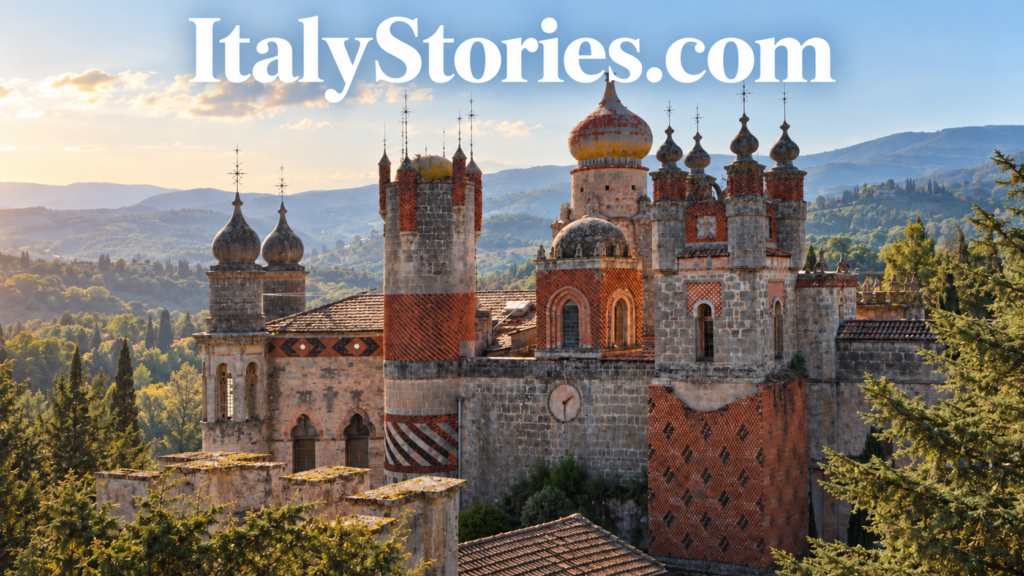
It rises above the forests of the Bolognese Apennines like an architectural hallucination. Medieval towers stand beside Moorish arches, onion-shaped domes appear above walls of grey stone and red brick, and staircases twist through rooms that seem to belong to different countries and different centuries. At first sight, Rocchetta Mattei does not look like a building that should exist in Italy. Yet it stands less than seventy kilometres from Bologna, hidden among the mountains of Emilia-Romagna.
The castle is located in Savignano, near the village of Riola, within the municipality of Grizzana Morandi. It occupies a rocky height overlooking the valleys of the Reno and Limentra rivers, surrounded by the green landscape of the Tuscan-Emilian Apennines. Its appearance has inspired comparisons with the Alhambra in Granada, but Rocchetta Mattei is not an ancient Islamic palace. It is an extraordinary nineteenth-century creation, born from the imagination of one of the most unusual personalities in modern Italian history.
Count Cesare Mattei was born in Bologna in 1809 into a wealthy family. He grew up among important intellectuals, politicians and artists, and in 1837 became one of the founders of the Cassa di Risparmio in Bologna. Pope Pius IX granted him the title of count in 1847. Mattei also took part in political life, but personal disappointment and the death of his mother gradually pushed him away from public affairs. He began to devote himself to the study of illness and to the development of a controversial system of alternative medicine that he called electrohomeopathy.
In 1850, Mattei purchased the land containing the ruins of the medieval Rocca di Savignano. The earlier fortress had occupied a strategically important position and had been connected to powerful medieval figures, but it had been destroyed centuries before. Mattei decided to build his residence directly over those remains. Construction began that same year, although the Rocchetta would continue to change throughout his lifetime and even after his death.
Mattei did not design a conventional aristocratic villa. He created a personal universe. The castle became a labyrinth of towers, monumental staircases, private apartments, reception rooms, courtyards, corridors and unexpected passages. Its architecture combines neo-medieval, neo-Renaissance, Moorish and later Art Nouveau influences. Some parts resemble a European fortress, while others evoke Andalusia, North Africa or the imagined palaces of the Arabian Nights.
The exterior offers the first surprise. Dark onion-shaped domes rise above square and cylindrical towers. Bands of grey stone alternate with red brick, while geometric decorations interrupt the surfaces of the walls. Roofs, battlements, arches and small turrets overlap without following the orderly symmetry normally expected from a noble residence. The building seems to have grown over time, responding more to Mattei’s imagination than to a single architectural plan.
Inside, the comparison with the Alhambra becomes much more precise. The castle contains a Courtyard of the Lions inspired by the celebrated court of the Nasrid palace in Granada. Slender columns support delicately decorated arches, surrounding a central fountain guarded by sculpted lions. It is not an archaeologically exact copy, but a smaller and highly theatrical nineteenth-century reinterpretation. Mattei borrowed the atmosphere and symbolic power of the Spanish original, adapting them to his private residence in the mountains of Bologna.
Another remarkable space is the chapel, whose alternating black-and-white decoration recalls the arches of the Great Mosque of Córdoba. From a distance, some of its surfaces appear to be made from precious stone or finely carved material. Much of the decoration, however, was created through ingenious and relatively inexpensive techniques using painted plaster, wood and carefully modelled cement. Mattei was skilled at producing an impression of extraordinary richness without relying exclusively on costly materials.
The Rocchetta is filled with optical tricks and architectural illusions. Painted surfaces imitate marble, wooden structures resemble stone and decorative patterns make rooms appear larger or deeper than they really are. Nothing is quite what it seems. Even the arrangement of the building contributes to the mystery: corridors suddenly change direction, small doors open into elaborate halls and staircases lead visitors from medieval-looking spaces into rooms decorated in an entirely different style.
Among its most curious interiors is the Room of the Ninety, a vast hall named after Mattei’s ambitious idea of holding a banquet there for ninety people when he reached the age of ninety. He never fulfilled the plan, dying in 1896 at the age of eighty-seven. Other areas of the castle were used to receive patients, visitors and important guests attracted by his international reputation.
Mattei’s electrohomeopathy combined ideas taken from homeopathy, herbal preparations and his own theories about energy and the human body. It had no proven scientific foundation, but during the nineteenth century it became enormously successful. Mattei’s remedies were distributed internationally, and by 1884 his organisation reportedly had more than one hundred distribution centres around the world. Patients travelled to the remote Apennine castle hoping to be treated by the mysterious count.
His fame became so widespread that he was even mentioned by Fyodor Dostoevsky in The Brothers Karamazov. In the novel, the devil refers to Count Mattei’s remedies while speaking to Ivan Karamazov. It is an extraordinary detail: a self-taught healer living in an eccentric castle near Bologna had become famous enough to enter one of the greatest works of Russian literature.
Mattei lived at the Rocchetta like the lord of an invented medieval court. The castle was simultaneously his home, headquarters, clinic, laboratory and monument to himself. His activities brought work and prosperity to many local families. The development of nearby Riola was also encouraged by the arrival of patients and by the railway connections Mattei promoted to make his isolated residence easier to reach.
Near the end of his life, financial difficulties caused by a relative threatened his work. Mattei eventually placed his trust in his collaborator Mario Venturoli, whom he adopted in 1888. Venturoli continued both the production of the remedies and the expansion of the castle. Cesare Mattei died in 1896, and according to his wishes, his remains were placed inside a monumental tomb in the Rocchetta’s chapel.
The history of the castle after Mattei’s death was complicated. His adopted son and later owners continued to modify the building. In 1959 the property was sold to the wife of a local merchant known as “Il Mercantone,” who transformed the complex into a tourist attraction with a hotel and restaurant. For a time, visitors once again filled its rooms. The business eventually declined, and during the 1980s the Rocchetta was abandoned.
Years without adequate maintenance placed the building at serious risk. Its unusual construction techniques made restoration especially difficult: beneath the exotic decoration were fragile materials, hidden structures and countless additions completed during different periods. In 2005, the Fondazione Cassa di Risparmio in Bologna purchased the property and began a long programme of study, consolidation and careful restoration.
The Rocchetta eventually reopened to the public in 2015. Today it belongs to the Carisbo Foundation and is managed by the Municipality of Grizzana Morandi in collaboration with local institutions. Restoration is still continuing, allowing more sections of the enormous complex to be recovered over time. Visits are conducted with a guide and must be booked in advance, partly to protect the building and partly because its labyrinthine structure would make independent exploration rather complicated.
Calling Rocchetta Mattei “the Italian Alhambra” is therefore not entirely wrong, because one of its most important courtyards was deliberately inspired by the palace in Granada. But the nickname risks reducing a far more complicated building to a simple imitation. The Rocchetta is not merely Moorish, medieval or Art Nouveau. It is all of these things simultaneously, held together by the personality of Cesare Mattei.
This is what makes the castle so fascinating. It was not designed to represent one historical period or one architectural tradition. It was created as the physical expression of a man who wanted to be a nobleman, scientist, healer, philosopher and ruler of his own private world. Every tower, illusion and secret passage contributes to the same strange dream.
Hidden among the forests of Emilia-Romagna, Rocchetta Mattei remains one of the most surprising buildings in Italy. It may contain a small piece of the Alhambra, an echo of Córdoba and the silhouette of a medieval fortress, but in the end it resembles nothing except itself.