

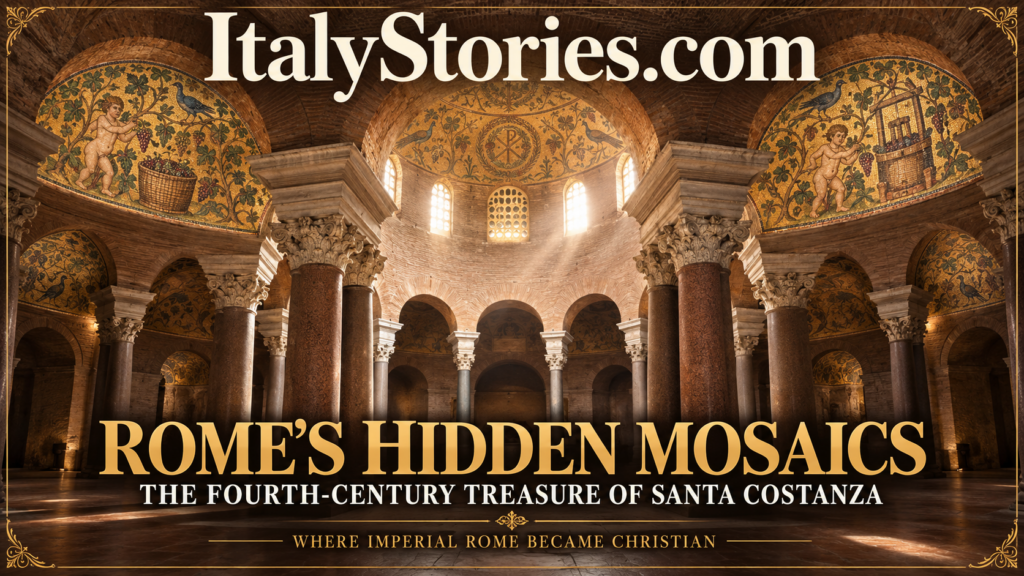
Beyond Rome’s ancient walls, away from the celebrated monuments of the historic centre, stands a circular brick building that preserves one of the most fascinating artistic transitions in European history. It is called Santa Costanza, and although many visitors to Rome have never heard of it, its vaulted passage contains mosaics created approximately seventeen centuries ago.
They belong to a world suspended between two eras. Their artists were working in an empire that still spoke the visual language of classical Rome but was gradually adopting Christianity. Pagan-looking cupids gather grapes, birds move among flowering branches, carts carry the harvest and workers press fruit into wine. Yet these scenes decorate a building associated with the family of Constantine the Great, the emperor whose reign fundamentally changed the position of Christianity in the Roman world.
Santa Costanza is therefore more than an ancient monument. It is a rare surviving witness to a moment when Rome had not simply abandoned its past. Instead, it was transforming familiar images and giving them new meanings.
THE IMPERIAL PRINCESS BEHIND THE MAUSOLEUM
The building traditionally known as Santa Costanza was originally an imperial mausoleum. It was constructed during the fourth century for Constantina—also called Constantia or Costanza—the daughter of Emperor Constantine I.
Constantine is remembered above all for ending the systematic persecution of Christians and supporting the Church. His victory at the Milvian Bridge in 312 became inseparable from the story of his conversion, while the agreement commonly known as the Edict of Milan, issued the following year, established religious toleration throughout the empire.
Constantina belonged to the first generation of Rome’s imperial family to live within this changed religious landscape. Ancient accounts portray her as a politically important and sometimes controversial figure. She was first married to Hannibalianus, a nephew of Constantine who was given authority in the eastern provinces. After his death during the violent dynastic purges of 337, she later married Gallus, another member of the Constantinian family.
She died in Bithynia, in present-day Turkey, in 354. Her body was returned to Rome and placed in an enormous red porphyry sarcophagus inside the mausoleum on the Via Nomentana.
The location was not accidental. The complex stood beside an enormous cemetery basilica connected with the tomb of Saint Agnes, the young Christian martyr whose cult had become extremely important in Rome. The Constantinian family’s decision to construct an imperial funerary monument near the martyr’s burial place expressed a powerful idea: imperial prestige was now being placed under the protection of Christian sanctity.
A BUILDING DESIGNED AROUND DEATH AND ETERNITY
From the outside, Santa Costanza appears surprisingly restrained. Its walls are made from brick-faced Roman concrete, and its circular mass gives little indication of the complexity within. On entering, however, the architecture reveals an extraordinary arrangement of light, columns and concentric spaces.
The centre of the mausoleum rises beneath a dome illuminated by windows in the drum. Around it runs a darker circular passage known as an ambulatory. Twelve pairs of granite columns, crowned by elaborately carved composite capitals, separate the luminous central space from this surrounding corridor.
The contrast is deliberate and dramatic. The centre feels open, vertical and filled with light. The ambulatory is lower, quieter and more mysterious. Walking through it produces the sensation of moving around a sacred core, almost as though the architecture were guiding the visitor in a ritual orbit around the imperial tomb.
Centralised mausoleums already existed in Roman architecture. What makes Santa Costanza remarkable is the way familiar imperial forms were adapted to a new Christian environment. The building still conveys the splendour expected of a member of the ruling dynasty, but its connection with Saint Agnes and its developing religious imagery point towards the architecture of medieval Christianity.
THE MOSAIC GARDEN ABOVE THE VISITOR
The greatest surviving treasure of Santa Costanza is found on the barrel vault of the ambulatory. Looking upward, visitors encounter a continuous mosaic world of vines, flowers, fruit, vessels, animals, human figures and geometric patterns.
Unlike the gold backgrounds associated with later Byzantine churches, these mosaics often use a pale ground and a relatively restrained palette of green, red, brown, yellow and dark blue. Their designs resemble the floor and ceiling decorations once seen in Roman villas, baths and imperial residences.
Some sections are organised into strict geometric compartments containing small heads, birds, branches and decorative objects. Elsewhere, natural forms spread more freely across the surface. Vines twist into elaborate patterns, enclosing figures and animals in a seemingly endless garden.
The most famous scenes depict the grape harvest. Small naked figures—often described as putti—climb through the vines and cut bunches of grapes. Others load the fruit into baskets or carts. Oxen transport the harvest, while still more figures tread the grapes in large vats. The liquid produced by their labour becomes wine.
To a Roman viewer, these images would have been immediately familiar. Grapevines, wine-making and playful putti had long appeared in art associated with Dionysus, or Bacchus, the classical god of wine, fertility and ecstatic transformation. Such scenes celebrated abundance, seasonal renewal and the pleasures of life.
Why, then, do they appear in an imperial monument connected with Christianity?
BETWEEN BACCHUS AND CHRIST
The mosaics of Santa Costanza have fascinated historians precisely because they resist a simple interpretation. They do not present a clean break between pagan Rome and Christian Rome. Instead, they show how images could survive while their meaning changed.
Wine already occupied a central position in Christian belief. During the Eucharist, it represented the blood of Christ. The vine also carried powerful biblical associations. In the Gospel of John, Christ declares himself to be the true vine, while his followers are described as its branches. Harvest imagery could evoke salvation, spiritual fruitfulness and the promise of eternal life.
The grape scenes at Santa Costanza could therefore be understood simultaneously through classical and Christian traditions. A fourth-century viewer may have recognised the cheerful visual language of Bacchic art while also perceiving the vine and wine as symbols of Christ, resurrection and the Eucharist.
It is equally possible that some of the decoration was selected primarily because it was considered appropriate for an imperial building. The artisans responsible for the mosaics inherited patterns and subjects that had been used for generations. Early Christian art did not emerge from nothing; it developed within the workshops, materials and aesthetic habits of the Roman Empire.
This ambiguity is what makes Santa Costanza so valuable. The building preserves the complexity of cultural change. It reminds us that historical transformations rarely occur overnight. Old forms often remain in place, gradually acquiring new interpretations.
THE LOST MOSAICS OF THE DOME
The mosaics visible today represent only part of the building’s original decoration. The central dome was once covered with an extensive mosaic cycle, but this magnificent surface has been lost.
Fortunately, before its final destruction, portions of the dome were recorded during the Renaissance. Between 1538 and 1540, the Portuguese artist and writer Francisco de Holanda produced watercolour copies of several scenes. These drawings indicate that the dome included biblical subjects arranged within an elaborate decorative framework.
Among the scenes identified or proposed by scholars are episodes involving Cain and Abel, Tobias, Noah, Moses striking the rock and Susanna and the Elders. Classical architectural ornaments, vegetal scrolls and supporting figures organised the compositions.
The loss of the dome mosaics radically changed the interior. Today the central brick surface appears austere, while the surviving ambulatory glitters around it. Originally, the entire space would have formed a much richer visual universe, uniting biblical narratives, imperial architecture and Roman decorative traditions.
CHRIST AS AN EMPEROR
Two mosaics in the lateral apses introduce much more explicit Christian imagery. Although their precise dates and later restorations have been debated, they are important examples of how the image of Christ absorbed the ceremonial language of imperial power.
In one scene, Christ appears with Saints Peter and Paul and hands Peter a scroll representing divine law. In another, Christ sits above the world and presents Peter with the keys. He is no longer shown merely as a humble teacher. He is represented with the authority of a ruler.
Roman audiences understood gestures, clothing and hierarchical composition as signs of power. Early Christian artists used that familiar language to express the sovereignty of Christ. The visual vocabulary once employed to honour emperors could now proclaim divine authority.
Santa Costanza therefore contains two different artistic worlds. The ambulatory preserves scenes that could almost belong to a luxurious Roman residence, while the apses anticipate the commanding Christian images that would dominate medieval churches. Together, they reveal the gradual conversion of Roman visual culture.
THE IMPERIAL SARCOPHAGUS
Constantina’s burial reflected her extraordinary social position. Her monumental sarcophagus was carved from Egyptian red porphyry, an exceptionally hard purple stone closely associated with imperial authority. Because purple symbolised sovereignty and the material came from distant, tightly controlled quarries, porphyry was reserved for the emperor and his family.
The sarcophagus repeated many of the images visible in the mosaics. Its surface was covered with scrolling vines, grape harvesting putti, birds and animals. Peacocks—frequently associated with immortality—reinforced the funerary promise of life beyond death.
The original sarcophagus is no longer inside Santa Costanza. It was removed from the mausoleum, taken to Piazza San Marco in Rome during the fifteenth century and finally transported to the Vatican Museums in 1790. According to the Vatican Museums, moving the immense object required a cart pulled by forty oxen.
A replica now recalls its former presence in the mausoleum. The original can be seen in the Vatican’s Pio-Clementine Museum, where its deep red stone and dense relief decoration still communicate the power of the Constantinian dynasty.
FROM IMPERIAL TOMB TO CHRISTIAN CHURCH
The identity of the building slowly changed after antiquity. Constantina came to be remembered as Saint Costanza, although her official status as a saint is historically uncertain. The mausoleum was eventually converted into a church and was formally consecrated by Pope Alexander IV in 1254.
Its new religious function helped ensure its survival. Many ancient structures in Rome disappeared because they were abandoned, dismantled for building materials or absorbed into later construction. Santa Costanza remained useful and sacred. Its walls, columns and mosaics endured because successive generations continued to inhabit and reinterpret the space.
During the Renaissance, the building attracted artists fascinated by antiquity. Its vine-covered mosaics were reportedly misunderstood by some visitors as evidence that the structure had once been a temple of Bacchus. This interpretation was incorrect, but it reveals how convincingly classical the decoration still appeared more than a thousand years after it was created.
A SURVIVING ROOM FROM A VANISHED ROME
Rome is filled with famous mosaics, from the great medieval apses of its basilicas to the ancient floors preserved in archaeological sites. Santa Costanza is different. Its mosaics do not simply represent one period or one belief system. They preserve a conversation between worlds.
Here, imperial burial customs meet Christian devotion. Pagan decorative traditions coexist with Eucharistic associations. The circular monumentality of Roman architecture becomes a setting for a Christian church. Christ adopts the visual authority of an emperor, while Bacchic grape harvesters can be read as figures of spiritual renewal.
Even the building’s atmosphere reflects this duality. Light descends into the central space, while the ancient mosaics survive in the shadowed ring around it. Visitors walk beneath images made by artists who could not have known how completely the empire around them would change.
Santa Costanza is sometimes described as hidden Rome, but its importance is far greater than the phrase suggests. It is not simply a forgotten attraction waiting to be photographed. It is a document made from stone, brick, glass and marble—a place where one civilisation can be seen becoming another.
Seventeen centuries later, its little harvesters are still climbing through the vines. The oxen still pull their heavy carts. The birds remain suspended among the branches, and the grapes are pressed into wine forever.
Above the visitor’s head, ancient Rome has never entirely disappeared. It has simply changed its meaning.