

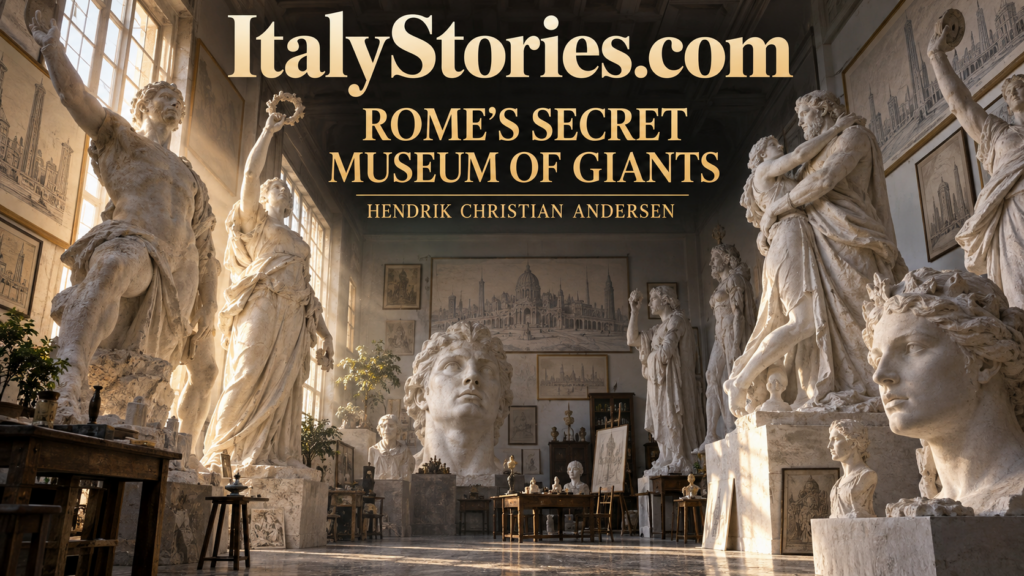
A few minutes from Piazza del Popolo, behind the dignified façade of an early twentieth-century villa, Rome hides a room filled with giants. Enormous white figures stand beneath high ceilings, stretch their arms towards the light, embrace one another, raise children above their heads and stare into the distance with the confidence of people who believe they are about to build a better world. They are not ancient Roman statues, although their heroic bodies and monumental poses might suggest otherwise. They were created by Hendrik Christian Andersen, a Norwegian-American sculptor who spent much of his life in Rome pursuing one extraordinary dream: the construction of a perfect international city capable of bringing peace, knowledge and progress to humanity.
The Museo Hendrik Christian Andersen is one of those places that many people in Rome pass without noticing. The building stands in Via Pasquale Stanislao Mancini, in the Flaminio district, close to the Tiber and the monumental entrance to Piazza del Popolo. From the street it resembles an elegant private residence, decorated in an eclectic neo-Renaissance style. Nothing outside fully prepares visitors for the scale of the figures crowded into the great studios on the ground floor. Crossing the entrance feels like discovering the abandoned workshop of an artist who expected his creations to be installed in the squares of a city that never existed.
Hendrik Christian Andersen should not be confused with Hans Christian Andersen, the celebrated Danish author of fairy tales. Hendrik was born in Bergen, Norway, in 1872. The following year his family emigrated to the United States and settled in Newport, Rhode Island, a city known for its wealthy families, imposing residences and international society. He grew up as an American citizen but remained connected to his European origins. As a young man he studied art and sculpture, then travelled to Europe in the 1890s in search of the artistic education and cultural atmosphere that the New World could not yet offer him.
Rome soon became the centre of his life. At the end of the nineteenth century, the Italian capital attracted painters, writers, sculptors, collectors and wealthy travellers from across Europe and the United States. Ancient ruins stood beside modern construction sites, aristocratic palaces became meeting places for international intellectuals, and foreign artists established studios in streets around Piazza di Spagna, Via Margutta and the Tiber. For Andersen, Rome was more than a beautiful place in which to work. It was evidence that a city could become a physical expression of civilisation.
His sculptures were inspired by classical art but enlarged by the ambition of the modern age. Andersen created idealised human bodies, allegorical families, athletes, mothers, lovers and heroic figures representing ideas such as life, brotherhood, progress, prayer, love and war. Many were conceived as components of fountains, monuments and public spaces. They were not intended to decorate a private sitting room. They belonged to boulevards, vast plazas and buildings designed for thousands of people. Their proportions make sense only when one understands the immense project that gradually came to dominate Andersen’s imagination.
He wanted to build a new world capital.
The idea developed during the first years of the twentieth century and was elaborated with the French architect Ernest Hébrard. Together they designed what Andersen called the World Centre of Communication: an international city dedicated to the highest achievements of humanity. It would bring together art, science, education, religion, physical culture, diplomacy, industry and law. Museums, academies, theatres, libraries, laboratories and sporting facilities would be arranged within an enormous and rigorously planned urban landscape. Monumental avenues would connect fountains, gardens and public buildings. Sculpture would not be added as decoration after construction; it would be part of the city’s moral purpose.
Andersen believed that beautiful surroundings could improve the people who lived within them. If architecture expressed harmony, citizens might become more harmonious. If public statues celebrated cooperation, strength, knowledge and family life, society might aspire to those virtues. The city would gather the finest ideas produced across the world and redistribute them for the benefit of everyone. It was an idealistic vision, extraordinarily ambitious and perhaps impossibly naïve, but it emerged from a genuine anxiety about nationalism, division and conflict in the years before the First World War.
The project was presented in magnificent form in 1913 through a monumental publication titled “Creation of a World Centre of Communication”. Filled with plans, illustrations, architectural perspectives and descriptions, the volume was itself a work of propaganda for the dream. Copies were sent to political leaders, cultural institutions and influential personalities in the hope of attracting international support. Andersen did not think of his city as an exercise in fantasy. He wanted it built.
No country, however, was prepared to surrender land, resources and political authority to such an enormous international experiment. The project had no definitive location, although several possibilities were considered. Its grand scale required financial commitments that were difficult to imagine even before Europe entered the catastrophe of war. After 1914, the belief that monumental art alone might lead humanity towards harmony became more difficult to defend. The First World War revealed the destructive power of modern states; the conflict that followed two decades later made Andersen’s universal dream appear even more distant.
Yet he never truly abandoned it.
The great plaster figures preserved in his Roman studio are the surviving inhabitants of that unbuilt city. Seen individually, they can appear theatrical or exaggerated. Seen together, they become fragments of a lost civilisation. They were created for fountains that never flowed, squares that were never paved and avenues along which nobody ever walked. Their raised arms continue to welcome citizens who never arrived.
The building that contains them was itself designed to serve Andersen’s artistic ambitions. Constructed between 1922 and 1925 according to his ideas, it combined a private residence with large working and exhibition studios. Andersen called it Villa Helene, in memory of his mother. Its façade was later enriched with allegorical decorations and portraits connected to the artist’s personal world. Behind its domestic appearance, the house provided the space necessary for producing and displaying sculptures of unusual dimensions.
The ground-floor studios remain the most surprising part of the museum. Tall windows illuminate a dense population of plaster and bronze. Monumental bodies stand almost shoulder to shoulder, while busts, smaller studies and fragments occupy the spaces between them. Because the rooms preserve the character of a working studio, the sculptures do not feel isolated in the way they might inside a conventional gallery. They appear to have accumulated naturally around the artist, as though Andersen had stepped outside only moments earlier and might return to adjust an arm or inspect a surface.
Among the works are groups associated with the immense Fountain of Life, an important element of his ideal city. Love, family, maternity, physical energy and spiritual aspiration return repeatedly in his sculptures. The human body becomes a language through which Andersen attempts to describe an improved society. His figures do not hesitate or display ordinary weakness. They reach, embrace, advance and triumph. They belong to a world in which doubt has been replaced by purpose.
There is something both inspiring and unsettling about them. Their confidence is so complete that it can appear almost inhuman. Andersen wanted art to elevate society, but his perfect bodies also reveal the dangers hidden within every vision of perfection. Real cities grow through accidents, compromises, arguments and the daily needs of imperfect people. Andersen’s World Centre was ordered from above, every avenue aligned and every institution given its symbolic position. It promised harmony, but very little disorder. Like many utopian projects, it raises an uncomfortable question: who decides what perfection should look like?
This tension makes the museum far more interesting than a simple collection of academic sculpture. Visitors are not merely looking at the works of an artist; they are entering the remains of a complete philosophy. Andersen believed in art with almost religious intensity. To him, beauty was not a pleasant addition to life. It was an instrument capable of changing human behaviour and perhaps preventing conflict. His sculptures were intended to educate, inspire and unite.
The museum also preserves the more personal side of his life. Portraits, furniture, books, letters, photographs and drawings reveal the man behind the colossal ambition. Among the most notable works is a bust of the American-born British writer Henry James. Andersen met James in Rome in 1899, and the two developed a close friendship maintained through years of affectionate correspondence. James, considerably older and already famous, offered encouragement while also expressing doubts about the practicality of Andersen’s enormous plans. Their letters reveal a relationship filled with admiration, tenderness and intellectual exchange.
Other portraits represent members of Andersen’s family and international circle. These quieter works create a contrast with the heroic figures intended for the World Centre. They remind visitors that the man who imagined a capital for all humanity also lived within a small network of friendships, losses and personal attachments. His dream may have been universal, but its emotional foundations were deeply private.
Andersen died in Rome in 1940. In his will, he left Villa Helene, his studio, papers and works to the Italian state, intending the house to preserve his artistic vision. The transformation into a public museum was not immediate. For decades the collection remained little known, and Andersen himself occupied an uncertain position in art history. His neoclassical monumentality seemed increasingly distant from the artistic movements that dominated the twentieth century.
After restoration, the house finally opened as a museum in 1999, nearly sixty years after his death. Today it preserves hundreds of sculptures, paintings, drawings, architectural plans, photographs and archival documents. It is both a house museum and the mausoleum of an idea: the only place where Andersen’s imaginary city can still be experienced as something more than lines on paper.
The great irony is that Andersen dreamed of creating one of the largest and most important cultural centres on Earth, yet his legacy survives in one of Rome’s least-known museums. Millions of visitors travel between the Colosseum, the Vatican Museums, the Trevi Fountain and the Pantheon without ever hearing his name. Only a small number enter Villa Helene and find themselves surrounded by the citizens of his impossible capital.
Perhaps obscurity suits the place. The discovery feels personal, almost forbidden. There are no enormous crowds separating the visitor from the sculptures. One can stand beneath the towering plaster figures and examine the marks, surfaces and physical weight of the artist’s work. In the silence of the studio, the distance between ambition and reality becomes almost tangible.
Andersen never built his World Centre of Communication. No international avenue carried diplomats towards its palaces, no athletes competed inside its stadiums and no students gathered in its academies. Yet failure did not completely erase the dream. Its statues survived, its plans remained and the house designed to contain them eventually became the museum he had hoped for.
Rome is filled with monuments celebrating empires, victories, saints and popes. Villa Helene preserves something rarer: a monument to an unrealised future. It belongs to a man who looked at a divided world and believed that architecture, sculpture and knowledge could persuade humanity to become better. He may have been unrealistic, but he was not timid.
Behind an ordinary Roman façade, his giants are still waiting for the city that was promised to them.
Follow ItalyStories.com to discover Rome’s secret museums, forgotten homes, hidden gardens and extraordinary stories beyond the usual tourist routes.