

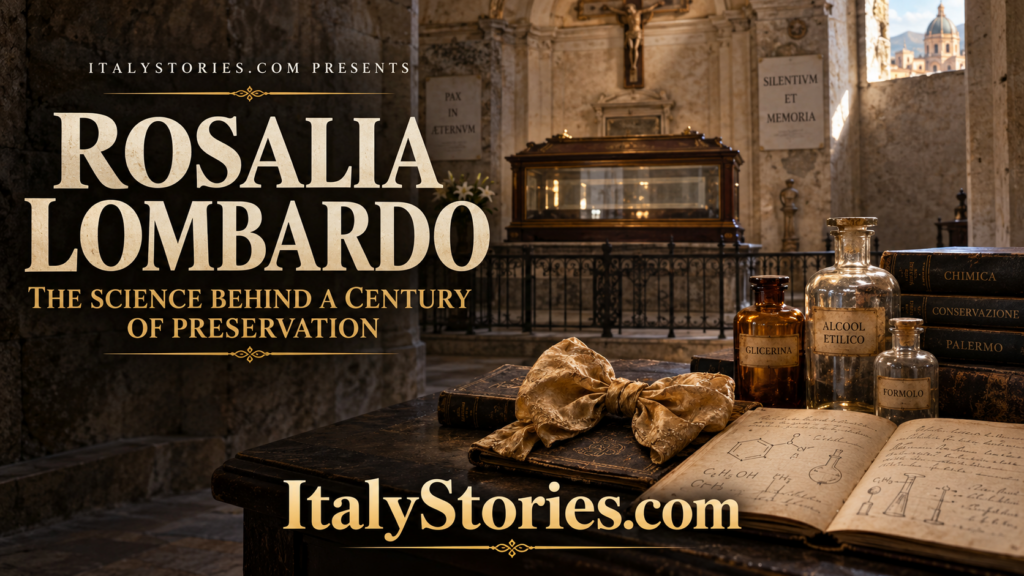
At the end of a long corridor beneath the Capuchin monastery of Palermo lies a small glass coffin. Inside rests Rosalia Lombardo, a Sicilian child who died in 1920, one week before her second birthday. Her hair still frames her face in soft curls, a faded silk bow rests above her head, and her delicate features appear so peaceful that generations of visitors have struggled to accept what they are seeing. More than a century has passed since her death, yet Rosalia seems suspended between history and memory, as though an ordinary afternoon sleep had somehow continued beyond the limits of time.
She is often called the “Sleeping Beauty of Palermo,” a name that expresses the emotion inspired by her appearance but can also obscure the reality of her story. Rosalia was not a legendary princess, a saint or the subject of an ancient Sicilian miracle. She was a real child from a real family, preserved through an exceptional early twentieth-century embalming procedure. Her appearance is the result of chemistry, anatomical knowledge and the extraordinary skill of Alfredo Salafia, one of the most remarkable embalmers in modern Italian history.
The science behind her preservation is now largely understood. The sadness that led to it is more difficult to measure.
A Child in Palermo
Rosalia Lombardo was born in Palermo on 13 December 1918, only weeks after the end of the First World War. Sicily was living through a difficult period marked by poverty, political uncertainty and the consequences of the influenza pandemic that had spread across the world. Palermo remained one of the great cities of the Mediterranean, filled with Arab-Norman churches, Baroque palaces, crowded markets and aristocratic villas, but daily life for many families was shadowed by disease and high infant mortality.
Rosalia was the daughter of Mario Lombardo. Details about her short life are limited, and many later accounts have filled the silence with sentimental inventions. What is reliably known is painfully simple: she became seriously ill and died in Palermo on 6 December 1920, one week before turning two. Bronchopneumonia is generally recorded as the cause of death, although popular retellings sometimes connect the illness directly to the influenza pandemic without sufficient medical documentation to establish the exact sequence.
For a parent in 1920, the death of a child was sadly not rare, but familiarity never made the loss less devastating. Mario Lombardo was reportedly unable to accept the rapid disappearance of his daughter’s face and asked Alfredo Salafia to preserve her body. Salafia was already known in Sicily for his ability to embalm the dead while maintaining a remarkably natural appearance.
Rosalia’s preservation was not an attempt to bring her back to life. It was an attempt to slow the physical destruction that follows death, allowing a grieving family to retain the visible presence of a beloved child for a little longer. The request belonged to an era in which photography, post-mortem portraits, domestic mourning rituals and carefully maintained graves provided different ways of keeping the dead within the emotional world of the living.
Alfredo Salafia, the Master of the Eternal Sleep
Alfredo Salafia was born in Sicily in 1869 and developed an unusual combination of chemical knowledge, anatomical understanding and practical experience. He was not simply a funeral worker applying a standard solution. He approached preservation as a scientific and aesthetic problem: how could decomposition be stopped without leaving the body discoloured, collapsed or visibly damaged?
His early work included taxidermy and experiments with preservation techniques. At the beginning of the twentieth century, he received permission to test his methods on human cadavers at an anatomical school in Palermo. His results attracted attention because the treated bodies retained their form and appeared less dramatically altered than those preserved by many contemporary methods.
Salafia became known well beyond ordinary funerary circles. Among the distinguished people associated with his work were the Sicilian ethnographer Giuseppe Pitrè, Cardinal Michelangelo Celesia and Francesco Crispi, the former Italian prime minister. Crispi had died in Naples in 1901, and his body deteriorated after an unsuccessful embalming attempt. Salafia was later asked to restore the remains, a difficult operation that strengthened his reputation.
He also travelled to the United States and presented aspects of his method in New York. At a time when modern embalming was developing rapidly, particularly after its use during the American Civil War, Salafia belonged to a generation attempting to replace ancient preservation rituals with controlled chemical intervention.
Yet he guarded the exact details of his procedure. For decades, the preservation of Rosalia was described as an unexplained secret, and stories grew around the supposed disappearance of Salafia’s formula. The truth was more prosaic and more interesting: the formula had been recorded in his handwritten papers and was eventually rediscovered and studied.
The Formula That Preserved Rosalia
Research into Salafia’s notes revealed a carefully balanced solution containing formalin, alcohol, glycerine, salicylic acid and zinc salts. Each component performed a different function. Formalin destroyed microorganisms and fixed biological tissue. Alcohol contributed to dehydration. Glycerine prevented excessive drying, helping the body retain a more natural volume. Salicylic acid discouraged fungal growth. Zinc chloride and zinc sulphate provided rigidity and helped preserve the structure of the tissues.
The brilliance of the formula lay not in any single ingredient but in their combination. A solution that dried the body too aggressively would have caused shrinkage and distortion. One that retained too much moisture would have allowed decomposition to continue. Salafia found a balance between disinfection, dehydration, flexibility and structural support.
The fluid was probably introduced through a single vascular access point, most likely using a gravity-fed injector. It then travelled through Rosalia’s circulatory system, reaching tissues throughout the body. There is no evidence that Salafia removed her internal organs or performed the extensive procedures associated with ancient Egyptian mummification. His intervention was comparatively limited from the outside, yet chemically sophisticated.
The zinc salts were especially important. They contributed to the firmness of the tissues, producing a result that later researchers compared to a gentle form of petrification. Combined with the other ingredients, they helped Rosalia’s face retain its contours instead of collapsing as moisture disappeared.
Her preservation was therefore neither natural mummification nor a supernatural event. It was one of the most successful known applications of a modern embalming method.
The Capuchin Catacombs of Palermo
Rosalia’s story cannot be separated from the extraordinary place in which she rests. The Capuchin Catacombs lie beneath a monastery in Palermo and contain one of the most important collections of preserved human remains in Europe. Their history began long before Rosalia’s birth.
During the sixteenth century, the Capuchin friars needed additional burial space. When older graves were opened, some bodies were found to have dried naturally in the local environment. The friars interpreted their preservation through the religious culture of the period and began placing the bodies in underground corridors rather than reburying them in the usual manner.
The first friar traditionally identified with the new crypt was Brother Silvestro of Gubbio, placed there in 1599. Over the following centuries, the catacombs expanded into a complex social cemetery. Monks occupied one area, while men, women, professionals, priests, children and virgins were organised in separate corridors or chapels. Clothing communicated status, occupation and family identity. Doctors, lawyers, soldiers and merchants remained dressed as they had been in life.
The methods of preservation varied. Some bodies were naturally desiccated in specialised drying rooms called colatoi. Others were treated with vinegar, lime, arsenic or different chemical solutions. Certain bodies were embalmed by professionals. Families could pay for their relatives to remain visible and sometimes returned to change their clothing or maintain their appearance.
To modern eyes, the display may appear macabre. Within the religious and social traditions of Palermo, however, the catacombs functioned as a continuous relationship between the living and the dead. They were a monumental expression of the Christian memento mori: the reminder that wealth, beauty and social position eventually yield to death.
They also became a record of Sicilian society. Fabrics, uniforms, hairstyles and personal objects preserved aspects of daily life that ordinary written documents often ignore. Travellers and writers visited the corridors, including the French author Guy de Maupassant, who described the experience during his journey through Sicily.
The catacombs were officially closed to new burials in the late nineteenth century, although a limited number of later exceptions occurred. Rosalia, admitted in 1920, was among the final people accepted into this historic cemetery.
Why Rosalia Looks Different
Most of the bodies in the Capuchin Catacombs visibly display the effects of desiccation. Faces have become skeletal, skin has darkened, and clothing sometimes seems more substantial than the person wearing it. Rosalia is different. Her rounded cheeks, eyelashes, hair and calm expression remain immediately recognisable.
Part of this difference results from Salafia’s method, but age also contributed. A very young child’s facial proportions and soft tissues respond differently from those of an adult. Her small body allowed the embalming fluid to circulate effectively, while the sealed coffin offered some protection from dust, handling and environmental changes.
Her position increased the impression of sleep. Unlike the standing bodies arranged along many of the catacomb walls, Rosalia lies horizontally beneath glass. Her head is slightly elevated, her mouth gently closed and her hands are not presented dramatically. The silk-coloured dress and large bow reinforce the visual language of childhood.
The effect is deeply emotional because the human mind recognises sleep before it recognises death. Visitors instinctively expect the subtle movement of breathing. When no movement comes, the stillness becomes more powerful.
Calling Rosalia “perfectly preserved” is understandable but scientifically imprecise. No human tissue remains completely unchanged for a century. Her skin has altered in colour and texture, internal organs have shrunk, and environmental conditions have caused gradual deterioration. Her preservation is exceptional, not absolute.
What Medical Imaging Revealed
Modern researchers have examined Rosalia without performing a destructive autopsy. Radiography and multidetector computed tomography made it possible to look beneath the clothing and skin while leaving the body undisturbed.
The scans confirmed that her skeleton and internal organs remained present. The brain, liver and other structures could still be identified, although they had undergone shrinkage and transformation. The examinations also supported the conclusion that Salafia had preserved the entire body rather than removing the organs.
These findings were important because external appearance alone can be misleading. A face may look intact while internal tissues have deteriorated. In Rosalia’s case, imaging demonstrated that the embalming fluid had penetrated deeply and preserved anatomical structures to an extraordinary degree.
The research also placed her within the broader field of paleopathology and mummy studies. Human remains can reveal information about disease, diet, medical practices and the lives of historical populations. The Sicily Mummy Project, involving anthropologists, physicians and conservation specialists, has examined individuals in the Palermo catacombs using non-invasive methods.
Rosalia is the most famous person in the collection, but she is not the only one of scientific interest. The corridors preserve evidence about monks, aristocrats, professionals, families and children from different periods of Sicilian history. Together, they form a biological and cultural archive beneath the city.
The scientific value of the catacombs must always be balanced with respect. These are not simply specimens. They are people whose bodies survived because of religious traditions, environmental conditions, family decisions and medical interventions.
The Mystery of the Opening Eyes
One of the most widely repeated stories about Rosalia claims that she opens and closes her eyes several times a day. Photographs taken at different times appear to show her eyelids changing position, sometimes revealing part of the iris. The effect has inspired supernatural interpretations, claims of an unexplained biological phenomenon and sensational descriptions of a mummy that still blinks.
The explanation is far less mysterious. Rosalia’s eyelids are not completely closed and apparently never were. Small changes in the angle and intensity of light entering the catacombs can make the narrow opening more or less visible. The position of the observer and the camera also changes the amount of iris seen beneath the lashes.
Older photographs taken under different lighting conditions exaggerated the contrast. As the daylight shifted through windows and openings, shadows moved across her face. Two photographs compared side by side could therefore create the illusion that the eyelids had moved.
Environmental changes may also have produced extremely slow alterations in the tissues over long periods, but there is no evidence that Rosalia repeatedly opens and closes her eyes. She does not blink, wake or respond to visitors. The phenomenon belongs to optics and perception, not to the supernatural.
Understanding the explanation does not diminish the emotional power of her appearance. In some ways, it makes the story more fascinating. Our own expectations create the movement because her face resembles that of a sleeping child so closely.
Protecting Her from Time
The environment of the catacombs changed during the twentieth century. Increased tourism introduced heat, humidity, carbon dioxide and microorganisms. Lighting and the opening of windows altered the delicate conditions that had allowed many bodies to survive. Dust accumulated, clothing weakened and insects or fungi threatened organic material.
Rosalia’s coffin could not protect her indefinitely. Signs of deterioration appeared, including changes in skin colour and texture. Conservation specialists therefore introduced a modern protective system. Her original coffin was placed inside a hermetically sealed glass enclosure filled with nitrogen. The stable atmosphere reduces oxygen, limits biological activity and helps control humidity.
The new enclosure represents a second chapter in her preservation. Salafia’s formula allowed Rosalia to survive the first century, while modern conservation science now attempts to slow further change. The objective is not to make her appear more alive or restore her artificially. It is to maintain the body in its present condition with the least possible intervention.
Conservation raises difficult ethical questions. How long should human remains be displayed? What responsibilities do museums, religious institutions and researchers have toward the dead? Does public interest justify permanent visibility?
There are no easy answers. Rosalia’s presence has scientific, historical and cultural significance, but she was unable to consent to becoming one of Palermo’s most famous attractions. Respectful interpretation should never forget her age or reduce her to a curiosity.
Between Faith, Science and Sicilian Tradition
Rosalia occupies a space where different ways of understanding death meet. For scientists, she demonstrates the effectiveness of Salafia’s embalming formula and provides an important case in conservation history. For visitors, her expression creates an immediate emotional encounter. For the Capuchin cemetery, she belongs to a tradition in which the dead remained physically close to the living.
Sicilian culture has long maintained a complex relationship with death. Religious processions, family tombs, memorial photographs and annual commemorations transform remembrance into a public and domestic practice. Palermo’s architecture itself contains layers of conquest, faith and burial: Phoenician origins, Arab streets, Norman churches, Spanish Baroque monuments and modern neighbourhoods coexist within one city.
The Capuchin Catacombs belong to this layered history. They are not evidence that Sicilians were unusually fascinated by horror. They reveal a period when death was more visible in everyday life and when families expressed love through forms that can seem unsettling today.
Visitors should enter the catacombs with the same respect expected in a cemetery. The bodies are not decorations created for tourism. Photography restrictions, barriers and conservation rules exist to protect people who can no longer protect themselves.
Rosalia’s fame can help communicate this responsibility. Her familiar face creates empathy that visitors may then extend to the less recognisable individuals throughout the corridors.
The Father Behind the Decision
Much of the story has focused on Salafia’s genius, but the decision began with Mario Lombardo’s grief. It is easy, a century later, to judge the desire to preserve a child’s body as strange or excessive. Grief, however, rarely follows the rules of ordinary logic.
In 1920, photographs were precious, moving images did not form part of family life, and medicine offered no way to save a child from severe pneumonia. A parent could watch illness transform a healthy daughter within days. Embalming promised one final act of protection after every other form of protection had failed.
Mario could not prevent Rosalia’s death, but he could ask Salafia to preserve the features he loved. The result lasted far beyond anything he could have imagined. What may have been intended as a private response to loss became part of the cultural identity of Palermo and one of the most discussed examples of embalming in the world.
We know little about how the family felt after Rosalia was placed in the catacombs. The absence of detail should not invite invention. It should remind us that the public story emerged from a private tragedy.
Alfredo Salafia also died without seeing the full historical importance of his work. His formula survived in handwritten notes, waiting for researchers to recognise its meaning. The scientist, the father and the child became connected across generations through a single act performed in Palermo in December 1920.
More Than the “World’s Most Beautiful Mummy”
Rosalia has often been described as the most beautiful mummy in the world. The phrase attracts attention but risks turning a deceased child into an aesthetic object. Her value does not depend on whether viewers consider her beautiful.
She matters because her preservation documents a moment in the history of medicine. She reveals the abilities of an Italian embalmer who understood tissue chemistry with exceptional precision. Her body offers researchers a non-invasive opportunity to study the long-term effects of early modern preservation. Her story also opens a discussion about mourning, childhood, religious tradition and the ethical display of human remains.
Most importantly, Rosalia restores individuality to a place filled with anonymous faces. Her name, dates and family story are known. She helps visitors understand that every person in the catacombs once possessed a name, relationships and a life beyond the corridor in which they now stand.
She died on 6 December 1920. The preserved face cannot tell us what games she enjoyed, which sounds made her laugh or how she responded to the streets and voices of Palermo. Science can describe her tissues but cannot reconstruct the world she experienced during those two brief years.
The Silence Beneath Palermo
Outside the monastery, Palermo continues in all its intensity. Traffic moves along the streets, vendors call through the markets of Ballarò and Vucciria, church bells cross the rooftops, and the light changes over Monte Pellegrino. Beneath the city, the corridors of the Capuchin Catacombs remain still.
At their end lies Rosalia Lombardo, protected first by Alfredo Salafia’s formula and now by a sealed conservation enclosure. She does not sleep, and she does not open her eyes. Yet she continues to create the impression of a moment interrupted rather than a life ended.
Her preservation may be explained scientifically, but explanation does not eliminate emotion. Formalin, glycerine, alcohol, salicylic acid and zinc salts describe how her body survived. They cannot explain why her face affects visitors so deeply.
Perhaps the answer lies in the contradiction she represents. Childhood suggests growth, movement and a future. Rosalia embodies stillness. She appears ready to awaken, yet she belongs to a city and a family that existed more than a century ago.
The true story of Rosalia Lombardo is therefore neither a miracle nor a horror tale. It is a story of a father’s grief, a Sicilian scientist’s extraordinary ability, the funerary traditions of Palermo and modern efforts to preserve a fragile human body with dignity.
Beneath the famous silk bow and peaceful expression remains a simple truth: Rosalia was loved, she was lost, and someone tried to prevent time from taking everything.
Follow ItalyStories.com to discover more stories about the people, cities, traditions and remarkable places that preserve the memory of Italy.