

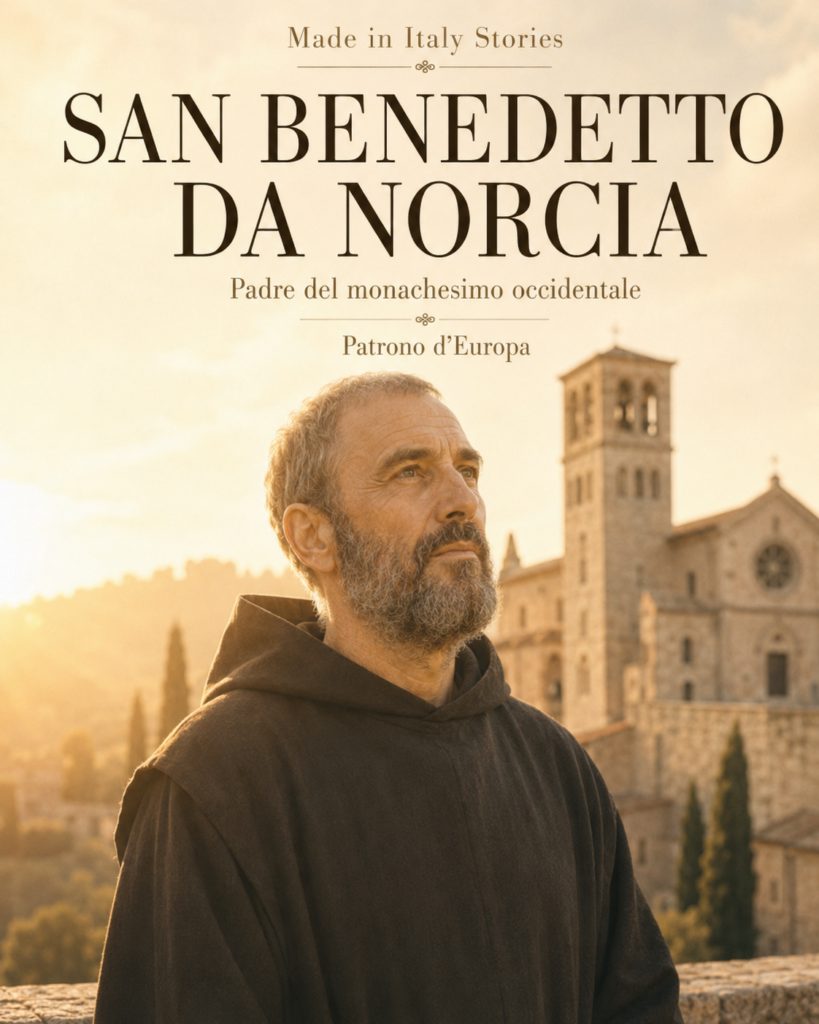
The monk from Norcia whose Rule helped shape the monasteries, culture and memory of Europe
Saint Benedict of Nursia is one of the most influential Italians who ever lived, even though we know surprisingly little about him with the certainty modern biography usually demands. He was not an emperor, general, pope or philosopher at a famous court. He was a monk who sought solitude and ended by shaping communities. His Rule, a compact guide for monastic life, spread across medieval Europe and became one of the foundational texts of Western monasticism. Through communities inspired by it, Benedict’s influence touched prayer, agriculture, education, manuscript culture, hospitality and the preservation of learning. Europe was not ‘saved by monks’ in the simplistic slogan sometimes repeated, but Benedictine monasticism became one of the great institutions through which late antique and medieval culture was transmitted, organized and transformed.
Benedict was born around 480 in Nursia, today’s Norcia in Umbria. The traditional source for his life is the second book of the Dialogues of Pope Gregory the Great, written roughly half a century after Benedict’s death. Gregory presents real locations, people and memories but writes as a hagiographer, using miracle stories to show the spiritual character of his subject. This means that Benedict’s broad life can be reconstructed, while many colorful episodes belong to the religious literary form of the sixth century rather than to the standards of modern documentary biography.
Gregory tells us that Benedict came from a respectable family and was sent to Rome for education. The city he encountered was no longer the capital of a stable ancient empire. The Western Roman Empire had formally ended in 476, Italy was governed by new political powers, and the old social order was being remade. According to Gregory, Benedict became disgusted by the moral atmosphere of student life and left before completing his studies. His desire was, in Gregory’s phrase, ‘to please God alone.’ That withdrawal would eventually have very public consequences.
He first lived for a time near Enfide, usually identified with modern Affile, before seeking deeper solitude at Subiaco in the mountains east of Rome. There, tradition says, a monk named Romanus helped him live as a hermit in a cave. Benedict spent roughly three years in seclusion. The site became the Sacro Speco, the Holy Cave, around which one of Italy’s most atmospheric monastic sanctuaries later developed. The image is important: before Benedict wrote a rule for communities, he lived alone. Before he became an organizer, he tested solitude.
Gregory’s account fills the Subiaco years with miracle stories and moral tests. Benedict is said to have resisted temptation, survived poison, discerned hidden behavior and attracted disciples because of his reputation for holiness. One famous story tells of monks who resented his strict leadership and tried to poison his wine; when Benedict blessed the cup, it shattered. Another tells of poisoned bread carried away by a raven. These stories should be understood as hagiographic narratives expressing themes of spiritual discernment and divine protection. Their historical details cannot be independently verified, but they show how early Benedictine memory interpreted his character.
As disciples gathered, Benedict organized communities around Subiaco. Gregory describes twelve small monasteries, each with twelve monks and an abbot, under Benedict’s broader guidance. The exact institutional details are difficult to verify, but the basic development is plausible: the hermit had become a leader of monks. Eventually conflict with a local priest, Florentius, contributed to Benedict’s departure from Subiaco. He moved south to Monte Cassino, the place most permanently associated with his name.
The traditional date for the foundation of Monte Cassino is around 529, though precise chronology remains uncertain. The mountain stood strategically between Rome and Naples. According to Gregory, Benedict found a surviving pagan cult there and replaced it with Christian worship, establishing the monastery that would become one of the most famous in Europe. Monte Cassino’s later history was dramatic beyond anything Benedict could have imagined: destruction by Lombards, rebuilding, medieval splendor, earthquakes, suppressions and the catastrophic Allied bombing of 1944 during the Second World War, followed by reconstruction. The monastery’s repeated destruction and rebirth became almost symbolic of the endurance associated with Benedict’s tradition.
It was for communities like Monte Cassino that Benedict composed the Rule now known by his name. It is not a long book, and that is part of its genius. The Rule draws on earlier monastic traditions, including the Rule of the Master, but Benedict reshaped inherited material with a distinctive sense of moderation and practical psychology. The community is governed by an abbot who must listen, teach and account for his decisions before God. Monks live under a balance of prayer, reading and work. Obedience matters, but so do discretion, care for the weak and adaptation to circumstances.
The famous phrase ora et labora, ‘pray and work,’ is not actually a direct quotation from Benedict’s Rule, though it captures something of the later Benedictine spirit. The Rule carefully orders the daily cycle of communal prayer, known as the Work of God, alongside manual labor and sacred reading. Time itself becomes structured. Bells, offices, meals, sleep, reading and work form a rhythm intended to convert ordinary life into disciplined attention. Benedict did not propose dramatic spiritual heroics for a tiny elite. He designed a school of service in which people could become better through repetition, patience and community.
Hospitality occupies an especially beautiful place in the Rule. Guests are to be received as Christ, with particular care for the poor and pilgrims. The sick are to be served with special attention. Clothing and food should be adapted sensibly to climate and need. Even the cellarer, the monk responsible for practical supplies, is told to treat the goods of the monastery as sacred vessels. These details explain why the Rule lasted. Benedict understood that ideals survive only when kitchens, schedules, personalities and human weakness are taken seriously.
Gregory also records Benedict’s relationship with his sister Scholastica, who had dedicated herself to religious life. In the most famous story about them, the two met for spiritual conversation near Monte Cassino. When Benedict wished to return to his monastery, Scholastica prayed, and a sudden storm made departure impossible, allowing them to continue talking through the night. Gregory presents the episode as a lesson that love, in that moment, proved stronger than rigid observance. Shortly afterward Benedict saw what he understood as Scholastica’s soul ascending to heaven in the form of a dove. The story is devotional, but its literary meaning is profound and surprisingly tender.
Another important episode involves Totila, the Ostrogothic king. Gregory says Benedict discerned a disguise sent to test him and later warned Totila about his violence and future. The chronology places Benedict in the middle of the wars that devastated sixth-century Italy. Whether every detail of the meeting happened as narrated, the setting is historically credible: Benedict lived during one of the most unstable periods in Italian history, when armies crossed the peninsula and the structures of the old Roman world were breaking apart.
Benedict died around the middle of the sixth century, traditionally in 547, at Monte Cassino. Gregory describes him dying in the church, supported by his monks, after receiving Communion and standing in prayer. He was buried, according to the tradition, in the same tomb area as Scholastica. There was no medieval canonization ceremony of the later formal type; Benedict’s sanctity was recognized through ancient cult and tradition long before centralized canonization procedures developed.
The astonishing expansion of Benedict’s influence took place after his death. The Rule gradually became dominant in Western monasticism, especially through Carolingian reform in the eighth and ninth centuries, when rulers and church leaders encouraged its adoption. Benedictine houses became religious centers, landowners, schools, libraries, scriptoria, hospitals, guesthouses and economic communities. Their influence varied enormously by time and place. Monks were not all scholars, monasteries were not always peaceful, and Benedictine history contains politics and wealth as well as prayer. But the institutional power of the tradition is undeniable.
Because monasteries copied manuscripts and maintained libraries, they became important agents in the transmission of Christian and classical texts. Because they managed land, they helped reshape rural economies. Because they educated clergy and sometimes lay students, they influenced intellectual life. Because they offered hospitality, they became nodes in networks of travel and pilgrimage. Benedict himself did not personally design medieval European civilization, but his Rule created a flexible framework that thousands of communities could use, and those communities helped build it.
In 1964 Pope Paul VI proclaimed Benedict patron of Europe, recognizing the civilizational role associated with the monastic tradition that bore his name. The title became even more poignant as Europe tried to understand itself after two world wars. Benedict’s message was not nationalism, conquest or centralized power. It was stability, community, disciplined freedom and the patient construction of order from daily acts. In a continent repeatedly destroyed by grand ambitions, there was something almost subversive in honoring a man whose greatest weapon was a timetable.
Norcia, Subiaco and Monte Cassino form a kind of Italian map of Benedict’s life: birth, solitude, community. Each place reveals a different dimension of the story. To visit them is to move through mountains, stone, silence and centuries of rebuilding. Benedict’s Europe began in very Italian landscapes, but it did not remain there. His spiritual descendants spread across the continent and eventually the world.
If you have visited Norcia, Subiaco or Monte Cassino, or if the Benedictine idea of prayer, work, hospitality and stability speaks to you, tell us in the comments. Follow Made in Italy Stories as we continue to tell the lives of the Italians whose influence traveled far beyond Italy. We tell you about Italy, as Italians.