

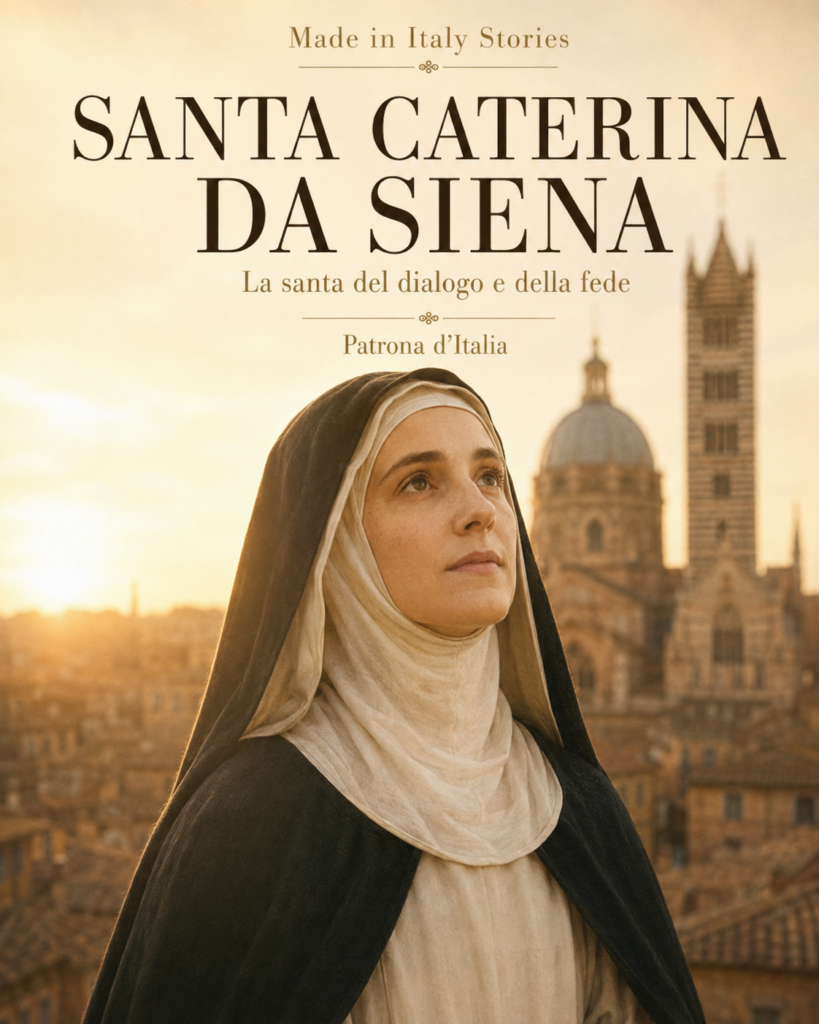
The dyer’s daughter who advised popes, crossed political battle lines and became a Doctor of the Church
Catherine of Siena lived only thirty-three years, never attended a university, struggled to learn reading and writing, held no official political office and belonged to no powerful noble dynasty. Yet she corresponded with kings, queens, cardinals, mercenary captains, city governments and popes. She entered the great political and ecclesiastical crises of fourteenth-century Europe with the confidence of someone who believed that moral authority did not require a title. She is remembered as a mystic, but that word can mislead if it makes us imagine someone withdrawn from ordinary reality. Catherine was one of the most active religious women of the Middle Ages: nursing plague victims, mediating conflicts, dictating hundreds of letters, traveling between Italian cities and Avignon, arguing for Church reform and throwing herself into the dangerous politics of a divided papacy.
She was born in Siena in 1347 into the large family of Jacopo Benincasa, a cloth dyer, and Lapa Piagenti. Sources traditionally describe her as the twenty-third of twenty-five children, one of twins, though not all the children survived infancy. Siena was then a wealthy but politically turbulent city, and Catherine’s birth came just before the Black Death devastated Europe in 1348. She grew up in a world where disease, factional conflict, religious imagery and the uncertainty of life were far more immediate than they are for most modern Europeans.
Her earliest biographies, especially that written by her confessor Raymond of Capua, describe visionary experiences beginning in childhood. At about six or seven she is said to have seen Christ in glory above the church of San Domenico. She later made a private vow of virginity. These episodes belong to hagiographic sources written within a devotional framework, and historians cannot verify mystical experiences in the same way they verify a journey or a letter. What is clear is that as an adolescent Catherine resisted her family’s plans for marriage with extraordinary determination. She cut her hair, adopted severe devotional practices and eventually persuaded her family to allow her to pursue a religious vocation without entering a cloistered convent.
Around the age of sixteen she joined the Mantellate, a group of women associated with the Dominican Third Order. They were generally older widows who lived lives of prayer and charity while remaining in the city rather than behind monastery walls. Catherine was unusually young and unmarried. She initially spent years in intense prayer and seclusion in her family home. Later she emerged into public service, caring for the sick, the poor and people rejected by others. Stories from this period emphasize her willingness to nurse patients with repellent diseases, part of a spirituality that saw service to suffering bodies as service to Christ.
As her reputation grew, a remarkable circle formed around her. Priests, laymen, women, scholars and political figures became what Catherine called her spiritual family. Many addressed her as ‘Mamma.’ She dictated letters with extraordinary energy, often combining affectionate language with devastating directness. Her correspondents included rulers and senior churchmen. Catherine’s letters do not sound like polite requests from a powerless medieval woman. They can be commanding, urgent and morally uncompromising. She repeatedly told powerful men to become what they ought to be, and apparently expected them to listen.
Her spirituality centered intensely on Christ, especially on the Eucharist, the blood of Christ and the transformation of the human will through love. Raymond of Capua recorded mystical traditions including a spiritual marriage with Christ and an exchange of hearts. In 1375, while in Pisa, Catherine was said to have received the stigmata, which according to the tradition remained invisible during her life. Such events are part of Catholic devotional understanding of her and cannot be established through ordinary historical evidence. What can be established are the writings, travels and networks of people who regarded her religious authority as real enough to influence their actions.
Catherine entered politics because she believed peace and Church reform were spiritual responsibilities. Fourteenth-century Italy was fragmented into communes, signories, papal territories and shifting alliances. Violence between cities and factions was common. The papacy itself had resided in Avignon since the early fourteenth century, a situation many Italians regarded as both politically damaging and symbolically wrong. Catherine began writing and traveling to promote peace, reform and the return of the pope to Rome.
Her encounter with Pope Gregory XI became one of the defining episodes of her life. In 1376 Catherine traveled to Avignon as part of diplomatic efforts connected with Florence and the papacy. She urged Gregory to return to Rome. It would be too simple to claim that Catherine single-handedly caused the move; the pope faced many political pressures and had already considered returning. Yet her advocacy was persistent and memorable, and she became one of the strongest moral voices encouraging him to act. Gregory left Avignon and entered Rome in January 1377, ending the long period in which the papal court had been based in France.
Catherine’s involvement with Florence was also dangerous. The city was in conflict with the papacy during the War of the Eight Saints, and she worked toward reconciliation. She traveled between hostile political environments and was sometimes treated with suspicion. Later sources describe an attempted attack on her in Florence. Whether every dramatic detail can be reconstructed is difficult, but her willingness to place herself physically inside political conflict is beyond doubt. For someone often depicted kneeling peacefully in religious art, Catherine spent an impressive amount of time in places where people were angry and armed.
The situation became even worse after Gregory XI died in 1378. The election of Urban VI was followed by rebellion among cardinals, who elected a rival, Clement VII. The Western Schism began, splitting European Christianity between competing papal obediences. Catherine supported Urban VI and moved to Rome, where she wrote relentlessly in his defense and urged him to govern with firmness but also with charity. Her letters from these years reveal both her fierce loyalty to the papacy and her willingness to criticize papal behavior. She could call the pope ‘sweet Christ on earth’ and still tell him, in effect, to behave better.
Catherine’s best-known literary work is the Dialogue of Divine Providence, dictated during the final years of her life. It presents a sustained spiritual conversation between the soul and God, developing themes of divine mercy, human freedom, virtue, the Church and Christ as a bridge between earth and heaven. Together with her letters and prayers, it became one of the major bodies of medieval spiritual writing. This is especially remarkable because Catherine’s formal education was limited. Her intellectual authority emerged not from scholastic credentials but from a powerful oral culture, Dominican teaching, biblical imagination and relentless spiritual reflection.
Her physical condition deteriorated severely in 1380. Catherine’s extreme fasting had long worried people around her, and modern readers should resist romanticizing practices that damaged health. Medieval mystical culture sometimes interpreted severe asceticism as evidence of spiritual intensity, but the body still paid the cost. In Rome Catherine became increasingly weak and suffered what may have been a stroke. She died on 29 April 1380, aged thirty-three, after spending her final months praying and working for the Church during the schism.
Her body was buried in the Dominican church of Santa Maria sopra Minerva in Rome, while her head was later taken to Siena, where it is venerated in the Basilica of San Domenico. To modern sensibilities the division of relics can seem strange, but medieval Christianity understood the physical remains of saints as powerful links between holy lives and local communities. Siena wanted Catherine home, even if not all of her could return.
Pope Pius II canonized Catherine in 1461. Her stature continued to grow across the centuries. In 1939 Pope Pius XII named her, together with Francis of Assisi, patron of Italy. In 1970 Pope Paul VI declared Catherine a Doctor of the Church, making her one of the first women to receive that title. In 1999 Pope John Paul II named her a co-patron of Europe. These honors reflect different dimensions of her legacy: Italian identity, theological teaching and the wider European significance of a woman who crossed borders long before anyone invented the phrase international diplomacy.
Catherine is sometimes presented as an obedient medieval woman and sometimes as a proto-feminist rebel. Both labels are too neat. She did not challenge the Catholic framework of her age; she inhabited it completely. Yet within that framework she exercised an astonishing freedom. She spoke to men at the highest levels of power without asking permission to have a conscience. Her authority came from the conviction that holiness created obligations, including obligations for rulers. That is why her life still feels surprisingly modern: not because she shared our categories, but because she refused to confuse rank with truth.
To visit Siena with Catherine in mind changes the city. The Benincasa house, San Domenico, the steep streets and the civic squares become part of a life that was intensely local and improbably international. Rome, too, holds her final chapter. She belongs to both cities and also to the larger history of Europe, where a dyer’s daughter became an adviser to popes without ever ceasing to describe herself as a servant.
If you have visited Siena, prayed at Catherine’s shrines, read her words, or simply discovered something unexpected in her story, tell us in the comments. Follow Made in Italy Stories as we continue to tell the lives behind Italy’s history, faith and culture. We tell you about Italy, as Italians.