

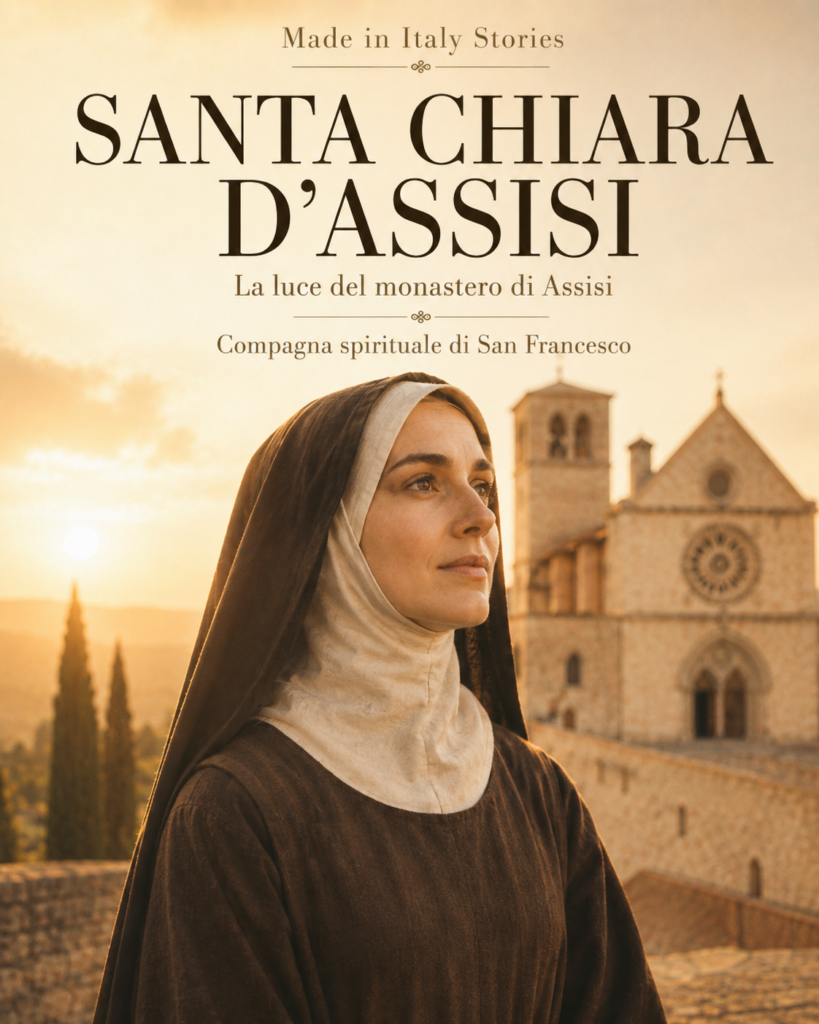
The noblewoman who chose radical poverty and fought for the freedom of her community
Clare of Assisi is often introduced as the female companion of Saint Francis, a description that is true and at the same time much too small. She was inspired by Francis, certainly, but she was not a shadow. She was the founder and spiritual center of a community of women, an author in her own right, a determined negotiator with popes and cardinals, and one of the clearest medieval examples of a woman insisting that her form of religious life not be softened for the sake of convenience. Her world expected noble daughters to marry strategically, preserve family alliances and accept the social structures into which they were born. Clare walked away from all of that and then spent four decades defending the consequences of her decision.
She was born in Assisi in 1193 or 1194 into the noble family of Favarone di Offreduccio. Her mother, Ortolana, was remembered as a deeply religious woman who had made pilgrimages to important Christian sites. Clare grew up in a household of status and privilege during a time of political tension between Assisi’s aristocracy and rising communal forces. Her family belonged to a social world in which marriage was an instrument of property, protection and political connection. The young Clare was therefore expected to marry well. Early sources, especially the testimony gathered for her canonization, describe her instead as serious about prayer, generous to the poor and increasingly unwilling to accept the future prepared for her.
Francis of Assisi was already causing a stir in the town. He had renounced his merchant father’s wealth, gathered companions and begun preaching a life of Gospel poverty. Clare heard him preach and met with him secretly, probably with trusted companions. The idea that poverty could be chosen rather than merely endured must have been explosive for a young aristocratic woman. For Francis, renunciation had meant conflict with a wealthy merchant family. For Clare, it meant confronting a noble household whose expectations for a daughter were even more rigid.
On the night after Palm Sunday in 1212, Clare left her family home. The dramatic escape became one of the foundational scenes of Franciscan history. She went to the Portiuncula, where Francis and the friars received her. There her hair was cut and she exchanged expensive clothing for a simple habit. The gesture was spiritual, but it was also unmistakably social: hair, clothing and marriageability were part of a noblewoman’s public identity, and Clare was declaring that the system no longer owned her future.
Francis initially placed her in the Benedictine monastery of San Paolo delle Abbadesse, partly because an established convent offered legal and physical protection. Her family came to retrieve her, apparently by force. The sources describe Clare clinging to the altar and revealing her shorn head as proof that she had already committed herself to religious life. Whether every dramatic detail unfolded exactly as later remembered, the conflict itself is well attested. Clare refused to return. She later moved briefly to another religious house before settling at San Damiano, the small church Francis had once repaired outside Assisi.
Her younger sister Caterina soon joined her and took the religious name Agnes. Other women followed, including eventually members of Clare’s own family. The community at San Damiano became known as the Poor Ladies. Unlike the friars, who traveled and preached, Clare and her sisters lived an enclosed life of prayer and work. Yet their enclosure should not be confused with passivity. Clare was building a new form of female Franciscan life, and its defining principle was absolute poverty: neither the sisters individually nor the community collectively should possess property that could guarantee their security.
This was where Clare’s quiet determination became historically remarkable. Church authorities admired the women’s devotion but were uneasy about a monastery without endowments. Medieval female religious communities were normally expected to own land or income because enclosure limited their ability to work or beg outside. Cardinals and popes tried at various times to give San Damiano a more conventional economic foundation. Clare resisted. She asked for and received what became known as the Privilege of Poverty, papal protection for the right not to be forced to own possessions. It is difficult to think of a more paradoxical legal privilege: the right to remain poor.
Clare served as abbess, though early Franciscan language often emphasized her maternal rather than hierarchical role. Canonization witnesses remembered her caring personally for sick sisters, performing humble tasks and living with exceptional austerity. She slept little, fasted rigorously and spent long periods in prayer. Francis himself eventually had to moderate some of her fasting because it threatened her health. Medieval holiness often admired bodily asceticism in ways that modern readers may find disturbing, and it is important not to romanticize suffering for its own sake. For Clare, however, these practices were understood as part of an attempt to imitate the poor and crucified Christ as completely as possible.
Her relationship with Francis was one of spiritual kinship, but the surviving evidence shows that Clare developed a mature identity independent of him. Francis died in 1226, while Clare lived until 1253. For nearly three decades she had to preserve the Franciscan ideal for women without his physical presence. She corresponded with important figures, most notably Agnes of Prague, a princess who had founded a similar community in Bohemia. Clare’s four surviving letters to Agnes are among the most beautiful examples of medieval women’s spiritual writing. They reveal an author of theological depth, poetic imagination and a strong sense that contemplating Christ should transform the person who looks.
Several famous episodes in Clare’s life belong to the borderland between documented witness and devotional interpretation. In the 1240s armed forces connected with Emperor Frederick II threatened the area around Assisi and San Damiano. Canonization testimony recounts Clare, already ill, asking to be carried to a place near the threatened entrance while the Eucharist was brought before her, after which the attackers withdrew. Catholic tradition came to remember this as miraculous protection through her faith in the Eucharist. Historians can confirm the military danger and the testimony of women who knew her; the supernatural causation belongs to faith rather than historical proof. This distinction does not diminish the importance of the story in Clare’s cult.
Another later tradition tells that when illness prevented Clare from attending Christmas worship, she miraculously saw and heard the liturgy from her room as though projected at a distance. This story became the reason Pope Pius XII declared her patron saint of television in 1958. It is a wonderful example of how old devotional stories acquire new cultural meanings. A thirteenth-century enclosed nun became the patron of a twentieth-century medium because tradition remembered her receiving images and sounds from far away. Saints have had stranger second careers.
Clare’s final achievement was institutional. For years she worked toward a written rule that would preserve the poverty she considered essential. Earlier forms of life for her community had drawn on other monastic rules and papal legislation. Clare eventually wrote a rule for her sisters that incorporated Franciscan principles while addressing the realities of enclosed women’s life. Pope Innocent IV approved it on 9 August 1253. Clare died two days later, on 11 August. According to tradition, the approved document reached her shortly before death. Whether one sees providence or simply extraordinary timing, she had won the legal recognition for which she had struggled most of her adult life.
Her canonization followed quickly. Pope Alexander IV declared her a saint in 1255. The Basilica of Saint Clare in Assisi later became the principal place associated with her remains and memory, while San Damiano preserved the more intimate atmosphere of the community she had led. The religious family that developed from her foundation became known as the Order of Saint Clare, or Poor Clares, and spread throughout the world.
Clare’s life is especially significant in the history of women because her strength did not depend on holding political office, commanding armies or breaking with religion. She exercised authority from within a medieval religious structure while refusing to let powerful men define the central principle of her vocation. Popes advised her. Cardinals negotiated with her. Clergy tried to protect her community through property. Clare listened respectfully and then continued asking for the opposite. Her resistance was not loud, but it lasted for decades. In the end the papacy approved the rule she wanted.
Assisi today naturally links Francis and Clare, and visitors often encounter them as a pair. That is appropriate if we remember that a pair is made of two distinct people. Francis showed Clare a possible path, but she walked it with her own intelligence and stubbornness. He died young, and she carried the experiment forward. The Franciscan movement would be incomplete without her, not because every great man requires a great woman in the background, but because Clare was herself one of the architects of the Franciscan idea.
If you visit Assisi, do not stop after the Basilica of Saint Francis. Walk to San Damiano. Enter the Basilica of Saint Clare. Think about a teenage aristocratic girl leaving home at night in 1212 and a sick woman receiving papal approval of her rule forty-one years later. The distance between those two moments is the real story of Clare: not an escape, but a lifetime of fidelity to a decision.
If Saint Clare’s story means something to you, or if you have visited the places where she lived, tell us in the comments what you remember most. Follow Made in Italy Stories as we continue to discover the Italians whose lives became part of world history. We tell you about Italy, as Italians.