

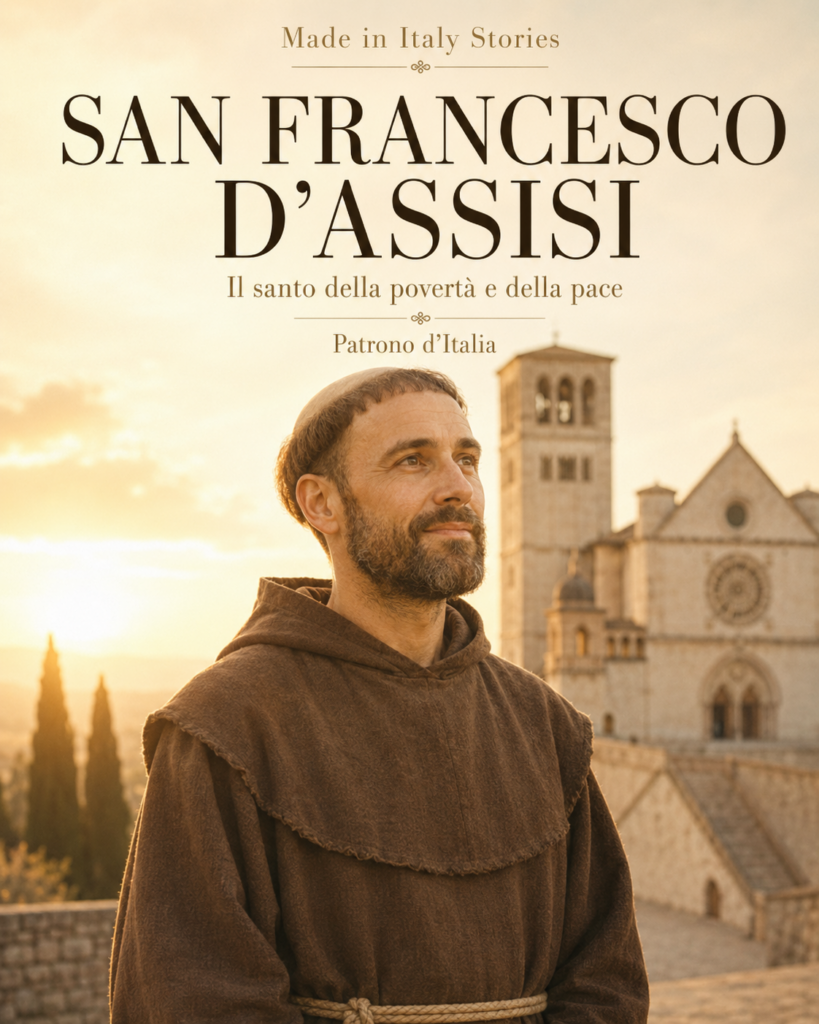
The restless merchant’s son who chose poverty and changed Christianity forever
Few names in Italian history are as universally recognized as Francis of Assisi, and few lives have been simplified so enthusiastically. He is often reduced to a gentle man surrounded by birds, flowers and wolves, smiling peacefully at nature as though medieval Italy had been one long garden. The real Francis was far more challenging. He was charismatic, stubborn, joyful, physically exhausted, radical in his poverty, suspicious of possessions, passionate about the Gospel and capable of making comfortable people deeply uncomfortable. He lived in a violent age of crusades, city wars, social inequality and rapid commercial change. His answer was not withdrawal from the world but a new form of Christian life lived in the streets, among ordinary people, without property and with a deliberately shocking commitment to humility.
Francis was born in Assisi at the end of 1181 or beginning of 1182. His father, Pietro di Bernardone, was a prosperous cloth merchant whose business connected the Umbrian town with the wider commercial world. His mother is traditionally called Pica and was later said to have come from Provence, though details about her origin are uncertain. The boy was baptized Giovanni, but his father came to call him Francesco, a name associated with France. He grew up in a household with money, and his youth appears to have been comfortable. Early sources describe him as sociable, generous and attracted to the ideals of chivalry. He wanted distinction, adventure and perhaps the noble status that successful merchants of his generation often admired from a social distance.
Assisi itself was changing. The rising merchant class was challenging older aristocratic structures, and conflict between towns was constant. In 1202 Francis joined Assisi’s forces in war against nearby Perugia. The battle ended disastrously for Assisi, and Francis was captured. He spent many months as a prisoner, probably because his family could afford a ransom and therefore made him more valuable alive. Illness followed his release. These experiences did not immediately turn him into a saint, but they seem to have cracked the certainty of his earlier ambitions. The glamorous world of knighthood had introduced him to mud, captivity and sickness.
He attempted military adventure again, setting out to join a campaign in southern Italy, but returned after an experience that early biographers describe as a dream or divine warning. From this point his life began to change more clearly. He spent more time in prayer, sought solitude and developed a new concern for people he had previously feared or avoided, especially lepers. Francis later remembered his encounter with lepers as one of the decisive reversals of his life: what had seemed bitter became sweet. That transformation matters because his conversion was not merely intellectual. It involved forcing himself across the boundaries of disgust, status and comfort.
One of the most famous episodes took place at the small ruined church of San Damiano outside Assisi. According to early Franciscan tradition, while praying before a painted crucifix Francis heard Christ tell him to repair his house, which was falling into ruin. Francis initially understood the command literally. He began repairing churches and took cloth from his father’s business to finance the work. Pietro di Bernardone was furious. The conflict between father and son culminated before the bishop of Assisi, where Francis publicly renounced his claims to paternal property. Later tradition dramatized the scene with Francis removing even the clothes his father had provided. Whatever the precise theatrical details, the break was real: Francis had chosen a life in which family wealth would no longer define him.
At first he lived as a penitent, repairing chapels, praying and serving the poor. Then followers began to gather around him. Around 1208 or 1209, after hearing a Gospel passage in which Christ sends disciples to preach without money or extra possessions, Francis recognized a pattern for his own life. His companions dressed simply, worked when they could, begged when necessary and preached repentance and peace. They called themselves Lesser Brothers, Friars Minor, a name that captured Francis’s desire to stand among the socially ‘lesser’ rather than the powerful.
In 1209 Francis and his first companions went to Rome seeking approval for their way of life. Pope Innocent III gave an initial oral approval, according to the Franciscan tradition. This was a crucial moment. The movement was radical enough to provoke suspicion, but Francis insisted on remaining within the Church rather than becoming one of the many reform movements that broke away from ecclesiastical authority. His revolution would be lived through obedience, a tension that remained difficult throughout his life as the movement expanded.
The expansion was astonishing. Men from different social backgrounds joined, and soon women were drawn to the same ideal. In 1212 Clare of Assisi left her aristocratic family and embraced a life of poverty under Francis’s guidance, founding the community that would eventually become known as the Poor Clares. Franciscan preaching spread across Italy and then Europe. The friars did not live behind monastery walls in the traditional sense. They moved among towns, roads and marketplaces. Their poverty was intended not as romantic destitution but as freedom from ownership, status and the power structures that property could create.
Francis’s relation to nature, now one of the most famous parts of his image, grew from this larger spiritual vision. The Canticle of the Creatures addresses the sun, moon, wind, water, fire and earth as brothers and sisters because all are created by the same God. It is one of the earliest major literary works in the Italian vernacular and one of the most beautiful religious poems of the Middle Ages. Stories of his preaching to birds and the taming of the wolf of Gubbio belong to the rich Franciscan narrative tradition. The wolf story in particular is found in later sources and should be treated as a devotional legend rather than a documented event, but it expresses something genuine about the Franciscan imagination: peace is possible even where fear appears natural.
Francis was not detached from the great conflicts of his age. In 1219, during the Fifth Crusade, he traveled to Egypt and crossed military lines to meet Sultan al-Malik al-Kamil. The event is historically attested, though later retellings embellished the details. Francis hoped to bear Christian witness, and some sources suggest he desired martyrdom. Instead he was received and allowed to return safely. The meeting has become a powerful modern symbol of interreligious encounter. It should not be sentimentalized: Francis remained a convinced Christian missionary, and the Sultan remained a Muslim ruler during wartime. Yet in an age of holy war, the fact that they met face to face rather than only through weapons remains extraordinary.
As the Franciscan movement grew, its very success created problems. Thousands of friars could not be governed with the informal simplicity of the first small group. Questions arose about education, buildings, books, money and institutional structure. Francis feared that the movement would lose the absolute poverty of its beginnings. Other friars believed organization was necessary if the order was to survive and serve the Church effectively. Francis gradually stepped back from administrative leadership, while Cardinal Ugolino, the future Pope Gregory IX, became an important protector of the order. The final Rule was approved by Pope Honorius III in 1223.
That same year Francis created one of the most enduring Christmas traditions in Christian culture. At Greccio he arranged a celebration centered on a manger, hay and animals in order to help people contemplate the poverty of Christ’s birth. It was not the invention of every nativity scene in the simplistic sense often repeated, but the Greccio event gave powerful momentum to the devotional tradition of representing the Nativity visibly and physically. Once again Francis’s genius was concrete: if people could see and feel poverty, perhaps they could understand the Gospel differently.
By his early forties Francis’s body was failing. Years of fasting, travel, illness and exposure had taken a serious toll. In 1224, while praying at La Verna, he experienced what Franciscan sources describe as a vision of a seraphic crucified figure and received wounds corresponding to the stigmata. The event became one of the central signs of his sanctity in Catholic tradition. As with all mystical phenomena, historians can describe the testimony and its reception but cannot verify the supernatural interpretation by ordinary historical methods. What is beyond dispute is that contemporaries believed Francis bore unusual wounds near the end of his life and that the episode transformed the way his followers understood him.
His final period was marked by pain and declining eyesight, yet also by some of his most enduring words. The Canticle of the Creatures belongs to these late years. He added verses about forgiveness and, near death, even about ‘Sister Bodily Death.’ On the evening of 3 October 1226, at the Portiuncula near Assisi, Francis died. Tradition describes him asking to be laid on the bare ground, consistent to the end with his desire to possess nothing. He was about forty-four years old.
The canonization came with remarkable speed. Pope Gregory IX declared Francis a saint in 1228, only two years after his death. Construction of the Basilica of Saint Francis began in Assisi, and the city became one of Europe’s major pilgrimage centers. The Franciscan movement developed into a vast religious family with friars, enclosed sisters, secular members, missionaries, scholars and reform branches. Its history would include disputes, divisions, extraordinary saints and immense intellectual influence, but the memory of the poor man of Assisi remained the point of origin.
Francis’s later reputation expanded far beyond the Catholic Church. He became associated with peace, care for creation, dialogue and solidarity with the poor. Pope Pius XII named Francis, together with Catherine of Siena, patron of Italy in 1939. Pope John Paul II later proclaimed him patron of ecology. Modern environmentalists, pacifists and interfaith activists often claim parts of his legacy, sometimes smoothing away the intense medieval Christianity that gave those commitments their meaning. The historical Francis was not a modern liberal, an environmental campaigner or a generic spiritual poet. He was a radical medieval Christian whose love of creation flowed from his love of the Creator and whose peace began with conversion.
What makes Francis endure is that he remains difficult to domesticate. The birds are charming; giving up status is harder. The nativity scene is beautiful; embracing the marginalized is harder. Calling the sun a brother is poetic; refusing to treat wealth as the measure of a person is harder. Francis continues to attract believers and nonbelievers because beneath the layers of legend there is a life that asks a direct question: how much of what we call necessary is actually necessary at all?
If you have visited Assisi, stood inside the Basilica, walked to San Damiano or the Portiuncula, or simply grown up hearing stories about Saint Francis, tell us what he represents to you. Follow Made in Italy Stories as we continue to tell the lives that shaped Italy and, in this case, much of the world. We tell you about Italy, as Italians.