

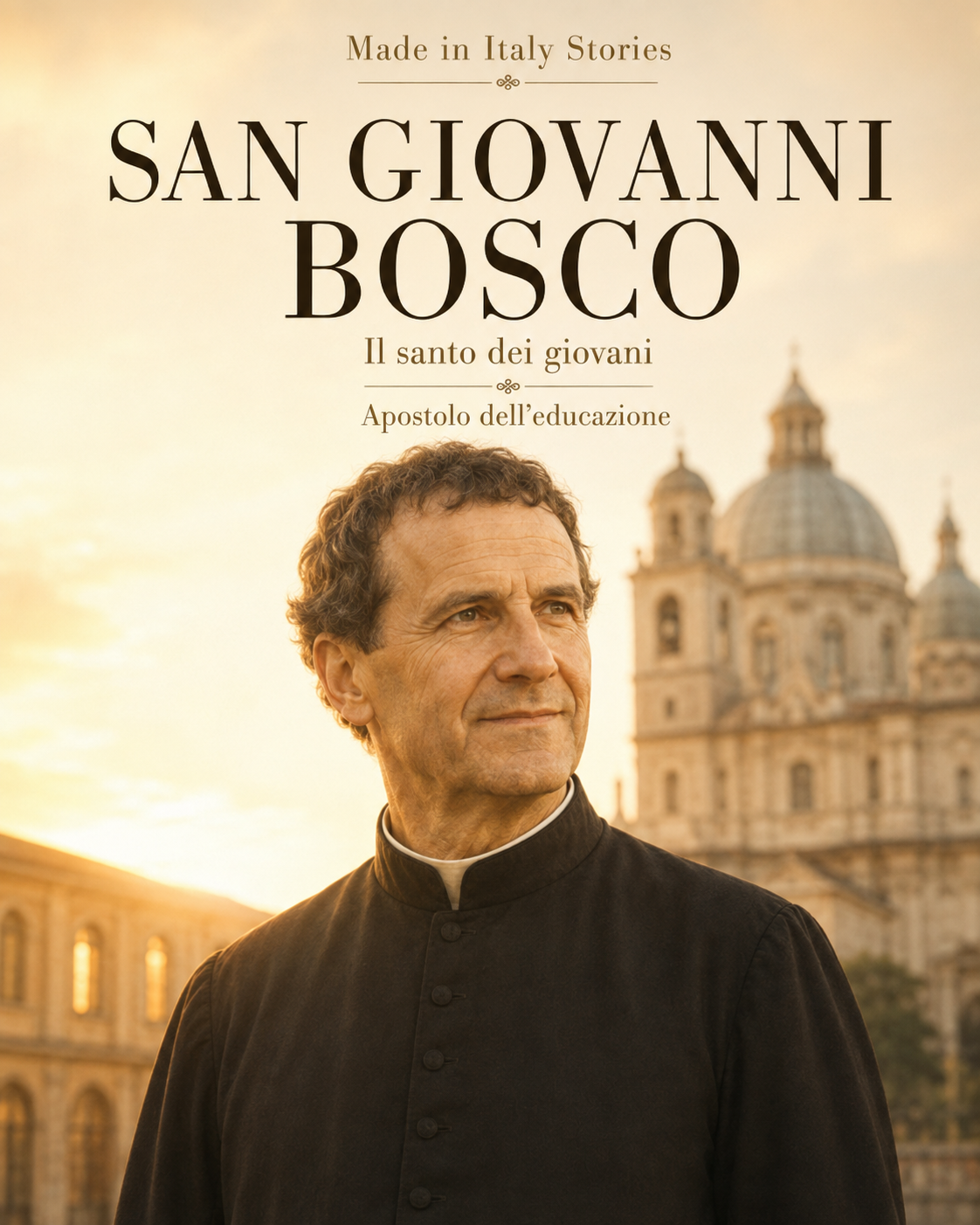
The Priest Who Built a Future for the Young
John Bosco entered history through a door that respectable society often preferred not to see: the door through which poor, abandoned, unemployed and delinquent boys entered the rapidly changing cities of nineteenth-century Italy. He could have become simply another good priest in Piedmont. Instead he built an educational movement that crossed continents. The world remembers him as Don Bosco, and the affectionate title is important. He was not primarily a theorist who later searched for children to fit a system. He began with young people in front of him, with their hunger, jokes, roughness, loneliness and potential, and his educational ideas grew out of the effort to keep them from being lost.
Giovanni Melchiorre Bosco was born on 16 August 1815 in the rural hamlet known as the Becchi, near Castelnuovo d’Asti in Piedmont, in a poor farming family. Italy did not yet exist as a unified state. The Napoleonic age had just ended, restoration politics were reshaping Europe, and rural families lived close to the edge of hardship. John’s father, Francesco Bosco, died when the boy was only two, leaving his mother Margherita Occhiena with the difficult task of holding the household together. Margherita, later affectionately remembered as Mamma Margaret, would become one of the foundational influences in her son’s life: practical, devout, direct and capable of extraordinary sacrifice without theatricality.
A famous episode from Don Bosco’s childhood is the dream he said he had at about nine years old. In it he saw a crowd of boys fighting and swearing. He tried to stop them by force, but a mysterious figure told him that he would have to win them through gentleness and charity. A woman then appeared and showed him the mission symbolically. For believers within the Salesian tradition, this dream has profound spiritual meaning. From a historical point of view, it comes to us through Bosco’s later recollections and cannot be independently verified as an external event. Yet it accurately expresses the direction his life eventually took: education not through fear, but through presence and trust.
Getting an education was not simple for a poor country boy. John worked, studied when he could, learned practical trades and relied on help from priests and benefactors. He possessed a lively intelligence and an extraordinary memory, and he understood early that to influence other boys he had to enter their world. He learned games, acrobatics and tricks, gathering local children around performances and ending with prayer or a lesson. The pattern foreshadowed his adult method: attract before instructing, establish relationship before demanding reform.
He entered the seminary and was ordained a priest in Turin in 1841. The Turin he encountered was being transformed by industrial and social change. Young migrants from the countryside arrived looking for work. Many found unstable labor, exploitation, overcrowding and the risk of prison. Bosco visited prisons and saw boys already caught in the machinery of punishment. The experience convinced him that waiting until a young person committed a crime was too late. Prevention had to come first.
The symbolic beginning of his youth apostolate is traditionally connected with 8 December 1841, when he encountered a young laborer named Bartolomeo Garelli. From such small beginnings grew the Oratory. At first the gatherings moved from place to place because large groups of noisy boys were not always welcomed by landlords or neighbors. Eventually Bosco established his work at Valdocco, on the edge of Turin. There the Oratory of Saint Francis de Sales became church, playground, school, workshop, home and social experiment all at once.
Don Bosco’s genius was not simply that he opened a building. He understood that vulnerable young people needed an environment. He wanted adults present among them, not merely supervising from a distance. He wanted games, music, prayer, vocational training, literacy, food, discipline and affection to reinforce one another. His method came to be known as the Preventive System, usually summarized by three pillars: reason, religion and loving-kindness. Instead of relying primarily on punishment after misconduct, educators were to create conditions in which the young were known, guided and helped to choose well before things went wrong.
This system sounds gentle, but it was not permissive. Bosco expected effort, honesty, faith and responsibility. What he rejected was humiliation. He believed that a young person should know he was loved. That conviction shaped the famous Salesian idea of educational presence: adults should be with the young, sharing their world and earning the right to guide them. In an age when institutional discipline could be severe, the approach was innovative enough to attract both admiration and suspicion.
The work expanded rapidly. Bosco organized schools and trade workshops so that boys could learn useful professions. He negotiated apprenticeship agreements and tried to defend young workers from abuse. He wrote books and pamphlets, produced popular religious literature, preached, heard confessions and raised money with astonishing persistence. Benefactors discovered that saying no to Don Bosco once did not necessarily end the conversation. He had the kind of cheerful persistence that can be exhausting in ordinary people and magnificent in founders.
In 1859 he founded the Society of Saint Francis de Sales, the Salesians, to continue his mission. In 1872, together with Maria Domenica Mazzarello, he helped establish the Daughters of Mary Help of Christians for the education of girls. He also developed the Salesian Cooperators, allowing lay people to share in the mission. These foundations reveal that Bosco’s vision was not a single orphanage or school. He was building a family of institutions capable of reproducing a style of education.
His devotion to Mary under the title Mary Help of Christians became a central element of his spirituality. The Basilica of Mary Help of Christians at Valdocco, consecrated in 1868, became the spiritual heart of the Salesian world. Bosco attributed many developments in his work to Mary’s intercession. Reports of prophetic dreams, healings and extraordinary intuitions surround his biography. Some are preserved in early Salesian memoirs and are cherished within the tradition; historians distinguish between well-documented events, testimony and later devotional interpretation. Don Bosco himself was less interested in satisfying curiosity than in keeping attention on faith and the young.
His relations with politics were equally fascinating. He lived through the Risorgimento, the creation of the Kingdom of Italy and intense conflict between the new Italian state and the papacy. Bosco was deeply loyal to the Church, yet he also dealt pragmatically with ministers and officials. He sometimes served as an informal intermediary in delicate matters concerning episcopal appointments and church-state relations. He was not a political theorist, but he possessed remarkable practical intelligence and knew how to speak with people who disagreed with him when the needs of his mission required it.
The Salesian project soon moved beyond Italy. In 1875 the first Salesian missionaries left for Argentina. Bosco dreamed of a global mission among young people and poorer communities, and this expansion continued rapidly after his death. The decision changed the scale of the movement forever. Schools, parishes, missions, technical institutes and youth centers eventually spread across the world. A priest who had begun with street boys in Turin had created one of the most extensive educational networks in modern Catholic history.
But the public success came at a cost. Bosco’s final years were marked by exhaustion, physical decline and constant demands. He had spent decades traveling, fundraising, writing, negotiating and carrying the worries of thousands of young people and collaborators. He died at Valdocco on 31 January 1888. By then he was already widely regarded as a holy man. His funeral revealed the depth of affection surrounding him, especially among those who believed he had given young people something more important than charity: a future.
The Church formally recognized his sanctity in the twentieth century. Pope Pius XI beatified him in 1929 and canonized him on 1 April 1934. Don Bosco became patron of apprentices, young people and many educational initiatives. His feast is celebrated on 31 January. Yet his real memorial is not only liturgical. It is institutional and pedagogical. The Salesian family continues to work in schools, vocational training, youth ministry and social projects across the world.
What makes Don Bosco particularly modern is his refusal to separate moral formation from material conditions. He knew that telling a hungry boy to behave better was not enough. A young person needed work, belonging, education, play, adults who cared and a reason to hope. He also understood something that modern psychology would later express in different language: relationship changes behavior more deeply than fear.
Turin still preserves the landscape of his work, especially Valdocco, where visitors can enter the basilica and the places associated with the first Oratory. But Don Bosco’s story belongs to a much larger Italy: the Italy of migration from countryside to city, of industrialization, of social inequality, of unification and of new debates about education. He did not observe these changes from a safe distance. He stepped into them and tried to prevent the poorest children from paying the entire price.
If you have studied in a Salesian school, known a Salesian community, or simply admire Don Bosco’s belief in the potential of young people, tell us what part of his story speaks most strongly to you. Follow Made in Italy Stories for more long-form portraits of the Italians whose lives changed not only their country, but the world beyond it.