

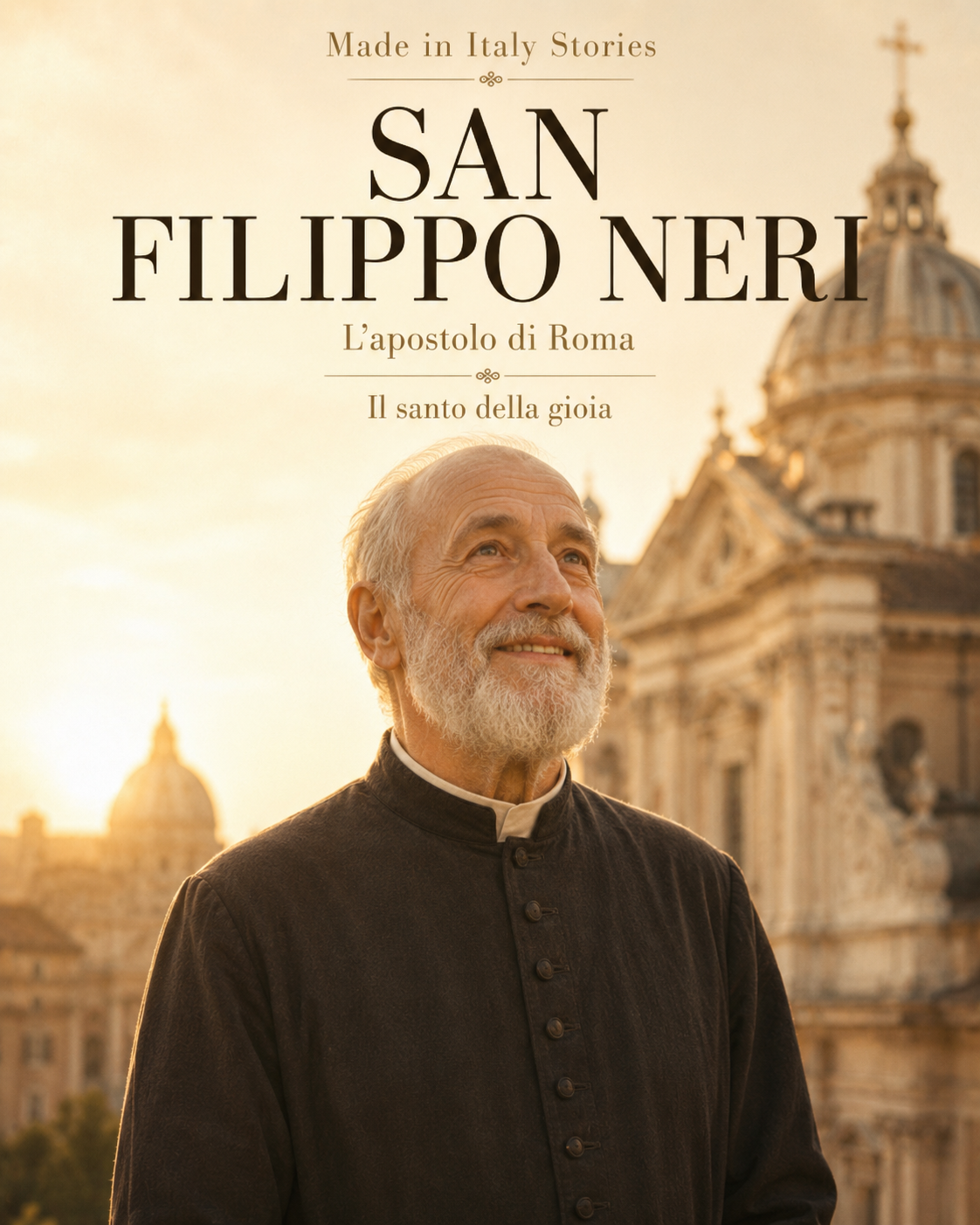
The Apostle of Rome and the Saint Who Refused to Be Gloomy
Saint Philip Neri is proof that holiness and humor are not natural enemies. In the Rome of the sixteenth century, a city of magnificent art, political ambition, spiritual anxiety and very human contradictions, Philip became famous not by founding a severe school of religious discipline but by speaking to people with warmth, intelligence, mischief and extraordinary spiritual depth. He could pray for hours in silence and then puncture someone’s vanity with a joke. He could advise cardinals and spend time with street boys. He became known as the Apostle of Rome, and perhaps no title fits him better: he adopted the city so completely that Rome eventually seemed to adopt him in return.
Filippo Neri was born in Florence on 21 July 1515. His father, Francesco, was a notary of modest means; his mother, Lucrezia da Mosciano, died when Philip was still young. He grew up in a Florence still resonant with the religious and political tensions of the Savonarolan period. The Dominican convent of San Marco played a role in his religious formation, and Philip retained a respect for Savonarola even though his own temperament would be very different from the apocalyptic severity often associated with the fiery preacher.
Around the age of eighteen Philip left Florence for San Germano, today’s Cassino, where a relative involved in commerce could have offered him a prosperous future. The commercial life did not hold him. Within a short time he abandoned the opportunity and moved to Rome, arriving there around 1534 as a young man without wealth or position. It is one of the great turning points of his life: he gave up the possibility of material security and entered a city that was still recovering from the trauma of the Sack of Rome in 1527.
For years Philip lived as a layman. He supported himself modestly, studied philosophy and theology for a time, and devoted increasing energy to prayer and charitable work. Rome was full of pilgrims, poor people, sick people, ambitious clerics, artists and young men searching for direction. Philip moved among them without a formal institution behind him. He visited hospitals, spoke with people in the streets and gradually became known for an unusual ability to reach individuals personally rather than through grand preaching.
One of his most characteristic practices was prayer in the ancient Christian sites of Rome, especially the catacombs of San Sebastiano. There, according to the spiritual tradition surrounding him, Philip underwent an intense mystical experience on the eve of Pentecost in 1544. He described an overwhelming sense of the Holy Spirit entering his heart, and later witnesses reported unusual physical changes around his chest. These accounts belong to the mystical testimony of his followers rather than to something modern medicine can reconstruct. What is historically clear is that from this period onward Philip’s life displayed extraordinary spiritual intensity.
He also helped organize the Confraternity of the Most Holy Trinity for pilgrims and the sick, which played an important role in welcoming the enormous numbers arriving in Rome for the Jubilee of 1550. This work shows an important side of Philip that can be missed when people remember only his jokes. His joy was practical. He fed people, found lodging, visited the ill and organized others to do the same. For him, religious enthusiasm without charity was not enough.
At the urging of his spiritual director, Philip was ordained a priest on 23 May 1551. He was thirty-five, almost thirty-six, and had already spent many years as a lay apostle. He took up residence among priests connected with San Girolamo della Carità, where his work as a confessor became central. People came to him because he listened, understood character and rarely treated spiritual direction as a performance. He possessed the gift, according to contemporaries, of making a person feel seen without making that person feel crushed.
From informal conversations after confession grew the Oratory. Groups gathered for prayer, discussion, readings from Scripture and the lives of saints, music and visits to churches. The meetings were intellectually alive but deliberately familiar. Philip did not want a cold academy. He wanted a school of the heart. The participants included young people, laymen, priests, nobles, artists and scholars. Cesare Baronio, the future cardinal and church historian, became one of his closest disciples. The composer Giovanni Pierluigi da Palestrina moved within the broader cultural world touched by the Oratory.
Music became particularly important. The gatherings helped encourage a form of spiritual musical drama that contributed to the development of what would later be known as the oratorio. Philip understood that beauty could educate where argument alone might fail. This was deeply Renaissance and deeply Christian at once. He did not reject art; he wanted to redirect its power toward joy, reflection and goodness.
His humor became legendary because it was often used against pride. Philip was suspicious of people who seemed too impressed with their own holiness. He could prescribe ridiculous acts of humility to deflate vanity. Stories tell of him appearing in odd clothing, shaving half his beard or making distinguished followers do embarrassing but harmless tasks. Not every anecdote can be documented with the same confidence, and generations of admirers certainly polished some stories. Yet the consistent testimony is unmistakable: Philip used laughter as a spiritual instrument.
This quality made him particularly effective with the young. He understood that moral seriousness did not require a gloomy face. He famously encouraged people to be cheerful while avoiding sin. Joy, for Philip, was not superficial entertainment but evidence that the Christian life should enlarge rather than suffocate the human heart. This helps explain why later popes called him a prophet of Christian joy.
In 1575 Pope Gregory XIII formally established the Congregation of the Oratory with the bull Copiosus in misericordia Deus. The community eventually centered at Santa Maria in Vallicella, rebuilt and known as the Chiesa Nuova. Unlike many religious orders, the Oratory did not bind its priests through the same structure of religious vows. Communities were relatively autonomous, united by the spirit inherited from Philip. The institutional form reflected his personality: fraternity without excessive machinery, discipline without theatrical severity.
Philip’s influence extended high into Roman society. Popes, cardinals, diplomats and aristocrats sought his advice. Yet he repeatedly resisted honors and ambitions that might have transformed him into a conventional church prince. He had a remarkable instinct for escaping prestige. When others wanted to elevate him, he often responded with humor. The ability to remain inwardly free while powerful people sought his company may have been one of his greatest achievements.
He also loved the practice of visiting the Seven Churches of Rome, turning pilgrimage through the city into prayer, companionship and movement. The route connected ancient basilicas and Christian memory with the life of contemporary Rome. In a sense, Philip’s spirituality was urban. He did not flee the city to become holy. He made the city itself the landscape of his mission.
By the end of his life Philip was one of the best-known spiritual figures in Rome. His health declined, but his humor and affection remained. He died in the early hours of 26 May 1595 at the age of seventy-nine. Rome mourned him intensely. His body rests in the Chiesa Nuova, still one of the principal places connected with his memory.
He was canonized in 1622 by Pope Gregory XV, in the famous ceremony that also canonized Ignatius of Loyola, Francis Xavier, Teresa of Ávila and Isidore the Farmer. The group was so distinguished that Roman humor reportedly joked that the pope had canonized four Spaniards and one saint. Philip would probably have enjoyed the joke.
Today his legacy survives in Oratorian communities around the world, in the musical tradition associated with the Oratory, in Roman devotional life and in a spiritual style that remains surprisingly fresh. He reminds us that religion can be demanding without becoming joyless, disciplined without becoming rigid, and intellectually serious without losing humanity.
If you have visited the Chiesa Nuova in Rome, walked the Seven Churches route, or simply love the idea of a saint who fought pride with laughter, tell us what you find most compelling about Philip Neri. Follow Made in Italy Stories for more biographies that reveal the unexpected personalities behind Italy’s history.