

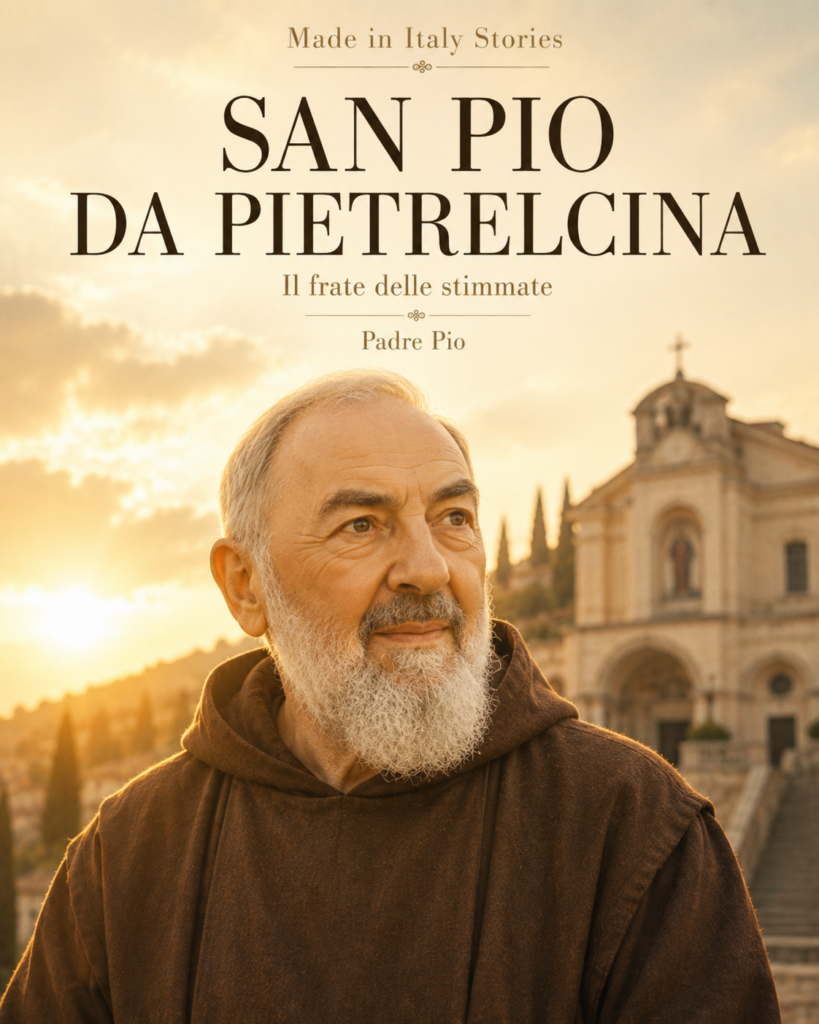
Padre Pio: faith, suffering, controversy and one of the most powerful devotions of modern Italy
There are saints whose lives seem to belong to a distant age of legends, and then there is Padre Pio, a man who died in 1968, was photographed, recorded, examined by doctors, discussed by journalists, scrutinized by Church authorities and remembered by millions of people who had actually seen him. That closeness to our own time is part of what makes his story so compelling. He lived in an Italy of trains, telephones, two world wars, newspapers and modern hospitals, yet his name became inseparable from ancient Christian themes: prayer, sacrifice, mystical experience, confession, suffering and the mysterious marks known as the stigmata. To believers he became one of the most extraordinary religious figures of the twentieth century. To skeptics he was a controversial friar surrounded by claims that demanded investigation. To the Church he was, eventually, Saint Pio of Pietrelcina. To countless Italians he was simply Padre Pio, a name spoken with the familiarity normally reserved for a member of the family.
He was born Francesco Forgione on 25 May 1887 in Pietrelcina, a small town in the province of Benevento, in southern Italy. His parents, Grazio Mario Forgione and Maria Giuseppa De Nunzio, were farmers. The household was poor but deeply religious, and the world into which Francesco was born was still one in which village life, agriculture, Catholic devotion and family identity were tightly woven together. He was baptized the following day and named Francesco. Later accounts from relatives and early biographers describe him as a serious, prayerful child who was drawn to churches and religious practices from an unusually young age. Some devotional biographies also attribute visions and spiritual experiences to his childhood. These belong mainly to the hagiographic tradition surrounding him and cannot all be verified independently, but they became important in the way his later life was understood by those closest to him.
Francesco’s health was fragile from youth, a fact that would repeatedly shape his path. He suffered from illnesses that made regular schooling difficult, and his education had to be strengthened privately when he began considering religious life. The young man was particularly impressed by the Capuchin friars, whose brown habit, beards, poverty and direct style of preaching made them recognizable throughout Catholic Italy. His family supported the vocation at considerable sacrifice. His father spent periods working abroad, including in the United States, in order to help finance his son’s studies. Behind the future saint, in other words, stood a very ordinary Italian story of family sacrifice and migration, one that was familiar to millions of southern Italians at the time.
On 6 January 1903, at the age of fifteen turning sixteen, Francesco entered the Capuchin novitiate at Morcone. Later that month he received the Franciscan habit and the religious name Fra Pio, Brother Pio. He made simple vows after the novitiate and solemn profession in 1907. The training was demanding and his poor health continued to interfere with it, yet he persevered through philosophy and theology. On 10 August 1910 he was ordained a priest in Benevento. Because of illness he spent long periods back in Pietrelcina after ordination, an unusual arrangement for a Capuchin, and for several years his superiors and doctors were uncertain whether he would ever be able to live permanently in a friary. He celebrated Mass, prayed, assisted local people and continued a spiritual life that those around him increasingly regarded as exceptional.
During these years, Pio began describing strange bodily wounds and mystical experiences in letters to his spiritual directors. In 1911 he referred to red marks and pain in his hands and feet. He asked that the matter remain secret. The phenomenon reached its most famous form on 20 September 1918 at San Giovanni Rotondo, where he had been living since 1916. After prayer before a crucifix, he was found with bleeding wounds on his hands, feet and side that resembled the wounds traditionally associated with the crucifixion of Christ. These marks remained linked with him for roughly fifty years. For devotees, the stigmata were a sign of profound mystical union with Christ’s suffering. For doctors and investigators, they became an extraordinary medical and psychological question. Different physicians examined them over the years and reached different conclusions. The Catholic Church itself did not simply accept every claim surrounding Padre Pio without examination. His life was marked as much by scrutiny as by devotion.
The years after the appearance of the stigmata transformed an obscure Capuchin friar in a remote part of Puglia into a national and eventually international figure. People began arriving at San Giovanni Rotondo in growing numbers. Many wanted to attend his Mass, speak with him, ask for prayer, or make confession. Stories spread that he could know hidden sins, appear at a distance, emit a mysterious fragrance or intercede in miraculous healings. Such claims became central to popular devotion but they must be described carefully: many come from witness testimony and devotional tradition rather than evidence that can be evaluated in the same way as ordinary historical events. The Church investigated particular claims during the processes that eventually led to beatification and canonization, but popular tradition always extended far beyond the limited number of events formally examined.
Padre Pio’s reputation as a confessor may be the most historically secure explanation for his enormous influence. He spent astonishing amounts of time hearing confessions, often for many hours a day. People waited long periods for the opportunity. His manner could be gentle, severe, humorous or startlingly blunt. Numerous witnesses remembered leaving the confessional with the feeling that he had seen through excuses they had carefully prepared. Whether one interprets this as spiritual insight, psychological perception or something more mysterious, it was clearly one of the reasons people returned. For Padre Pio, confession was not an accessory to religion but a place of conversion, where a person had to stop performing and tell the truth.
His celebration of Mass was equally famous. Witnesses described it as slow, intense and emotionally charged. Padre Pio appeared absorbed, sometimes visibly suffering, and people traveled great distances simply to be present. In an era when Catholic liturgy was usually conducted with formal regularity and little personalization, his Mass seemed to many observers almost dramatic in its concentration. This intensity made him beloved, but it also contributed to concerns among Church authorities about the cult surrounding him. Rome feared exaggeration, commercial exploitation and the possibility that unverifiable supernatural claims were spreading faster than careful judgment.
The relationship between Padre Pio and Church authorities was therefore complicated. Investigations began while he was still relatively young. At different times restrictions were imposed on his public ministry, correspondence and contact with the faithful. In the early 1930s he was temporarily prevented from publicly celebrating Mass and hearing confessions except under limited circumstances. These measures caused enormous distress among his supporters, who often assumed persecution. The historical reality is more nuanced. The Holy Office was responsible for investigating claims of supernatural phenomena and protecting the Church from fraud, fanaticism and scandal. Officials received conflicting reports about Padre Pio, the people around him and the handling of donations. The friar, for his part, generally submitted to restrictions even when they were painful. This obedience would later become an important part of the Church’s assessment of his character.
Another major chapter of his life was not mystical at all but astonishingly practical. Padre Pio wanted to build a hospital in one of the poorest areas of southern Italy. The project became Casa Sollievo della Sofferenza, the Home for the Relief of Suffering, inaugurated in 1956 at San Giovanni Rotondo. It was conceived not as a small charitable clinic but as a modern hospital combining excellent medical care with attention to human dignity. Funds came from donations, including substantial support from abroad. The hospital became one of the most concrete legacies of his life. It also tells us something essential about him: his spirituality was not only about visions, wounds and prayer. It was also about beds, doctors, laboratories, nurses and the conviction that compassion should be organized efficiently.
The Second World War and its aftermath expanded his circle of spiritual influence. Soldiers wrote to him. Families asked for news and prayers. Groups devoted to prayer formed around his spiritual direction and later became the Padre Pio Prayer Groups. His cell, the friary, the church and eventually the hospital turned San Giovanni Rotondo into a place of constant pilgrimage. This created new tensions, because whenever devotion attracts crowds, money and organization follow. Padre Pio himself lived with Franciscan simplicity, but the world gathering around him became increasingly complex.
In the final years of his life, his health deteriorated. He suffered respiratory problems, weakness and the accumulated physical burden of age and illness. Yet he continued celebrating Mass and hearing confessions as much as he could. On 22 September 1968 he celebrated a solemn Mass marking the fiftieth anniversary of the stigmata. He died in the early hours of 23 September. According to those who prepared his body, the wounds that had marked him for decades were no longer visible in the same form at death, a detail that became another element of devotional fascination. His funeral drew immense crowds. The friar who had entered a Capuchin novitiate almost unnoticed had become one of the most recognizable religious figures in the world.
The formal path to sainthood came later. Pope John Paul II, who as a young Polish priest had visited Padre Pio and corresponded with him, beatified him on 2 May 1999. He canonized him on 16 June 2002 before an enormous crowd in Rome. The canonization did not require Catholics to accept every popular story ever told about Padre Pio. It represented the Church’s judgment about the holiness of his life and the miracles examined in the canonical process. His feast is celebrated on 23 September.
Today the pilgrimage center at San Giovanni Rotondo is one of the largest in the Catholic world. The modern church designed by Renzo Piano stands near the older friary, and the hospital continues its work. Padre Pio’s remains are venerated by pilgrims, and his image appears in homes, cars, shops and hospitals across Italy and far beyond. There is something distinctly Italian in the intensity of this devotion: personal, familial, emotional and direct. People do not always speak about Padre Pio as an abstract historical saint. They speak about him as someone who listens.
His legacy remains fascinating because it refuses to fit into one category. He was a mystic and a practical organizer, a controversial figure and an obedient friar, a man surrounded by extraordinary claims and a priest whose daily work consisted largely of very ordinary acts repeated relentlessly: Mass, confession, prayer, letters, guidance and care for the sick. For historians, his life offers a window into twentieth-century Catholicism, popular devotion, institutional caution and the cultural world of southern Italy. For believers, it tells a story of suffering transformed into service. For everyone else, it remains the remarkable story of how Francesco Forgione, a poor farmer’s son from Pietrelcina, became Padre Pio.
If you have ever visited San Giovanni Rotondo, grown up with a picture of Padre Pio in your family home, or heard a story about him from someone you trust, tell us in the comments. Follow Made in Italy Stories as we continue to tell the lives, traditions and people that shaped Italy. We tell you about Italy, as Italians.