

The Woman Who Made Forgiveness Stronger Than Revenge
Saint Rita of Cascia is often called the saint of impossible causes, but that familiar title can obscure the extraordinary reality of her life. Before becoming the figure to whom millions turn when every ordinary solution seems exhausted, Rita was a daughter, a wife, a mother, a widow, a peacemaker and finally an Augustinian nun. Her story is not remarkable because it escaped suffering. It is remarkable because suffering entered almost every stage of it and she repeatedly chose not to let suffering dictate the final meaning of her life.
Even the dates of Rita’s life require some historical care. The official tradition of the sanctuary presents two main chronologies: one placing her birth in 1371 and death in 1447, another placing her birth in 1381 and death in 1457. The latter chronology is widely used today and is supported by the epitaph on her early sarcophagus and by the Codex of Miracles beginning in 1457. She was born as Margherita Lotti in Roccaporena, a small village near Cascia in Umbria, into a family remembered for a role as local peacemakers. Her parents, Antonio Lotti and Amata Ferri, lived in a society where family disputes could easily become violent and where reconciliation was not sentimental language but practical survival.
Rita’s childhood unfolded in this harshly beautiful landscape of mountains, stone houses, strong kinship ties and intense religious culture. Later devotional biographies filled her early years with prodigious signs, including the famous story of bees entering and leaving her mouth without harming her. Such episodes belong to the language of hagiographic tradition rather than to securely documented history. What is more historically plausible is that she received religious formation from the Augustinian environment around Cascia and grew up with a strong desire for a life dedicated to God.
According to the traditional account, Rita wished to enter religious life when she was young, but her family arranged a marriage. Here again later biographies sometimes dramatized her husband as exceptionally violent, while modern historians and the official sanctuary present the marriage more carefully. His name is generally given as Paolo Mancini. Rita became wife and mother and had two sons. Whatever the precise temperament of her husband, she lived in a culture marked by family rivalries, and the decisive tragedy of her married life came when Paolo was murdered.
The murder could easily have pulled the family into the cycle of vengeance that shaped so many medieval communities. Rita’s sons, according to long-standing tradition, were tempted toward revenge. She, however, forgave the killers and tried to prevent retaliation. This choice has become one of the central reasons she is remembered. Forgiveness in her world was not a soft emotion. It was a refusal to continue a system in which one death demanded another. The story says that Rita prayed that her sons would not become murderers, even if that meant losing them. Both boys died within a relatively short period, probably during an epidemic. Devotional tradition interpreted their deaths through the mother’s desperate prayer for their souls; history can establish only that she was left widowed and childless.
The woman who remained had now lost the central earthly relationships of her adult life. Rita again sought entry into the Augustinian monastery of Santa Maria Maddalena in Cascia. Tradition says she was initially refused, perhaps because of the unresolved blood feud associated with her husband’s death, and that she worked to reconcile the opposing families before being accepted. This detail, whether preserved with complete documentary precision or not, fits the spiritual logic of her life: Rita could not ask for a life of prayer while leaving hatred burning behind her.
Her entrance into the monastery marked the beginning of a long religious life, traditionally lasting about forty years. There were no famous preaching tours, no political offices, no scholarly treatises and no institutional empire. Rita left no writings. Her holiness, therefore, must be reconstructed from memory, devotional documents and the testimony of the community that preserved her name. This is one reason she became so accessible to ordinary believers. She was not a saint of public power. She was a saint of endurance in the private places where life often hurts most.
Within the monastery Rita embraced the Augustinian rhythm of prayer, community, obedience and penance. Later accounts describe her intense meditation on the Passion of Christ. The most famous mystical tradition associated with her tells that while praying before an image of the crucified Christ, she received a wound on her forehead resembling the mark of a thorn from the Crown of Thorns. The wound is not something historical science can verify; within the devotional tradition it became a sign of her desire to participate spiritually in Christ’s suffering. Accounts also describe the wound as painful and difficult, separating her physically from the other sisters at times because of its condition.
Another beloved story concerns a pilgrimage to Rome during the Jubilee of 1450. According to the sanctuary tradition, the wound on her forehead temporarily healed so that she could travel with the other sisters and take part in the pilgrimage. Whether every detail can be documented or not, the journey is consistent with the intense religious culture of the period and with the importance of jubilees in Rita’s life. She would have walked through a Rome very different from the city we know today, but already filled with the tombs of apostles and martyrs that drew pilgrims from across Europe.
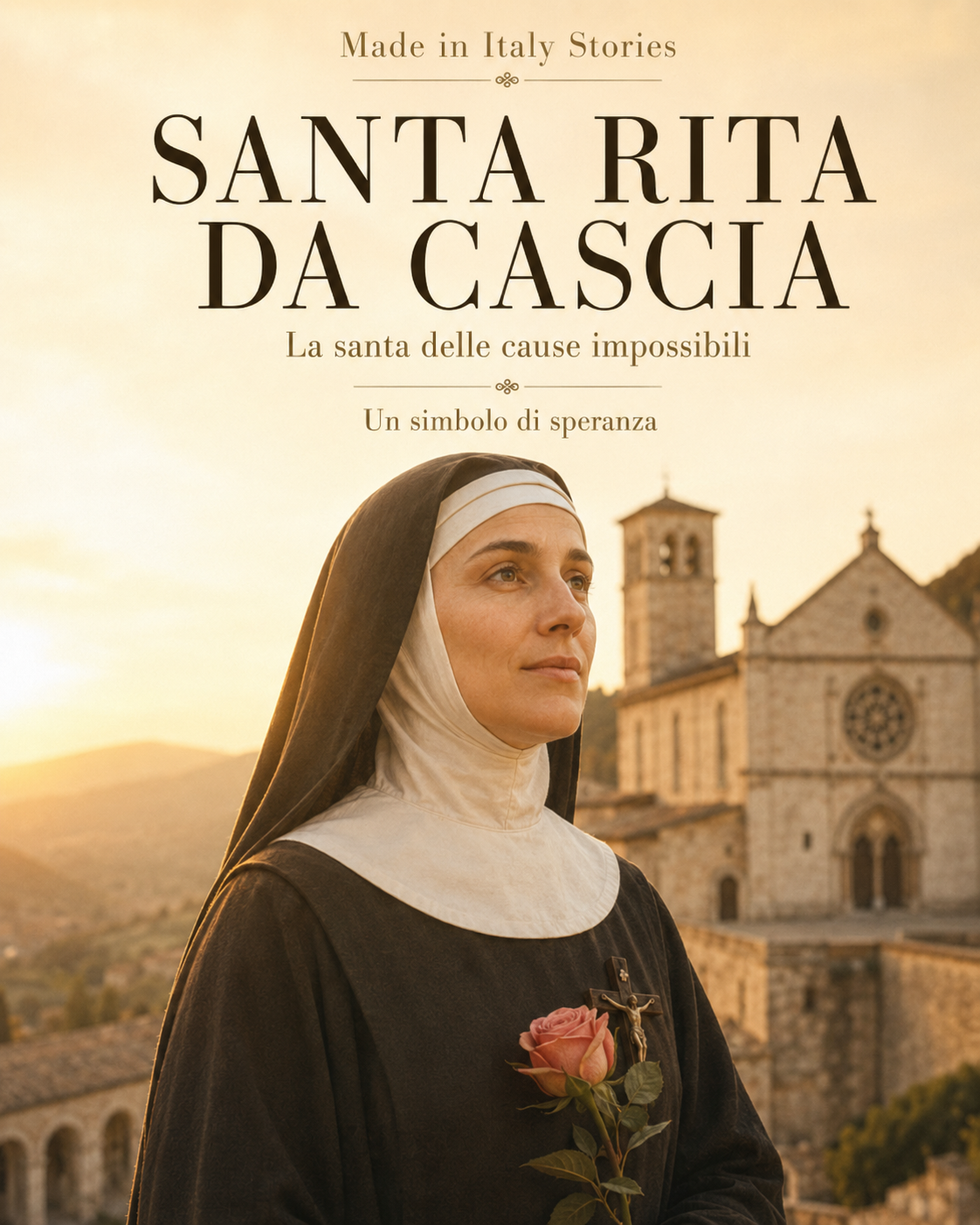
Toward the end of her life, Rita became seriously ill. The story of the rose belongs to the most tender layer of her tradition. In winter, she is said to have asked a relative returning to Roccaporena to bring her a rose from the family garden, along with figs. The request seemed impossible in the cold. Yet the relative reportedly found the flower and fruit. The rose became Rita’s symbol: life appearing where nature itself seems to say no. It is easy to understand why this image helped shape her later title as the saint of impossible causes.
Rita died in Cascia in the night between 21 and 22 May, traditionally in 1457. Devotion arose quickly. The Codex of Miracles records reports of favors and healings associated with her intercession soon after her death. Her body was not buried in the ordinary way but preserved and venerated, becoming the focus of an increasingly strong local cult. This early popular devotion is important because it shows that Rita’s reputation did not begin centuries later as a manufactured campaign. People around Cascia already regarded her life as exceptional.
Her formal recognition by the Church took a long time. A process was opened in the seventeenth century. In 1627 Pope Urban VIII authorized liturgical honors connected with her cult, effectively establishing her beatified status according to the procedures of that time. The cause then moved slowly across generations. In 1900, on 24 May, Pope Leo XIII formally canonized Rita. By then devotion to her had spread far beyond Umbria. In the twentieth century it became international, and the Basilica of Santa Rita in Cascia grew into a major pilgrimage destination.
Why did this woman become so beloved? Part of the answer lies in the variety of roles she lived. Married women see a wife. Parents see a mother. Those who have lost spouses or children see someone who knew bereavement intimately. People trapped in family conflict see a peacemaker. Religious women see a nun. Those carrying physical pain see the tradition of the thorn. Those who feel a situation has become impossible see the winter rose. Rita’s life touches ordinary suffering at multiple points, and that makes her feel near.
It is essential, however, not to turn her story into sugary legend. Rita’s world was violent. Widowhood could be economically and socially dangerous. Religious life was demanding. The idea of forgiveness after murder was radical. Her greatness lies precisely in this difficulty. She did not become a symbol of hope because life was easy for her. She became one because she kept making choices that refused to let bitterness become destiny.
Today Cascia and Roccaporena still preserve her memory in landscape and ritual. Pilgrims visit the monastery, the basilica, the places associated with her birth and family, and the famous rock of Roccaporena where tradition says she prayed. Roses remain central to her feast on 22 May, often blessed and carried home by devotees. The flower is beautiful, but the message behind it is more severe and more useful: reconciliation can bloom even from a life scarred by loss.
If you have ever prayed to Saint Rita, visited Cascia, or simply found strength in her story, tell us what part of her life speaks most powerfully to you. Follow Made in Italy Stories for more long-form stories about the people, places and traditions that shaped Italy, told with respect for both history and faith.