

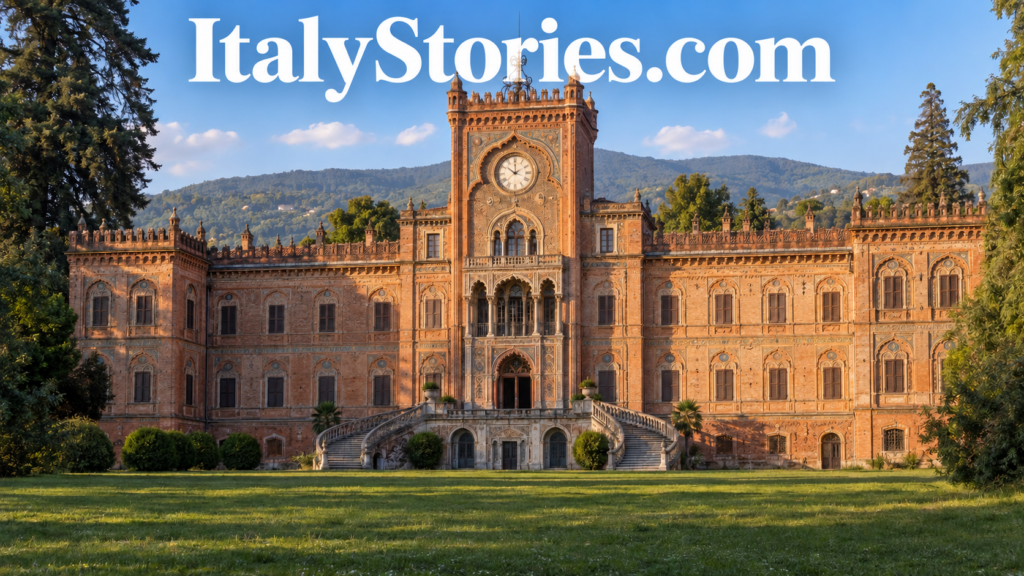
Imagine driving through the familiar Tuscan countryside, surrounded by vineyards, olive groves, cypress trees and Renaissance villas. Everything looks exactly as expected until, behind a thick curtain of trees, something completely improbable appears. Onion-shaped domes rise above the forest, red bricks form elaborate geometric patterns and towers that seem to belong in Seville, Marrakech or Rajasthan emerge from the hills. This is not Spain, Morocco or India. It is Sammezzano Castle, one of the most extraordinary and unexpected buildings in Italy.
The castle stands near Leccio, in the municipality of Reggello, approximately thirty kilometres southeast of Florence. Its secluded position inside an extensive historic park has helped to create the impression of a secret palace, concealed from the world and known only through a collection of astonishing photographs. It is often described as “the Italian Alhambra,” although that nickname tells only part of the story. Sammezzano is not a medieval Moorish palace, nor is it a direct copy of the Alhambra in Granada. It is an ambitious nineteenth-century interpretation of Eastern and Islamic architecture, created by a remarkable Tuscan aristocrat with an imagination large enough to transform an entire estate.
The history of the site stretches much further back than its exotic appearance suggests. A residence existed at Sammezzano long before the present palace was created, and the estate passed through the hands of several important Florentine families. A large country house was built there during the early seventeenth century for the Ximenes d’Aragona family. Its transformation into the building we know today, however, began in the nineteenth century under Ferdinando Panciatichi Ximenes d’Aragona.
Ferdinando was not simply a wealthy nobleman looking for an unusual home. He was a politician, intellectual, collector, botanist and passionate student of architecture. Between 1853 and 1889, he redesigned Sammezzano almost completely, financing the work and personally supervising its development. He did not merely commission a fashionable architect and wait for the result. The palace became his life’s project, an architectural manifesto created over several decades.
The result was unlike anything else in Tuscany. Sammezzano combines elements inspired by Moorish Spain, North Africa, the Middle East and India, all filtered through the eclectic imagination of nineteenth-century Europe. Horseshoe arches, polychrome tiles, carved plaster, Arabic-inspired inscriptions, geometric patterns, columns and honeycomb-like ceilings fill its monumental rooms. The exterior, with its towers, domes and patterned brickwork, offers only the first indication of what lies inside.
The palace’s interiors are its greatest wonder. Each room was designed with a separate identity, colour scheme and decorative language. The Hall of the Peacocks is perhaps the most famous, with an explosion of colours spreading across the ceiling like the open tail of an enormous bird. The Hall of the Lovers is softer and more romantic, while other rooms are filled with intricate muqarnas, interlocking patterns and surfaces that appear to dissolve into ornament. Every arch reveals another arch, every ceiling seems to hide a second structure within it, and almost no surface was left undecorated.
Sammezzano was not assembled from treasures imported from distant countries. Many of its bricks, tiles, stucco decorations and architectural elements were produced locally by craftsmen trained specifically for the project. This makes the castle even more fascinating: its appearance evokes distant civilisations, but its physical substance remains deeply Tuscan. It is a dream of the East constructed with local materials, local labour and the obsessive vision of one man.
Colour plays a fundamental role throughout the building. Red, blue, gold, white and turquoise are arranged in elaborate combinations, changing from one room to another. Light enters through narrow windows and passes across carved surfaces, causing the patterns to shift during the day. In some rooms the effect is joyful and theatrical; in others it becomes almost hypnotic. The decoration is so dense that the eye struggles to decide where to look first.
The castle is surrounded by a vast park that Ferdinando transformed with the same energy he devoted to the palace. He introduced many exotic species, including giant sequoias that still rise dramatically above the surrounding woodland. The path through the park was intended to prepare visitors for the vision of Sammezzano. After walking among unusual trees and monumental vegetation, the appearance of the Orientalist palace would have felt like the final scene of a carefully planned journey.
Following Ferdinando’s death in 1897, Sammezzano entered a long and complicated period. During the twentieth century it was used for different purposes and eventually became a luxury hotel. Its theatrical architecture also made it an attractive setting for films and television productions. The hotel later closed, and decades of uncertainty, legal disputes and changes of ownership left the building inaccessible and increasingly vulnerable.
For many years, Sammezzano became one of Italy’s most beautiful endangered monuments. Photographs of its abandoned rooms travelled around the world, generating amazement and anger. Thousands of people supported campaigns demanding its protection, and in 2016 the castle won the national “Places of the Heart” census organised by the Italian Environmental Fund. Its neglected condition turned Sammezzano into a symbol of the difficulties involved in preserving Italy’s enormous architectural heritage, particularly when historically important buildings remain privately owned.
A major change finally arrived in 2025, when the property was acquired by the Florentine Moretti family. A programme of safety work and restoration was announced, with plans to preserve the monumental rooms, recover the historic park and eventually allow public access. The project also includes museum and hospitality activities intended to make the enormous complex economically sustainable. After decades of failed auctions and uncertainty, the castle appears to have been given a genuine opportunity for survival.
For the moment, however, Sammezzano is not a conventional tourist attraction. Both the palace and its park are closed while restoration and safety work continues. It should never be approached through unofficial entrances or by crossing the private estate. The fragile interiors, abandoned for many years, require careful conservation, and unauthorized access would be dangerous as well as damaging.
The comparison with the Alhambra remains irresistible, but Sammezzano deserves to be understood on its own terms. The Alhambra is an authentic masterpiece of Islamic architecture created by the Nasrid dynasty in medieval Granada. Sammezzano is something entirely different: a nineteenth-century European vision of distant cultures, designed by an Italian aristocrat who used architecture to construct a personal universe.
That distinction does not make the Tuscan castle less extraordinary. In some ways, it makes it even more fascinating. Sammezzano represents the moment when scholarship, fantasy, craftsmanship and obsession came together in the mind of one man. Ferdinando Panciatichi Ximenes d’Aragona did not travel to another world to find his palace. He brought his imagined world to Tuscany and built it among the olive groves and forests near Florence.
From the outside, the domes and towers still appear almost impossible against the Tuscan landscape. Inside, hidden rooms wait behind closed doors, filled with colours and patterns that have survived abandonment, vandalism and time. Sammezzano may not be Italy’s Alhambra, but it does not need to be. It is something rarer: a place that belongs completely to Italy while looking like nowhere else in the country.