

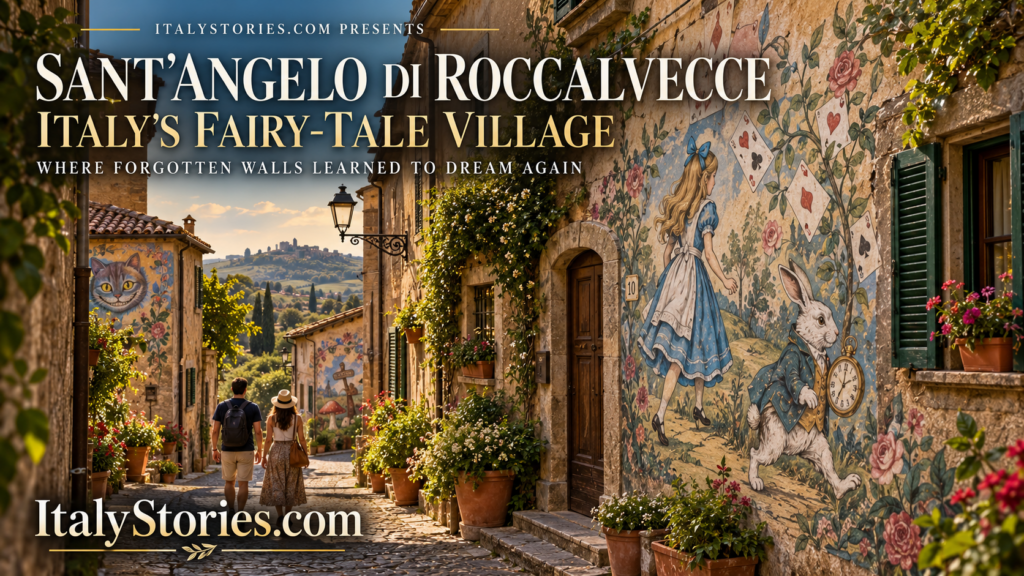
There are villages in Italy that survive because they stand beside a famous monument, others because they are surrounded by vineyards, beaches or mountains, and a few because someone decided that surrendering to abandonment was not the only possible ending. Sant’Angelo di Roccalvecce belongs to this last and most surprising group. Hidden in the countryside of Tuscia, in northern Lazio, this tiny hamlet within the municipality of Viterbo has transformed its ageing walls into the pages of an enormous storybook. Alice follows the White Rabbit across a house façade, Pinocchio appears around a corner, the Little Prince watches from another wall, and characters from stories once whispered beside children’s beds now inhabit doors, staircases and quiet village lanes.
Today Sant’Angelo di Roccalvecce is widely known as Italy’s Fairy-Tale Village, but its transformation did not begin as a decorative exercise or a plan to build a picturesque tourist attraction. It began as an attempt to save a community that feared it was slowly disappearing. Like many small Italian settlements far from major economic centres, Sant’Angelo had watched its population decline as younger residents left in search of work, education and a more convenient life. Houses closed, local activities disappeared and the silence that visitors now find charming risked becoming the silence of abandonment.
The fairy tales did not arrive because the village had forgotten reality. They arrived because its residents understood reality very well.
A Small Village in the Heart of Tuscia
Sant’Angelo di Roccalvecce lies in the rural landscape north of Viterbo, an area traditionally known as Tuscia. It is a territory of volcanic hills, olive groves, woods, vineyards and deep valleys carved into tuff. Medieval towns rise from rocky plateaus, Etruscan remains appear beside country roads, and abandoned farmhouses stand among fields that seem to change colour with every hour of the day.
The hamlet is small enough to explore without a map. Its stone houses, narrow lanes, steps and modest squares were never designed to impress crowds. They belonged to an agricultural community in which people recognised one another’s footsteps and daily life followed the rhythm of the countryside.
There was no single spectacular monument capable of attracting large numbers of visitors. Sant’Angelo possessed the quiet beauty shared by many Italian villages, but quiet beauty alone does not always prevent decline. Thousands of small communities compete for attention, often against famous destinations with cathedrals, castles and international reputations.
The greatest strength of Sant’Angelo was not a grand palace or archaeological treasure. It was the empty surface of its walls and the determination of people who still believed those walls had something to say.
The Threat of Becoming a Ghost Village
Depopulation is one of the most serious challenges facing rural Italy. The process usually happens gradually. A shop closes because there are too few customers. A school loses pupils. Public transport becomes less frequent. Young families move away, and houses that once contained several generations are opened only for summer holidays or left empty.
Nothing dramatic appears to happen on a single day. There is no final announcement that a village has begun to die. The decline can be seen instead in locked shutters, uncultivated gardens and the disappearance of familiar voices from the square.
Sant’Angelo di Roccalvecce faced this danger. Its inhabitants understood that preserving old stones would not be sufficient if the village lost its people, identity and reason to be visited. Restoration was necessary, but the community needed something more than repaired walls. It needed a new story.
In December 2016, Gianluca Chiovelli established the cultural association ACAS, bringing together energy, local commitment and the ambition to give Sant’Angelo a different future. The association’s project was daring precisely because it appeared so simple: invite artists to paint fairy tales on the houses and transform the entire village into an open-air gallery.
The idea did not require Sant’Angelo to pretend to be something else. The murals would not hide its age or replace its rural character. They would use the cracks, doors, windows and irregular surfaces of the existing buildings as part of the artwork. The village itself would become the frame.
Alice Arrives in Sant’Angelo
The decisive moment came on 27 November 2017, when the first major mural was inaugurated. Created by Roman street artist Tina Loiodice, it was inspired by Lewis Carroll’s Alice’s Adventures in Wonderland and presented Alice together with the White Rabbit and his famous watch.
The choice was perfect for a village preparing to enter another reality. Alice follows a white rabbit and falls into a world where ordinary rules no longer apply. Sant’Angelo was also passing through an unexpected doorway, leaving behind the possibility of becoming anonymous and discovering a new identity through imagination.
The watch in the mural contains a small detail that connects fantasy to local history: its hands indicate 11:27, referring to the date of the inauguration, 27 November. It is the kind of secret that visitors may easily miss, but once discovered it changes the painting. The clock is not merely an illustration from Alice. It records the moment when the village’s transformation truly began.
The mural covered a large façade and immediately demonstrated how effectively street art could interact with the architecture. Alice and the White Rabbit did not appear to have been placed on a neutral canvas. They seemed to belong to the house, emerging from its weathered surface and inviting the viewer to follow them farther into the village.
One painting was enough to suggest what Sant’Angelo might become. It was not enough to complete the project.
When the Walls Became Storybook Pages
New murals gradually appeared along the streets. Each artist interpreted a different tale, legend or work of imaginative literature. Pinocchio, perhaps the most internationally famous character created by an Italian writer, found a natural home among the old houses. The Little Prince brought his quiet reflections on friendship and responsibility. Peter Pan carried the promise of a childhood that refuses to disappear, while Don Quixote introduced a hero whose dreams appear foolish only to those who have completely surrendered their imagination.
Visitors began to encounter scenes inspired by Snow White, Hansel and Gretel, Cinderella, The Ugly Duckling, The Jungle Book, The Sword in the Stone and Jack and the Beanstalk. Other works drew upon myths, fantastic literature and stories that adults recognise from books read many years ago.
The project was not limited to copying familiar illustrations. The artists reinterpreted the characters through their own styles. Some murals are delicate and dreamlike; others are theatrical, humorous or slightly mysterious. A figure may appear to step through a real doorway, lean toward a window or disappear around the edge of a building. Architectural irregularities become part of the narrative: a drainpipe turns into a branch, a shutter frames a character, and the curve of a wall suggests movement.
Many of the artists involved have been women, giving the project a distinctive identity within the world of Italian street art. Tina Loiodice was followed by creators including Alessandra Carloni, Daniela Lai, Lidia Scalzo, Isabella Modanese, Stefania Capati, Cecilia Tacconi, Lena Ortmann, Ginevra Giovannoni and Stefania Marchetto, known as SteReal. Each brought a personal visual language while respecting the larger idea of a village united by storytelling.
The number of works has continued to grow, making any fixed total quickly outdated. What began with one Alice mural developed into a route containing dozens of paintings and installations. Sant’Angelo is not a completed museum with a final catalogue. It is a work still being written.
Street Art Without an Urban Street
Street art is usually associated with large cities, railway underpasses, industrial buildings and neglected suburbs. In Sant’Angelo it enters a very different environment. The surfaces are those of rural houses, barns, passageways and walls that have absorbed decades of rain and sunlight.
This contrast is one of the project’s greatest strengths. Contemporary mural painting does not erase the historic village; it creates a conversation with it. The freshness of the colours stands beside old stone, worn plaster and terracotta roof tiles. The images belong to global popular culture, while the architecture remains unmistakably Italian.
Sant’Angelo also challenges the idea that heritage must always be protected by keeping it visually unchanged. Preservation is essential, especially where buildings possess historical and architectural importance, but a living village cannot become only a display case. It must be allowed to develop a present.
Here the murals are not an attempt to reconstruct a lost medieval appearance. They acknowledge that the village has entered the twenty-first century and needs contemporary reasons to remain alive. The project protects the past by making the place relevant again.
It also changes the traditional relationship between visitor and artwork. In a museum, paintings are separated from daily life by walls, guards and carefully controlled lighting. In Sant’Angelo, the artwork may stand beside a letterbox, a flowerpot or a doorway used every morning by the person who lives behind it. A cat may sleep beneath Cinderella. Laundry may move in the wind beside the Little Prince.
This ordinary life prevents the village from becoming a theatrical set. The murals may be magical, but the houses remain homes.
Fairy Tales as a Universal Language
The success of the project also comes from the choice of subject. Fairy tales cross borders and generations. A visitor from another country may not understand Italian, but Alice, Pinocchio or the White Rabbit requires no translation. Parents recognise stories from their childhood, while children experience the excitement of finding familiar characters on walls much larger than any picture book.
Fairy tales are often treated as simple entertainment for children, yet their origins are rarely simple. They contain hunger, danger, abandonment, poverty, transformation and fear. Children disappear into forests, houses conceal threats, kings lose their kingdoms and apparently weak characters survive through intelligence or courage.
These themes make the murals particularly appropriate for a village threatened by disappearance. The stories are not merely decorative. They speak about surviving difficult journeys, changing identity and discovering possibilities where none seemed to exist.
Pinocchio is especially meaningful in an Italian setting. Carlo Collodi’s wooden puppet is disobedient, naïve and constantly distracted, but he is also driven by the desire to become something more than he is. The Ugly Duckling speaks of transformation and recognition. Jack’s beanstalk begins with an apparently foolish exchange and grows into an unexpected route toward fortune. Cinderella moves from neglect to visibility.
A community does not need to believe literally in magic to understand the power of these stories. It needs only to believe that the ending has not yet been decided.
More Than a Beautiful Background for Photographs
The murals brought visitors, and visitors brought attention. People who might never have heard of Sant’Angelo began arriving to walk through its lanes, photograph the artworks and discover the surrounding Tuscia countryside.
Tourism can offer important opportunities to a small community. It supports local businesses, encourages the maintenance of public spaces and gives abandoned buildings new economic value. Above all, it makes residents feel that their village is no longer invisible.
Yet popularity creates responsibilities. Sant’Angelo is not an amusement park, and its façades are not simply backgrounds for social-media photographs. People live behind the painted walls. Visitors enter a real community with private homes, narrow roads and fragile public spaces.
The most rewarding way to experience the village is therefore slowly and respectfully. The murals are best discovered rather than rapidly collected. A small painted element may be hidden beside a doorway, while another work reveals its relationship with the landscape only when viewed from the opposite side of the street.
Children naturally search for recognisable characters. Adults often find themselves noticing the quality of the painting, the intelligence with which a window has been incorporated into a scene or the emotional connection between a story and the building that carries it.
The route encourages a kind of attention that hurried tourism often destroys. There is no single masterpiece that must be reached before leaving. The village itself is the artwork.
The Artists Behind the Magic
Calling Sant’Angelo a fairy-tale village should not obscure the skill required to create it. A mural is physically demanding. Artists work on scaffolding, adapt drawings to irregular surfaces and respond to changing weather and light. A design that looks convincing on paper must be enlarged across several floors without losing proportion or emotional clarity.
The wall has its own history. Cracks, stone frames and layers of plaster cannot always be ignored. The most successful murals use these imperfections rather than fighting them. An arch becomes an entrance into the story. A damaged area resembles an ancient page. Flowers painted around a real window blur the boundary between garden and illustration.
Every work must also coexist with the others. If all the murals followed an identical style, the village would risk becoming repetitive. If they had no relationship at all, the route would feel accidental. The shared world of tales provides unity, while the individuality of the artists provides variation.
The project has shown that street art can be a form of rural regeneration rather than only an urban statement. It does not solve every economic or demographic problem, but it changes the way a place is perceived. A wall previously seen as old and damaged becomes a cultural surface. A lane formerly associated with decline becomes something people travel to see.
Art does not create jobs, services and new residents by itself. It can, however, begin the more difficult process of restoring confidence.
A Village Within a Landscape of Stories
Sant’Angelo belongs to a part of Lazio already rich in places where reality appears close to fantasy. The surrounding province contains Viterbo’s medieval quarters, the monumental gardens of Villa Lante at Bagnaia, the strange stone creatures of Bomarzo’s Sacred Wood and the dramatic hill towns built upon volcanic rock.
Nearby villages preserve castles, churches, fountains and stories of noble families. The landscape contains Etruscan roads cut deeply into the stone and forests in which ancient tombs appear almost without warning. Even before the fairy-tale murals arrived, Tuscia was a territory where history and imagination easily met.
What makes Sant’Angelo different is that its identity is contemporary and community-created. It was not inherited fully formed from the Middle Ages or Renaissance. The residents and artists deliberately constructed it in response to a modern problem.
This distinction matters. Italy’s cultural heritage is usually discussed as something received from the past. Sant’Angelo demonstrates that heritage can also be created in the present. The mural painted today may become the story that a future generation feels responsible for protecting.
Can Art Really Save a Village?
The phrase “saved by art” is attractive, but it should be used carefully. Murals cannot reopen every closed school, guarantee public transport or persuade every young resident to remain. Depopulation has structural causes involving employment, services, housing and national economic change.
What art can do is interrupt the expectation of inevitable decline. It can bring people together around a visible project, attract outside interest and create the conditions from which other initiatives may grow. It gives a place a recognisable identity without requiring the construction of something artificial or enormous.
Sant’Angelo’s achievement lies partly in scale. The project began with a single wall and expanded gradually. Each new work confirmed that the transformation was continuing. Residents could see progress directly, while visitors had a reason to return and discover what had changed.
The fairy tales also avoided turning the village’s difficulties into its main attraction. Sant’Angelo does not ask visitors to admire abandonment. It offers colour, invention and confidence. The decline remains part of the story, but it is not allowed to write the ending.
This approach has inspired interest far beyond Tuscia because many communities recognise the same danger. Italy contains hundreds of small villages with remarkable landscapes and ageing populations. Not every one can or should become a mural village, but Sant’Angelo offers a broader lesson: renewal is strongest when it grows from local identity, community participation and an idea distinctive enough to be remembered.
Where Adults Become Children Again
Children arrive in Sant’Angelo expecting fairy tales. Adults are often the ones most surprised by what they feel.
A painted rabbit with a watch can bring back a book read by a parent at bedtime. Pinocchio may recall an illustrated edition kept in a childhood bedroom. Peter Pan can revive the distant belief that growing up was optional. These are not simply memories of stories; they are memories of the people who told them.
The murals therefore operate on two levels. For children, they make imaginary characters physically enormous and exciting. For adults, they restore something small and private that time had covered.
Walking through the village becomes an encounter with one’s own memory. The experience does not require pretending to be young again. It asks only that the visitor recognise that childhood imagination has not entirely disappeared.
This emotional connection explains why the project works better than a collection of unrelated decorative paintings might have done. Fairy tales are shared cultural memory. They belong to no single age group, social class or nationality. Their details change, but their journeys remain familiar.
The Story Continues
Sant’Angelo di Roccalvecce did not become famous because it possessed something that every other Italian village lacked. It became remarkable because its community looked at what seemed to be a weakness—empty walls, silence and distance from the main tourist routes—and saw the beginning of an idea.
The first Alice mural opened the door. Other artists and stories followed. Slowly, the village changed from a place threatened by invisibility into a destination whose identity could be understood through a single photograph.
But photographs show only the surface. The deeper story is about people refusing to accept that decline must be permanent. It is about contemporary artists placing their work in the service of a community and residents allowing the familiar appearance of their homes to be transformed.
The result is not a perfect fairy-tale kingdom. It is something more interesting: a real Italian village using fairy tales to face real problems.
At the end of many traditional stories, the characters return home changed by what they have experienced. Sant’Angelo’s journey follows a similar pattern. The village did not escape from its history or abandon its landscape. It rediscovered both through art.
Its houses are still made of stone. Its streets remain small and quiet. The Tuscia countryside still begins at the edge of the last building. Yet the walls now carry rabbits, princes, wooden puppets, enchanted forests and children who refuse to grow old.
In Sant’Angelo di Roccalvecce, the most important magic is not painted. It is the decision of a community to believe that even a forgotten wall can learn to dream again.
Follow ItalyStories.com to discover more hidden villages, artistic transformations and extraordinary stories from Italy.