

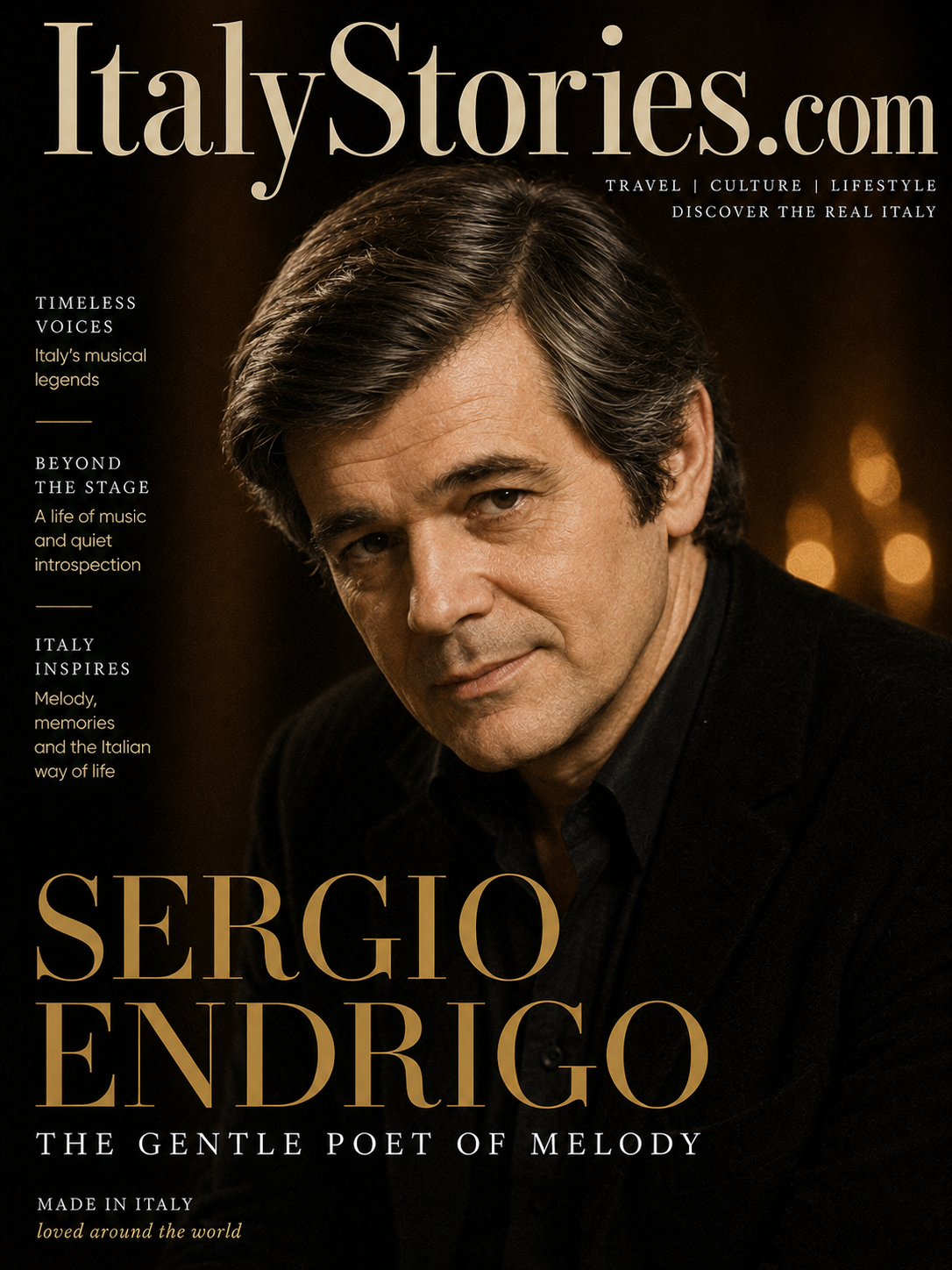
On the evening of 3 February 1968, the Casino of Sanremo belonged to a singer who seemed almost constitutionally incapable of behaving like a winner. Sergio Endrigo stood onstage with the reserved expression audiences already knew: no triumphant gesture, no theatrical conquest of the camera, none of the swagger associated with popular music’s most visible stars. Beside him was Roberto Carlos, the Brazilian singer who had performed the second version of the same entry. The song was “Canzone per te,” and it had just won the Festival di Sanremo.
The victory placed Endrigo at the center of Italian television, yet the man and the song resisted the usual logic of spectacle. “Canzone per te” was built around the aftermath of love, not its melodramatic explosion. Its strength lay in restraint: a melody that opened gradually, words that accepted loss without pretending it did not hurt, and a voice that sounded as if it were addressing one person rather than millions. That night condensed the paradox of Endrigo’s career. He became famous through the largest institutions of Italian popular entertainment while remaining one of its least showy figures.
To understand how that happened, it is necessary to travel away from Sanremo, away from television studios and record companies, and back to a childhood shaped by the Adriatic, war, bereavement and exile.
Pola, a Father’s Voice and a Country That Disappeared
Sergio Endrigo was born in Pola on 15 June 1933. At the time, the Istrian city belonged to Italy; today it is Pula, in Croatia. Geography in his biography is never a decorative detail. Borders moved around him, names changed, and a childhood landscape became politically and emotionally distant. That experience would later surface in “1947,” one of his most personal songs, where private memory and the displacement of the Istrian exodus meet without slogans.
His father, Romeo Endrigo, was a sculptor and an autodidact tenor. Sergio barely knew him. He spent part of his earliest childhood with relatives in Trieste, and Romeo died in 1939, when his son was six. Yet the absent father left an artistic trace. In his own autobiographical recollections, Endrigo remembered newspaper clippings about Romeo’s singing and an article praising a tenor who did not exaggerate his vowels or indulge in empty vocal display. The observation stayed with him. Sergio’s mature style would be founded on precisely that refusal of excess.
The Second World War transformed Istria, and its aftermath transformed Endrigo’s family. In 1947, when Pola passed to Yugoslavia, a large part of the Italian population left. Sergio, his mother Claudia and other relatives departed on the motor ship Toscana. The journey was not simply a change of address. It meant leaving a familiar city under historical pressure and entering the unsettled life of postwar refugees.
They lived first in Brindisi and later in Venice. Endrigo left school early and worked to help his family. Before the elegant suits, recording studios and international concerts, there were years in which music was not a career plan but a practical possibility slowly emerging from necessity. He learned guitar, sang in dance halls and nightclubs, and developed the ability to hold a room without overpowering it.
Those early venues mattered. A nightclub singer had to understand mood, timing and proximity. The audience might be dining, talking or dancing. Volume alone could not command attention. Endrigo learned to sing as if confidence did not require force. American standards, French chanson and the work of singers such as Gilbert Bécaud and Charles Aznavour helped broaden his vocabulary, but he never became an imitation. The melancholy was his own, rooted in displacement and a temperament suspicious of display.
Learning the Trade in Nightclubs and Dance Orchestras
During the 1950s Endrigo performed with orchestras and small groups in the clubs of northern Italy. It was a mobile, uncertain apprenticeship. He sang other people’s songs, adapted to changing audiences and discovered what his voice could do. He was not a virtuoso in the operatic sense, nor did he need to be. His gift was interpretive concentration. He could lower the emotional temperature of a room and, paradoxically, make listeners pay closer attention.
The Italian music industry was changing around him. The postwar economy was expanding; radio remained powerful, television was becoming a national ritual, jukeboxes and 45 rpm singles were reshaping listening habits, and record companies were searching for voices that could represent a modern Italy. At the same time, a new generation of singer-songwriters was challenging the separation between the person who wrote a song and the person who performed it.
In Milan, the Ricordi environment brought together figures including Gino Paoli, Luigi Tenco, Giorgio Gaber and Umberto Bindi. They were often grouped under convenient labels, but their voices and ambitions differed. What connected them was the idea that an Italian popular song could be intimate, literary and recognizably contemporary without abandoning melody.
Endrigo initially recorded under the name Notarnicola and worked as an interpreter. These early steps did not make him famous, but they taught him the machinery of the recording business: repertoire, arrangers, studio discipline, contracts and the frustrating distance between a good performance and a song that actually reaches the public.
“Io che amo solo te”: Success Without Noise
The decisive popular breakthrough arrived in 1962 with “Io che amo solo te.” Its architecture is almost severe. The song does not depend on a complicated plot. It turns devotion into a series of clear declarations, and Endrigo sings them without trying to prove their importance. The melody carries the emotional expansion; the voice remains controlled.
That balance explains the song’s endurance. It can function as a love song at a wedding, as a private dedication or as a memory of someone absent. Later generations returned to it because the recording is tied to its era without being trapped there. The arrangement belongs to early-1960s Italian popular music, but the central promise is timeless.
The success established Endrigo as an author-performer rather than simply a nightclub interpreter. It also clarified his artistic territory. He would write about love, but rarely as uncomplicated happiness. His songs often begin after something has already been lost: a person, a place, certainty, youth or the belief that history naturally improves.
“Via Broletto 34” pushed that sensibility into darker narrative territory. “Aria di neve” made emotional coldness almost physical. “Teresa,” “Adesso sì” and “Dove credi di andare” showed different versions of the same discipline: direct language, carefully controlled melodic lines and an interpreter who refused to turn suffering into vocal exhibitionism.
The Voice: Intimacy as a Form of Authority
Endrigo’s voice was warm but shaded, masculine without hardness, melancholy without fragility. He often seemed to begin from the middle of a thought. Consonants remained clear; phrases were allowed to breathe; vibrato served the sentence rather than announcing technique. The result was conversational, but never casual.
His restraint can be misunderstood as simplicity. In fact, singing quietly exposes every weakness. A performer cannot hide behind volume or ornament. Endrigo’s timing, particularly the slight delay with which he sometimes settled into a phrase, created the impression of thought occurring while the song was being sung.
This was also an ethical position. The public figure resembled the vocal style: reserved, ironic, often uncomfortable with promotional ritual. Friends and colleagues described a man capable of humor and conviviality, but the mass audience saw someone who did not court it aggressively. In an industry that increasingly rewarded visibility, his lack of self-promotion eventually carried a cost.
Sanremo Before the Victory
Endrigo first competed at Sanremo in 1966 with “Adesso sì,” finishing eighth. He returned in 1967 with “Dove credi di andare,” which placed seventh. These results mattered less than the fact that his songwriting survived the festival format. Sanremo demanded immediate impact, orchestral clarity and a melody capable of passing from one paired performer to another. Endrigo’s songs could meet those requirements without surrendering their personality.
Then came 1968. “Canzone per te,” written by Endrigo and Sergio Bardotti, with Luis Bacalov associated with its musical and orchestral realization, was performed by Endrigo and Roberto Carlos under the festival’s double-performance system. The Brazilian connection was not accidental decoration. Endrigo was developing relationships that would become central to his work, and Roberto Carlos helped carry the song into a vast Portuguese- and Spanish-speaking world.
The song won. Endrigo subsequently represented Italy at the Eurovision Song Contest in London with “Marianne,” finishing tenth. Eurovision did not reproduce the Sanremo triumph, but the year confirmed that his music could cross borders. “Canzone per te” was recorded by other interpreters and entered the repertoire of Roberto Carlos, who continued to sing it to enormous audiences in Brazil.
“Lontano dagli occhi” and the Art of Distance
In 1969 Endrigo returned to Sanremo with “Lontano dagli occhi,” paired with Mary Hopkin, and finished second. The title could almost serve as a summary of his imagination. Distance in Endrigo is never merely geographical. It is what happens when memory keeps a person present after daily life has removed them.
The song’s melody is expansive, yet the emotional point remains precise: absence alters the scale of ordinary experience. Endrigo does not need a detailed storyline. A few images and the movement of the refrain create a world.
The following year he presented “L’arca di Noè,” paired with Iva Zanicchi, again finishing near the top. The song widened his field. Rather than concentrating only on romantic intimacy, it assembled an almost biblical procession of humanity, animals, fear and environmental unease. Its theatrical quality demonstrated that the supposedly subdued singer could think on a large symbolic scale.
Sergio Bardotti, Luis Bacalov and the Work Behind the Voice
Endrigo’s career cannot be understood as the work of a solitary poet. Sergio Bardotti was one of his most important collaborators. A lyricist, translator and cultural mediator, Bardotti helped connect Italian songwriting with Brazilian music and with literary projects that exceeded the standard commercial album.
Luis Bacalov brought orchestral intelligence and an ability to support melody without suffocating it. The arrangements around Endrigo often leave room for the voice while creating harmonic colors that deepen the text. They are not neutral accompaniments; they shape the listener’s emotional route.
Other relationships were equally important. Endrigo belonged to a generation that included Luigi Tenco, Bruno Lauzi, Gino Paoli and Fabrizio De André, yet he maintained an independent path. He wrote for and supported other performers, including Marisa Sannia. He collaborated with poets and composers not to borrow prestige, but because he genuinely believed the popular song could converse with literature.
When Italian Song Met Brazil
The Brazilian chapter is among the richest parts of Endrigo’s story. His encounter with Vinicius de Moraes, Toquinho and the world of Brazilian popular music was based on affinity rather than fashion. Both traditions valued melody, poetic compression and the ability to place sophisticated harmony inside an apparently natural song.
The 1969 project “La vita, amico, è l’arte dell’incontro” brought together Endrigo, Vinicius and Giuseppe Ungaretti. The combination sounds improbable only if popular music, poetry and translation are treated as separate territories. For Endrigo and Bardotti they were connected forms of attention.
Ungaretti recited translations of Vinicius; Brazilian rhythms entered an Italian recording context; song became a meeting place between languages and generations. The album included material that would remain associated with Endrigo’s repertoire and helped introduce Italian listeners to a wider Brazilian cultural world.
His relationship with Brazil continued. In 1979 he recorded “Exclusivamente Brasil” in Portuguese, including pieces written for him by Vinicius and Toquinho and by Chico Buarque. Endrigo’s popularity in Latin America often outlasted the Italian industry’s attention. He sang in several languages and discovered that the emotional directness of his work traveled especially well across Spanish- and Portuguese-speaking countries.
That international life complicates the familiar story of a singer fading after his peak. In Italy, reduced television exposure and changing record-company priorities made his later career less visible. Abroad, audiences continued to recognize him as a major interpreter of Italian song.
Gianni Rodari and Songs That Refused to Speak Down to Children
Another essential collaboration was with Gianni Rodari, one of Italy’s greatest writers for children. The 1974 album “Ci vuole un fiore,” with texts by Rodari and music associated with Endrigo and Bacalov, achieved something rare: it created children’s songs that adults did not have to pretend to enjoy.
The title song begins from an elementary chain of connections: to make a table one needs wood, to make wood one needs a tree, to make a tree one needs a seed, and to make a seed one needs a flower. The structure is playful, memorable and philosophically clear. Objects are not isolated. Human life depends on natural processes that modern consumption tends to hide.
Endrigo sings the song without adopting a false childish voice. That choice is crucial. Children are treated as listeners capable of following rhythm, logic and imagination. The album belongs to his wider artistic project because it joins simplicity with intelligence.
“1947”: Exile Without Rhetoric
Among Endrigo’s most revealing songs, “1947” returns to the departure from Pola. It is not a political manifesto and does not attempt to settle the history of the eastern Adriatic in a few verses. Its authority comes from specific memory: a boy, a city, a leaving.
The song demonstrates how personal testimony can illuminate history without pretending to replace it. Postwar Italy is often narrated through reconstruction, industrial growth and the creation of a democratic republic. Endrigo carried another story: the experience of people whose birthplace changed country and whose identity became entangled with contested borders.
The emotional discipline is again decisive. Had he pushed the song toward accusation or grand tragedy, its reach might have narrowed. Instead, the loss remains intimate. Listeners who know nothing about the Istrian exodus can still understand the wound of a home that survives only in memory.
For ItalyStories, this part of Endrigo’s work matters especially. His songs show that Italy is not only a stable map. It is also migration, borderland, dialect, remembered landscape and the complicated inheritance of the twentieth century.
The Years When the Industry Looked Elsewhere
From the late 1970s onward, Endrigo continued to write and record, but the center of Italian popular music moved. Television became more visually aggressive, record companies consolidated, and promotional cycles shortened. The songwriter who distrusted publicity found himself increasingly outside the dominant system.
Albums such as “Sarebbe bello,” “E allora balliamo,” “Qualcosa di meglio” and the late “Altre emozioni” contain work that never received the attention granted to his 1960s songs. Endrigo was frank, sometimes bitter, about this neglect. He knew that artistic continuity did not guarantee industrial support.
There were also personal and professional disappointments. His memoir’s provocative title, “Quanto mi dai se mi sparo?,” captures the dark humor with which he could describe the machinery of entertainment. It should not be read as the slogan of a permanently tragic man. Rather, it reflects his impatience with an industry that romanticized artists while often treating them as disposable products.
The decline in mass visibility did not erase the audience. Concerts, international appearances and the loyalty of listeners preserved a different kind of career. He remained a reference point for songwriters who valued language and melodic economy.
The Italy Inside Endrigo’s Songs
What Italy emerges from his music? Not the postcard nation of monuments and uncomplicated sunshine. Endrigo’s Italy is made of hotel rooms, provincial streets, dance halls, departed friends, postwar borders and urban addresses that can hold an entire drama. It is also an Italy open to the world: attentive to France, deeply connected to Brazil, capable of bringing Ungaretti and Vinicius into the same recording project.
His relationship with Milan belongs to the story of the modern record industry and the new singer-songwriters. His later life and work in Rome connect him to television, RCA and the cultural institutions of the capital. Sanremo represents the national stage, while Pola remains the lost beginning that gives the map its emotional depth.
Endrigo also reveals a less discussed side of the economic boom. The period produced confidence and consumption, but his songs often listen for those left behind by optimism. They preserve solitude inside modernization. Even when love is the subject, the surrounding world is present in the way people leave, wait and remember.
A Legacy Measured in Returning Voices
Sergio Endrigo died in Rome on 7 September 2005. In the years since, tributes, reissues, books and reinterpretations have continued to return his work to public attention. His daughter Claudia has played an important role in protecting and narrating his memory, not as a polished legend but as the story of an artist and a father.
The songs have circulated through new voices. “Io che amo solo te” repeatedly reappears because performers recognize its structural strength. “Canzone per te” remains linked to Sanremo and to Roberto Carlos’s international repertoire. “Ci vuole un fiore” continues to be sung by children who may not yet know Endrigo’s name. “1947” gains new meaning whenever Europe confronts borders, exile and the fragility of belonging.
His influence is not always announced through imitation. It can be heard whenever an Italian singer trusts a quiet phrase, whenever a songwriter treats melody as a form of thought, and whenever a performer refuses to confuse sincerity with exhibition.
Endrigo did not build a mythology of the conquering star. He built a body of songs in which attention itself becomes dramatic. The listener leans closer, and the world inside the song grows larger.
Why Sergio Endrigo Still Matters
The image from Sanremo 1968 remains useful. A reserved man wins the loudest competition in Italian music with a song about accepting the end of love. The victory was real, but it did not transform him into someone else. He continued to connect private emotion with history, Italian melody with Brazilian poetry, adult songwriting with children’s imagination, and personal exile with the unsettled geography of the nation.
His career also carries a warning. Cultural memory is not automatic. Important work can become less visible when industries change, catalogues are neglected and television stops inviting certain faces. Rediscovery requires listeners, archivists, families, journalists and musicians willing to return to the recordings.
When they do, Endrigo does not sound like a monument. He sounds close. That may be his rarest achievement: he turned the quiet voice of one displaced boy from Pola into a place where millions of people could recognize their own memories.
Thank you for spending time with the story of Sergio Endrigo. Continue exploring the voices, places and cultural encounters that shaped modern Italy through the stories of ItalyStories.com.