

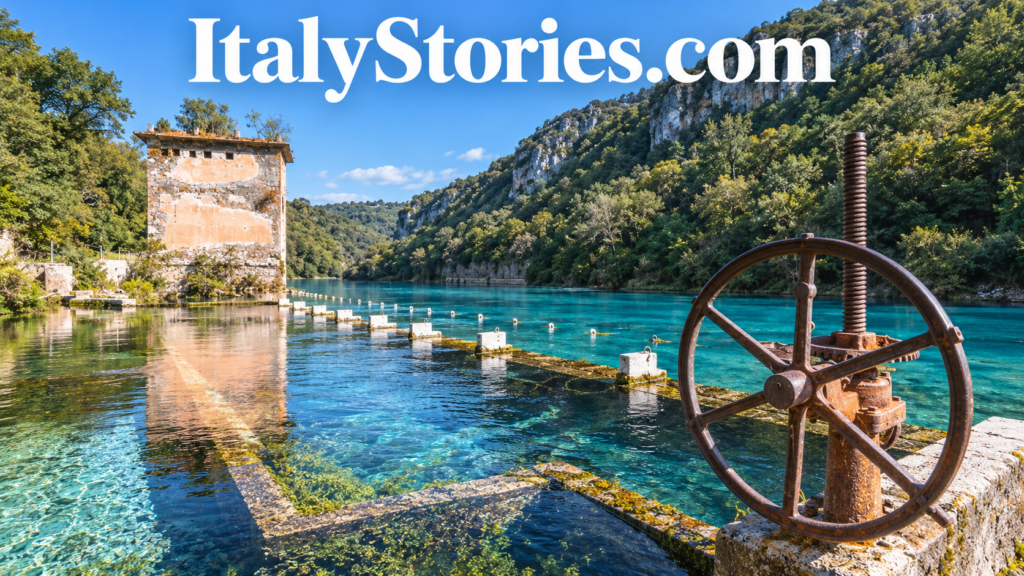
At first sight, it hardly seems possible that this water belongs to an Italian river. Its intense turquoise colour recalls a tropical lagoon, while its extraordinary clarity reveals stones, plants and submerged structures beneath the surface. Yet this place is hidden in the green heart of Italy, a short distance from the ancient town of Narni. It is the Morìca Spring, one of the most fascinating corners of Stifone and the Nera Gorge.
Stifone is a tiny hamlet in the municipality of Narni, in southern Umbria. Its medieval houses cling to the side of the gorge and appear to grow directly from the riverbank. Here, nature and human history have lived together for centuries, shaped by the cold, powerful waters of the River Nera and by the numerous springs that emerge from the surrounding limestone.
The water is the first thing visitors notice. Depending on the sunlight, it changes from transparent blue to emerald green and deep turquoise. The colour is not created by artificial treatment or photographic fantasy. It results from the remarkable clarity of the spring water, the light and the pale riverbed visible beneath the surface.
The Morìca Spring is recognisable from its old industrial structures. A large iron wheel and screw mechanism stand beside the water, while a weathered rectangular building rises from the opposite side. Low walls, channels and small concrete supports cross the transparent pool. These remains tell the story of a landscape that was not only beautiful but also economically important.
The power of the water was used here for mills and, in more recent times, for hydroelectric production. What now appears to be an almost forgotten piece of machinery was once part of a working system designed to control the flow of water. The former hydroelectric structures give the place its unusual character: half natural paradise, half monument to Italy’s early industrial history.
Stifone itself developed in a close relationship with the river. Its houses were built along the left bank of the Nera, squeezed between the water and the steep slopes of the gorge. The village retains its traditional appearance, with stone buildings, narrow passages, small squares and the Church of Santa Marina, distinguished by its brick portal and simple bell gable.
The surrounding area is known as the Gole del Nera, or Nera Gorge. A walking and cycling route follows part of a former railway line through tunnels, woodland and dramatic limestone scenery. The trail provides one of the best ways to discover the landscape slowly, following the river between Narni, Stifone and the nearby natural pools known as the Mole di Narni.
But there is another, more mysterious chapter in the history of this valley. Approximately nine hundred metres south of Stifone are archaeological remains commonly described as an ancient Roman shipyard. The structures lie inside an artificial channel close to what was once the river port of ancient Narnia, the Roman predecessor of Narni.
Classical writers recorded that the lower stretch of the Nera was navigable and connected with the Tiber, providing a river route towards Rome. This made the area strategically important for the transport of people, timber and agricultural products.
The remains found near Stifone include rock-cut walls and rows of squared holes that may once have held wooden supports. Some researchers have suggested that boats or river vessels could have been constructed or repaired there. It is a fascinating possibility, although the exact function and dating of the site are still subjects of historical and archaeological discussion. For this reason, it is more accurate to describe it as a probable or traditionally identified Roman shipyard rather than a fully understood naval complex.
The long history of water power continued through the Middle Ages, when mills were constructed along the river, and into the industrial age, when the same abundant flow was used to produce electricity. Few places show so clearly how one river could support Roman navigation, medieval industry and modern hydroelectric engineering.
Today, silence has returned to much of the valley. The rusted mechanisms beside the Morìca Spring no longer dominate the soundscape. Instead, visitors hear moving water, birds and the wind passing through the trees. The contrast between the abandoned machinery and the luminous water creates an atmosphere that is both peaceful and slightly mysterious.
Access to the Morìca Spring may be regulated during busy periods, particularly in summer and on selected weekends. Admission arrangements, opening times and rules concerning swimming can change according to water conditions, maintenance work and safety requirements. Visitors should therefore consult the official Gole del Nera park information before travelling.
This is also a delicate natural environment. The beauty of the water can tempt visitors to treat it like an ordinary swimming pool, but it remains part of a living river and spring system. Respecting marked routes, access regulations and protected areas is essential to preserving its clarity and tranquillity.
Stifone does not need enormous monuments or crowded squares to make an impression. Its attraction lies in a combination that is difficult to find elsewhere: a medieval riverside hamlet, transparent blue water, industrial archaeology, Roman mysteries and a wild Umbrian gorge.
It is one of those Italian places that seems almost unbelievable until you see it. Behind the quiet surface of the Morìca Spring lies a story shaped by water over thousands of years. Romans may have built boats nearby, medieval workers powered their mills with the current and engineers later transformed the same river into electricity.
Now the old iron wheel stands motionless beside the turquoise water, like a reminder of everything that once happened here. Stifone may still be one of Umbria’s lesser-known destinations, but anyone who discovers it is unlikely to forget it.
#Stifone #MoricaSpring #NeraGorge #Narni #VisitUmbria #HiddenItaly #ItalianVillages #NatureInItaly #UmbriaTravel #ItalyStories