

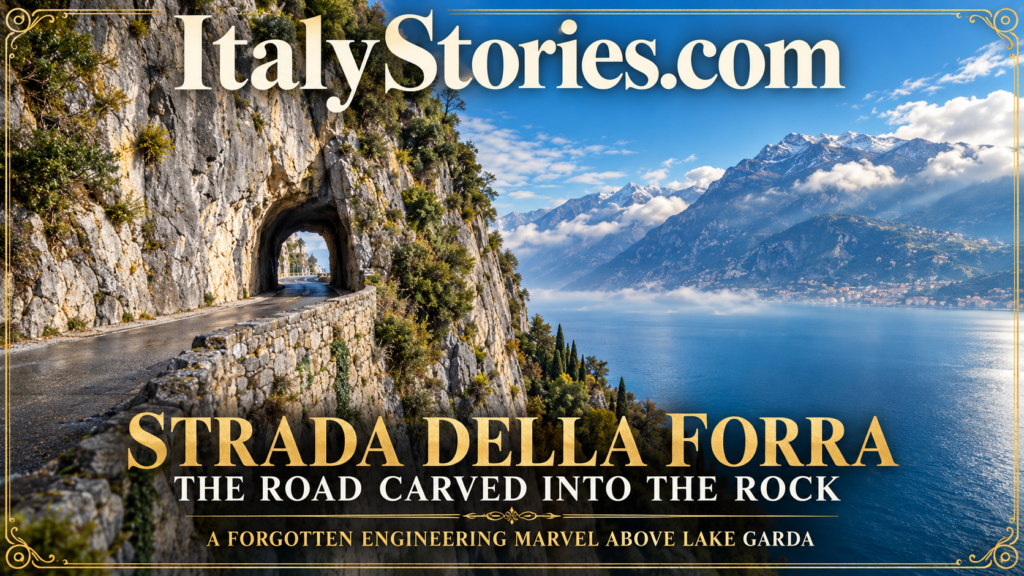
On the western shore of Lake Garda, where the mountains rise almost vertically from the water, there is a road that appears to have been designed by someone who refused to accept the meaning of the word “impossible.” It enters the rock, follows the course of a mountain stream, squeezes between walls of limestone and climbs towards villages that once seemed suspended between the sky and the lake.
Its name is Strada della Forra, the Road of the Gorge. It is one of the most dramatic roads in Italy, but its purpose was never to entertain tourists or provide spectacular photographs. It was built because the inhabitants of Tremosine needed a reliable connection with the outside world.
Today, its tunnels and sharp bends attract travellers from many countries. A century ago, however, the road represented something far more important: freedom from isolation.
AN ALTOPIANO ABOVE THE LAKE
Tremosine sul Garda is not a single compact town but a scattered community formed by eighteen hamlets. Most of them stand on a plateau high above the western shore of Lake Garda, surrounded by mountains, meadows, forests and deep valleys.
The landscape is magnificent, but for centuries it created enormous practical difficulties. Between the settlements of the plateau and the lake stood a wall of rock several hundred metres high. The village of Pieve, one of the most spectacular hamlets, was built near the edge of this natural balcony, almost directly above the water.
From the lake, the houses appeared close enough to touch. In reality, reaching them required climbing steep paths cut into the mountainside.
Before the construction of a proper road, residents depended on narrow mule tracks, stairways and difficult routes unsuitable for modern transport. People, animals and goods had to overcome a landscape that offered few easy passages. Lake Garda was an important route for trade, but the communities above it remained physically separated from the ports below.
Every sack of flour, piece of equipment or building material had to be carried upward with considerable effort. Agricultural products from the plateau faced the opposite journey. Timber, cheese, livestock and other goods had value, but transporting them to the lake and regional markets was slow and expensive.
Isolation also affected daily life. Reaching doctors, public offices or larger commercial centres could become a serious undertaking. During bad weather, already dangerous routes became even more difficult.
The people of Tremosine did not need a scenic road. They needed a lifeline.
THE MAN WHO SAW A ROAD INSIDE THE MOUNTAIN
The person most closely associated with the solution was Arturo Cozzaglio, a remarkable local figure whose knowledge extended across geology, hydrology, engineering and the study of the Lake Garda territory.
Cozzaglio had no conventional university engineering degree, but he possessed something perhaps even more important for this particular challenge: an intimate understanding of the mountain.
He knew the structure of the cliffs, the behaviour of water and the geological history of the area. He had studied the rocks around Lake Garda and understood that the landscape was not simply an obstacle. Hidden inside it was a possible route.
The key was the Brasa stream.
Over thousands of years, the torrent had carved a deep and narrow gorge through the limestone. In places, the rock walls almost met above the water. The gorge was wild, dark and difficult to enter, yet it created a natural passage from the lake towards the plateau.
Where other observers saw an inaccessible ravine, Cozzaglio imagined a road.
His idea was daring. The route would have to climb from the port area towards Pieve and Vesio, following the gorge where possible, cutting tunnels into solid rock and constructing retaining walls wherever the mountain offered no natural support.
This was not a project for a broad modern highway. It was a road designed to fit inside the landscape, adapting to the shape of the rock rather than attempting to erase it.
FINANCING THE IMPOSSIBLE
A brilliant design was not enough. Tremosine was a relatively small and isolated municipality, and constructing such a difficult road required financial support beyond its local resources.
The project received public funding under legislation approved in 1903. Half of the cost was covered by the Italian state, while the Province of Brescia and the Municipality of Tremosine each contributed a quarter.
The distribution of the costs reveals the importance attached to the road. It was not regarded merely as a local convenience but as infrastructure capable of improving economic and social conditions across the territory.
Work began in 1908.
Italy at the beginning of the twentieth century was rapidly modernising, but road construction in a narrow mountain gorge remained extremely demanding. Workers did not possess today’s computer-controlled drilling equipment, reinforced tunnelling machines or powerful earth-moving vehicles.
Much of the work depended on physical labour, mechanical drills, explosives, ropes, scaffolding and a precise understanding of the stone. The builders had to excavate tunnels, stabilise exposed surfaces, construct masonry walls and create a roadbed above a torrent that could change character after heavy rain.
The gorge offered little room for errors. In wider mountain terrain, a road can often move sideways to find a gentler slope. Inside the Forra, the walls dictated the route. Every curve had to respond to the rock, and every metre had to be won from the mountain.
The road was completed in 1913.
Its official route connected Porto, Pieve and Vesio. What looks today like a romantic historical monument was, at the time, a bold piece of modern infrastructure.
A ROAD THROUGH THE HEART OF THE GORGE
The most famous section enters the narrow gorge of the Brasa. Daylight disappears, the temperature falls and the sound of water echoes between the rock walls.
The road passes through rough tunnels that seem less constructed than hollowed directly from the mountain. In some sections, the stone forms the walls and ceiling of the passage. Elsewhere, arches and retaining structures support the route above the stream.
The experience is almost theatrical. One moment, Lake Garda fills the horizon. A few bends later, the traveller is enclosed inside a dark ravine where the sky has been reduced to a thin strip overhead.
The road is narrow because the gorge is narrow. Its geometry was determined by the available space and the needs of early twentieth-century traffic, not by the size of modern vehicles.
This is precisely what gives the Strada della Forra its character. It does not stand apart from the landscape like a large viaduct. It enters the mountain and becomes part of it.
Rock, water and masonry are so closely combined that it can be difficult to determine where nature ends and engineering begins.
THE FIRST JOURNEYS
When the road opened, it transformed the relationship between the plateau and the lake. Carts and early motor vehicles could travel along a route that had previously been possible only through steep and exhausting paths.
Goods could move more efficiently. Agricultural production could reach markets more easily, while materials from the lakeshore could be brought to the villages above. Communication improved, and the communities of Tremosine became less isolated from the economic life of the Garda region.
The psychological effect must also have been considerable. A mountain community that had always looked down at the lake from above finally possessed a direct road to it.
The new route did not make the mountain disappear. Travel remained demanding, especially in poor weather, and the road required constant maintenance. Falling rocks, water, ice and erosion have always been part of its history.
Nevertheless, the Strada della Forra changed what was possible. It demonstrated that infrastructure could be created without completely destroying the landscape it crossed.
The builders did not flatten the gorge. They followed it.
THE ARRIVAL OF THE GARDESANA OCCIDENTALE
When the Strada della Forra opened in 1913, the great lakeside road now known as the Gardesana Occidentale did not yet exist in its complete modern form.
Travelling along the western shore of Lake Garda remained difficult because cliffs repeatedly interrupted the route. Boats continued to play a central role in transport. Only later, during the interwar period, was the spectacular Gardesana Occidentale completed, with its long series of tunnels carved into the lakeside mountains.
When the Gardesana opened in 1931, it created a continuous road connection along the western shore. The Strada della Forra could then connect more directly with this expanding road network.
The two roads represent different approaches to the same geological challenge. The Gardesana follows the edge of the lake through numerous tunnels, while the Strada della Forra turns away from the shore and climbs into the gorge.
Together, they transformed mobility in an area where mountains had once made travel by land extremely difficult.
THE LEGEND OF WINSTON CHURCHILL
One of the most repeated stories about the Strada della Forra claims that Winston Churchill called it “the eighth wonder of the world.”
The phrase appears in countless tourist descriptions and has become part of the road’s modern mythology. Yet reliable documentary evidence establishing exactly when and where Churchill supposedly made the remark is difficult to find.
It is possible that he travelled in the Lake Garda region and admired its roads. Churchill had a well-known affection for Italy and visited the country on several occasions. However, the famous quotation should be treated as an attribution rather than an unquestionably documented statement.
Fortunately, the Strada della Forra does not require Churchill’s approval to be extraordinary.
The road’s real history is impressive enough: a local geologist imagined a route through a seemingly inaccessible gorge, public institutions financed it, and workers completed the project with early twentieth-century technology.
The legend survives because it sounds appropriate. On seeing the road for the first time, many visitors probably feel that someone important ought to have called it a wonder.
THE ROAD AND JAMES BOND
Lake Garda became an international cinema location for the opening car chase of the 2008 James Bond film Quantum of Solace. The sequence featured an Aston Martin DBS pursued by Alfa Romeo 159s along roads on the western side of the lake.
This association helped turn the area into a destination for motoring enthusiasts. The Strada della Forra is frequently described as a “James Bond road,” although the geography of the filmed sequence and the road promoted by tourism are often simplified or combined.
What matters is that the landscape is undeniably cinematic. The combination of tunnels, cliffs, deep water and sudden changes of light seems made for the screen.
But real life on the Strada della Forra is not a high-speed chase. Its narrow passages demand patience and respect. The road was designed to connect communities, not to serve as a racetrack.
Its beauty is best understood slowly.
ARTURO COZZAGLIO’S GREATER LEGACY
The Strada della Forra is the work most closely associated with Arturo Cozzaglio, but his importance reaches beyond one road.
He studied the geology and archaeology of the Lake Garda region, investigated prehistoric sites and worked on other difficult engineering projects. His approach combined scientific observation with practical knowledge of the territory.
Cozzaglio belonged to a generation for whom engineering was closely connected with direct experience of the landscape. Before satellite mapping and digital geological models, understanding a mountain required walking across it, examining exposed rock, studying springs and watching how water behaved during different seasons.
The Strada della Forra reflects that knowledge. Its route does not feel imposed by someone drawing a line on a distant map. It feels discovered by someone who knew where the mountain might permit a passage.
This is perhaps why the road remains so emotionally powerful. It is not simply a triumph over nature. It is the result of listening to nature carefully enough to find a way through.
THE FRAGILITY OF A MASTERPIECE
A road built inside a gorge is never truly finished. Water continues to shape the limestone, vegetation grows into cracks and seasonal temperature changes place stress on exposed surfaces.
Rockfalls and severe weather have repeatedly required inspections, closures and structural work. Modern safety standards also create difficult questions. The road must remain secure for contemporary use without losing the features that make it historically and visually unique.
Widening every tunnel or replacing every stone wall with modern concrete would alter its identity. Leaving it untouched, however, would eventually make it unsafe.
Preserving the Strada della Forra therefore requires a careful balance between conservation and engineering. It is both a transport route and a cultural monument. Unlike a building that can be closed and observed from outside, a road survives partly because people continue to use it.
Its vulnerability also reminds us that the dramatic landscape is still active. The same water that created the gorge continues to flow through it. The same cliffs that inspired the road continue to move, fracture and erode.
THE VILLAGES AT THE END OF THE CLIMB
The journey does not end when the road leaves the narrow gorge. It continues upward towards the plateau, where the landscape opens into meadows, wooded slopes and small settlements.
Pieve is the village most closely associated with the dramatic view over Lake Garda. Its buildings stand near the edge of a cliff approximately four hundred metres above the water. From its terraces, the lake appears enormous, bordered by mountains that change colour throughout the day.
Higher on the plateau, the other hamlets of Tremosine preserve a different side of Lake Garda. This is not the familiar world of crowded promenades and waterside hotels. It is a mountain territory of cattle pastures, stone houses, woodland paths and agricultural traditions.
The Strada della Forra connects these two environments. In only a few kilometres, it moves from the Mediterranean atmosphere of the lakeshore to an alpine landscape above.
The road is therefore more than an isolated attraction. It is the entrance to an entire inhabited territory.
A DIFFERENT KIND OF PANORAMIC ROAD
Most panoramic roads offer a continuous view. They remain exposed on an open slope, allowing travellers to admire the landscape for kilometre after kilometre.
The Strada della Forra works differently. Its power comes from concealment and revelation.
The lake appears, disappears and returns. The traveller moves from intense daylight into shadow, from open cliff to enclosed tunnel, from a vast horizontal view to a passage only a few metres wide.
This rhythm creates suspense. The road does not reveal everything immediately. It forces the landscape to unfold in stages.
Inside the gorge, the lake may feel impossibly distant. Then the road emerges from the rock and the entire blue surface suddenly opens below.
The result is not simply beautiful. It changes the traveller’s sense of scale. The cars seem small, the road seems fragile and the mountain appears immense.
A ROAD BUILT FOR PEOPLE, NOT LEGENDS
Over time, dramatic descriptions have accumulated around the Strada della Forra. It has been called the most beautiful road in the world, the eighth wonder and a road worthy of James Bond.
Such labels attract attention, but they can overshadow the human story that makes the road genuinely significant.
It was not built for celebrities, sports cars or tourism campaigns. It was built for the residents of an isolated plateau. Its first importance was measured not in photographs but in shorter journeys, safer transport and goods that could finally reach their destination without being carried along dangerous mountain paths.
The great achievement of Arturo Cozzaglio was not simply creating a spectacular road. It was turning an extraordinary engineering idea into an everyday public service.
That is the quiet paradox of the Strada della Forra. What now seems exceptional was designed to make ordinary life possible.
THE ROAD THAT THE MOUNTAIN ALLOWED
More than a century after its completion, the Strada della Forra still feels daring. Modern visitors enter its tunnels and wonder how anyone could have imagined building there with the tools available in 1908.
Yet the road’s endurance comes from something more subtle than courage. Cozzaglio understood that the mountain could not simply be defeated. The route had to cooperate with the gorge, following its curves and accepting its restrictions.
The result is a work of engineering that has become inseparable from the landscape. Remove the road and the gorge would lose part of its modern history. Remove the gorge and the road would lose its entire meaning.
High above Lake Garda, stone arches, tunnels and parapets preserve the memory of workers who carved a connection through solid limestone. Each bend recalls the isolation of the villages before 1913, and each opening towards the lake reveals what the road finally made accessible.
The Strada della Forra is beautiful, but beauty was never its original purpose. It is beautiful because necessity, intelligence and landscape met in exactly the same place.
It is not simply a road carved into the mountain.
It is the road the mountain allowed.
[…] more remarkable Italian landscapes, discover Strada della Forra, the pink salt pans of Marsala, the Tempio del Valadier, the secret city beneath Camerano and Villa […]