

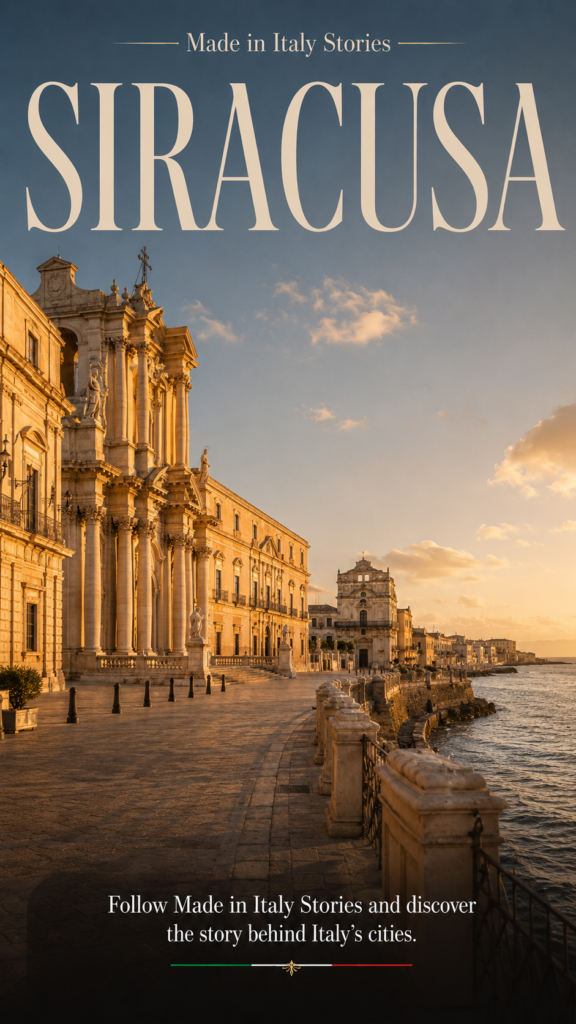
Where Greece, Sicily, and the Sea Still Speak Together
Syracuse is one of those cities where history does not lie politely beneath the surface. It rises up everywhere. It glitters in the harbor light, echoes in ancient stone, hides inside cathedral walls and drifts through the sea air around Ortigia at sunset. To arrive in Syracuse is to enter a place where Greek ambition, Roman conquest, Christian devotion, Arab memory, Norman layers and Sicilian baroque have all agreed, after many centuries of argument, to coexist. The result is dazzling.
The story begins in the eighth century BCE, when Greek settlers from Corinth founded the city on the island of Ortigia. Few colonial foundations in the ancient Mediterranean became so important so quickly. Syracuse grew into one of the greatest Greek cities in the western world, wealthy, powerful and often formidable. Its position was ideal: protected harbors, fertile hinterland, maritime reach. This was not a picturesque little settlement waiting to be admired by future tourists. It was a serious power.
In the classical age Syracuse reached heights that made the rest of the Greek world pay attention. Under rulers such as Gelon, Hieron and later Dionysius, the city became militarily strong and culturally significant. Its most famous moment in Greek military history came during the Athenian expedition to Sicily in the fifth century BCE. Athens arrived with imperial confidence and left in catastrophe. Syracuse played a central role in that defeat, reminding the Mediterranean that ambition and good planning are not always the same thing. The city could be brilliant, hard, sophisticated and ruthless, often at once.
It also produced one of antiquity’s greatest minds: Archimedes. His name still hangs over Syracuse like an invisible monument. Mathematician, engineer, inventor and legend, he represents the city at its most intellectually radiant. Tradition says he was killed during the Roman capture of Syracuse in 212 BCE, too absorbed in his geometric work to appreciate military interruptions. Whether the details have been polished by memory or not, the image has survived because it feels true to a larger reality: Syracuse was a place where thought mattered.
Roman conquest folded the city into a new political world, but Syracuse did not lose its stature overnight. Cicero admired it greatly, and the city remained one of the major centers of ancient Sicily. In later antiquity Christianity took deeper root here, and Syracuse became associated forever with Saint Lucy, the young martyr whose cult would travel far beyond Sicily. There was even a remarkable Byzantine episode in the seventh century when Emperor Constans II made Syracuse his seat for several years, briefly turning the city into an imperial center of astonishing importance. Italy is full of forgotten political surprises, and this is one of the best.
The Arab conquest of 878 changed the city profoundly, shifting power elsewhere on the island and beginning a long new phase of Sicilian history. Yet Syracuse endured. Under the Normans and subsequent rulers it regained significance, and over centuries the city accumulated layers rather than replacing one identity with another. This is one of the great lessons of Syracuse: civilizations do not always erase one another here. Quite often they settle into the same stone.
Nowhere is that clearer than in the cathedral of Syracuse on Piazza Duomo. At first glance it appears as a splendid baroque church, and indeed its façade belongs to that later world. But step closer and you realize the building incorporates the ancient Temple of Athena. Massive Doric columns still form part of the structure. It is one of the most eloquent architectural palimpsests in Italy. Greek sacred space became Christian sacred space, and the building wears both histories without apology. Piazza Duomo itself, luminous and theatrical, is one of the most beautiful urban rooms in Sicily.
Ortigia, the historic heart, is the part of Syracuse that most visitors fall in love with first. Its lanes, courtyards, noble facades, waterfront promenades and shifting light make it unforgettable. The Fountain of Arethusa adds myth to the experience. According to Greek legend, the nymph Arethusa fled here pursued by the river god Alpheus and was transformed into a spring. Whether one believes in mythological hydrology is a personal matter, but the place remains enchanting. Syracuse has always understood that stories and water belong together.
Beyond Ortigia stands the vast archaeological heritage of Neapolis. The Greek Theatre, carved into the rock, is one of the major classical sites in the Mediterranean. Nearby is the cave known as the Ear of Dionysius, named centuries later by Caravaggio because of its shape and acoustic qualities. Tradition claims that the tyrant Dionysius used it to spy on prisoners; that story belongs more to legend than to documented fact, but it survives because Syracuse is exactly the kind of place where legend feels at home beside archaeology. There are also the Roman amphitheater, ancient roads, quarries and traces of a city that once counted among the giants of the Greek world.
Daily life in Syracuse moves between grandeur and familiarity. Markets fill Ortigia with fish, citrus, tomatoes, olives and the sound of people who know food is a social event before it becomes a plate. The cuisine is intensely Sicilian and strongly maritime: seafood pastas, swordfish, tuna, caponata, fried treats, granita, almond pastries and produce fragrant with sun. Papyrus, which still grows in the area around the Ciane River, adds another unusual note to local identity. There are few places in Europe where you can think about Archimedes, buy excellent seafood and encounter papyrus in the same day without any of it feeling forced.
Tourism has long recognized Syracuse, and understandably so. Yet the city is more than a sequence of famous spots. What makes it different from other Italian cities is the extraordinary way it remains Greek and Sicilian at the same time. Naples is layered, Palermo is layered, Rome is layered; all great cities are layered. But Syracuse carries the Greek inheritance with uncommon immediacy. If you visit, you should see the archaeological park, the cathedral, Ortigia, the seafront and the castle of Maniace. You should also walk at evening, when the stone begins to glow and the city seems to remember every civilization that ever loved it.
Over the centuries Syracuse has changed from an ancient superpower to a regional city, from imperial prize to baroque beauty, from strategic port to cultural destination. Today it stands as one of Sicily’s great historical centers, still marked by the sea, still nourished by memory and still capable of giving the visitor that thrilling sensation that history here is not dead material. It is atmosphere.
If you have visited Syracuse, tell us what remained with you most: the Greek theatre, Ortigia at sunset, the cathedral, the sea, the market, or the strange and wonderful feeling of walking through a city where so many centuries are present at once. Follow Made in Italy Stories and share in the comments what part of Syracuse you still carry with you.