

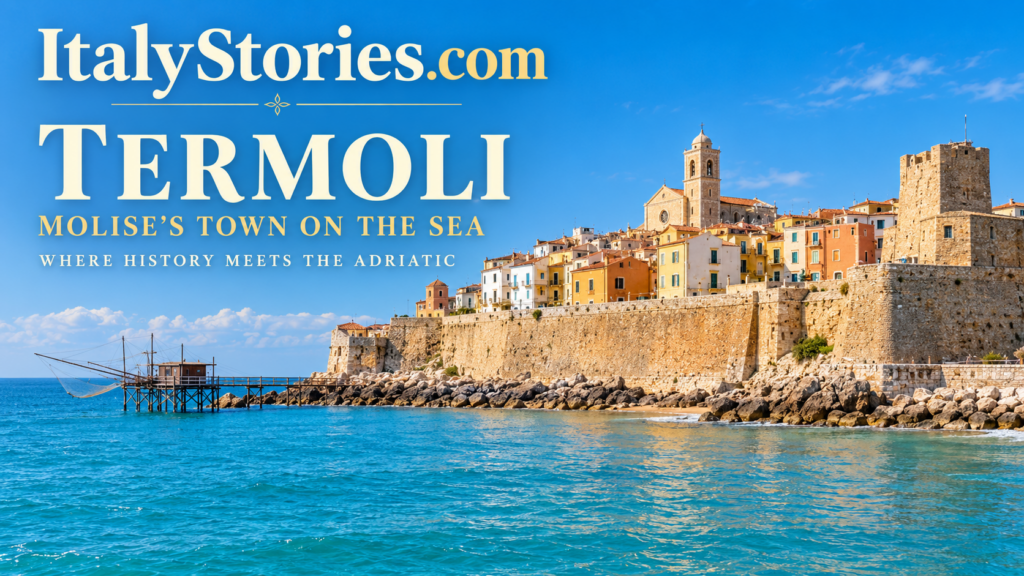
Italy’s Adriatic coast is filled with famous destinations, yet some of its most captivating places remain outside the usual tourist routes. Termoli is one of them. Standing on a rocky promontory above the sea, its old town resembles the bow of a great stone ship sailing into the blue waters of the Adriatic.
Termoli lies in Molise, one of Italy’s smallest and least explored regions. The modern town has grown considerably, but its historic heart, known locally as the Borgo Vecchio or Paese Vecchio, still retains the atmosphere of an ancient fortified settlement. Surrounded by massive defensive walls and bordered by the sea on several sides, the old town forms a compact maze of houses, stairways, arches and narrow streets.
For centuries, Termoli’s position made it both valuable and vulnerable. Its coastline was exposed to attacks by pirates and foreign fleets, while its harbour connected the town with maritime trade across the Adriatic. The defensive walls and castle were therefore essential for protecting the local population.
The most recognisable monument is the Castello Svevo, the severe stone fortress standing near the entrance to the old town. Its origins are probably Norman, although it became known as “Swabian” following the reconstruction and fortification ordered by Emperor Frederick II in 1240. Unlike the romantic castles of fairy tales, it was designed primarily for surveillance and defence. Its square, compact shape still dominates Termoli’s skyline.
Inside the walls stands the Cathedral of Santa Maria della Purificazione, a beautiful example of medieval architecture. Its pale stone façade, decorated with arches and sculpted details, rises among the closely packed houses of the old town. The cathedral is dedicated to the Virgin Mary and preserves the relics of Saint Basso, the patron saint of Termoli, and Saint Timothy.
The streets surrounding the cathedral reveal the more intimate side of the town. Laundry hangs from balconies, flowerpots brighten stone doorways and small passages suddenly open onto views of the sea. One of the most curious corners is the Rejecelle, an exceptionally narrow alley through which only one person can pass at a time. It is often described as one of the narrowest streets in Italy.
Walking around the defensive walls, the Adriatic is almost always visible. On one side lies Sant’Antonio Beach; on the other, the coast extends towards Rio Vivo and the harbour. The contrast between the golden stone of the fortifications and the intense blue of the water gives Termoli much of its distinctive beauty.
Traditional fishing structures known as trabucchi can also be seen along this stretch of coast. Built on wooden platforms extending over the sea, they use a system of poles, ropes and large nets to catch fish without requiring a boat. These delicate-looking constructions are part of an ancient Adriatic fishing tradition and remain among the most evocative symbols of the coastline.
Fishing has naturally shaped Termoli’s cuisine. One of its best-known dishes is brodetto alla termolese, a rich fish stew traditionally prepared with several varieties of the day’s catch, tomatoes and peppers. Like many genuine Italian recipes, it began as a practical meal made by fishermen using fish that were difficult to sell, but eventually became an important expression of local identity.
Termoli is particularly beautiful in the soft light of morning, when the old walls glow above the water, and in the evening, when the narrow streets of the Borgo Vecchio become quiet and the sound of the sea rises from below. It possesses the character of a southern Italian town but also the reserved, almost secretive personality of Molise.
Perhaps that is Termoli’s greatest charm. It does not feel like a place created for tourism. It is a living town where history, fishing traditions, beaches and everyday life continue to exist together. Visitors do not simply discover a beautiful seaside destination; they encounter a part of Italy that still feels authentic and wonderfully unexpected.
From its medieval castle to its fishermen’s houses, from the cathedral to the trabucchi suspended over the Adriatic, Termoli proves that some of Italy’s most beautiful places are also among its least celebrated.