

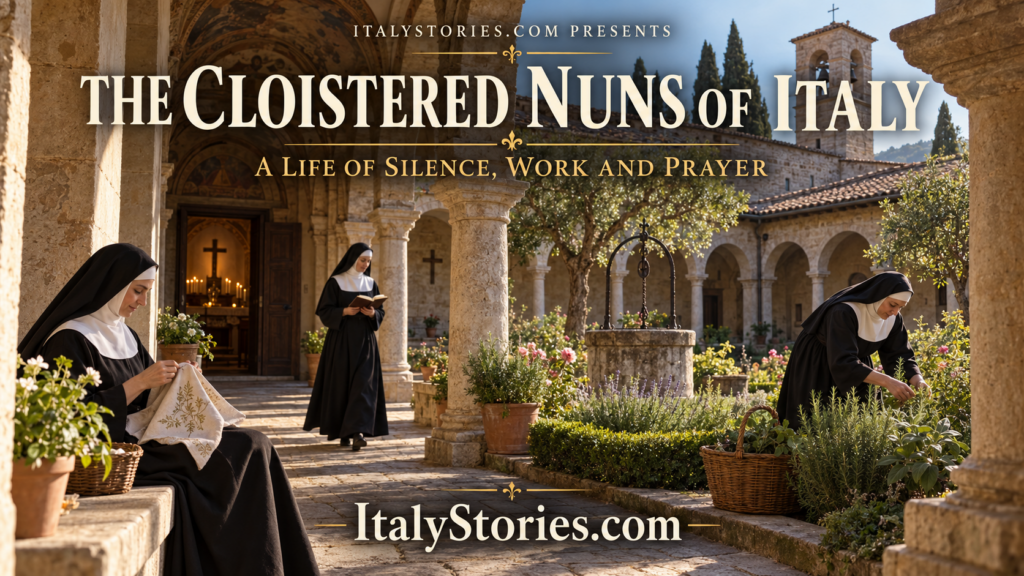
Behind the walls of ancient monasteries scattered across Italy, from the green hills of Umbria to the crowded streets of Rome, from Tuscan villages to the historic centres of Sicily, communities of women continue to live according to rhythms that seem almost untouched by the speed of the modern world. The cloistered nuns of Italy do not belong only to medieval history, romantic paintings or half-forgotten legends. They are still present today, living in communities devoted primarily to prayer, contemplation, work and silence. Their doors may remain closed to casual visitors, but the life behind them is neither empty nor frozen in time.
The word “cloistered” often creates an image of imprisonment: locked gates, dark corridors and women forced to abandon the world. That image is powerful, but it is also deeply misleading when applied without distinction. A contemporary woman who enters a contemplative monastery normally does so voluntarily, after a long period of discernment and formation. She is not disappearing because she has nothing to contribute outside the walls. She is choosing a form of life in which separation becomes a way of concentrating attention, limiting distractions and dedicating herself to a spiritual vocation.
Historically, however, the story was more complicated. Some women entered convents because of a genuine religious calling, while others were influenced or pressured by their families. Monasteries could be places of faith, education, artistic activity and female authority, but they could also reflect the inequalities of the societies surrounding them. The history of cloistered women is therefore neither a simple tale of oppression nor an uncomplicated portrait of serenity. It is the story of women who lived within strict institutions while creating communities, preserving knowledge, managing property, producing art and developing forms of independence that were often unavailable elsewhere.
The Origins of Female Monastic Life
Christian women began choosing lives of prayer and celibacy long before the great stone monasteries of Italy were built. In the early centuries of Christianity, some lived as hermits, while others formed small communities in private houses. Their decision to remain unmarried could itself be radical in a society where a woman’s identity and security were generally connected to marriage and family.
As monastic traditions developed, communities adopted increasingly organised rules. The Rule of Saint Benedict, written in the sixth century, became one of the most influential texts in Western monasticism. Although originally composed for a community of men, its principles also shaped many female monasteries. Prayer, work, obedience, moderation and life in common created a rhythm intended to balance spiritual concentration with the practical demands of everyday existence.
Italy eventually became home to numerous female contemplative traditions. Benedictine nuns followed a life shaped by communal prayer and work. Poor Clares embraced the Franciscan ideal of poverty associated with Saint Clare of Assisi. Dominican contemplative nuns placed particular emphasis on prayer, study and the search for truth. Carmelite communities developed an intense spirituality centred on interior prayer. Cistercian, Augustinian and Visitandine monasteries added their own customs and forms of discipline.
These communities were never identical. A Benedictine abbey with agricultural land might operate very differently from a small Carmelite convent inside a city. The clothing, timetable, liturgy, diet and rules concerning contact with outsiders varied according to the order, historical period and local circumstances. Even the meaning of enclosure changed over time.
When the Cloister Became a Wall
The cloister was originally an architectural and spiritual centre. The word evokes the covered walkway surrounding a garden or courtyard, a place where members of a religious community could move between the church, refectory, chapter room, dormitory and areas of work. Over the centuries, however, it also came to describe the regulated separation of monastic communities from the outside world.
For women, enclosure became particularly strict during the Middle Ages and the early modern period. Church authorities increasingly required nuns to remain within defined monastic spaces, while outsiders could enter only under specific conditions. The enclosure was reinforced during the Catholic reforms that followed the Council of Trent in the sixteenth century.
The rules were intended to protect religious discipline and express complete dedication to contemplative life. They also reflected contemporary ideas about female honour, sexuality and public visibility. Women’s bodies and movements were controlled more strictly than those of men, both inside and outside religious institutions.
Architectural details still reveal this history. In many Italian convent churches, nuns attended Mass from a separate choir, sometimes positioned behind the main altar or above the public nave. Metal grilles or carved stone screens allowed them to hear the liturgy while remaining unseen or partially hidden. Parlours were divided by grilles, curtains or double sets of bars. Objects could pass through a rotating wooden cylinder known as a ruota, while direct physical contact remained limited.
The walls did not completely eliminate communication. Nuns received letters, met approved visitors in the parlour, spoke with confessors and maintained relationships with relatives, benefactors and Church officials. Some corresponded with political leaders, artists and intellectuals. Others became trusted spiritual advisers whose influence extended far beyond the monastery.
The enclosure was therefore both a boundary and a filter. It restricted movement, but it did not always prevent ideas, requests, information and authority from travelling in both directions.
Why Women Entered the Convent
The reasons women entered monasteries differed enormously. For some, religious life represented a profound vocation. They felt drawn to prayer, community and the renunciation of marriage and personal property. For others, the convent offered education, stability and protection from the dangers associated with childbirth, widowhood or an unwanted marriage.
Families also used convents as part of social and economic strategies. Among wealthy or noble households, arranging suitable marriages for several daughters could require enormous dowries. A religious dowry was often less expensive than a marriage settlement, and placing one or more daughters in a convent helped preserve family property for male heirs.
This did not mean that every young woman sent to a convent lacked faith, nor did it mean that every decision was freely made. Personal vocation, family expectation and economic calculation could exist together. Some women accepted the life chosen for them and eventually embraced it. Others resisted, wrote desperate letters or attempted to leave.
For women who actively desired intellectual or spiritual independence, a monastery could provide opportunities rarely available in marriage. A nun might learn Latin, music, accounting, herbal medicine, painting or manuscript production. An abbess could govern a large community, supervise property, negotiate with civil and religious authorities and manage a complex economy. In an age when most public offices were closed to women, the head of an important monastery could exercise considerable responsibility.
Life remained regulated, and authority was never unlimited. Bishops, male religious superiors and family patrons could intervene. Nevertheless, the convent created a recognised female community in which women occupied nearly every daily position: superior, teacher, infirmarian, sacristan, archivist, cellarer, cook, porter, novice mistress and financial administrator.
A Day Measured by Bells
The daily life of cloistered nuns is often imagined as an uninterrupted sequence of prayers. Prayer is central, but a monastery cannot survive on prayer alone. Food must be prepared, buildings maintained, accounts managed, elderly sisters assisted, gardens cultivated and work completed.
The precise schedule differs among communities, but the bell generally divides the day into periods of prayer, labour, study, meals and rest. The day may begin before sunrise. The sisters gather in the choir for the first office, praying psalms and listening to readings while the world outside is still dark. The silence of the church at that hour is not theatrical. It is practical and deliberate: the community begins the day before ordinary demands can occupy the mind.
Morning prayer is followed by personal meditation, Mass and a simple breakfast. The sisters then move to their assigned duties. One may work in the kitchen, another in the laundry, another in the garden. A nun trained in administration may deal with invoices and correspondence, while another prepares the chapel or cares for a sick member of the community.
At fixed hours, work stops and the sisters return to prayer. This repeated movement between contemplation and practical activity is essential to monastic life. Work is not merely a way to earn money or fill time. It is understood as part of the vocation, an exercise in attention, responsibility and service.
Meals are normally simple and eaten together. In some communities, they may be accompanied by a reading rather than conversation. Periods of recreation allow the sisters to speak more freely, exchange news and enjoy one another’s company. Cloistered life is not a continuous funeral. Humour, friendship, disagreement and ordinary human affection all exist inside a monastery.
The day closes with evening prayer and a period of greater silence that continues through the night. The repetition may appear monotonous from outside, but those who choose the life often describe the structure as liberating. Decisions that dominate ordinary life—what to wear, where to go, what to buy and how to fill each hour—are deliberately reduced. The resulting space is directed toward prayer and communal responsibility.
Silence Does Not Mean Never Speaking
One of the most persistent myths about cloistered nuns is that they take a vow never to speak. Most do not. Silence is an important discipline, but it is usually observed at certain times and in designated areas rather than maintained continuously.
The purpose is not to erase personality or prevent communication. It is to create an environment in which words are used more carefully. Conversation takes place when required for work, community decisions, formation and mutual support. Recreation periods may be animated, and anyone imagining a room full of permanently solemn women would probably be surprised by the laughter found in many religious communities.
Silence also has a practical dimension. In a monastery where many people share the same spaces and follow an intensive prayer schedule, constant noise would make concentration impossible. Quiet becomes a form of respect.
There is a difference between silence and isolation. Contemplative nuns live in community, sometimes for decades with the same group of women. This requires patience and emotional maturity. Personal habits that seem insignificant during an occasional visit become impossible to ignore when repeated every day for forty years. Holiness may be the goal, but learning not to be irritated by the way another person closes a door can be part of the journey.
Community decisions are often discussed in a chapter meeting. Depending on the constitutions of the order, the sisters may vote on practical matters and the election of their superior. A monastery is therefore not simply a collection of individuals following orders. It is a structured community with responsibilities, procedures and internal relationships.
Prayer for a World They Rarely See
Cloistered communities describe their separation from the world not as rejection but as another way of being connected to it. People write or telephone monasteries asking for prayers for illness, family difficulties, bereavement, employment, war and personal crises. These requests become part of the community’s daily intercession.
The sisters may know little about the individuals whose names arrive on small pieces of paper, yet those lives enter the monastery through prayer. Behind a closed door, news of the outside world is transformed into a list of people, places and situations entrusted to the community.
This does not mean that contemplative nuns are unaware of current events. Many follow important news, receive publications, use computers for necessary work and communicate with their religious federations. The extent of access to television, telephones and the internet varies. The objective is not to pretend that modernity does not exist but to prevent information and technology from dominating the rhythm of life.
A monastery may maintain a website, answer emails and sell its products online while remaining genuinely cloistered. Technology is treated as a tool rather than as an unlimited space for distraction. It would be difficult to imagine a sharper contrast with a society in which people often reach for a telephone before they have fully opened their eyes in the morning.
The Work of Their Hands
Italian monasteries have long produced food, textiles, medicines, manuscripts and religious objects. Work supported the community and provided goods for local populations. Some traditions became closely associated with particular places.
Nuns prepared bread, biscuits, pastries, preserves, liqueurs and herbal products. They embroidered liturgical vestments, repaired altar cloths, restored books and created candles or hosts for Mass. In some communities, recipes were transmitted across generations and became part of regional culinary history.
The romantic image of a nun quietly embroidering beside a window contains some truth, but monastic work also involves less picturesque tasks. Boilers fail, roofs leak, historic buildings require constant maintenance and electricity bills still arrive. The age of the building may be spiritually impressive while remaining financially merciless.
Modern communities must balance prayer with the economic reality of caring for elderly members and preserving large complexes designed for populations far greater than those living there today. Some sell products through small shops, receive donations or offer limited hospitality in areas separated from the enclosure. Others depend on assistance from their order, diocese or federation.
The work is normally organised so that it does not overwhelm the contemplative purpose of the monastery. A community cannot simply transform itself into a commercial enterprise without losing the reason for which it exists. Yet complete economic isolation is equally impossible.
Libraries, Music and Knowledge Behind the Walls
Female monasteries played a significant role in preserving and producing culture. Nuns copied texts, maintained archives, composed music and educated girls. Their libraries held devotional works, legal documents, medical knowledge, correspondence and records of local life.
Some Italian convents became important musical centres. Talented women composed sacred works, sang behind screens and mastered instruments. In certain cities, performances by nuns attracted listeners who could hear the music without seeing the performers. The enclosure concealed the musicians while allowing their reputation to travel.
Monastic pharmacies and gardens preserved practical knowledge of plants and remedies. Nuns cared for sick members of their own communities and sometimes prepared medicines for outsiders. Their understanding was shaped by the medical beliefs of the time, but it also drew on generations of observation.
Convents commissioned architecture and artworks, negotiated with painters and supervised the decoration of churches. Wealthy nuns could bring family connections and resources into a community, while abbesses acted as patrons. The artistic heritage now admired by visitors in many Italian churches was not created only for male clergy or public congregations. Some of it emerged from the needs, decisions and devotion of women living behind the enclosure.
Their personal writings also reveal complex inner worlds. Letters and spiritual diaries speak of faith, doubt, physical illness, friendship, obedience and conflict. They remind us that the habit never erased the individual.
The Grille and the Family
Entering a cloistered community does not necessarily mean that a woman never sees her family again. Visits are possible, although they take place according to the monastery’s rules, often in a designated parlour. Historically, grilles and curtains made the separation visible. Today the arrangements vary, and some communities use less severe architectural divisions while preserving the principle of enclosure.
The emotional cost can still be considerable. A nun may miss weddings, ordinary family gatherings and the everyday growth of nieces and nephews. She may be unable to accompany a sick parent in the way another daughter could. Serious circumstances can sometimes justify leaving the enclosure with permission, but the vocation inevitably changes family relationships.
For relatives, the decision may be difficult to understand. Parents can experience pride, grief or both. A daughter is not dead and has not disappeared, but her availability has changed permanently. Over time, some families come to see the monastery as part of their own extended world.
The relationship works in both directions. A sister brings her family history, education, temperament and regional culture into the community. An Italian monastery may contain women from several countries and generations, each with different expectations. The cloister separates them from ordinary society, but it does not remove the society already present within them.
Myths, Legends and Uncomfortable Truths
Closed doors encourage imagination. For centuries, stories circulated about secret tunnels, forbidden romances, hidden children, cruel punishments and mysterious deaths inside convents. Some tales were inventions created by anti-clerical writers or Gothic literature; others grew from real cases of coercion, scandal or abuse.
It would be dishonest to deny that women were sometimes forced into religious life or treated harshly. The history of convents includes injustice as well as devotion. Families could use enclosure to remove an inconvenient daughter, protect inheritance or conceal a social scandal. Religious authority could be misused, and a woman with no genuine vocation might face a life she had never chosen.
It would be equally misleading to reduce every nun to a victim. Many women fought to enter monasteries despite family opposition. Others found education, authority and spiritual fulfilment there. Some became powerful abbesses, writers, musicians, mystics and advisers. The same walls that limited physical movement could create a protected space in which women governed a community of their own.
The truth changes from one life to another. There was never a single experience shared by all cloistered women, just as there is no single explanation for those who choose the life today.
The Cloister in the Modern World
The twentieth century brought profound changes. Wars, urbanisation, declining birth rates and new opportunities for women altered the social environment from which religious vocations emerged. The Second Vatican Council encouraged religious communities to return to the original spirit of their founders while adapting aspects of their lives to contemporary conditions.
More recent Church regulations have addressed formation, autonomy, communication and cooperation between monasteries. Communities that were once almost entirely independent are encouraged to participate in federations, sharing resources and avoiding dangerous isolation. A monastery must possess more than an ancient building and a legal title: it needs a sufficiently vital community, sound governance, proper formation and a realistic economic foundation.
Many Italian monasteries face an uncertain future because their communities are ageing and new vocations are fewer. A building designed for sixty nuns may now house fewer than ten. When a community can no longer govern itself or provide adequate care, it may be affiliated with another monastery, transferred or eventually closed.
The closure of a monastery is not merely an administrative event. It ends a continuous presence that may have lasted centuries. The final sisters leave behind a church, an archive, a garden and thousands of ordinary memories. The local community loses neighbours who were rarely seen but whose bells, prayers and traditions formed part of the identity of the place.
At the same time, new vocations continue to appear. Some women enter after university, professional careers or years of independent adult life. Their decision cannot easily be explained as a lack of alternatives. They know what the modern world offers and choose a different measure of time.
Formation is deliberately long. A candidate does not arrive one afternoon and make permanent vows the next morning. She normally passes through stages of observation, postulancy, novitiate and temporary profession before making a definitive commitment. Both the woman and the community must decide whether the vocation is genuine and sustainable.
Freedom Behind a Closed Door
From outside, the paradox seems unavoidable: how can enclosure represent freedom? The answer depends on what freedom means. If it means unlimited movement, unlimited choice and unlimited access to experience, cloistered life is clearly restrictive. If it also means choosing a purpose and accepting the discipline required to pursue it, the question becomes more complex.
A musician gives years to practice. An athlete accepts training, diet and repetition. A parent reorganises life around the needs of a child. Every serious commitment closes some possibilities in order to make another possible.
For a cloistered nun, the monastery is not intended to make life smaller but deeper. Whether an outside observer accepts the religious belief behind that choice is another matter. It is still possible to recognise the consistency and courage required to live it.
The life is not automatically peaceful. A woman carries her character, memories, fears and weaknesses through the monastery door. Silence can reveal inner conflicts rather than remove them. Community life can console, but it can also challenge. Prayer does not eliminate illness, ageing or grief.
What changes is the framework within which these experiences are understood. Time is no longer organised primarily around career, entertainment or personal advancement. It is placed inside a repeated cycle of prayer, work and relationship.
The Presence Behind the Walls
Walk through an Italian town early in the morning and you may hear a monastery bell without seeing the women who respond to it. Behind a wall, lights are switched on, books are opened and a community gathers in a chapel. Later, someone will prepare lunch, answer a letter, water the garden, mend a garment or sit beside an elderly sister who no longer remembers the words of the prayers she once knew by heart.
Nothing about this daily life is as dramatic as the legends surrounding convents. Its meaning lies precisely in repetition. The same psalms return, the same seasons pass through the cloister garden and generations of women occupy the same wooden stalls in the choir.
They have not stopped time. They have chosen to measure it differently.
The cloistered nuns of Italy are neither ghosts of a vanished country nor mysterious figures who exist only behind iron grilles. They are women living an ancient vocation in a modern society that often struggles to understand silence, permanence and limits. Their communities carry difficult histories, remarkable cultural achievements and uncertain futures.
Behind those doors there is prayer, but also administration. There is sacrifice, but also companionship. There is silence, but not an absence of voices. Above all, there are individual lives that cannot be reduced to a black veil and a closed gate.
Follow ItalyStories.com to discover more hidden lives, ancient traditions and extraordinary stories from Italy’s cultural heritage.