

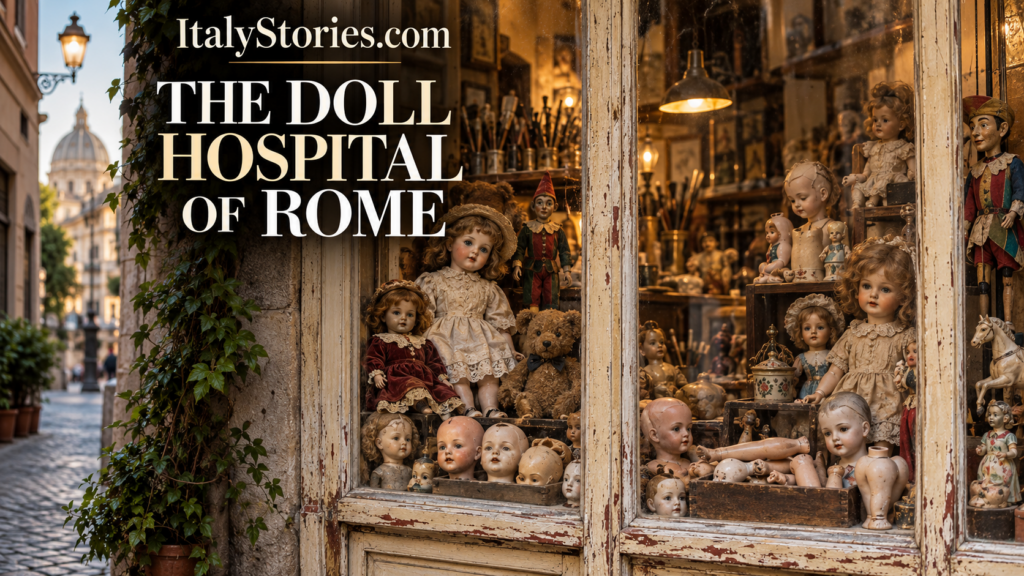
In the historic centre of Rome, a short walk from Piazza del Popolo, there is a shop window capable of stopping even the most distracted passer-by. Behind its old glass, dozens of faces stare out at the street. Some have perfect porcelain complexions and elegant curls; others are cracked, faded or separated from their bodies. Tiny arms, legs, heads, teddy bears, marionettes and ceramic figures crowd the shelves. At first glance, the Doll Hospital of Rome may look like the set of an unsettling film. Look closer, however, and its true nature emerges: this is not a collection of abandoned toys but a workshop devoted to giving damaged objects—and the memories attached to them—a second life.
The official name of the shop is Restauri Artistici Squatriti. Romans have long known it by the more imaginative name Ospedale delle Bambole, the Doll Hospital. It stands at Via di Ripetta 29, on the corner with Via del Vantaggio, in one of the most historic parts of the capital. The workshop occupies only a few square metres, yet it contains an entire world: generations of craftsmanship, family history, antique materials and thousands of objects that their owners were unable to throw away.
A Strange Window in the Heart of Rome
Via di Ripetta begins near Piazza del Popolo and forms one side of Rome’s famous Tridente, the three streets that open southward into the historic centre. Today it is surrounded by galleries, elegant buildings, restaurants and the constant movement of visitors, but traces of an older, more intimate Rome can still be found along its route.
The Doll Hospital is one of those traces. Its weathered wooden frontage seems almost too fragile for the modern city around it. The window is filled with such an extraordinary quantity of dolls and doll parts that many people stop without initially understanding what they are seeing.
A row of small faces may appear between antique ceramic figures. A porcelain head rests beside a teddy bear. A pair of glass eyes waits in a box. A doll with only one arm leans against another whose hair is being replaced. Some figures are complete and beautifully dressed, while others are clearly awaiting treatment.
The effect can be slightly eerie, especially after dark, but describing the shop as merely frightening misses its meaning. The objects in the window are not displayed to shock visitors. They are patients, spare parts and examples of the materials repaired inside. What appears macabre from a distance becomes unexpectedly tender when one understands the work being done.
The shop is, in its own peculiar way, a place of hope.
The Woman Who Created the Doll Hospital of Rome
The history of Restauri Artistici Squatriti began during the difficult years following the Second World War. Rome was recovering from occupation, bombing, hunger and uncertainty. Work was scarce, families repaired whatever could still be used, and the modern culture of replacing damaged objects had not yet arrived.
Concetta Pesci, the grandmother of the workshop’s present generation, was determined to secure a future for her two sons, Mario and Renato. Near Piazza del Popolo, there was a craftsman who repaired different kinds of household objects. Concetta sent the boys to learn the trade, ensuring that they would possess a practical skill capable of providing work.
They did not spend a few afternoons observing from the doorway. They remained in the workshop for approximately six or seven years, learning how broken ceramics were joined, missing sections reconstructed, surfaces prepared and colours matched. Restoration at the time was often less scientifically precise than it is today, but it required patience, manual ability and a deep familiarity with materials.
In 1953, Concetta opened the family’s own shop in Via di Ripetta. The decision was practical, but also remarkably ambitious. Post-war Rome needed people who could repair what families could not afford—or could not bear—to replace. Mario and Renato had acquired the necessary skills, and Concetta understood that those skills could become the foundation of an independent business.
The workshop prospered. Other relatives joined the activity, and the knowledge passed from one generation to another. Federico Squatriti eventually learned the craft primarily from his father Mario and his mother Gelsomina, known as Gelsy, who continued working in the shop well into old age.
The Doll Hospital was never created as a tourist attraction. Its unusual appearance developed naturally from the work performed inside. The window became crowded because a restorer of dolls needs heads, hands, limbs, wigs, eyes, clothes and components from many different periods. Over time, that practical collection created one of the most unforgettable shopfronts in Rome.
Not Only Dolls
Despite its popular nickname, Restauri Artistici Squatriti has never repaired only dolls. The family has worked on porcelain, ceramics, majolica, terracotta, plaster, nativity figures, small statues, cups, plates, vases, puppets, marionettes and other decorative objects.
The materials determine the treatment. A porcelain doll cannot be repaired in the same way as one made of composition, papier-mâché, cloth or celluloid. Antique dolls may combine several materials: a ceramic head, glass eyes, a fabric body, human or synthetic hair, wooden limbs, leather shoes and tiny metal joints.
Each part ages differently. Fabric weakens, glue dries, elastic loses tension and paint fades. Porcelain can crack or shatter, while composition materials may swell, split or flake. Celluloid, once widely used for dolls and toys, becomes fragile with age and requires particular care.
A restoration may involve cleaning the object, joining broken fragments, filling cracks, reconstructing missing sections, reproducing a hand or foot, replacing internal elastic and carefully retouching the surface. The aim is not always to make the object look completely new. Excessive restoration can erase its history and reduce its authenticity.
A skilled restorer must decide how far to go. Should every sign of age disappear, or should the object retain some evidence of the life it has lived? A century-old doll is not supposed to look as if it left a factory yesterday. The most respectful restoration returns stability and visual harmony without turning the object into an imitation of itself.
That judgement cannot be learned from a simple instruction manual. It develops through experience, failed attempts, observation and knowledge passed from one pair of hands to another.
The Patients Arrive with Their Own Stories
Some dolls enter the workshop because they are rare collectors’ pieces. They may have porcelain heads produced in France or Germany during the late nineteenth and early twentieth centuries, carefully painted features and original clothing. Their financial value can be considerable, and restoring them requires historical knowledge as well as technical skill.
Many others possess little monetary value. They may be ordinary dolls produced in large numbers, toys that would attract no particular attention at an auction. Yet their owners bring them to Via di Ripetta with the same concern someone else might reserve for a valuable painting.
The reason is simple: the true value of these objects is emotional.
A doll may have belonged to a grandmother who is no longer alive. It may have been given to a child after a difficult illness, carried during a family journey or saved from a childhood home. Its worn dress, missing fingers and faded face contain a private biography that cannot be measured in euros.
Replacing it with a perfect new doll would be meaningless. The owner does not want another object of the same shape. The owner wants that particular doll—the one that occupied a bed, attended imaginary tea parties and listened silently to childhood secrets.
People sometimes return repeatedly while a restoration is in progress, asking about the condition of their doll as though checking on a relative in hospital. The language of treatment comes naturally: patients are admitted, examined, operated on and eventually discharged.
Behind the humour lies genuine affection. When an adult carries a broken childhood toy into the shop, that person is often carrying part of a former life. The restorer’s task therefore involves more than glue, plaster and colour. It requires sensitivity toward something another person considers irreplaceable.
Inside the Tiny Workshop
The interior of the Doll Hospital is remarkably small—roughly 15 or 16 square metres according to descriptions of the shop. Every available surface seems to serve several purposes. Shelves hold materials, completed repairs and objects waiting their turn. Tools share space with brushes, pigments, adhesives and containers filled with components.
The apparent disorder conceals the logic of an old artisan workshop. A head that seems abandoned may provide the model for reconstructing another. A box of tiny limbs may contain the exact size required for a damaged figure. An antique glass eye, useless on its own, may complete a doll that has waited decades to see again.
Restoration begins with examination. The craftsman must identify the material, age, construction method and previous repairs. Old glue may need to be removed. A badly completed repair from decades earlier can be more difficult to correct than the original damage.
Broken fragments are cleaned and tested before being joined. Missing sections may be modelled and integrated into the surviving surface. Colours must be mixed carefully because a repair that is structurally perfect can still fail visually if the new paint appears too bright or too uniform.
Faces are particularly demanding. The expression of a doll depends on details measuring only a few millimetres: the curve of an eyebrow, the position of a pupil, the colour of a cheek or the shape of the mouth. A minor mistake can transform sweetness into surprise or serenity into something unintentionally comic.
This is slow work. Modern consumers are accustomed to immediate replacement and next-day delivery, but restoration follows another rhythm. Materials need time to dry, colours must be built gradually and delicate components cannot be rushed.
A Family Linked to the Theatre
The Squatriti family also has an intriguing connection to the theatrical world. Members of Federico’s paternal family worked in the theatre, an occupation as fascinating as it was uncertain.
A distant relative was Antonio Petito, one of the famous interpreters associated with Pulcinella, the great masked character of the Neapolitan theatrical tradition. Federico’s grandfather Vincenzo Squatriti, who performed under the name Enzo Petito, worked in the company of Eduardo De Filippo.
This theatrical background seems perfectly suited to the workshop. Dolls, marionettes, puppets and nativity figures are actors in miniature. They possess costumes, expressions and characters. Even when motionless, they suggest stories.
The Doll Hospital therefore stands at a meeting point between craftsmanship and performance. A marionette without an arm cannot complete its gesture. A Pulcinella figure with a damaged face loses its personality. Restoring these objects means restoring their ability to perform, even if their stage is now only a shelf in someone’s home.
The Art of Repair in a Disposable World
When the shop opened in 1953, repairing possessions was an ordinary part of life. Clothes were mended, shoes resoled, furniture refinished and household objects carefully joined after being broken. Replacement was expensive, and materials were respected.
Italy’s economic boom changed habits. Mass production made consumer goods cheaper and more widely available. Plastic toys replaced many traditional materials, and objects increasingly became disposable. When something broke, purchasing another often cost less than paying someone to repair it.
From a purely economic perspective, the Doll Hospital should perhaps have disappeared long ago. A tiny artisan workshop cannot compete with industrial production, online shopping or inexpensive imported toys. Yet it survives because it offers something the disposable economy cannot manufacture: continuity.
Repairing an old object is an act of resistance against the idea that everything damaged has lost its usefulness. It recognises that age can add meaning and that imperfection does not necessarily eliminate value.
This philosophy feels especially powerful today. Environmental concerns have renewed interest in repairing, reusing and preserving possessions. What once appeared old-fashioned now seems unexpectedly modern. The Squatriti workshop has practised sustainability since before the term became fashionable—not as a marketing strategy, but as the natural consequence of believing that broken things deserve attention.
Why the Window Fascinates Visitors
Photographs of the Doll Hospital circulate around the world because the window possesses immediate visual power. Human beings instinctively respond to faces, even when those faces belong to porcelain figures. A hundred dolls looking through old glass create a scene that is difficult to ignore.
Some visitors find the display enchanting. Others consider it unsettling. Many experience both feelings at once. The dolls are familiar objects associated with childhood, but their separated parts disturb the sense of order we expect from them.
This ambiguity makes the shop unforgettable. It is neither a conventional museum nor a carefully arranged tourist attraction. It is a working environment that has developed its appearance naturally over decades.
The window also invites imagination. Who owned the doll in the faded dress? Why is the small teddy bear missing an ear? How many Christmas mornings, family homes and childhood bedrooms are represented on those shelves?
Every object appears to contain a silent story. The passer-by may never learn any of them, but the possibility is enough.
A Different Kind of Roman Monument
Rome is famous for preserving ancient temples, Renaissance palaces, Baroque churches and monumental fountains. Yet the city’s identity also depends on places that do not appear in standard histories: bookbinders, tailors, framers, goldsmiths, mosaic makers and restorers working in small shops.
These workshops preserve skills that cannot be separated from the people who practise them. If a building closes, its architecture may survive. If an artisan shop closes without passing on its knowledge, an entire vocabulary of gestures, materials and solutions can disappear.
The Doll Hospital is therefore a different kind of Roman monument. It is not made of marble and was not commissioned by a pope. Its importance lies in the continuity of human hands: Concetta’s determination, the years Mario and Renato spent learning their trade, Gelsomina’s long experience and Federico’s decision to continue.
Its history reflects Rome itself—a city where the ancient and everyday live beside one another, where beauty is often discovered behind a worn door and where objects are rarely just objects.
Where Memories Wait to Be Repaired
The dolls behind the glass may initially look abandoned, but they are actually waiting. Some need new eyes, others require a reconstructed hand or a repaired porcelain face. A few may be used to help restore another patient. All of them contribute to the atmosphere of a place where time has accumulated rather than passed.
The work carried out in Via di Ripetta does not promise to reverse age. It does something more honest: it makes survival possible. Cracks may remain visible under close examination, fabrics may still show wear and colours may never recover their original brightness. Yet the object can return home and continue its story.
Perhaps that is why the Doll Hospital touches people so deeply. Everyone carries some damage. Everyone has memories that cannot be replaced. The idea that patient hands can gather scattered pieces, understand how they once fitted together and give them a future is comforting far beyond the world of toys.
In the heart of Rome, surrounded by monuments that have survived centuries, a tiny workshop offers the same promise on a smaller and more personal scale: what has been broken is not necessarily lost.
Follow ItalyStories.com to discover more secret corners, historic workshops and remarkable traditions hidden throughout Italy.