

The Italian Train That Made the Future Look Beautiful
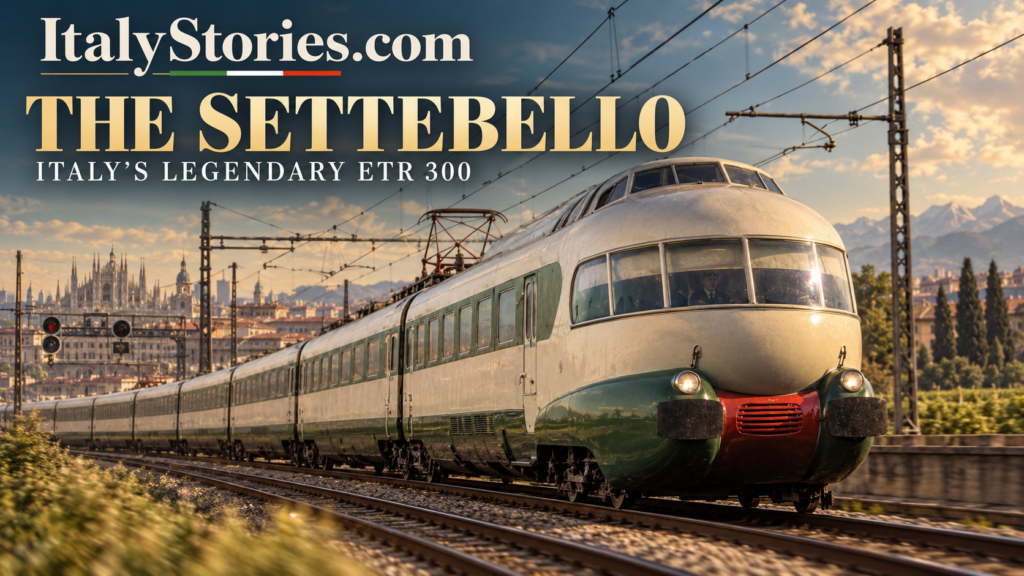
When the ETR 300 Settebello entered regular service between Milan and Rome in 1953, it did much more than shorten the distance between Italy’s two most important cities. It announced that a wounded country had returned to the front rank of European industry, engineering and design. With its extraordinary rounded nose, panoramic lounges, elevated driving cab and luxurious interiors, the Settebello looked less like an ordinary train than a machine that had arrived from the future.
During the 1950s, many trains were fast and some were comfortable, but very few possessed a genuine personality. The Settebello had one from the moment it appeared. Its seven-car formation moved across Italy in an elegant combination of magnolia green and mist grey, carrying businesspeople, politicians, artists, actors and wealthy international travellers between Milan, Bologna, Florence and Rome. For more than thirty years, it remained one of the most recognisable symbols of Italian rail travel and of the economic miracle that transformed the country after the Second World War.
The Settebello was not merely designed to transport passengers. It was created to impress them.
Italy Returns to the Rails
At the end of the Second World War, the Italian railway system was in a dramatic condition. Stations, bridges, tracks, electrical installations and rolling stock had been damaged or destroyed. Many of the elegant ETR 200 electric trains that had represented Italian technical progress during the 1930s were unusable or required extensive rebuilding.
The reconstruction of the railways became part of the reconstruction of Italy itself. Ferrovie dello Stato repaired the network, restored damaged trains and began considering an entirely new generation of fast electric units for the most prestigious national services. These trains would have to be reliable and technologically advanced, but they would also need to express a new image of the country.
Italy was beginning to move beyond the grey years of war and scarcity. Factories were reopening, industrial production was increasing and a new urban middle class was emerging. Milan became the engine room of this transformation, while Rome was returning to its role as a political, cultural and cinematic capital. The line connecting the two cities was therefore not simply another railway route. It was the central axis of a country accelerating towards modernity.
The design of the new train began around 1950. Construction was entrusted to the Società Italiana Ernesto Breda at Sesto San Giovanni, one of Italy’s most important industrial centres. Breda already possessed considerable experience in producing fast electric rolling stock, but the ETR 300 would be unlike anything it had previously built.
The first trainset, ETR 301, was presented on November 21, 1952, before entering a period of testing. The second, ETR 302, followed in 1953. The two trains began regular Milan–Rome service on March 30, 1953. A third unit, ETR 303, was completed in 1959.
Only three examples were ultimately produced. An initial plan for a larger fleet was reduced because these highly sophisticated trains were extraordinarily expensive. That rarity would contribute to their prestige. Seeing a Settebello arrive at a station was never an ordinary event.
Why Was It Called Settebello?
The official railway classification was ETR 300, with ETR standing for ElettroTreno Rapido, or Fast Electric Train. The name by which it became famous had a much more affectionate and characteristically Italian origin.
During construction, workers at Breda reportedly began calling the new train “Settebello,” the popular name of the seven of coins in the traditional Italian card game scopa. The card is often regarded as particularly valuable or fortunate. The nickname also suited a train formed of seven carriages, and it quickly escaped from the factory into newspapers and public conversation.
The name was eventually adopted officially, accompanied by an emblem representing the seven of coins. It was a perfect choice: informal, memorable and instantly Italian. “ETR 300” described a machine, but “Settebello” described a character.
The train looked proud of its name. It did not hide behind anonymity or bureaucratic numbering. It arrived with the confidence of a film star, carrying its emblem like a tailored monogram.
The Most Extraordinary View on European Rails
The most famous feature of the Settebello was visible before a passenger even stepped aboard. At both ends of the train, the rounded nose contained a panoramic observation lounge known as the belvedere. Large curved windows offered passengers a spectacular forward view of the railway.
Instead of occupying the conventional position at the front, the driver sat in a small elevated cab above and behind the passenger lounge. The controls could be reached through an internal passage, while the people seated below watched the tracks unfold directly in front of them.
It was an audacious arrangement. Normally, the front of a train belonged entirely to machinery and railway personnel. On the Settebello, it became one of the most desirable places for passengers. Railway travel was transformed into theatre, with rails, signals, tunnels and stations providing a constantly changing performance through the glass.
Children must have felt as though they were driving the train themselves. Adults could experience the Italian landscape from a perspective normally reserved for the driver: the long straight lines across the Po Valley, the approach to Bologna, the mountain tunnels of the Apennines and the descent toward Florence and Rome.
The elevated cab gave the train its unusual double-level nose, whose rounded surfaces were influenced by contemporary aeronautical design. In an age fascinated by jet aircraft, speed and the conquest of distance, the Settebello possessed the optimism of a machine designed to move confidently into tomorrow.
The panoramic lounges were not decorative curiosities. They represented the philosophy of the entire project. The railway journey was not an inconvenient interval between departure and arrival. It was an experience worth watching.
Italian Design at 160 Kilometres per Hour
The Settebello’s exterior was only the beginning. Its interiors were entrusted principally to the architect Giulio Minoletti, who approached the train as a complete environment rather than a collection of seats inside a metal shell. Every space had to combine elegance, function and comfort while surviving vibration, movement and the intensive demands of railway service.
The passenger saloons were divided into intimate areas instead of resembling the long, anonymous corridors found on conventional trains. Armchairs could be adjusted and rotated, allowing travellers to face one another for conversation or turn toward the windows. Carefully selected fabrics, woods, laminates, metals and lighting fixtures created an atmosphere closer to a fashionable hotel or private club than a railway carriage.
The interiors reflected the best qualities of post-war Italian design: clean lines, practical intelligence and a refusal to believe that functionality required ugliness. Nothing appeared heavy or unnecessarily monumental. The spaces felt modern, refined and distinctly Italian.
The train offered only first-class accommodation during the greater part of its prestigious career. It included a restaurant, kitchen, bar and baggage facilities. Meals were served at properly arranged tables while the landscape passed outside. Passengers could enjoy restaurant service instead of balancing a wrapped sandwich on their knees, and even telephone communication was available through the railway network—an impressive luxury during the 1950s.
The original trains offered around 160 passenger seats. Later modifications, introduced with the third unit and extended to the others, increased capacity to approximately 190. The restaurant was also enlarged, but the Settebello remained intentionally spacious. Its purpose was not to carry the maximum number of people at the minimum cost. It was designed to provide the best possible journey.
Travelling aboard it became a social occasion. Important passengers recognised one another, conversations began in the bar and business continued over lunch. The train connected not only cities but also the political, industrial and cultural worlds of post-war Italy.
The Engineering Beneath the Elegance
Behind its sophisticated appearance was an equally ambitious mechanical project. The Settebello was a permanently coupled seven-car electric trainset approximately 165.5 metres long. Unlike a conventional train pulled by a separate locomotive, its traction equipment was distributed throughout the formation.
The cars were organised in articulated groups, with some adjacent bodies sharing Jacobs-type bogies. This solution reduced the number of bogies, saved weight and contributed to a more stable and unified train. It also made the Settebello look like a single complete machine rather than a random series of coaches connected behind a locomotive.
Power was collected from Italy’s 3,000-volt direct-current overhead system through pantographs. Twelve traction motors distributed power across the train, providing strong acceleration and reducing dependence on a single powered vehicle. The original continuous output was about 1,800 kilowatts, with greater power available for shorter periods.
The Settebello was initially authorised for speeds around 160 kilometres per hour, already impressive on the Italian network of the early 1950s. The problem was not simply building a faster train. Tracks, signalling systems, curves and braking distances also had to support higher speeds. Much of the Milan–Rome route had been designed in an earlier era, particularly the difficult crossing of the Apennines.
The train nevertheless demonstrated excellent performance. In 1958 it covered the approximately 147-kilometre section between Piacenza and Bologna in about 68 and a half minutes, maintaining an average speed of roughly 135.5 kilometres per hour despite restrictions along the route.
In 1969 the ETR 300 fleet underwent an important technical modernisation. More powerful T165 motors were fitted, raising continuous output to approximately 2,616 kilowatts and short-term output to more than 3,100 kilowatts. New bogies, rheostatic braking, improved signalling equipment and modifications to the front lighting were introduced. These upgrades prepared the trains for operation at speeds theoretically reaching 200 kilometres per hour, although such speed was not normally sustained in regular service on the infrastructure available at the time.
The modernisation demonstrated how advanced the original design had been. A train created at the beginning of the 1950s could still be developed for the requirements of a much faster railway nearly twenty years later.
Milan, Bologna, Florence and Rome
The Settebello’s natural territory was the Milan–Rome route. It linked the financial and industrial north with the political capital, passing through Bologna and Florence. The service was aimed at passengers who required speed but expected comfort and prestige.
In the early years, travelling between Milan and Rome still required considerably more time than it does today. The Settebello gradually reduced the journey as infrastructure and operating methods improved. By the 1970s, it could complete the trip in approximately five hours and 45 minutes, an exceptional performance before the modern high-speed network and the long tunnels of today’s Direttissima.
Its principal intermediate stops were Bologna and Florence. The rhythm of the journey became familiar: departure from Milano Centrale, rapid progress across the Po Valley, the complicated passage through the Apennines, Florence and then the final run south toward Rome.
At the major stations, the arrival of the Settebello attracted attention. Its unusual nose, elegant colour scheme and seven-of-coins emblem made it immediately recognisable. Railway employees treated it as the flagship of the system, while passengers knew that boarding it meant entering the highest level of Italian rail travel.
The train also appeared in promotional films, posters and photographs designed to present a modern image of Italy abroad. It was an ideal ambassador because it united three qualities the country wanted the world to recognise: technical competence, speed and beauty.
The Settebello and the Italian Economic Miracle
The Settebello reached maturity during the years of the Italian economic miracle. Between the late 1950s and early 1960s, Italy changed with astonishing speed. Millions of people moved from rural areas to industrial cities, car ownership increased, motorways expanded and household appliances entered ordinary homes.
Industrial products such as Vespa scooters, Olivetti typewriters, Fiat automobiles and Italian furniture became internationally admired. The cinema of Fellini, Visconti and Antonioni carried a sophisticated image of Italy around the world. Fashion, architecture and product design flourished.
The Settebello belonged naturally to this landscape. It was a railway equivalent of a beautifully designed Italian grand tourer: technically serious, visually distinctive and capable of making speed feel elegant.
It also embodied a specifically Italian conviction that a machine should not be reduced to its mechanical purpose. A chair should be comfortable but also beautiful. A typewriter should work perfectly but also deserve a place on a desk. A train should be fast, but it should also provide an emotional experience.
The Settebello made modernity feel welcoming. Its future was not cold, metallic or intimidating. It contained armchairs, conversation, good food, panoramic windows and carefully designed light.
From National Flagship to Trans Europ Express
On May 26, 1974, the Settebello entered the prestigious Trans Europ Express network. The TEE system connected major European cities with fast, first-class trains aimed particularly at business travellers. Admission placed the Milan–Rome service among Europe’s most important international-quality railway operations, even though its route remained entirely within Italy.
The trains operated as TEE 68 and 69, carrying the Settebello name and maintaining their status as the national flagship. By then, however, railway technology was changing. New locomotive-hauled trains equipped with modern Gran Comfort coaches offered greater flexibility. Capacity could be adjusted by adding or removing carriages, while maintenance was easier because a problem in one coach did not immobilise an entire permanently coupled trainset.
The very qualities that made the ETR 300 special also created limitations. There were only three units, their interiors were costly to maintain, and their fixed formation was less adaptable than conventional trains. They were masterpieces, but masterpieces are not always the easiest machines to operate economically.
On June 2, 1984, the Settebello service between Milan and Rome came to an end. It was replaced by the TEE Colosseum, formed with conventional Gran Comfort coaches. The ETR 300 units were reassigned to other routes connecting cities including Milan, Venice, Florence and Genoa.
The trains continued working, but the magic was fading. Later interior alterations removed much of the original furniture and divided spaces differently. The attempt to make the trains more practical also erased part of what had made them unique.
Regular operation ended during the early 1990s. Two of the three trainsets were eventually dismantled. Only ETR 302 survived, used for a time on exhibitions and special journeys before being withdrawn in 2004.
The Long Road Back
The surviving ETR 302 then entered a difficult period. It remained stored for years, exposed to weather, deterioration and vandalism. Components disappeared, surfaces corroded and the once magnificent train seemed dangerously close to sharing the fate of its two companions.
In 2016, Fondazione FS Italiane arranged for the train to be moved to the railway workshops at Voghera, beginning the path toward recovery. It was later transferred to specialised workshops for an exceptionally complex restoration project.
Restoring the Settebello does not simply mean repairing motors and repainting the body. Much of the original interior was removed or lost, requiring furniture, fabrics, lighting and decorative elements to be reconstructed through historical photographs, drawings and surviving documentation. Modern safety and signalling systems must also be installed without destroying the character of the train.
It is an enormous undertaking, but the importance of the surviving Settebello goes far beyond railway nostalgia. The ETR 302 is a major work of Italian industrial design. Its preservation is comparable to restoring a historic building, an important automobile or a celebrated piece of architecture.
A Train That Was More Than Transportation
Today, Italy has one of Europe’s most successful high-speed railway networks. Modern trains travel between Milan and Rome in less than three hours, offering levels of performance the designers of the ETR 300 could only imagine. Yet few contemporary trains inspire the same affection.
The Settebello possessed something difficult to calculate in kilometres per hour or kilowatts. It had theatrical presence. Passengers seated in the belvedere did not merely reach their destination; they watched Italy open in front of them. People waiting on platforms did not simply see another service arrive; they saw a national symbol.
Its beauty was not accidental decoration placed over ordinary engineering. Form and function were developed together. The panoramic nose determined the position of the driver. The articulated formation influenced the train’s movement and silhouette. The interiors transformed travel time into social and cultural space.
The Settebello represented a moment when Italy looked at the future with remarkable confidence. The country had suffered poverty, dictatorship and war, but now it was building machines that the rest of the world admired. The train carried that optimism along the tracks every day.
More than seventy years after its debut, the ETR 300 Settebello remains one of the most beautiful trains ever created. It was fast without being brutal, luxurious without becoming vulgar and futuristic without losing warmth. It put post-war Italy on the tracks of the future—and made the journey look magnificent.
Follow ItalyStories.com to discover more extraordinary stories about Italian engineering, design, culture and the machines that changed the world.