

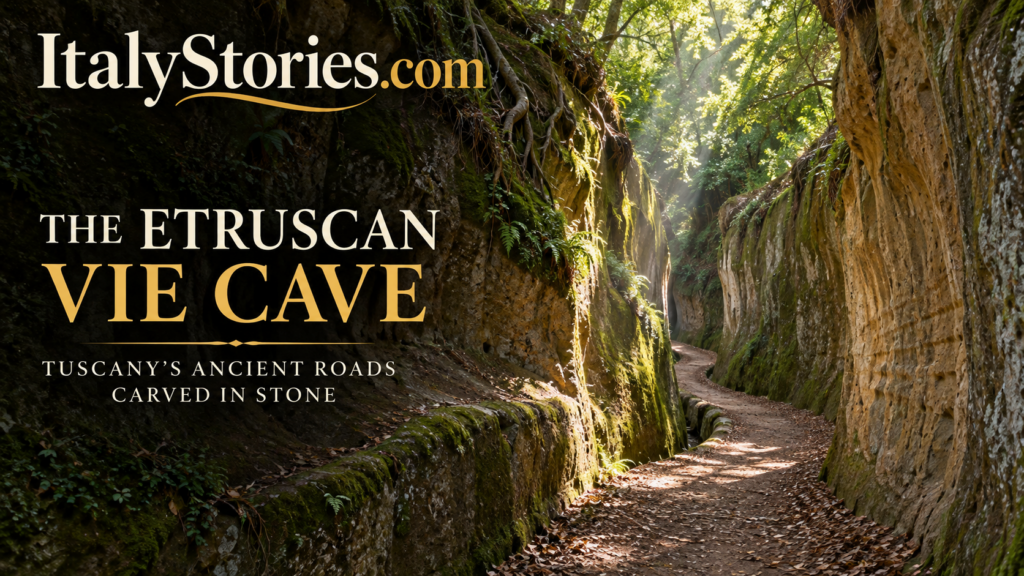
They resemble narrow canyons created by an ancient river, yet these extraordinary corridors were carved by human hands. Hidden in the countryside of southern Tuscany, between Pitigliano, Sovana and Sorano, the Vie Cave are among the most mysterious and impressive remains of the Etruscan world.
Some passages descend deep into the volcanic rock, enclosed by walls that can rise more than twenty metres above the path. Sunlight enters only through the narrow opening overhead, illuminating moss, ferns, twisted roots and the marks left on the stone by centuries of use. Walking through them feels less like following an ordinary road and more like entering a secret passage into Italy’s distant past.
The Vie Cave were excavated into the area’s soft volcanic tuff, probably beginning during the Etruscan period. They connected settlements, agricultural areas and necropolises surrounding the ancient towns of the Maremma. However, their precise purpose is still debated. Some scholars consider them mainly practical roads, while others believe that certain routes may also have possessed a religious or ceremonial meaning because of their proximity to tombs and sacred places.
Whatever their original function, creating them required an extraordinary amount of work. The builders had no modern machinery. Stone had to be removed using simple tools, one section at a time, until entire roads appeared inside the hills. The surfaces still reveal cuts, grooves and irregularities produced by generations of travellers, animals and carts.
Over the centuries, erosion and repeated maintenance made several passages deeper. What may have started as a relatively shallow road gradually became a monumental corridor enclosed by towering walls. Rainwater flowed along the paths, wheels wore grooves into the ground and later inhabitants continued to modify the routes according to their needs.
The Vie Cave did not disappear after the end of the Etruscan civilisation. Romans, medieval travellers, farmers and local communities continued to use them. Christian crosses, small shrines and sacred images were sometimes added to the walls. These symbols were believed to protect travellers and drive away evil presences from places that had long been surrounded by legends and superstition.
Each path has its own appearance and atmosphere. The Via Cava di San Giuseppe near Pitigliano is associated with a traditional torchlight celebration, while the Cavone and Via Cava di San Sebastiano near Sovana pass through a landscape rich in Etruscan archaeological remains. Around Sorano, the Via Cava di San Rocco winds beneath the remains of ancient settlements and tombs.
The vegetation makes these roads even more remarkable. Ferns emerge from cracks in the rock, moss creates green carpets on the shaded walls and tree roots descend from above like enormous natural sculptures. In some stretches, the temperature seems to fall as soon as the traveller enters the passage. The sounds of the surrounding countryside fade, replaced by dripping water, rustling leaves and footsteps echoing against the stone.
These are not artificial attractions built to impress modern visitors. They are working landscapes shaped by more than two thousand years of history. Their beauty comes from the meeting of archaeology and nature: a human road slowly reclaimed, decorated and protected by the forest.
The Vie Cave also reveal something essential about the Etruscans. Although many details of their civilisation remain uncertain, these paths demonstrate their ability to understand and transform the landscape. Rather than building over the hills, they entered them, creating roads that became part of the rock itself.
Today, walking through one of these ancient corridors offers an unusual connection with the past. There are no glass cases separating the traveller from history. The same stone lies underfoot, the same walls rise overhead and the route continues towards the same Tuscan settlements it once served.
Perhaps this is why the Vie Cave remain so fascinating. They do not provide all the answers. Their original builders left no explanation carved beside the entrance, and the silence surrounding them allows history and imagination to coexist.
In the heart of Tuscany, far from the famous Renaissance cities, these mysterious roads remind us that Italy still contains places capable of surprising even those who believe they already know it. The Vie Cave are not simply paths through the countryside. They are passages through time, carved into stone and guarded by the forest.