

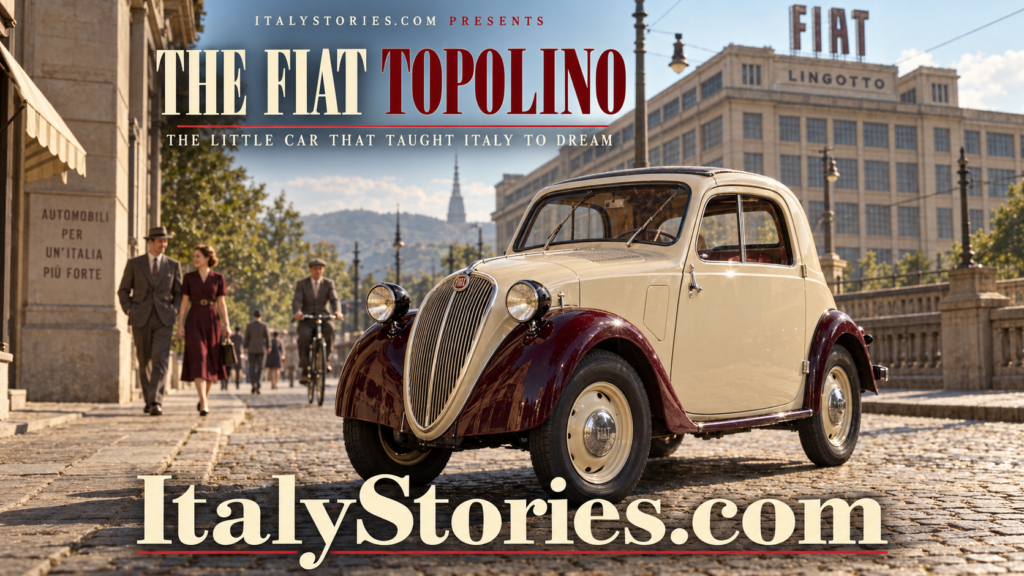
The Fiat Topolino was born in a country where the automobile was still a distant object for most families. In the Italy of the early 1930s, a car belonged to industrialists, doctors, wealthy professionals, government officials and the fortunate few who could afford not only to buy one, but also to feed it with petrol, maintain it and find somewhere to keep it. The streets were filled with bicycles, trams, carts, motorcycles and pedestrians. In the countryside, distances were still measured through the endurance of animals and people. Fiat understood that the future of the motor industry could not depend forever on large, expensive cars. If the automobile was to leave the world of privilege, it had to become smaller, lighter, cheaper and easier to operate. It needed to be a complete car, not a fragile cyclecar or an improvised machine assembled around a motorcycle engine. It also had to look respectable, because even a modest Italian buyer wanted dignity, not a mechanical apology. From that difficult combination of ambition and economy came the first Fiat 500, launched in 1936 and almost immediately renamed Topolino—“little mouse”—by the public.
Its familiar nickname was never necessary on the badge. People gave it to the car spontaneously, partly because Topolino was the Italian name for Mickey Mouse and partly because the little Fiat’s projecting round headlamps, narrow bonnet and alert expression made it resemble a friendly mechanical creature. It was tiny but not timid, inexpensive by automobile standards but never cheap in conception. Its proportions generated affection before the engine had even started. With the Topolino, Fiat discovered something that would become central to its identity: an economical car could be emotionally desirable. It did not need to imitate luxury badly. It could create a personality of its own.
A Difficult Assignment for a Young Engineer
The project emerged from Fiat’s desire to develop a genuine small car for a much wider public. The frequently repeated story that the Fascist government demanded a car costing 5,000 lire contains a mixture of political propaganda and industrial reality. What is certain is that Giovanni Agnelli wanted Fiat to explore the lowest possible end of the market and that, in 1933, the task reached a young engineer named Dante Giacosa. Giacosa had joined Fiat in 1928 and worked under Antonio Fessia, one of the company’s most influential technical figures. Still in his twenties when he became deeply involved in the project, he was asked to design the mechanical heart and chassis of a car in which every kilogram, component and centimetre mattered.
Designing an inexpensive car is often more difficult than designing an expensive one. A luxury model can solve problems by adding stronger materials, additional mechanisms or more generous dimensions. A people’s car must solve them by removing everything unnecessary without compromising the essentials. Giacosa approached the assignment with the mentality that would define his career. He did not merely shrink an existing automobile. He reconsidered the relationship among engine, radiator, gearbox, suspension, passenger compartment and chassis so that the small external dimensions could contain as much usable space as possible.
The resulting car was just over three metres long and approximately 1.27 metres wide. Its wheelbase was two metres, and it weighed little more than half a tonne depending on the version. These figures made it one of the smallest mass-produced cars of its era. Yet it possessed a water-cooled four-cylinder engine, a four-speed gearbox, hydraulic brakes and independent front suspension. In other words, it was mechanically a real automobile reduced to its most intelligent essentials.
The Ingenious Mechanics Beneath the Friendly Face
The first Topolino used a 569 cc inline four-cylinder engine with side valves. Its output was approximately 13 horsepower, a figure that appears almost comic today but was sufficient to move such a light and narrow car at around 85 kilometres per hour. Nobody bought a Topolino to dominate the autostrada. On the ordinary roads of the 1930s, many of them unpaved or badly maintained, its realistic cruising speed was far lower. What mattered was that it could travel considerable distances while using roughly five to six litres of petrol per 100 kilometres.
The packaging of the mechanical components was particularly clever. The engine sat far forward, extending over the front axle, while the radiator was positioned behind it rather than in front. This allowed the bonnet to slope downward instead of ending in the tall, vertical wall typical of many contemporary cars. The driver gained unusually good forward visibility, and the Topolino acquired its unmistakable aerodynamic nose.
The cooling system worked through thermosiphon circulation, exploiting the natural movement of hot and cold water and eliminating the need for a conventional water pump. Fuel could reach the carburettor by gravity, reducing the number of components once again. These decisions were not primitive shortcuts. They were examples of disciplined engineering: if a physical principle could perform a task reliably, there was no reason to add another pump, belt or mechanism that would increase cost and create another possible failure.
At the front, independent suspension combined wishbones with a transverse leaf spring. This arrangement gave the small car respectable comfort and steering precision on difficult roads. Hydraulic brakes were another serious feature in a vehicle conceived for economy. At the rear, early cars used short quarter-elliptic springs. Experience soon showed that owners rarely respected the Topolino’s official two-seat capacity. Families loaded children, relatives, luggage, parcels and sometimes an astonishing quantity of household possessions behind the front seats. Fiat consequently strengthened and revised the rear structure, introducing longer semi-elliptic springs and modifying the chassis to tolerate the real life that customers imposed upon the car.
Officially, the early Topolino was a two-seater with space behind the seats for luggage. In practice, Italians interpreted that area with impressive imagination. Children travelled there, adults squeezed themselves into positions never considered by the designers, and holiday luggage rose toward the roof like a small mountain held together by rope. The Topolino was not spacious, but it offered something more important: independence. It allowed a couple or a family to leave the railway timetable behind and decide when to depart, where to stop and which road to take.
A Small Car That Was Not Yet for Everyone
The original goal had been an automobile costing around 5,000 lire, but the production car reached the market at roughly 8,900 lire, with some early price lists and versions approaching 9,750. That was competitive for a complete automobile but still represented an enormous amount of money for an ordinary worker. The Topolino therefore did not instantly turn Italy into a nation of motorists. Describing it as the car that single-handedly “put Italy on wheels” is emotionally attractive, but historically incomplete.
Before the Second World War, private motorisation remained limited. The Topolino broadened access to car ownership, especially among professionals, shopkeepers, small business owners and families with stable incomes, but it did not yet become a universal household object. Its greater achievement was psychological and industrial. It demonstrated that a small car could be reliable, civilised and desirable. It familiarised Italy with the possibility of private mobility and taught Fiat how to design and manufacture compact automobiles on a large scale. The true explosion of mass motoring would arrive later, with the Fiat 600 in 1955 and the Nuova 500 in 1957. Those cars inherited a road that the Topolino had already opened.
When the first Fiat 500 was presented in June 1936, its appearance helped disguise the austerity of its construction. The separate flowing fenders, externally mounted headlamps, narrow shield-shaped grille and gently curved roof gave it the air of a miniature grand tourer. The long bonnet suggested more power than the engine could honestly provide, while the compact cabin appeared almost formal. Buyers could choose a closed saloon or a trasformabile version with a large folding fabric roof. The latter became especially popular in a country where sunshine was free and steel was not.
War Interrupts the Journey
The Topolino’s career crossed one of the most violent periods in European history. Production continued during the Second World War, although civilian manufacturing was increasingly constrained by shortages, military priorities and the disruption of bombing. The car was never intended as a military vehicle: its limited power, modest ground clearance and weight distribution made it far better suited to roads than battlefields. Nevertheless, wartime necessity placed many examples into service as staff and communications vehicles. Others were requisitioned, damaged, abandoned or adapted in ways their designers had never imagined.
For private owners, keeping a Topolino running during the war demanded ingenuity. Petrol was scarce, tyres were difficult to replace and spare parts could become precious objects. Some cars were converted to run on alternative fuels, while others simply disappeared into barns and garages to wait for better times. The survival of many early examples says as much about the resourcefulness of their owners as it does about Fiat engineering.
When peace returned, Italy was exhausted. Cities had been bombed, roads and railways damaged, factories disrupted and family savings destroyed. Yet the need for mobility was greater than ever. The Topolino re-emerged not merely as a prewar product, but as a practical instrument of reconstruction. Doctors used it to reach patients, representatives crossed provinces in it, artisans transformed commercial versions into mobile workshops, and families carried goods between town and countryside. On the damaged roads of the late 1940s, the little Fiat became part passenger car, part van and part stubborn domestic animal.
The 500 B: Familiar Outside, New Beneath the Bonnet
In 1948 Fiat introduced the 500 B. At first glance it looked very similar to the original model, but its mechanics had evolved substantially. The 569 cc engine received overhead valves operated through pushrods and rocker arms. Power increased to approximately 16.5 horsepower, while breathing, efficiency and flexibility improved. Maximum speed rose toward 95 kilometres per hour, though the real benefit was not the chance to travel ten kilometres per hour faster. The stronger engine made hills, overtaking and heavily loaded journeys less exhausting.
The chassis also received refinements, including improved damping and revisions intended to make the car more comfortable and stable. An optional heating system made winter journeys rather less heroic. The Topolino was slowly becoming more mature without abandoning its original philosophy.
The most significant addition was the 500 B Giardiniera, a small four-seat estate car with a rear door and folding rear seat. Its body used an external wooden structure and wood-derived panels, following the fashion of American “woodies” but also reducing the need for expensive pressed-steel tooling. The result was charming, practical and unexpectedly elegant. It allowed the Topolino platform to serve families, tradespeople and rural users who needed more space than the saloon could offer.
The Giardiniera demonstrated that a small car did not have to perform a single task. It could carry passengers during the week, goods for a shop, produce from the countryside or luggage for a rare holiday. This versatility would become one of the great traditions of Italian small-car design.
The 500 C Brings the Topolino into a New Era
The 500 B remained in production only briefly. In 1949 it was replaced by the Fiat 500 C, the most extensively revised version in the Topolino family and reportedly the hundredth passenger-car model developed by Fiat. The old freestanding headlamps disappeared into the front wings, while a wider horizontal grille and smoother body surfaces gave the car a more modern, postwar expression. The externally mounted spare wheel vanished from the tail, producing a cleaner shape. The engine retained its overhead-valve arrangement, with an aluminium cylinder head replacing the earlier cast-iron component.
Some enthusiasts prefer the innocent face of the first series, but the 500 C was a more rational car for a changing Italy. Its styling no longer looked back toward the early 1930s. It belonged to a country attempting to modernise, rebuild its industries and participate in a new European economy.
The large folding roof became a defining feature. It saved metal, reduced weight and turned every journey into a form of inexpensive open-air motoring. With the fabric rolled back, the little cabin filled with sunlight, wind and the mechanical conversation of the four-cylinder engine. The Topolino did not isolate its occupants from the landscape. It placed them directly inside it.
The Giardiniera continued alongside the saloon until the wooden construction was replaced by the all-steel Belvedere in the early 1950s. The new name referred to a place offering a broad view, an appropriate description for a compact estate car with generous windows. The pressed-steel body was easier to manufacture consistently and more durable in daily use. The Belvedere became one of the most characterful members of the family and an important ancestor of later Fiat estate cars.
A Platform for Craftsmen, Coachbuilders and Racers
Because the Topolino was light, simple and relatively accessible, it soon attracted Italian coachbuilders and tuning specialists. Its chassis and mechanical components became the basis for vans, estate cars, open sports bodies and competition machines. Companies such as Siata, Giannini, Zagato and other workshops discovered that reducing weight, improving breathing and fitting a streamlined body could transform the modest 569 cc Fiat into a surprisingly effective small racing car.
This world of Topolino-based specials helped democratise Italian motorsport. A young enthusiast who could never dream of buying an Alfa Romeo or Maserati might acquire used Fiat mechanical parts, modify an engine and construct a small barchetta. Performance remained relative, but competition is never measured only by absolute speed. On narrow roads and demanding circuits, ingenuity could compensate for a lack of money.
Elio Zagato began his own competition experience with a heavily transformed Topolino van chassis. Similar adventures unfolded in workshops throughout Italy, where engines were bored out, cylinder heads modified and lightweight aluminium bodies shaped by hand. Some of the people who learned their craft through these humble machines later contributed to the extraordinary flowering of Italian sports-car engineering during the 1950s and 1960s.
The Topolino’s influence also travelled abroad. Fiat-related companies and licensees produced local versions in several countries. In France, Simca manufactured the closely related Simca 5 and later Simca 6. Versions were also assembled or produced through Fiat-associated operations in Germany, Austria, Poland and India. The little car became an international industrial idea: Italian packaging and mechanical simplicity adapted to different markets.
The Topolino in the Italian Imagination
Machines acquire cultural meaning when people place their own lives inside them. The Topolino became associated with courtship, Sunday outings, seaside journeys and the first family holidays taken without a train. It appeared in films and photographs because it was immediately recognisable and because its modest dimensions made the people around it seem important. It never dominated a scene aggressively. It participated in it.
For many Italians, the car represented the first moment when distance became negotiable. A village was no longer isolated if a doctor, teacher or merchant could reach it independently. A city family could visit relatives in the countryside without planning its life around a railway connection. Young couples could disappear beyond the last tram stop, an advantage that no technical catalogue was likely to mention.
The emotional power of the car survived long after production ended. Paolo Conte’s song “La Topolino amaranto,” released in 1975 and set during the summer of 1946, captured the mixture of poverty, hope and freedom associated with the little Fiat. The amaranth-coloured Topolino in the song is not simply transportation. It is a time machine carrying its passengers into the uncertain happiness of the first postwar summer.
End of Production and the Beginning of Mass Motorisation
By the middle of the 1950s, the Topolino’s architecture had reached its natural limit. Italy was changing rapidly. Industrial employment was growing, internal migration was accelerating and families expected more space, performance and comfort. Fiat needed a car designed for large-scale postwar production rather than an improved continuation of a prewar concept.
The Fiat 600 arrived in 1955 with a rear-mounted engine, four proper seats and a more efficient use of interior space. Two years later, the Nuova 500 took the original numerical name and reinterpreted the Topolino’s mission with an air-cooled two-cylinder engine, rear-engine layout and a body perfectly suited to the crowded streets of modern Italy.
Production of the Topolino family ended in 1955 after approximately 520,000 examples had been built across its three main series. That figure was impressive, particularly considering the war years, but it was small compared with the millions of Fiat 600s and Nuova 500s that followed. The statistics reveal an important distinction: the Topolino did not complete Italy’s motorisation. It made it imaginable.
Its engineering lessons passed directly into later Fiats. Dante Giacosa continued to refine the art of designing compact, efficient cars and eventually became one of the most influential automotive engineers of the twentieth century. His work on the Topolino established the method he would apply repeatedly: reduce weight, simplify mechanisms, concentrate space around people and never assume that economy must eliminate character.
Why the Fiat Topolino Still Matters
A surviving Topolino seems delicate beside modern traffic, yet the principles behind it remain remarkably contemporary. It used minimal material, consumed little fuel, occupied little road space and performed its intended task without excess. It was repairable, mechanically understandable and adaptable to numerous roles. These virtues were born from economic necessity, but they now appear almost environmentally prophetic.
Driving one today requires a change of rhythm. The narrow cabin, upright steering wheel, long gear lever and modest acceleration make every action deliberate. The engine does not deliver effortless speed; it asks the driver to preserve momentum. Hills must be anticipated, braking distances respected and overtaking considered with the seriousness of a diplomatic mission. Yet the reward is a direct and cheerful connection with the machine. At ordinary speeds, the Topolino turns a short journey into an event.
Its appearance remains equally powerful. Children who know nothing about its history recognise it as something friendly. Older spectators may remember a parent, grandparent or photograph from a vanished family album. Enthusiasts see the intelligence hidden beneath the charm: the forward engine position, rear-mounted radiator, disciplined chassis, independent front suspension and extraordinary economy of construction.
The original Fiat 500 deserves its place among the great Italian automobiles not because it was fast, luxurious or technically extravagant, but because it gave dignity to smallness. It proved that an inexpensive car could possess identity, good engineering and emotional warmth. It survived dictatorship, war, scarcity and reconstruction, adapting itself to each new period without losing the essential simplicity of Giacosa’s idea.
The Topolino did not place every Italian family behind a steering wheel. That task belonged largely to the Fiat 600 and the Nuova 500. But before those cars could transform Italy, someone had to demonstrate that a tiny automobile could carry not only two people and their luggage, but also their expectations for a different life.
That is the Topolino’s real legacy. It was the little car that taught Italy to dream of movement—slowly at first, with thirteen horsepower, a folding roof and an optimistic face—before an entire nation finally started its engine.
Follow ItalyStories.com for more stories about the automobiles, engineers, designers and unforgettable machines that helped shape modern Italy.