

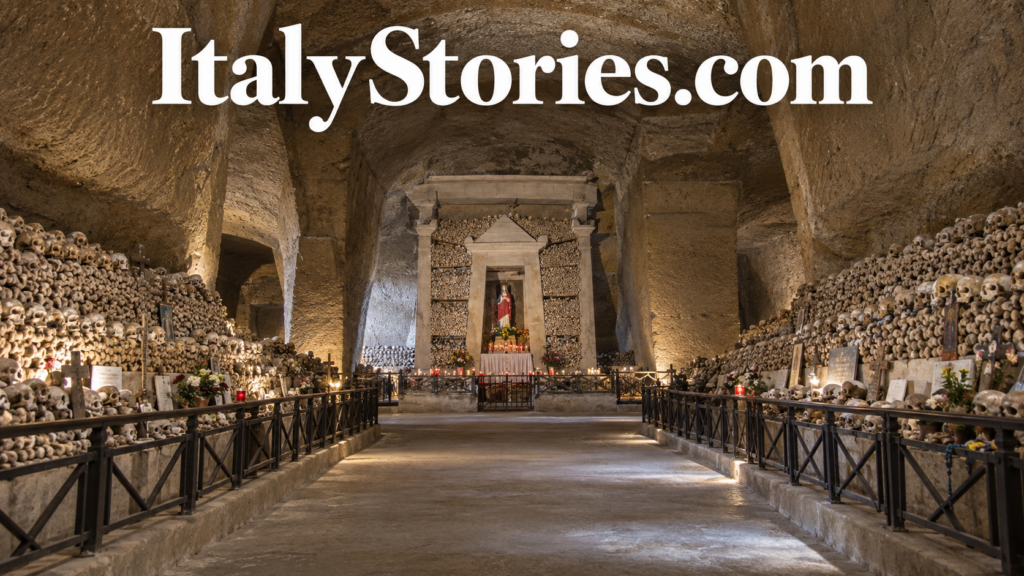
Naples has always lived in close company with its dead. Saints are addressed like old friends, miracles are discussed with the seriousness of daily news and the boundary between faith, superstition and family tradition is often wonderfully difficult to identify. Yet even in a city accustomed to mysteries, the Fontanelle Cemetery is something extraordinary: an immense underground ossuary containing the remains of tens of thousands of anonymous people, hidden inside ancient tuff quarries beneath the Rione Sanità.
After years of closure, the cemetery was officially returned to the city in April 2026. Its reopening was more than the recovery of another tourist attraction. For the people of the Sanità district, it marked the return of a place deeply connected with the history, suffering and popular spirituality of Naples.
The Cimitero delle Fontanelle is located beneath the Materdei hill, at the end of Via Fontanelle. Its name recalls the water sources that once existed in the area. Long before the caves became an ossuary, they were quarries from which yellow volcanic tuff was extracted to construct the buildings of Naples. As stone was removed, enormous underground spaces were created, with ceilings rising like the vaults of a subterranean cathedral.
Entering the cemetery does not feel like walking into a conventional burial ground. There are no orderly avenues, marble family tombs or rows of engraved headstones. Instead, visitors enter three immense galleries carved directly into the rock. Along their sides are thousands of skulls, tibias and other bones, arranged behind railings, placed on ledges or gathered in monumental displays.
Most of these remains no longer have names. They belonged to ordinary people whose identities were lost during some of the most difficult periods in the city’s history. Many bones came from overcrowded church burial grounds, while others were traditionally associated with victims of epidemics, including the devastating plague of 1656 and later outbreaks of cholera.
Naples expanded, burial spaces became increasingly crowded and old remains were often removed to make room for the newly dead. The vast caves at Fontanelle offered a practical, if unsettling, solution. Bones could be transported underground and stored away from the densely populated streets above.
For many years, the remains lay in confusion. In the nineteenth century, Canon Gaetano Barbati encouraged the organisation of the ossuary. With the assistance of local women, the bones were cleaned and arranged more systematically. Skulls were separated from other remains and placed where they could be seen, transforming the caves into the strange and solemn space that survives today.
It was then that the Fontanelle became associated with one of Naples’s most remarkable popular traditions: the cult of the anime pezzentelle, the “poor little souls.” These were believed to be abandoned souls in Purgatory, forgotten because no living relative remained to pray for them.
A Neapolitan—very often a woman—would choose or “adopt” an anonymous skull known as a capuzzella. She would clean it, pray for its soul, bring flowers, candles or rosaries and sometimes protect it inside a small wooden or glass box. In return, the soul was expected to offer protection, assistance or guidance.
The relationship was imagined almost as an agreement between two forms of poverty. The dead person was poor because nobody remembered their name; the living person might be poor because life had offered few opportunities. By caring for one another, both could hope to improve their condition: the forgotten soul through prayer and the devotee through supernatural help.
Some capuzzelle acquired names and elaborate legends. Devotees claimed that particular souls appeared in dreams, warned them of danger, helped with illness or revealed numbers to play in the Neapolitan lottery. If a favour was granted, the skull might receive a better box, embroidered cloth, candles or a written message of thanks.
This practice was never simply a fascination with death. It expressed the Neapolitan desire to give an identity to those who had lost everything, even their names. The skull ceased to be an anonymous object and became a person again—someone with whom the living could speak, argue, negotiate and form a bond.
The Catholic Church eventually discouraged the cult, concerned that devotion to anonymous remains was becoming mixed with superstition and requests for material favours. The tradition gradually declined, but its traces remain everywhere inside the cemetery. Small shrines, devotional objects and skulls once carefully protected by individual families preserve the memory of a relationship that lasted across the boundary between life and death.
Among the figures associated with the Fontanelle is the legendary Captain, whose skull became the centre of several ghost stories. One version tells of a young woman devoted to the Captain’s capuzzella and her jealous fiancé, who mocked the skull and invited it to their wedding. On the day of the ceremony, a mysterious man dressed in a military uniform supposedly appeared among the guests, revealing himself as the Captain before terrifying everyone present.
Another well-known skull is that of Donna Concetta, remembered as “the sweating skull.” Its polished surface was said to appear damp, and devotees interpreted this mysterious moisture as evidence of the soul’s supernatural activity. Such stories are impossible to verify, but they form an essential part of the cemetery’s identity and of Naples’s enormous oral tradition.
The Fontanelle Cemetery should not be treated like a horror-film set. The bones are real human remains, and the site carries the memory of poverty, epidemics and forgotten lives. Its atmosphere is certainly mysterious, but it is also profoundly moving. The great galleries show how a community transformed anonymity into remembrance and abandonment into an unusual form of affection.
The cemetery remained inaccessible for several years because of safety and conservation problems. Its reopening in April 2026 followed restoration, structural work and the development of a new system for managing visitors. The project was also connected with the cultural and social regeneration of the Rione Sanità, a district that contains some of Naples’s most important underground sites.
Visits are now organised and advance booking is required. Access is controlled to protect both the fragile environment and the solemn character of the ossuary. Opening arrangements, ticket options and available tours should always be checked on the official website before travelling.
The Rione Sanità itself deserves time. Built beyond the walls of ancient Naples and once crossed by processions heading towards burial sites, it contains catacombs, churches, historic palaces and lively neighbourhood streets. The return of the Fontanelle Cemetery adds another essential chapter to a district that has learned to transform its difficult history into cultural energy.
Few places explain Naples as powerfully as the Fontanelle. It is dramatic without having been designed as a spectacle, spiritual without fitting neatly into official religion and unsettling without losing its humanity. Its thousands of anonymous skulls do not merely speak about death. They tell the story of a city that refused to leave even its most forgotten souls completely alone.