

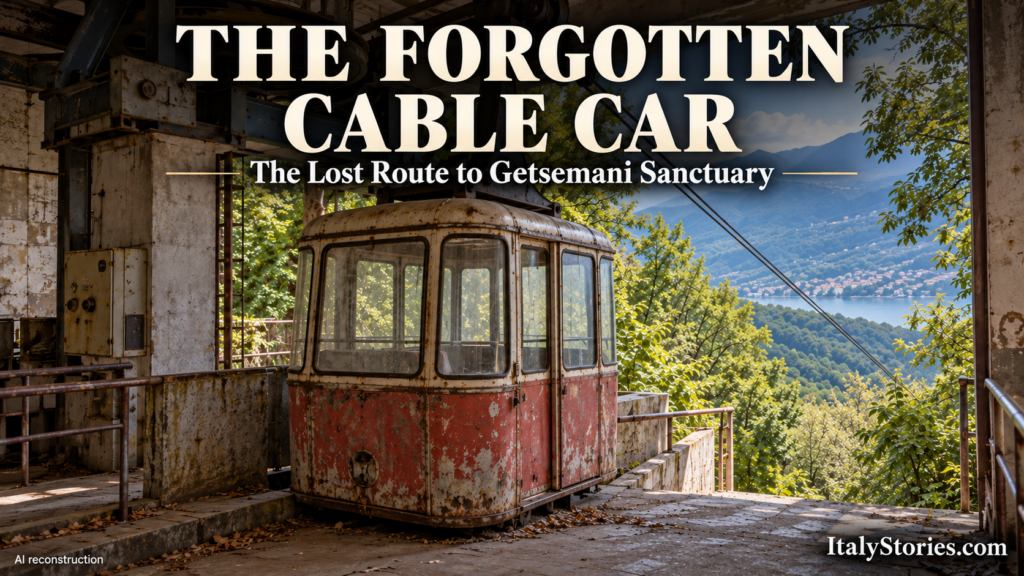
Only five people could fit inside. The journey was barely 200 metres long. Yet this tiny cable car had a destination unlike most others: a sanctuary hidden among the wooded slopes of Piedmont, in northern Italy. In Casale Corte Cerro, the Getsemani cable car once connected everyday village life with a place created for prayer, silence and reflection. Today, its abandoned machinery tells a lesser-known story of Italian faith and engineering.
Built in 1956, the installation linked the village to the Getsemani sanctuary, overcoming a height difference of approximately 85 metres. There were no intermediate towers along the short route. A single cabin travelled back and forth between the two stations, carrying up to five passengers at a time. Inside were two folding seats; luggage racks provided space for belongings. Everything about it was small in scale, but its purpose was clear: to provide a mechanical connection to the religious complex above.
Imagine that brief journey when the system was still running: stepping into a compact cabin, watching the ground fall away and seeing the woodland pass beneath you. Within a short distance, the familiar surroundings of the village would give way to the atmosphere of a spiritual retreat. For visitors arriving at the Getsemani, the ascent could become part of the experience itself, a quiet transition between the world below and the place they had come to reach.
The sanctuary complex was built during the 1950s at the initiative of Luigi Gedda, with a design by architect Ildo Avetta. It was conceived as a place for spiritual exercises and religious reflection, with accommodation forming part of the complex. Its architecture and artistic decoration gave it a distinctive identity. Works by Théodore Strawinsky enriched the sanctuary, including religious imagery that connected the buildings with the purpose for which they had been created.
There was also a walking route to the sanctuary. A stone-paved path, approximately 700 metres long, climbed through the woodland past the Stations of the Cross. Visitors approaching on foot followed an itinerary designed for meditation, with the landscape becoming part of their arrival. The cable car offered another way up, adding a small but remarkable piece of transport history to this wooded corner of Piedmont.
Eventually, the cabin stopped making its journeys. Accounts documenting the disused installation describe it stored in the upper station, with machinery and controls still present at the time of those observations. The short route became obscured by vegetation. A connection once kept clear for the passage of visitors slowly disappeared into the woodland around it.
The municipality now lists the Getsemani complex as closed to the public. Its history, however, extends beyond the image of an abandoned building or an idle cabin. This was a place planned, built and used by people who believed in its purpose. The little cable car was part of that ambition: a practical answer to a steep climb, created specifically to serve a sanctuary.
There is something especially moving about such modest forgotten places. A five-person cabin makes the past feel close and human. It invites us to think about individual journeys, about the people who operated the machinery and the visitors who stepped aboard. We may not know their names or what brought them there, but the existence of that small connection reminds us that this hillside once had a rhythm of arrivals and departures.
Italy’s history is also preserved in places like this: a quiet station, an unused mechanism, a wooded path leading to a closed doorway. The Getsemani cable car carried its passengers only a short distance, yet its story still offers a glimpse of the hopes, ideas and everyday ingenuity of another era.
Had you ever heard of this forgotten cable car in Piedmont? Did you or someone in your family visit the Getsemani sanctuary while it was open? If you have memories or old photographs, share them in the comments. They could help bring a little more of this story back into view.
Follow Italy Stories for more overlooked places, local memories and remarkable chapters of Italian history.