

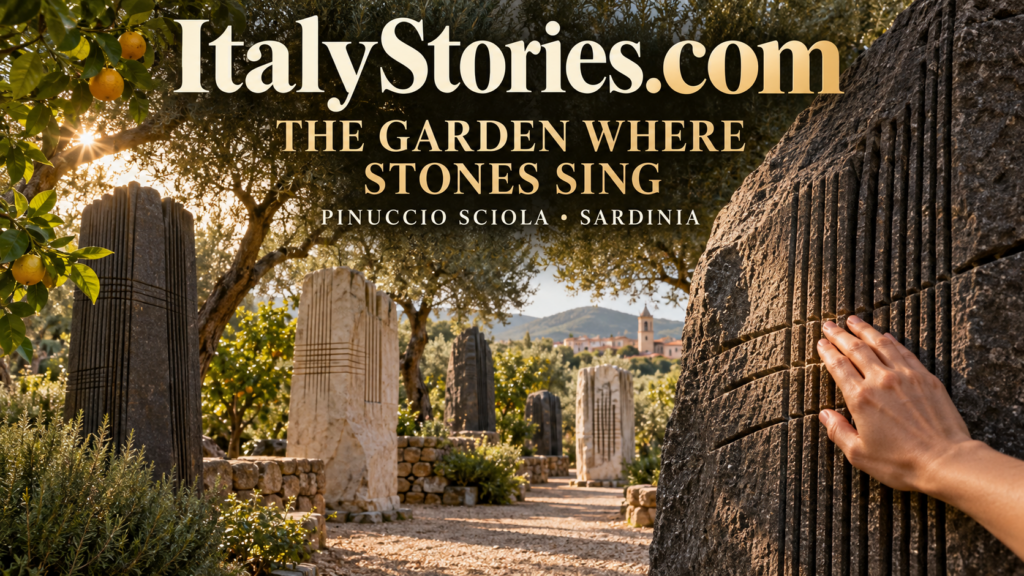
In a citrus garden on the outskirts of San Sperate, a small town in southern Sardinia, stones have learned to sing. They stand among orange trees and olive branches like mysterious modern menhirs, their surfaces crossed by hundreds of precise cuts. At first they seem silent, heavy and immovable, exactly as stone is expected to be. Then a hand passes gently across one of them and the garden fills with a sound that appears impossible: a deep vibration, a metallic echo, a glass-like note or a soft voice that seems to rise from inside the earth.
This is the Giardino Sonoro, the Sound Garden created by Sardinian sculptor Pinuccio Sciola. It is an open-air museum, an artist’s former workshop and one of the most unusual sensory experiences in Italy. Visitors do not come only to look at sculpture. They come to listen to limestone and basalt, to feel vibrations through their fingertips and to discover that one of nature’s hardest materials can produce sounds of astonishing delicacy.
The garden lies on land historically belonging to Sciola’s family, beyond the centre of San Sperate and not far from Cagliari. The setting is essential to the experience. These sculptures were not conceived for a silent white gallery separated from the landscape. They rise from Sardinian soil among Mediterranean plants, warmed by the sun and surrounded by the scent of citrus fruit. Birds, leaves and distant rural sounds become part of the performance. Nothing begins when a curtain rises and nothing truly ends. The music remains hidden inside the stone, waiting for the right gesture.
Pinuccio Sciola was born Giuseppe Sciola in San Sperate in 1942, into a farming family. His childhood was shaped by the physical world of the countryside: earth, tools, seeds, animals, dry stone, changing seasons and hands marked by work. He did not initially belong to the refined world of galleries and academies. His first artistic education came from observing nature and understanding materials not as abstract concepts, but as things that had to be touched, moved and transformed.
As a teenager, his talent earned him the opportunity to study art in Cagliari. From there his education expanded far beyond Sardinia. He travelled, studied and encountered artists and artistic movements across Europe. His experiences eventually took him to Mexico, where he came into contact with the great tradition of Mexican muralism and worked alongside David Alfaro Siqueiros. This idea of art as something public, collective and capable of transforming an entire community would become fundamental to Sciola’s vision.
In 1968, while Europe was experiencing political unrest and cultural revolution, Sciola returned to San Sperate with an idea that was both artistic and social. He began encouraging residents to cover the village’s traditional mud-brick walls with white lime, turning the houses into enormous blank canvases. Artists were invited to paint them, while local people participated directly in the transformation. Everyday streets became exhibition spaces and the entire town gradually developed into what became known as a “Paese Museo”, a museum village.
This was not street art created to decorate a neighbourhood after its original identity had disappeared. It grew from the community itself. Murals spoke about agricultural work, Sardinian traditions, politics, memory, migration and ordinary village life. Art appeared on houses, walls and public buildings where everyone could encounter it without buying a ticket or entering a formal museum. San Sperate became a place where culture did not stand apart from daily existence. It lived beside doors, windows, courtyards and gardens.
Sciola’s international career developed alongside this local transformation. His work appeared at exhibitions and cultural events in Italy and abroad, including the Venice Biennale. Yet however widely he travelled, Sardinia remained the physical and emotional centre of his art. The island’s prehistoric towers, standing stones, ancient tombs and volcanic landscapes offered him a language older than written history. In Sardinia, stone is not simply a construction material. It is architecture, archaeology, memory and identity.
The decisive discovery came during the 1990s. Sciola had long worked with large monoliths, cutting and shaping their surfaces while preserving their natural power. Through experimentation, he realised that certain patterns of parallel incisions allowed sections of stone to vibrate. If these narrow stone elements were touched or gently rubbed in the correct way, the vibration travelled through the material and emerged as sound.
The result appears magical, but no electronics are concealed inside the sculptures. There are no speakers, recordings or mechanical devices. The sound comes from the physical properties of the stone itself. Sciola’s cuts divide parts of the block into slender, resonating sections. Their thickness, length, spacing and direction influence the note, just as the shape and tension of a string affect the voice of a musical instrument. The sculpture becomes both artwork and instrument.
The gesture required is surprisingly gentle. Striking the stone aggressively does not reveal its most beautiful voice and may damage it. The surface is caressed with the hand or carefully touched using a smaller stone. Friction causes the carved sections to vibrate, releasing tones that seem completely out of proportion to the material. A massive block weighing hundreds of kilograms can respond to the movement of a few fingers.
Different stones produce different voices. Sciola worked particularly with basalt and limestone, materials with distinct geological origins and acoustic characteristics. Basalt was born from volcanic fire. Dark, dense and compact, it can produce deep, powerful or metallic sounds that suggest the ancient interior of the earth. Limestone, formed through long sedimentary processes connected to water and organic material, often gives a lighter, more fluid and melodic response. Some notes resemble glass, others wood or metal; occasionally the vibration seems uncannily close to a human voice.
For Sciola, these differences were not merely technical. He believed that every stone contained a memory of the natural forces that had created it. Basalt carried the memory of fire, while limestone preserved the distant presence of water and ancient marine life. The sculptor did not claim that he had given the stones a voice. He preferred to say that the voice had always been inside them and that his work had simply made it possible for human beings to hear it.
His Sounding Stones were publicly presented in 1996 at the Time in Jazz festival in Berchidda, Sardinia, where percussionist Pierre Favre played them. It was an extraordinary reversal of expectations: one of the world’s oldest materials became a contemporary musical instrument. The sculptures soon travelled beyond the island, appearing in exhibitions, public spaces and performances in Italy and abroad.
They were presented at international events including Expo 2000 in Hanover and installed in places associated with art, spirituality and architecture. One of Sciola’s large sounding stones was placed near the Auditorium Parco della Musica in Rome, the celebrated complex designed by Renzo Piano. Other works reached Assisi, Paris, Luxembourg, Budapest, Havana and numerous Italian cities. Wherever they appeared, the essential experience remained the same: an apparently silent block of stone suddenly answered the human hand.
The Giardino Sonoro brings this long artistic journey back to its point of origin. The sculptures are arranged throughout the former family orchard and outdoor workshop where Sciola worked. Some are tall and narrow, recalling Sardinia’s ancient menhirs. Others resemble enormous seeds, sails, leaves or fragmented architectural columns. Dark basalt stands beside pale limestone, creating a dramatic contrast between fire and water, weight and melody.
The incisions are visually beautiful even before the sculptures are played. Closely spaced vertical lines create the impression that solid rock has become flexible. Intersecting cuts form grids, rhythms and shadows that change throughout the day. In strong Sardinian sunlight, the carved surfaces alternate between brilliant edges and deep darkness. The stones appear to have been written upon in an alphabet that can be understood only through touch and sound.
A visit to the garden is therefore different from an ordinary museum experience. In most galleries, touching the artwork is strictly forbidden. Distance protects the object and sight becomes the visitor’s primary sense. At the Giardino Sonoro, guided contact is central to understanding the work. Visitors listen, observe and feel the vibrations transmitted through the stone. The body becomes part of the encounter.
This tactile dimension has made Sciola’s work particularly meaningful in projects devoted to accessibility. A sculpture that communicates through shape, texture, vibration and sound can be experienced in several ways, including by people who cannot rely exclusively on sight. Sciola’s stones do not require specialised technology to become interactive. They ask only for attention, patience and a hand capable of touching without violence.
The garden also changes according to the weather and the hour. Morning light reveals the pale limestone against green foliage. In the afternoon, basalt absorbs the heat and its dark surfaces become almost black. Wind moves through the leaves, insects hum around the plants and the air carries the perfume of orange blossom when the citrus trees are flowering. The sculptures do not dominate nature; they participate in it.
There is something ancient about the scene, despite the contemporary form of the works. Sardinia contains thousands of archaeological structures built by cultures that placed enormous importance on stone. Nuraghi, sacred wells, menhirs and the monumental burials known as Giants’ Tombs still shape the island’s landscape. Sciola did not copy these structures, but his vertical stones seem to continue their conversation with the land. They look both prehistoric and futuristic, as though they had been discovered rather than created.
His work also preserved the values of the farming world in which he grew up. Seeds frequently appeared in his sculpture as symbols of life, growth and possibility. A seed may look inert, just as a stone appears silent, yet both contain something waiting to emerge. Sciola often treated artistic creation as a form of cultivation. The sculptor, like the farmer, must understand the material, respect its nature and create the conditions in which its hidden potential can appear.
Pinuccio Sciola died in 2016, but the Sound Garden did not become a frozen memorial. His children established the Fondazione Pinuccio Sciola to protect his works, archives and philosophy. The garden continues to welcome visitors, musicians, students and researchers, while specialised guides demonstrate how the sculptures produce their different voices. Preserving them requires care because the delicate carved sections that make sound possible can also be damaged by incorrect handling.
Sciola left hundreds of works in San Sperate and helped transform the identity of the entire town. The murals remain visible along its streets, while sculptures appear in squares and public spaces. The Giardino Sonoro is therefore not an isolated attraction. It is the heart of a much larger artistic landscape created over decades through the collaboration of an artist, a community and visitors from around the world.
Perhaps the most memorable moment comes when the first stone begins to vibrate. The eye insists that it is solid and silent, but the ear receives something completely different. A note continues after the hand has moved, spreading through the garden like the sound of an instrument from an unknown civilisation. For a few seconds, geology and music become the same thing.
The experience changes a simple assumption carried since childhood: stones do not speak. At San Sperate, they do. They whisper, ring, tremble and sometimes seem to breathe. Their music is not loud, but it feels ancient, as though the earth has been waiting millions of years for someone patient enough to listen.
Pinuccio Sciola found that patience. He did not force the stone to become something else. He carved it until its hidden nature could be heard.
And in a Sardinian garden scented with citrus fruit, the earth continues to sing.
Follow ItalyStories.com to discover Italy’s secret gardens, visionary artists, hidden museums and extraordinary places beyond the usual tourist routes.