

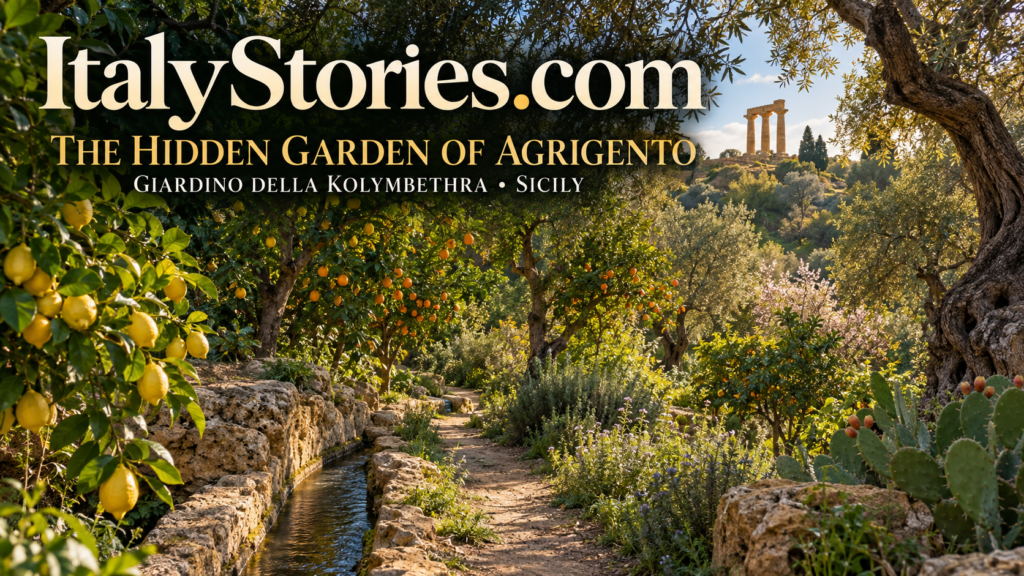
Most visitors arrive in Agrigento looking for stone. They come to see the great Doric temples standing beneath the Sicilian sun, monumental remains of ancient Akragas, one of the richest and most powerful cities of the Greek Mediterranean. They expect golden columns, archaeological ruins and a landscape scorched by heat. Few imagine that hidden below those temples lies a cool, fertile garden filled with lemons, oranges, ancient olive trees and running water.
The Giardino della Kolymbethra is one of the most surprising places in the Valley of the Temples. It occupies a natural hollow between the area of the Temple of Castor and Pollux and the ruins traditionally associated with the Temple of Hephaestus. From the archaeological paths above, it can appear to be little more than a thick patch of vegetation. Only after descending into the valley does its true character emerge.
The air becomes cooler. The noise of the exposed plateau begins to fade. Stone paths lead beneath branches heavy with citrus fruit, the scent of orange blossom mixes with wild herbs, and water moves quietly through channels whose origins reach back more than two thousand years. Kolymbethra is not simply a garden beside an archaeological site. It is itself an archaeological landscape, one created through a long alliance between human ingenuity, fertile soil and the most precious substance in Sicily: water.
Its story begins with ancient Akragas. Founded by Greek settlers in the sixth century BC, the city grew rapidly and became famous for its wealth, monumental architecture and agricultural abundance. Yet its location presented a serious problem. The surrounding landscape could be brutally dry, while a large and prosperous population required a reliable water supply.
According to the ancient historian Diodorus Siculus, after the Greek victory over the Carthaginians at the Battle of Himera in 480 BC, Theron, the ruler of Akragas, ordered the construction of an ambitious hydraulic system. The engineer traditionally associated with the project was Phaeax, whose name survives in the expression “Phaeacian aqueducts.”
These were not aqueducts in the familiar Roman sense, carried across valleys on high stone arches. Much of the system was underground. Tunnels were excavated through the soft calcarenite rock to collect and direct groundwater towards the city. The work is said to have been performed partly by Carthaginian prisoners captured after the battle, although, as with many accounts of the ancient world, history and the desire to glorify the victors may have become intertwined.
The water flowing through these underground galleries eventually reached a large basin below the city. It was called a kolymbethra, a Greek word referring to a pool or reservoir. Ancient descriptions transform it into something almost fabulous: a vast body of water populated by fish and visited by swans and other birds, surrounded by vegetation and used as both a practical reservoir and a place of pleasure.
It must have been an astonishing sight beneath the temples of Akragas. Above stood the buildings that displayed the city’s wealth and devotion to the gods. Below lay the hydraulic system that made urban life possible. The temples received the glory, but water kept the city alive.
Over the centuries, the great basin changed. Sediment accumulated, the reservoir gradually lost its original form and the area became increasingly suitable for cultivation. What had once been a pool was transformed into fertile agricultural land. The ancient underground tunnels continued to provide water, but now they irrigated orchards and vegetable gardens instead of supplying a monumental basin.
Different cultures left their mark on this hidden valley. Agricultural traditions were adapted and refined, particularly during the centuries of Arab influence in Sicily. Irrigation channels, small reservoirs and carefully organised plots allowed farmers to use every available drop of water. The result was not a formal ornamental garden designed only to be admired. Kolymbethra became a productive landscape, beautiful because it was useful and alive.
This distinction is important. There are no perfectly trimmed hedges, artificial perspectives or marble fountains arranged to impress aristocratic guests. The beauty of Kolymbethra comes from shaded paths, uneven dry-stone walls, old irrigation channels and trees that have been cultivated for generations. It is a garden shaped by farmers rather than court architects.
Citrus trees eventually became its most recognisable feature. Lemons, mandarins, bitter oranges, citrons and traditional varieties of sweet orange found an ideal habitat in the protected valley. The surrounding rock sheltered the plants from strong winds, while the ancient water system kept the soil fertile. In certain seasons, flowers and fruit appear on the same branches, filling the garden with both colour and perfume.
Beyond the citrus grove are almond trees, mulberries, figs, pomegranates, carobs and enormous old olive trees. Where the water does not easily reach, the landscape becomes drier and more characteristically Mediterranean. Prickly pears, capers and aromatic plants emerge from the rocky ground. Along the wetter areas grow reeds, poplars, tamarisks and willows.
The garden contains, within a relatively small space, several versions of Sicily. There is the dry island of olives, almonds and pale stone, but also the green island of irrigation, citrus and deep shade. Kolymbethra demonstrates how quickly the Sicilian landscape can change when water is present.
Its underground world is just as important as the vegetation above. The ancient hypogea, galleries excavated into the rock, reveal the extraordinary technical knowledge that supported Akragas. Some passages remain connected to the water that feeds the garden. Entering them means moving beyond the romantic image of orange trees and discovering the engineering hidden beneath the landscape.
These tunnels remind us that ancient monuments were never isolated works of art. A city needed reservoirs, drains, quarries, roads, farms and water systems. The temples of Agrigento could not have existed without the less glamorous infrastructure surrounding them. Kolymbethra makes that invisible city visible again.
For centuries the valley continued to be cultivated, eventually becoming connected with Church property and admired by visitors travelling through Sicily. During the eighteenth and nineteenth centuries, Agrigento became an important destination on the Grand Tour. Artists, writers and wealthy European travellers came to see the temples, often portraying them as romantic ruins surrounded by a timeless Mediterranean landscape.
Kolymbethra offered a different kind of enchantment. After walking across the dry archaeological plateau, travellers could descend into a green garden animated by water and agricultural life. The contrast between ancient columns and citrus trees helped create the image of Sicily as a place where classical civilisation and nature had become inseparable.
During the second half of the twentieth century, however, traditional agriculture became less profitable and the garden was progressively abandoned. Vegetation grew uncontrolled, paths disappeared and the irrigation network deteriorated. A landscape that had survived by being cultivated was at risk of vanishing precisely because nobody was cultivating it anymore.
In 1999, the Sicilian regional authorities entrusted the area to FAI, the Italian National Trust. A long recovery began. The goal was not to redesign Kolymbethra as a modern park, but to restore its historic agricultural identity. Paths and dry-stone walls were repaired, water channels were recovered, neglected trees were pruned and traditional varieties were protected.
The revival of the garden also brought back the knowledge required to care for it. An ancient agricultural landscape is not preserved simply by placing a fence around it. Trees continue to grow, water must be directed, fruit must be harvested and the balance between cultivated land and wild vegetation must be maintained. Kolymbethra survives because it is still treated as a living garden rather than as a frozen museum exhibit.
Today, descending into the valley feels like entering a hidden room within the Valley of the Temples. Above, the great ruins speak of rulers, gods, wars and public ambition. Below, the garden tells a quieter story: the daily search for water, the patience of cultivation and the knowledge passed from one generation of farmers to another.
Its beauty is intensely sensory. Visitors hear water before they see it. They notice the fragrance of lemons and damp earth, the cooler air beneath the trees and the rough texture of the surrounding stone. Sunlight arrives in fragments through the branches, illuminating yellow fruit, silver olive leaves and sections of ancient wall.
Nothing about Kolymbethra feels motionless. Fruit ripens, flowers open, insects move between plants and water continues along routes first created in antiquity. The garden is historical, but it is also stubbornly alive.
Perhaps this is what makes it so different from the temples above. Archaeological ruins usually confront us with what has been lost. Kolymbethra shows what can survive when people continue to care for it. The purpose of the ancient basin changed, cultures succeeded one another and the original city disappeared, yet water continued to flow and the valley remained fertile.
The garden also corrects a common idea about Sicily. The island is often represented as a land of relentless sun, dry hills and burnt summer colours. Kolymbethra reveals another Sicily hidden inside that image: shaded, moist, fragrant and unexpectedly green. It is a landscape made possible by intelligence and labour, not by abundance alone.
The ancient Greeks created a system to capture water. Later communities transformed a reservoir into farmland. Arab agricultural knowledge improved the use of irrigation. Sicilian farmers filled the valley with citrus and fruit trees. Modern conservation rescued the garden when abandonment threatened to erase it. Every period added a new layer without completely destroying the previous one.
Kolymbethra is therefore much more than a pleasant garden near some famous ruins. It is a history of Sicily told through water. Its underground tunnels, cultivated terraces and old trees demonstrate how civilisations survive not only through monuments, but through practical knowledge: how to collect, conserve and share what the land does not easily provide.
When visitors climb back towards the temples, the columns may appear slightly different. They remain magnificent, but they are no longer the whole story. Somewhere below them, hidden among lemon trees and ancient olives, water is still travelling through the rock.
The Giardino della Kolymbethra does not compete with the Valley of the Temples. It completes it. The temples show the grandeur of ancient Akragas; the garden reveals the intelligence that allowed that grandeur to exist.
Follow ItalyStories.com to discover more secret gardens, forgotten landscapes and extraordinary places across Italy.