

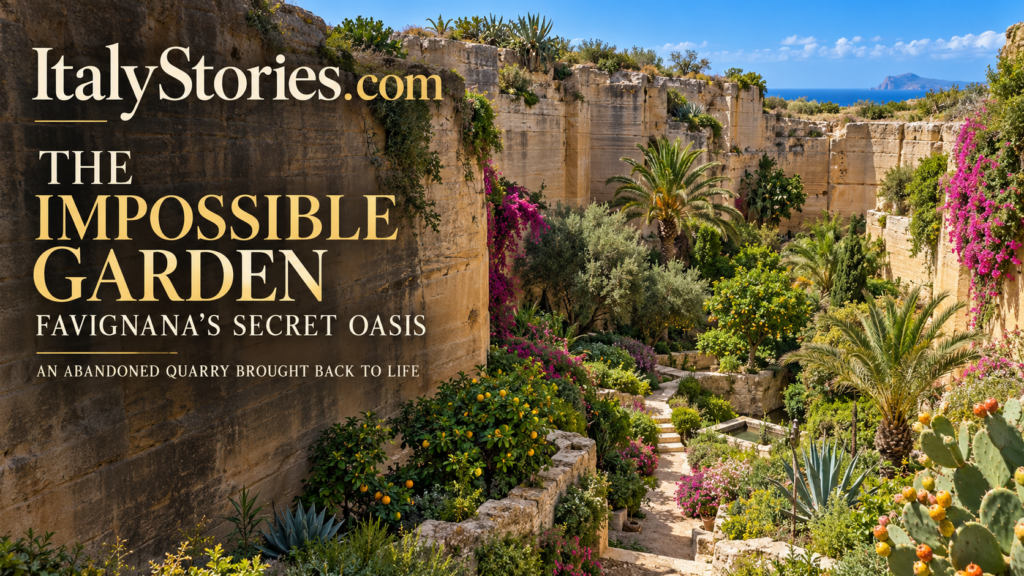
Favignana is famous for transparent water, white beaches and ancient tuna-fishing traditions. Yet hidden away from its coastline is a place that seems to contradict everything we expect from this dry, windswept Sicilian island: a lush botanical garden growing inside a labyrinth of abandoned stone quarries.
It is called the Giardino dell’Impossibile — the Impossible Garden — and its name tells the story of a dream that almost everyone believed could never become reality.
The landscape of Favignana has been shaped by the extraction of calcarenite, a pale local stone commonly described as tuff. For generations, quarry workers cut enormous blocks from the island, leaving behind deep pits, vertical walls, underground chambers and geometric corridors. These quarries supplied building material for houses, churches and palaces, but when the extraction ended, many of them were abandoned.
The eastern side of Favignana became marked by a strange hidden geography. From the surface, the countryside appeared dry and ordinary. Below road level, however, there were enormous excavated spaces protected by high stone walls. The same quarries that had once seemed like wounds in the landscape would eventually offer the perfect conditions for an extraordinary garden.
The project began during the 1960s thanks to Donna Maria Gabriella, who refused to accept that flowers and delicate plants could not grow in Favignana’s rocky soil. The local climate presented several difficulties: intense summer heat, limited rainfall, salty air and powerful winds arriving from the sea. Creating a large garden here genuinely appeared impossible.
But the abandoned quarries possessed an unexpected advantage. Their high walls offered protection from the wind, retained humidity and created cooler shaded areas beneath the harsh Sicilian sun. Different levels of light and temperature produced a series of small microclimates, allowing plants with very different needs to grow surprisingly close together.
Slowly, the empty quarry became a green labyrinth. Paths were created between the stone walls, while trees and flowering plants occupied terraces, chambers and narrow passages. Nature did not hide the quarry’s industrial past; it grew around it, softened it and transformed it into something new.
Today, the garden covers approximately four hectares, almost half of which lies below street level. It contains nearly five hundred plant species originating from different parts of the world. Mediterranean plants grow alongside subtropical varieties, creating an unusual mixture of colours, shapes and perfumes.
Citrus trees, palms, hibiscus, bougainvillea, jasmine, agaves, cycads and prickly pears thrive among the pale quarry walls. In some places, the vegetation appears dense and almost tropical. In others, sunlight reaches the bottom of the quarry and reveals the precise marks left by the workers who once cut stone from the island.
The contrast is extraordinary. Massive walls of golden rock rise beside delicate flowers. Tree roots descend through cracks in the stone. Narrow pathways disappear beneath leaves, while stairs connect different levels of the garden. Small pools, sculptures and quiet corners appear unexpectedly along the way.
The Giardino dell’Impossibile is more than a botanical collection. It is an example of environmental regeneration—a place where an abandoned industrial landscape has been given a completely different future. The quarries were not filled in or erased. Their unusual form became the foundation of the garden’s identity.
This transformation also reflects an important part of Favignana’s history. The island’s architecture is inseparable from its stone. Quarrying supported families, shaped buildings and permanently changed the landscape. The garden preserves that memory while demonstrating that a place created through extraction can eventually become a refuge for biodiversity.
Walking through it feels like moving between two different worlds. Above the quarry lies the bright, dry Mediterranean countryside of Favignana. Below it, protected by stone, is a cool and intimate universe of vegetation, shadows and unexpected colour.
Its name therefore carries a gentle irony. The garden was called impossible because so many people believed it could not exist. Its flourishing trees and flowers now provide the most convincing answer.
Favignana may be celebrated for its blue sea, but the Giardino dell’Impossibile reveals another side of the island: patient, inventive and deeply connected to the land. It proves that abandoned places do not always have to remain empty and that, with imagination and determination, even a stone quarry can be taught to bloom.