

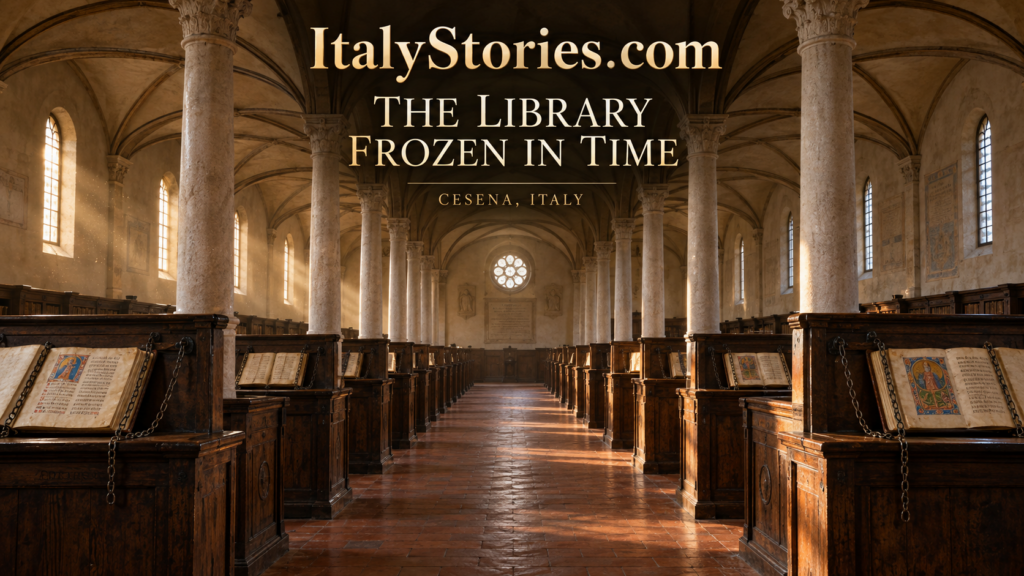
In the heart of Cesena, a graceful city in Italy’s Emilia-Romagna region, there is a door that does something extraordinary: it takes visitors back more than five centuries. Beyond it lies the Biblioteca Malatestiana, one of the most remarkable libraries in the world and a place where the Renaissance does not feel like a distant chapter in a history book. It feels present, tangible and almost alive. The wooden reading desks remain in their original positions, the ancient manuscripts are still kept where they were placed centuries ago, and the chains that once protected these priceless books continue to connect them to the furniture made for them. Nothing here seems to have been rearranged for modern visitors. The library has survived as a complete environment: architecture, furnishings and collection preserved together in the same place. Entering it is not simply like visiting an old building. It is like walking into a quiet morning in the year 1454 and discovering that everyone has just stepped outside.
The story begins with Malatesta Novello, lord of Cesena and a member of the powerful Malatesta family. His world was shaped by military rivalries, shifting alliances and the ambitions of Italian courts, but he understood that lasting power could also be created through knowledge. During the fifteenth century, Cesena’s Franciscan friars possessed a growing collection of manuscripts and needed a suitable place in which to preserve and study them. Malatesta Novello transformed that need into a far more ambitious project: a great library intended not merely as a private display of wealth, but as an institution connected to the city and its intellectual life. Construction began in 1447 inside the Franciscan convent and was completed in 1452 under the direction of Matteo Nuti of Fano. The library was formally opened in 1454, shortly before Gutenberg’s printing revolution began to transform Europe. This makes the Malatestiana one of the last great libraries created for a world in which every book was still copied by hand.
From the outside, nothing fully prepares visitors for the interior. After passing through the entrance and the beautiful fifteenth-century wooden door, the Sala del Nuti appears as a long, perfectly measured space divided into three naves by two rows of pale stone columns. Its form recalls a church, but the object of devotion here is human knowledge. A central aisle leads towards a rose window at the far end, while smaller windows along the sides allow daylight to fall across the desks. The effect is remarkably calm. The room is not filled with the gold and theatrical decoration often associated with later Italian interiors. Its beauty comes from proportion, repetition, balance and light. White columns, warm terracotta floors, dark timber and the muted tones of old manuscripts create an atmosphere that is both austere and welcoming. It is architecture designed to help the mind concentrate.
On either side of the central aisle stand 58 wooden desks known as plutei, arranged in two long rows of 29. These were not ordinary tables. Each piece of furniture combined a bench, an inclined reading surface and a lower shelf where manuscripts could be stored. The books were secured by chains attached to metal rods, allowing a reader to lift a volume onto the desk without removing it from the room. Today, the idea of chaining a book may sound harsh, almost as though the manuscripts were prisoners. In reality, the chains reveal just how precious books once were. Before printing, producing a single codex could require months or even years of work. Parchment had to be prepared, texts copied carefully by trained scribes, initials decorated and, in the finest examples, pages illuminated with pigments and gold. A substantial manuscript could be worth as much as a house. Leaving it unattended would have been rather like placing a small treasure chest on a public table and hoping everyone behaved themselves.
The chains also tell us something important about the purpose of the Malatestiana. These books were not created merely to be admired from a distance. They were meant to be consulted. Malatesta Novello arranged for the collection to belong to the municipality of Cesena, while the Franciscan community helped guard and manage it. This unusual shared responsibility protected the library from becoming the private possession of one family or disappearing when political power changed hands. It is widely regarded as Europe’s first civic library: a collection owned by the city and made available for study. In an age when most great collections belonged to monasteries, universities, princes or popes, this was a remarkably farsighted decision.
At the centre of the library’s identity are 343 codices, still preserved in the setting for which they were assembled. They contain far more than religious texts. The collection reflects the intellectual curiosity of Renaissance humanism, bringing together theology, philosophy, history, literature, law, medicine and science. Classical Greek and Latin authors stand beside medieval scholars and Christian writers. The library represents a moment when educated Europeans were rediscovering the ancient world and attempting to reconcile it with their own beliefs and experiences. These books were tools for understanding humanity, nature, faith, government, health and the universe itself. Some contain beautifully decorated initials and miniature paintings; others may appear visually modest but preserve works of enormous historical value. Every page was created before keyboards, printers and photocopiers, when the survival of an idea depended on the patience of a human hand.
The arrangement of the manuscripts is part of the miracle. In most ancient libraries, collections were expanded, dispersed, reorganised, sold, stolen or destroyed. Buildings changed function, furniture was replaced and books travelled from one owner to another. At Cesena, the relationship between the room, the desks and the manuscripts has remained exceptionally intact. A scholar from the fifteenth century would still recognise the space. The sensation is difficult to reproduce in a museum, because the Malatestiana is not a reconstruction assembled from surviving pieces. It is the original place. The same architectural rhythm continues down the hall, the same desks remain under the same windows, and the same books rest within the system designed for them more than five hundred years ago.
Small details connect the room to the man who created it. Malatesta emblems appear on capitals, desks and decorations. Among them is the elephant, accompanied by the proud Latin motto “Elephas Indicus culices non timet” — “The Indian elephant does not fear mosquitoes.” It is an unforgettable image: the powerful elephant ignoring the insignificant insects around it. The motto expressed strength, confidence and perhaps a certain aristocratic contempt for minor enemies. It also seems strangely appropriate for the library itself. Dynasties disappeared, armies marched through Italy, governments rose and fell, religious institutions were suppressed and modern wars reached the region. Yet the Malatestiana endured, silent and stubborn, while the historical mosquitoes buzzed around it.
Its survival was never guaranteed. The Franciscan complex was affected by political transformations, particularly during the Napoleonic period, when religious houses were suppressed and their possessions often scattered. Across Europe, libraries were dismantled and manuscripts separated from the places that had protected them. Cesena’s collection faced danger, but the essential unity of the Malatestiana was preserved. This continuity is one reason UNESCO entered the Library of Malatesta Novello in the Memory of the World Register in 2005. The recognition concerns not only the beauty of individual manuscripts but the extraordinary survival of an entire humanist library: its books, architecture and original furnishings forming one inseparable historical document.
The Malatestiana also changes the way we think about libraries. Today, books are relatively inexpensive, information can travel around the world in seconds and a small electronic device can store more texts than any Renaissance prince could have imagined. In the fifteenth century, however, a library was a declaration of faith in the future. It required enormous investment without offering immediate profit. Its purpose was to protect knowledge so that people not yet born might one day use it. Malatesta Novello could not have known who would enter the room five centuries later, but the library was created with that possibility in mind. It was a gift to an unknown reader.
Perhaps this is why the room remains so moving. Its silence is not empty. It contains the traces of scribes, scholars, friars, physicians and readers who lived in completely different versions of Italy. Imagine one of them seated at a wooden desk, leaning towards a manuscript as daylight slowly crossed the page. Outside, Cesena would have sounded and smelled like a medieval city. News travelled on horseback, books were rare and much of the known world remained unreachable. Yet inside this room, a reader could meet Homer, Plato, Aristotle, the great Roman authors, Christian thinkers, doctors and scientists. The library offered a journey far greater than the distance between its walls.
Visiting the Biblioteca Malatestiana means discovering an Italy that is often overshadowed by famous cathedrals, palaces and archaeological sites. Cesena does not receive the same crowds as Florence, Venice or Rome, and perhaps that makes the experience even more powerful. There is no need for an enormous monument to announce the importance of this place. Its treasure is hidden behind a door, in a room where time appears to have stopped and where the books are still waiting patiently beside their chains.
More than five hundred years after its opening, the Malatestiana remains what its founder intended it to be: not a tomb for old books, but a monument to curiosity. It reminds us that civilisation depends not only on creating knowledge, but on caring for it. Empires can disappear, buildings can collapse and technologies can become obsolete. A carefully protected idea, however, can continue speaking across centuries.
In Cesena, 343 ancient manuscripts are still doing exactly that.
Follow ItalyStories.com to discover the hidden libraries, forgotten theatres, secret gardens and extraordinary places that reveal a different side of Italy.