

The Morning Two Italian Cities Disappeared
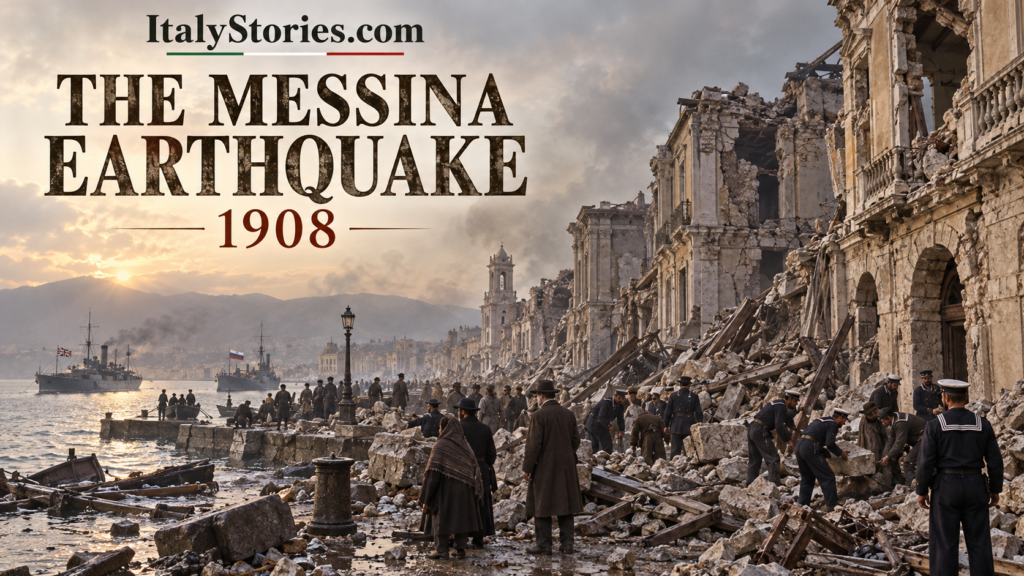
At 5:20 on the morning of December 28, 1908, most of the people living along the Strait of Messina were asleep. Christmas had passed only three days earlier, and the final Monday of the year had not yet begun. In the darkness between Sicily and Calabria, the earth suddenly moved with catastrophic violence. For approximately 37 seconds, buildings twisted, floors collapsed and entire streets disappeared beneath clouds of dust. Messina and Reggio Calabria, the two cities facing one another across the narrow stretch of sea, were almost completely destroyed.
The earthquake was followed by fires, landslides and a tsunami that struck both coasts, killing people who had escaped the collapsing buildings and moved toward the waterfront in search of safety. Telegraph lines, railways and roads were cut. Hospitals, barracks, police stations and government buildings fell together with ordinary homes. Many of the people who might normally have organised a rescue operation were themselves dead, injured or trapped.
The precise number of victims will never be known. Historical estimates vary widely, generally ranging from more than 75,000 to well above 100,000 deaths across Sicily and Calabria. Entire families vanished, municipal records were buried, and thousands of bodies were never identified or recovered. It remains the deadliest natural disaster in modern Italian history and one of the most devastating earthquakes ever recorded in Europe.
Yet the Messina earthquake of 1908 is also a story of extraordinary courage. Survivors dug through ruins with their bare hands. Italian sailors, soldiers, railway workers and civilians began rescuing people almost immediately. Russian, British, French, American and other foreign ships rushed to the Strait, turning the disaster into one of the first great international humanitarian operations of the twentieth century.
Thirty-Seven Seconds in the Darkness
The main shock occurred at approximately 5:20 a.m. and is now estimated to have had a moment magnitude of about 7.1. Its centre lay in or near the Strait of Messina, the narrow marine passage separating the northeastern corner of Sicily from the southern tip of Calabria.
This is one of the most geologically complex areas of the Mediterranean. The region lies within a broad zone shaped by the interaction of the African and Eurasian tectonic systems. The land around the Strait has been affected for millennia by faulting, uplift, subsidence, volcanic activity and destructive earthquakes.
The exact fault responsible for the 1908 catastrophe continues to be studied. The general movement appears to have involved vertical displacement along a normal fault, but scientists have proposed different models for its precise location and geometry.
For the people of Messina and Reggio Calabria, none of this was visible. There was only a deep sound from beneath the ground, followed by movement so violent that standing became almost impossible.
The earthquake struck with an intensity reaching the extreme level of XI on the Mercalli scale in some locations. Buildings did not simply crack; many collapsed completely. Heavy floors fell onto those below, exterior walls separated from internal structures and roofs crashed into bedrooms where entire families were sleeping.
Thirty-seven seconds is shorter than an ordinary television advertisement. On that morning, it was long enough to erase centuries of architecture and change the lives of hundreds of thousands of people.
Why the Destruction Was So Enormous
The power of the earthquake alone does not explain the extraordinary death toll. The cities around the Strait were extremely vulnerable.
Messina had already suffered destructive earthquakes, including the great Calabrian seismic sequence of 1783. Despite this history, many buildings constructed or rebuilt during the nineteenth century were not capable of resisting strong horizontal movement. Walls were often made from irregular masonry held together with weak mortar, while heavy roofs and floors placed enormous loads on poorly connected structures.
Some buildings had been modified repeatedly over the years, with additional storeys built above older walls. Decorative façades sometimes concealed fragile construction. Narrow streets increased the danger because collapsing buildings fell against one another, filling passageways with debris and blocking escape.
The early hour multiplied the casualties. Most inhabitants were indoors and asleep, with little possibility of reacting before ceilings and walls collapsed.
The ground conditions also influenced the damage. Areas near the Messina waterfront stood on relatively soft sediments that intensified the shaking. The elegant seafront and the densely populated central districts suffered especially severe destruction.
In Messina, around 90 per cent of the buildings were destroyed or damaged beyond use. Reggio Calabria suffered a similar catastrophe. Smaller towns and villages on both sides of the Strait were also devastated, including Palmi and numerous coastal communities.
This was not the destruction of one city. It was the collapse of an entire region.
Messina Before the Disaster
Before 1908, Messina was one of Sicily’s most important ports. Its magnificent natural harbour curved around the water like a sickle, giving the city both its ancient Greek name, Zancle, and its strategic importance.
For centuries, Messina had connected Sicily with continental Italy and the wider Mediterranean. Merchant ships, passenger vessels, fishing boats and naval units crowded its harbour. The city possessed churches, palaces, schools, hotels, theatres, hospitals and important public institutions.
Its most celebrated architectural feature was the Palazzata, a long and imposing sequence of buildings facing the harbour. Earlier versions had been destroyed by previous earthquakes and rebuilt, but the nineteenth-century waterfront still presented visitors arriving by sea with a grand urban façade.
The cathedral preserved elements of Messina’s Norman and medieval history despite centuries of earthquakes, fires and alterations. Its bell tower, public buildings and crowded streets expressed the pride of a city that had repeatedly reconstructed itself after disaster.
On the morning of December 28, much of this world vanished. The cathedral partially collapsed, the Palazzata was ruined and the civic centre became an immense field of rubble. Railway facilities, hotels, barracks and hospitals were destroyed. Fires broke out where damaged gas lines and cooking flames encountered broken timber.
The city’s population at the beginning of the twentieth century was close to 150,000. A huge proportion of those residents were killed.
Reggio Calabria: The Other Destroyed City
The disaster is commonly remembered as the Messina earthquake, but Reggio Calabria was struck with comparable violence. The city stood only a few kilometres away on the opposite side of the Strait and had no protection from the seismic waves.
Homes, churches, barracks, administrative buildings and medical facilities collapsed. The destruction of hospitals was particularly tragic because it eliminated much of the local capacity to care for the injured precisely when it was most desperately needed.
At the civil hospital, only a small fraction of patients and staff survived. Military buildings also suffered catastrophic losses. Streets became blocked, communications failed and the city’s historic centre was largely erased.
Other Calabrian communities were devastated. Palmi suffered hundreds of deaths, while coastal settlements south of Reggio were hit by both the earthquake and the tsunami.
Remembering only Messina risks losing half the story. The disaster belonged to both shores, to Sicily and Calabria, and to the thousands of small personal worlds that disappeared on each side of the water.
The Sea Withdraws
For many survivors, the earthquake was only the first catastrophe.
Shortly after the main shock, the sea behaved strangely. In some areas, the water withdrew from the shore, exposing parts of the seabed. People who had escaped damaged buildings moved toward open spaces and the waterfront, believing the coast would be safer than streets filled with unstable walls.
Then the sea returned.
Several powerful waves struck the shores of Sicily and Calabria. In certain locations, wave heights are estimated to have reached between 6 and 12 metres, with even greater local measurements reported along parts of the Calabrian coast.
The water surged across harbours and streets, carrying boats, timber and debris. People who had survived the collapse of their homes were swept away. Waterfront buildings still standing after the earthquake were damaged or destroyed by the waves.
The precise mechanism that generated the tsunami remains debated. Movement of the seabed during the earthquake certainly disturbed the water, while some scientific studies suggest that an underwater landslide may have greatly increased the size of the waves.
Whatever the exact cause, the combination of earthquake and tsunami made the disaster exceptionally destructive. The land had driven people toward the sea; the sea then attacked the places where they sought refuge.
A City Without Authorities
In the first hours after the earthquake, organised government almost ceased to exist in Messina. Senior officials, police officers, soldiers, doctors, nurses and municipal employees had been killed or trapped. Government buildings and records were buried beneath masonry.
The destruction of the hospitals left injured survivors without treatment. Pharmacies had collapsed, clean water was scarce and streets could not be crossed. Communication with the rest of Italy was nearly impossible because telegraph lines, telephone connections and railway routes had been severed.
The scale of the catastrophe was initially unknown in Rome. Early messages suggested a serious earthquake somewhere in the south, but they could not communicate that two cities had effectively disappeared.
Survivors began rescuing one another. People listened for voices beneath the rubble and removed stones by hand. Neighbours who had lost their own families tried to reach others. Some survivors remained trapped for days in air pockets created by collapsed floors and furniture.
Aftershocks repeatedly interrupted the work. Every movement of damaged walls created the possibility of another collapse. Rain, cold and darkness added to the suffering.
There were episodes of theft and violence, but later accounts sometimes exaggerated the scale of looting while ignoring the desperate circumstances. Many people searching through destroyed shops and houses were not criminals but survivors looking for food, clothing, medicine or relatives.
The First Rescuers
Italian naval vessels already in or near Messina were among the first organised forces to respond. Sailors from the cruiser Piemonte and torpedo boats in the harbour began helping survivors, carrying the injured and attempting to restore communication.
The damaged port was filled with wreckage, making movement difficult. Nevertheless, naval personnel transported hundreds of injured people and refugees away from the city. Messages were carried along the coast until a functioning telegraph connection could be found.
Once news of the true scale of the disaster began to spread, military units, medical personnel, supplies and ships were mobilised from across Italy.
The geography of the Strait made maritime assistance essential. Roads and railways had been destroyed, but ships could still approach the devastated coastline, bring food, water and doctors, and evacuate the wounded.
The sea that had carried the tsunami now became the principal route of rescue.
Russian Sailors in Messina
Among the most celebrated rescuers were sailors from a Russian naval squadron operating in the Mediterranean. Russian ships, including the battleships Slava and Tsesarevich and the cruisers Admiral Makarov and Bogatyr, were in the region and quickly sailed toward the Strait after receiving news of the disaster.
Their sailors went ashore amid unstable ruins and began searching for survivors. They dug through masonry, carried injured people to the ships and helped establish order in a city where almost every institution had collapsed.
Communication was difficult because few rescuers spoke Italian, but gestures and immediate necessity overcame the language barrier. Russian medical teams treated the injured aboard their vessels, while sailors risked their lives entering damaged buildings.
The people of Messina remembered their work with lasting gratitude. More than a century later, the Russian sailors remain part of the city’s collective memory, honoured through monuments, ceremonies and street names.
Their intervention also carried a powerful meaning. Europe in 1908 was divided by imperial rivalries and military alliances that would contribute to the outbreak of the First World War only six years later. In Messina, warships designed for conflict became floating hospitals and their crews worked together to save civilians.
British, French, American and International Aid
British naval ships also reached the disaster area quickly. Their sailors joined search operations, distributed supplies and carried survivors to safer ports. French vessels, American ships and units from other nations followed.
The international response expanded rapidly as newspapers around the world published photographs and descriptions of the destruction. Governments, religious organisations, humanitarian groups and private citizens collected money, medicine, blankets and food.
American assistance was especially important in constructing temporary homes. New districts were given names recalling the countries and regions that had contributed, creating an unusual geography of gratitude among the emergency settlements.
The Red Cross organised medical support, while ships transported thousands of wounded people to hospitals in Naples, Palermo, Catania and other cities.
The rescue was heroic but inevitably chaotic. Nobody possessed a complete map of the destruction, reliable casualty figures or a central list of survivors. Families were divided among different ships and destinations, sometimes spending weeks without knowing who was alive.
The King and the “Queen of Charity”
King Victor Emmanuel III and Queen Elena arrived in the disaster area on December 30. The monarchy’s presence had strong symbolic importance at a moment when the scale of the tragedy threatened to overwhelm public confidence.
Queen Elena became particularly associated with relief efforts. She assisted the injured, supported medical personnel and helped organise care aboard ships. Her work contributed to her popular image as a compassionate and practical figure, sometimes described as the “Queen of Charity.”
Pope Pius X also supported relief operations and made Vatican spaces available for refugees. Donations arrived from Italian communities around the world, including the enormous population of southern Italian emigrants living in the United States, Argentina and other countries.
The catastrophe became a shared national experience. Italy had been politically unified for less than fifty years, and regional divisions remained deep. The destruction of Messina and Reggio inspired an immense movement of solidarity, but it also exposed inequality, bureaucratic weakness and the long neglect of the south.
Lives Beneath the Statistics
The number of victims is so large that it can become almost impossible to understand. Tens of thousands can turn into an abstraction. The true scale of the disaster appears more clearly through individual stories.
Historian and politician Gaetano Salvemini was living in Messina and teaching at the university. He survived, but his wife, five children and sister were killed. He emerged from the ruins as the only survivor of his immediate household.
Countless families suffered similar losses without leaving written testimony. Parents searched for children, children became orphans and entire branches of families disappeared from public records.
Seven-year-old Salvatore Quasimodo, the future winner of the Nobel Prize in Literature, arrived in devastated Messina shortly after the earthquake because his father, a railway employee, had been sent there to help restore transport. The family lived temporarily in railway carriages, an experience Quasimodo would remember in his later writing.
These stories remind us that the earthquake did not end when the ground stopped shaking. Survivors carried it for the rest of their lives.
Should Messina Be Abandoned?
The devastation was so complete that some officials questioned whether Messina should be rebuilt in the same location. The city stood in an area of known seismic danger, and almost every essential structure had been lost.
The inhabitants rejected the idea of abandoning it. Messina’s harbour, history and identity could not simply be transferred somewhere else. Clearing the ruins began while emergency settlements spread around the surviving city.
Temporary wooden houses, commonly known as baracche, were constructed to shelter refugees. They were intended as a short-term solution, but many remained occupied for years or even decades. Temporary neighbourhoods gradually became permanent symbols of delayed reconstruction and social inequality.
Rebuilding a city while housing, feeding and employing tens of thousands of displaced people was an enormous task. The process was complicated by bureaucracy, arguments over land ownership, shortages of materials and accusations concerning the management of donated funds.
Messina would rise again, but not quickly and not without controversy.
Building a Safer City
The reconstruction changed the appearance of both Messina and Reggio Calabria. Engineers and planners attempted to create cities less vulnerable to future earthquakes.
Luigi Borzì prepared the new urban plan for Messina, while Pietro De Nava played a central role in the reconstruction of Reggio Calabria. New streets were generally wider and straighter, making evacuation and rescue easier while reducing the risk that collapsing buildings would completely block passage.
Building heights were limited, and new construction rules required stronger structural systems and better connections between walls, floors and foundations. Reinforced concrete began to play an increasingly important role.
These measures did not eliminate seismic risk, but they represented a major step in the development of modern Italian earthquake-resistant planning. The tragedy demonstrated that the number of deaths in an earthquake depends not only on geological power but also on how cities are constructed.
Much of the historic character of Messina and Reggio was permanently lost. Medieval, Baroque and nineteenth-century buildings disappeared, sometimes replaced by new architecture and sometimes demolished even when parts might have been saved.
The rebuilt cities therefore possess a different identity from the ones that existed before 1908. Their streets contain visible and invisible traces of the catastrophe: reconstructed monuments, surviving fragments and urban spaces created from the ruins.
The Cathedral and the Memory of What Was Lost
Messina Cathedral became one of the most important symbols of reconstruction. The earthquake caused enormous damage, leaving parts of the medieval structure standing but destroying much of the building.
It was later reconstructed in an effort to recover its Norman appearance. Further destruction came during the Second World War, when bombing and fire again damaged the cathedral, requiring another major restoration.
This repeated destruction and rebuilding reflects the history of Messina itself. The city has been damaged by earthquakes, war and fire, yet it has repeatedly refused to disappear.
The famous bell tower beside the cathedral now contains one of the world’s largest astronomical clocks. Every day at noon, its mechanical figures move above the square, attracting visitors who may not realise how completely the surrounding city was transformed in 1908.
The Lesson of Messina
The earthquake became a fundamental case in the history of seismology, engineering and disaster management. Instruments across Europe recorded the event, allowing scientists to compare seismic waves and improve their understanding of earthquakes.
Engineers studied which buildings had collapsed and which had survived. Stronger construction standards gradually developed, although their application across Italy remained inconsistent for many decades.
The catastrophe also demonstrated the importance of functioning communications, prepared emergency services, open evacuation routes and coordinated international assistance. In 1908, rescue depended heavily on the accidental presence of naval ships in the Mediterranean and the courage of individuals acting without a modern disaster plan.
Today, the Strait remains a region of significant seismic and tsunami risk. The geological forces that created the landscape have not disappeared. The memory of 1908 is therefore not only historical; it remains a warning.
Earthquakes cannot be prevented. Catastrophes can be reduced through knowledge, construction, preparedness and respect for the lessons left by earlier disasters.
The Cities That Returned
Messina and Reggio Calabria survived because their people chose to rebuild. Survivors created new families, reopened businesses and reconstructed institutions. Children grew up in wooden emergency settlements while new streets and buildings slowly appeared around them.
The modern cities are not replicas of those lost in 1908. They are their descendants.
At the Strait, Sicily and Calabria still face one another across brilliant blue water. Ferries cross continuously, carrying trains, cars and passengers between the island and the mainland. The sea appears peaceful, and the scale of the old disaster can be difficult to imagine.
But every December 28, the memory returns: the darkness, the shaking, the sea withdrawing and the waves striking the coast. Bells ring, ceremonies are held and the names of rescuers and victims are recalled.
The earthquake destroyed buildings in less than a minute, but it could not completely destroy the communities that had built them. That is the final story of Messina and Reggio Calabria—not only the morning when two cities disappeared, but the long and difficult years in which they learned how to exist again.
Follow ItalyStories.com to discover more defining moments, forgotten tragedies and extraordinary stories from Italy’s past.