

Meta description: Beneath medieval Venzone in Friuli, naturally preserved human bodies have survived for centuries, an earthquake and an enduring scientific mystery.
Excerpt: In the small fortified town of Venzone, at the foot of the Friulian Alps, a group of naturally mummified bodies has survived centuries of history and the devastating earthquake of 1976. Their remarkable preservation was not produced by embalming, but by an unusual combination of environmental conditions that science has yet to explain completely.
A Medieval Town Guarding an Unexpected Secret
Venzone appears almost too perfect to be real. Enclosed by medieval walls and surrounded by the mountains of Friuli-Venezia Giulia, the town stands near the Tagliamento Valley, where roads from the Adriatic plain begin their climb toward the Alpine passes. Its narrow streets, pale stone houses and elegant town hall evoke the orderly beauty of a settlement that has watched merchants, soldiers, pilgrims and travellers pass for centuries. Yet beside the Cathedral of Sant’Andrea Apostolo, inside the small former Chapel of San Michele, Venzone preserves something far more unusual than medieval architecture: a group of human bodies that nature transformed into mummies.
They are not Egyptian mummies wrapped in linen, nor aristocrats preserved through elaborate embalming. No resin, salt, spices or artificial chemicals were used. These were ordinary inhabitants of Venzone who died between the late Middle Ages and the modern era and were buried according to the customs of their community. Under particular environmental conditions, decomposition stopped before their bodies disappeared. Skin, muscles and other tissues dried rapidly, leaving behind remarkably complete human forms.
Their survival has made the Mummies of Venzone one of Italy’s most intriguing anthropological collections. They are evidence of a rare natural process, but they are also something more personal: the physical presence of individuals who once walked through the same streets that visitors cross today.
The Discovery Beneath the Cathedral
The story traditionally begins in 1647, during building work around the Cathedral of Sant’Andrea. Workers opening old tombs encountered approximately twenty bodies that appeared unexpectedly intact. Instead of finding only disarticulated bones, they discovered light, dry human figures whose faces, hands and physical characteristics could still be recognised.
Among the earliest and best-known remains was a body that became popularly known as the “Hunchback of Venzone.” Scientific observations suggested that the man had died between approximately 45 and 60 years of age. He may have been buried not long after the cathedral’s consecration in 1338, making him one of the oldest individuals associated with the collection. The nickname reflects the descriptive habits of earlier centuries rather than a reliably documented identity, and it should not distract from the fact that this was once a living person whose real name has been lost.
More mummified bodies were identified as old burial spaces were examined. Historical accounts eventually mentioned as many as 42, although totals vary according to period and source. Some were remarkably complete, while others were fragmentary. The bodies weighed very little—often between about ten and twenty kilograms—because almost all their water had disappeared.
For the inhabitants of seventeenth- and eighteenth-century Venzone, the discovery existed somewhere between religious wonder, local curiosity and natural mystery. In an age before modern forensic medicine, a body resisting ordinary decay could easily acquire spiritual significance. Nevertheless, the mummies were never officially presented as miraculous relics. Their preservation appeared to be connected to the place in which they had been buried.
Nature, Not Embalming
Natural mummification occurs when environmental conditions interrupt the microorganisms and chemical reactions responsible for decomposition. Intense cold can freeze a body, peat bogs can preserve soft tissue through acidic and oxygen-poor conditions, and extreme heat can remove moisture before decay becomes established. In Venzone, rapid dehydration appears to have been the decisive factor.
The old graves and tombs around the cathedral created a distinctive microenvironment. Air circulation, seasonal temperature, relatively low moisture and the mineral composition of the ground may have worked together to draw water from the bodies. The soil has often been described as rich in calcium sulphate, a substance associated with moisture absorption. The wooden coffins and the architecture of the burial spaces could also have helped create the necessary ventilation.
What makes Venzone scientifically fascinating is that none of these elements, considered alone, fully explains what happened. The process was not seen in every burial, and researchers have never reproduced the exact phenomenon under controlled conditions. The mummies are therefore the result of a rare convergence of circumstances rather than a simple natural recipe.
Their dry, parchment-like skin and extremely low weight are consistent with rapid desiccation. If moisture is removed soon enough, many bacteria cannot continue their normal activity. The body becomes an environment in which decomposition slows dramatically. It does not remain unchanged forever, but its overall form can survive for centuries.
The Famous Fungus Theory
For generations, popular descriptions attributed the mummification almost entirely to a fungus called Hypha bombycina, sometimes appearing in older texts under the variant name Hypha tombicina. The theory became attractive because the fungus was reportedly observed in the tombs and on wooden coffins. It was thought to possess an extraordinary ability to absorb moisture and therefore to dry the bodies rapidly.
The idea was already discussed during the nineteenth century and reached an international audience through publications produced in the early twentieth century. Its unusual simplicity made it memorable: a mysterious local fungus had supposedly turned the dead of Venzone into mummies.
Modern caution is necessary. Later investigations did not consistently detect the fungus in material associated with the bodies, and its exact role has never been conclusively demonstrated. It may have contributed to the burial environment, but describing it as the sole “mummifying fungus” turns a complex scientific question into a legend.
The most responsible explanation is therefore environmental and multifactorial. Temperature, ventilation, humidity, mineral-rich soil, coffin construction and microorganisms may all have played a part. The precise balance remains uncertain because the original burial conditions were altered long ago and the surviving material available for scientific sampling is limited.
That uncertainty does not weaken the story. On the contrary, it gives the mummies their enduring scientific value. They remind us that historical human remains cannot always be reduced to a single dramatic explanation.
What the Bodies Can Reveal
Naturally preserved bodies provide information that skeletons alone cannot. Bone can reveal age, sex, trauma and disease, but preserved soft tissue may offer further evidence about injuries, nutritional conditions and the physical effects of illness. Clothing fragments and the position of the body can also provide insights into burial customs and social life.
The Mummies of Venzone belong to people who lived in a strategic Alpine community. Their world was shaped by agriculture, trade, religion, harsh winters and the traffic moving through the valleys of northeastern Italy. They experienced periods of prosperity and political change under the Patriarchate of Aquileia, the Republic of Venice, Habsburg rule and, eventually, the Italian state.
Most of their individual stories have disappeared. One of the displayed bodies has traditionally been associated with Paolo Marpillero, a member of a notable local family, but many other identities remain uncertain. Their anonymous condition makes them strangely representative: they stand not as kings or conquerors, but as inhabitants of an ordinary European community.
It is tempting to study their faces and imagine personalities. Yet appearances can deceive, and descriptive nicknames assigned centuries after death are not biographies. Scientific observation can reconstruct parts of a life, but it cannot restore a person’s private memories, relationships or voice.
Curiosity, Fame and Changing Attitudes
The mummies soon became famous beyond Friuli. Travellers, scholars and members of the European elite visited Venzone to see them. According to local tradition, Napoleon Bonaparte viewed the bodies during his passage through the town in 1807 and was fascinated by their state of preservation. The story is frequently repeated, although some picturesque details attached to it belong more to local legend than firmly documented history.
During the nineteenth and early twentieth centuries, preserved human remains were often treated very differently from the way museums approach them today. They could be displayed as medical curiosities, transported for examination or presented to audiences seeking the extraordinary. Accounts of the Venzone mummies appeared in foreign publications, transforming a small Friulian town into the setting of an international mystery.
Postwar photography brought them to an even larger audience. Some historical images show residents handling or carrying the mummies in ways that now appear startling. Such photographs belong to an era when ethical standards surrounding the exhibition of human remains were less developed and local familiarity with the bodies was very different from the expectations of contemporary visitors.
Today, the emphasis should be on anthropology, history and respect. These bodies are not theatrical monsters. They are the dead of Venzone, preserved by an accident of nature and inherited by a community that has protected them through extraordinary circumstances.
The Earthquake That Nearly Destroyed Everything
On the evening of 6 May 1976, a powerful earthquake struck Friuli. Venzone was among the towns hit most severely. Houses collapsed, medieval streets were buried and residents lost their lives. The Cathedral of Sant’Andrea was devastated, as were the structures associated with the mummies. Further destructive shocks in September worsened the damage.
Before the disaster, 21 mummies were reportedly kept at Venzone. Only 15 were recovered from the ruins in a condition that allowed them to be preserved. The loss was irreversible, but the rescue of the survivors became part of the wider effort to save the cultural identity of the town.
The earthquake created a challenge larger than the restoration of isolated monuments. Venzone itself appeared to have been erased. One possibility was to clear the ruins and replace the historic settlement with modern construction. The inhabitants chose a far more difficult path.
Stones were collected, catalogued and studied. Photographs, measurements and historical evidence were used to determine their original positions. Buildings and fortifications were reconstructed through painstaking anastylosis, reusing surviving material wherever possible. The cathedral was rebuilt stone by stone, while certain visible irregularities were retained as evidence of destruction and recovery.
The rebirth of Venzone became one of Italy’s most powerful examples of cultural reconstruction. The town visitors see today is therefore neither an untouched medieval village nor an artificial replica. It is a place rebuilt from its own remains, carrying the memory of disaster within its walls.
This history creates an unexpected parallel with the mummies. Both the town and its dead endured a violent interruption. Both emerged incomplete but recognisable. In Venzone, preservation is not an abstract idea—it is the principle through which the community recovered its identity.
The Five Mummies on Display Today
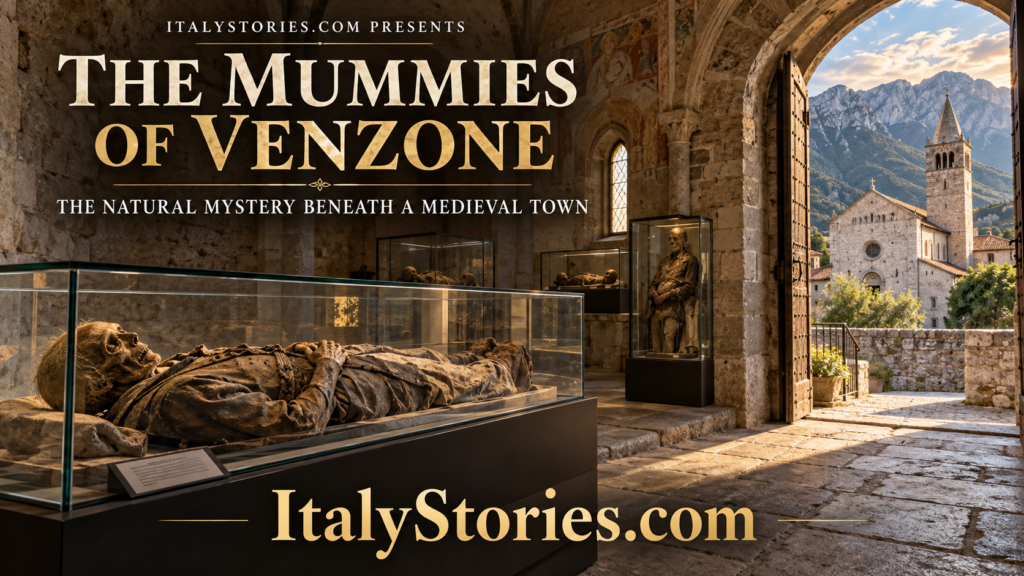
Five mummies are currently exhibited in the crypt of the former Baptistery or Chapel of San Michele, a small Romanesque building close to the cathedral. The actual setting is more restrained than the crowded, cavernous museum sometimes imagined in promotional artwork. Visitors encounter a compact historical space in which the bodies are protected inside individual cases.
The experience can be unsettling, but it need not be sensational. Seen at close range, the mummies reveal the vulnerability of the human body. Their folded limbs, dried skin and traces of clothing collapse the comfortable distance separating the living from historical populations. These people do not look like abstract archaeological objects. They still possess the proportions and gestures of human beings.
The small scale of the display encourages quiet observation. Outside, Venzone continues with cafés, houses, bells and people crossing the square. Inside, several inhabitants of an earlier town remain physically present. Few Italian places create such an immediate connection between daily life and mortality.
Visitors should approach the chapel as they would a burial place or an anthropological collection: without intrusive behaviour and without reducing the remains to macabre entertainment. Photography rules and opening arrangements may change, so they should be checked locally before visiting.
Between Science and Mystery
The word “mystery” is often used carelessly, especially when history is transformed into entertainment. In Venzone, however, it remains appropriate—provided that it does not imply supernatural intervention. Researchers understand the general process of natural mummification, but the exact combination that preserved these particular bodies has not been definitively established.
The historic fungus theory, the calcium sulphate in the soil, the ventilation of the tombs and the local microclimate are pieces of the explanation. None provides a complete answer by itself. The surviving bodies are the final result of a natural experiment that cannot simply be repeated because its original environment no longer exists.
This makes Venzone different from invented tales of curses and walking corpses. Its mystery is quieter and more intelligent. It concerns the interaction between human burial practices, architecture, geology and biology. It asks why certain bodies survived while others did not and how a small medieval community came to preserve physical evidence of its ancestors for hundreds of years.
A Place Where Memory Has a Body
Venzone’s greatest lesson is not that death can be made frightening. It is that memory is fragile, material and dependent on care. The mummies survived because nature unexpectedly protected them. They survived the earthquake because people recovered them from the rubble. The town survived because its inhabitants refused to accept that destruction should be the final chapter.
Walking from the Chapel of San Michele into the reconstructed streets, visitors may notice stones bearing marks of age, damage and restoration. Nothing here offers the illusion that history is perfect. Buildings can fall, names can disappear and bodies can be separated from their identities. What remains must be studied, protected and interpreted responsibly.
The Mummies of Venzone are therefore not simply a strange attraction hidden in Friuli. They form part of a larger story about the relationship between a community and its past. Their silent presence connects medieval burial traditions, early scientific curiosity, modern anthropology and the trauma of the 1976 earthquake.
They also remind us that the people of history were physically real. They became tired, suffered illnesses, worked, prayed, loved and eventually died. Centuries later, an unusual combination of soil, air and time has allowed five of them to stand before us.
Their secret may never be explained completely. Perhaps that is why they remain so compelling. Beneath the apparent stillness of their display lies a story of nature, catastrophe, survival and human dignity—one that belongs not only to Venzone, but to the broader cultural memory of Italy.
Follow ItalyStories.com to discover more hidden places, forgotten lives and extraordinary stories from the heart of Italy.