

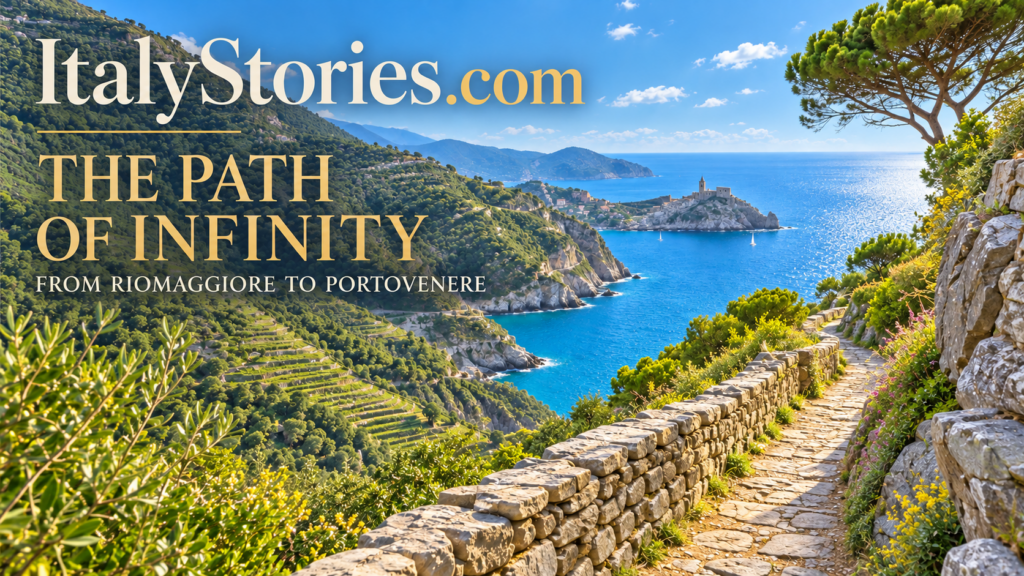
There are paths that take you from one place to another, and there are paths that make the destination almost irrelevant. The spectacular coastal route between Riomaggiore and Portovenere belongs to the second category. Often known as the “Path of Infinity,” it follows the heights of eastern Liguria through vineyards, Mediterranean woodland and ancient stone terraces, with the sea remaining a constant presence far below.
This is not the famous Sentiero Azzurro that connects the five villages of the Cinque Terre. Instead, the route heads southeast from Riomaggiore towards the Gulf of La Spezia, crossing a wilder and less densely inhabited landscape. Depending on the chosen paths and variations, its length can change, which is why different descriptions give different distances. What never changes is the extraordinary beauty of the scenery.
Leaving Riomaggiore behind, the path begins to climb above the colourful houses and narrow streets of the village. The ascent soon reveals the true character of this coastline: steep slopes shaped by generations of farmers who built dry-stone walls and narrow terraces in places that appear almost impossible to cultivate.
For centuries, local families carried soil, stones, tools and baskets along these trails. They planted vines above the sea and created one of Italy’s most dramatic agricultural landscapes. Every terrace is evidence of stubbornness, patience and an intimate understanding of the land.
Higher up, the atmosphere changes. The villages disappear behind the ridges, the air becomes cooler and the path enters woods of chestnut, holm oak and maritime pine. Then, almost without warning, the trees open and the Mediterranean returns, immense and intensely blue.
One of the principal landmarks along the route is Colle del Telegrafo, an important meeting point for several paths in the Cinque Terre network. From here, the journey continues towards Campiglia, a small village positioned on the ridge between the open sea and the Gulf of La Spezia.
Around Campiglia, the view seems to stretch without limits. On clear days, the meeting between sea and sky becomes almost impossible to distinguish. This endless blue horizon is one of the reasons the route has acquired its poetic name.
Below the ridge lie the isolated coastal settlements of Schiara, Monesteroli and Fossola. Their houses cling to the cliffs and are reached by extraordinary flights of stone steps. These hamlets tell the story of a Liguria created through physical effort, where people lived and cultivated vines on slopes descending directly towards the water.
The route gradually approaches Portovenere, one of the most enchanting towns on the Ligurian coast. The landscape becomes increasingly dramatic as the rocky promontory appears ahead and the islands of Palmaria, Tino and Tinetto emerge from the sea.
At the end of the journey stands the Church of San Pietro, built on the edge of the Portovenere headland. With its striped stone walls and exposed position above the waves, it seems less like the conclusion of a trail and more like a gateway suspended between land and water.
The Path of Infinity is beautiful, but it should not be mistaken for an easy seaside walk. It includes long climbs, steep descents, exposed stretches and rough ground. Its charm comes precisely from its rugged nature and from the sensation of travelling through a landscape that has resisted becoming ordinary.
Along the way there are no grand monuments in the traditional sense. The monuments are the terraces, the ancient steps, the little chapels, the vineyards and the dry-stone walls constructed without mortar. Together they form a cultural landscape created over centuries by the people of Liguria.
What makes this journey unforgettable is the uninterrupted relationship with the sea. Sometimes it lies directly below the path; elsewhere it appears between pine trees or beyond abandoned terraces. It changes colour with the light, moving from turquoise near the rocks to an almost infinite blue towards the horizon.
Arriving in Portovenere, the traveller understands that this path is not simply about covering a distance. It is a slow passage through the identity of Liguria—a narrow region where mountains descend into the sea and where every metre of cultivable land had to be earned.
Perhaps “Path of Infinity” is not only a name inspired by the horizon. It also describes the feeling created by the journey: the impression that the sea, the sky and the ancient stone trail could continue forever.