

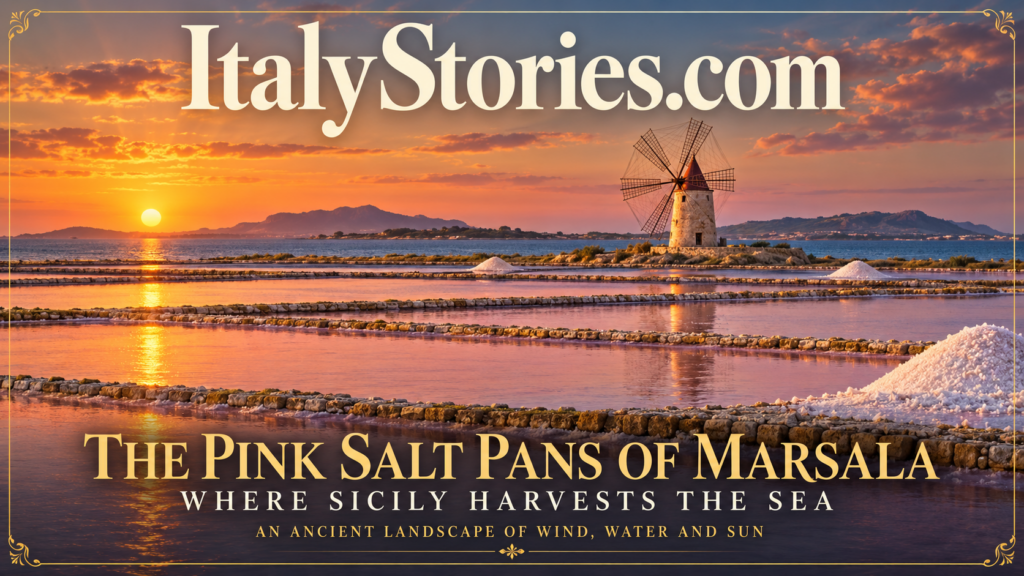
On the western edge of Sicily, where the island turns towards North Africa and the sun disappears behind the Egadi Islands, the sea seems to break into hundreds of pieces. Some pools are silver, others pale blue, copper, violet or an almost unbelievable shade of pink. Long stone embankments divide the water into geometric basins, while old windmills stand above the horizon like silent guardians of a landscape that is partly natural and partly created by human hands.
These are the salt pans of Marsala, set along the shores of the Stagnone, the largest lagoon in Sicily. They are among the most extraordinary cultural landscapes in the Mediterranean, yet their beauty is not the result of decoration. Every wall, channel, basin and windmill belongs to a working system designed to transform seawater into salt.
The scenery may appear romantic, especially at sunset, but the history behind it is one of physical labour, commercial ambition and patient observation of nature. For centuries, generations of salt workers learned how to use the three elements that western Sicily possesses in abundance: wind, water and sun.
They did not manufacture salt in the modern sense. They persuaded the sea to leave it behind.
THE LAGOON CREATED BY AN ISLAND
The Stagnone lies north of Marsala, between Capo Boeo—known in antiquity as Lilybaeum—and Punta San Teodoro. Its name comes from the Italian word stagno, meaning a pond or body of still water. Stagnone can be translated as “large pond,” an affectionate description of a lagoon covering approximately two thousand hectares.
Its formation is connected with Isola Grande, also called Isola Lunga. Over time, sand, marine currents and sediment joined a series of smaller rocky formations, creating a long natural barrier between the open Mediterranean and the Sicilian coast. Protected by this island, the water inside the lagoon became calmer, warmer and exceptionally shallow.
In many areas, it is no more than a few dozen centimetres deep. Even at its deepest, the water generally remains modest compared with the open sea. These conditions produced a distinctive environment of high salinity, warm temperatures and limited water exchange.
For salt production, the geography was almost perfect. The shallow lagoon provided seawater that could easily be channelled into artificial basins. Sicily’s long dry summers encouraged evaporation, while the persistent coastal winds accelerated the process and powered the machinery needed to move the water.
Human beings did not create the Stagnone, but they understood how to work with it. The salt pans were built by adapting the lagoon rather than overpowering it, turning natural conditions into one of Sicily’s most recognisable traditional industries.
The landscape is now protected by the Isole dello Stagnone di Marsala Nature Reserve, established in 1984. The reserve includes the lagoon, its salt pans and four islands: Isola Grande, Santa Maria, Schola and San Pantaleo, better known as Mozia.
A HISTORY THAT BEGINS WITH THE MEDITERRANEAN
It is often said that salt production at Marsala began with the Phoenicians. The tradition is entirely plausible: salt was essential to ancient Mediterranean trade, and the Phoenicians were highly skilled sailors and merchants who understood the commercial value of Sicily’s western coast.
However, it is wise to distinguish between a reasonable historical connection and an uninterrupted industrial record. The precise form and extent of Phoenician salt production around the Stagnone cannot be reconstructed in every detail. What is certain is that salt was a strategic commodity in the ancient world and that the nearby island of Mozia became one of the most important Phoenician settlements in the central Mediterranean.
Before refrigeration, salt was far more than something sprinkled over food. It allowed fish, meat and other products to be preserved for months. It made long sea journeys possible, supported armies and protected communities against periods of scarcity. A reliable source of salt could create wealth, attract merchants and influence political power.
The Phoenicians founded their city on Mozia during the late eighth century BC. The small island occupied an ideal position, protected by the lagoon but connected with the maritime routes between Sicily, Sardinia, North Africa and the Iberian Peninsula.
Mozia developed into a prosperous fortified trading centre. Ships arrived carrying pottery, metals, textiles and luxury goods. From this protected harbour, merchants could reach the western Sicilian coast and the wider Mediterranean. Salt, preserved fish and agricultural products were all part of the economic world in which the city flourished.
In 397 BC, the ruler Dionysius I of Syracuse attacked Mozia. The siege was violent, and the city was captured and destroyed. Unlike many ancient settlements, Mozia was never completely rebuilt on the same scale. This tragedy ultimately helped preserve its archaeological remains, which were not buried beneath a continuously expanding later city.
Today, the ruins of Mozia survive within the same lagoon as the salt pans. Ancient walls, sanctuaries, workshops and roads stand only a short boat journey from the windmills. Few places in Italy unite archaeology, industrial history and natural scenery so closely.
THE ART OF MOVING WATER
The apparent simplicity of a salt pan is deceptive. Producing sea salt requires a carefully controlled sequence of evaporation and concentration. Seawater cannot simply be left in a single pond until the water disappears. It must travel through a system of connected basins, each performing a different function.
At the beginning of the cycle, seawater enters the largest and deepest outer pools. Here, sediment can settle and the sun begins to reduce the volume of water. The increasingly concentrated brine is then transferred into smaller evaporation basins.
As it moves from one pool to another, the concentration of dissolved minerals rises. Different substances precipitate at different stages. Careful management is necessary to prevent unwanted minerals from contaminating the final salt.
Eventually, the brine reaches the shallow crystallising basins. By this point, the water is highly concentrated. Under the heat of the Sicilian summer, crystals begin to form on the bottom until a visible layer of salt develops.
The salt workers must understand the water almost as a farmer understands the soil. Wind direction, temperature, humidity and unexpected rain can all change the result. Too much water delays crystallisation. Too little can damage the quality of the harvest. A summer storm arriving at the wrong moment may dissolve days of work.
The process therefore depends on experience as much as machinery. Traditionally, knowledge passed from older workers to younger ones through practice rather than textbooks. They learned to recognise changes in the brine by its colour, density and movement.
The lagoon may look still, but inside the salt pans the water is always on a carefully planned journey.
THE WINDMILLS OF MARSALA
The windmills are the most famous symbols of the Marsala salt pans. Their stone towers and wide wooden sails rise above the flat landscape, giving the horizon a form that has become inseparable from western Sicily.
They were not built merely to appear picturesque. They were working machines.
The coastal wind turned the sails, producing energy that could be used to operate pumps. These pumps moved water from one basin to another, allowing salt workers to control the different stages of concentration. Some mills were also equipped to grind the harvested salt.
In a landscape with almost no natural difference in elevation, moving large quantities of water was a serious technical challenge. The windmills provided a practical solution using an energy source that was free, abundant and perfectly suited to the location.
Their design reflects centuries of Mediterranean engineering. Wind-powered machinery had developed through exchanges between European and Islamic cultures, travelling along many of the same commercial routes once used by salt merchants.
Today, several historic mills survive around the Stagnone. The best known is the mill associated with the Ettore and Infersa salt pans. Carefully restored, it can still be put into operation, demonstrating that the windmills were sophisticated pieces of industrial equipment rather than decorative fantasies.
When their dark sails turn against the orange sky, they reconnect the modern landscape with the period when nearly every stage of salt production depended on human strength, wood, rope, stone and wind.
WHY THE WATER TURNS PINK
The extraordinary colours of the salt pans are real, although they are not always present with the same intensity. The shades vary according to the season, light, weather and salinity of each basin.
As water evaporates, the environment becomes too salty for many ordinary organisms. Yet some microscopic forms of life are specially adapted to extreme salinity. Among them are microorganisms capable of producing red, orange and pink pigments.
A salt-loving microalga known as Dunaliella salina produces carotenoids that help protect it from intense sunlight. Halophilic microorganisms, including certain archaea, can add further reddish and purple tones to highly concentrated brine. Tiny saltwater organisms may also contribute to the changing appearance of the pools.
The result is a living palette. Basins at different stages of evaporation can display completely different colours even when separated by only a narrow embankment. One remains blue-green, another becomes pale rose, while the most concentrated water may turn deep red or violet.
Sunset intensifies everything. The low light reflects on the shallow pools, combining the biological colour of the water with orange, gold and crimson from the sky. For a few minutes, the industrial geometry of the salt pans seems to dissolve into pure colour.
The pink is therefore neither dye nor photographic invention. It is the visible result of chemistry, biology, sunlight and salt.
THE HARVEST
The traditional harvest takes place during the hottest part of the year, generally after weeks of evaporation have produced a thick layer of crystals in the final basins.
Historically, salt workers entered the shallow pools carrying long wooden tools. They broke the crust, gathered the crystals and pushed them into rows. The salt was then transported to the narrow strips of land between the basins and formed into brilliant white piles.
This was exhausting labour. The summer sun reflected from the white crystals and shallow water, increasing the heat. Salt irritated the skin and damaged tools, footwear and clothing. Workers had to move heavy material while maintaining the delicate structure of the basins.
The piles were traditionally covered with terracotta roof tiles. The tiles protected the salt from rain while allowing air to circulate, producing one of the most characteristic sights of the Sicilian salt landscape: white mounds wrapped in rows of reddish clay.
Some machinery is now used, but manual knowledge remains essential. Sea salt produced in this way is not created by an automated chemical plant. It is the final product of a seasonal relationship between workers and the lagoon.
The expression “harvesting salt” is particularly appropriate. Like grain, grapes or olives, salt has its season. It depends on the weather, must be gathered at the correct moment and reflects the characteristics of the place where it was produced.
MOZIA AND THE ENGLISHMAN WHO REDISCOVERED IT
The modern rediscovery of Mozia is linked to Joseph Whitaker, a member of an English family that had established an important commercial presence in western Sicily during the nineteenth century.
The Whitakers were connected with the production and export of Marsala wine, which had become enormously popular in Britain and other international markets. Joseph, however, was fascinated not only by business but also by archaeology, natural history and ornithology.
At the beginning of the twentieth century, he began systematic excavations on Mozia. His work helped reveal the scale and importance of the ancient Phoenician city. Buildings, defensive walls, religious areas and thousands of objects emerged from the soil.
The island remains associated with the Whitaker Foundation, which protects its archaeological heritage. Its museum houses discoveries from the excavations, including the celebrated marble statue commonly known as the Youth of Mozia, one of the most enigmatic masterpieces of ancient sculpture found in Sicily.
The presence of Mozia adds another layer to the experience of the salt pans. The landscape is not simply beautiful; it is historical in almost every direction. Beyond a pink basin may lie a submerged ancient road. Behind a line of salt mounds stands an island where Phoenician merchants once lived. A modern boat crosses water that protected one of the Mediterranean’s most important ancient cities.
A SANCTUARY FOR MIGRATING BIRDS
The Stagnone is also a significant wetland ecosystem. Its shallow water, mudflats, salt marshes and varying degrees of salinity create habitats for numerous species.
Migratory birds use western Sicily as a resting point when travelling between Europe and Africa. Flamingos, herons, egrets, cormorants and many species of wading birds can be observed in and around the lagoon.
The presence of flamingos is especially appropriate in a landscape already famous for its pink water. Their colour comes from pigments obtained through their diet, including small aquatic organisms that live in saline environments.
The salt pans demonstrate that productive human landscapes are not always incompatible with wildlife. When traditional systems are maintained responsibly, the different water levels and concentrations can create a mosaic of habitats.
Salt-tolerant plants grow along the banks, including glasswort and sea lavender. The rare Calendula maritima, or sea marigold, is associated with this part of western Sicily and is now considered seriously threatened.
Protecting the Stagnone therefore means preserving more than an attractive view. It means safeguarding a complex relationship between the sea, islands, human work, archaeological remains, plants and migrating animals.
THE SALT ROADS OF SICILY
For centuries, the salt produced between Marsala and Trapani travelled far beyond Sicily. It was loaded onto carts, carried to warehouses and transported by sea to markets throughout Italy and the Mediterranean.
The nearby port of Trapani became an important centre for the salt trade. Political authorities understood the value of the product and frequently imposed taxes, monopolies and regulations upon it. Control of salt could generate considerable revenue because almost every household, fishing community and military force required it.
Under different rulers—Norman, Swabian, Aragonese and Spanish—the salt economy changed, but the basic importance of the product remained. Sicily’s geographical position allowed its salt to reach many Mediterranean ports, while the island’s climate gave producers an important natural advantage.
The Marsala landscape was therefore connected with a much larger commercial world. The quiet basins were one end of a network that included sailors, merchants, warehouse workers, fishermen, tax collectors and food producers.
Every grain of salt carried a little of Sicily’s sun, but it also carried the labour and politics of the Mediterranean.
A LANDSCAPE THAT CHANGES EVERY HOUR
The Stagnone never presents exactly the same face twice. In the morning, the pools can appear pale and almost metallic. At midday, the strong Sicilian light removes the shadows and sharpens every embankment. When the wind rises, the lagoon becomes dark blue while the protected basins remain smooth.
Then evening arrives.
The salt pans become mirrors. The silhouettes of the windmills lengthen across the water, the white salt piles turn gold and the islands darken against the horizon. Under certain conditions, the sky, pools and land appear to merge into layers of pink, orange and purple.
It is easy to understand why the area has become famous for its sunsets. Yet concentrating only on the beauty of the moment risks overlooking the true character of the place.
These colours exist because people constructed the basins. The windmills exist because water had to be moved. The salt piles exist because workers gathered them under the summer sun. Even the most poetic view is connected with engineering, trade and labour.
That combination is what makes the Stagnone extraordinary. It is neither untouched wilderness nor an ordinary industrial site. It is a cultural landscape in which nature and human work have influenced each other for centuries.
WHERE SICILY HARVESTS THE SEA
Many places in Italy preserve ancient buildings. Others preserve traditional crafts or important natural habitats. The Marsala salt pans preserve all these things together.
Here, the sea becomes architecture. Water is divided into geometric fields, moved by wind and reduced by sunlight until it produces white crystals. Microscopic life turns the basins pink. Migrating birds stop between continents. Beyond the windmills, the ruins of Mozia recall the Phoenicians who made the western Mediterranean a network of cities and trade routes.
The scene appears timeless, but it is also fragile. Without maintenance, the walls separating the basins would collapse. Without controlled water circulation, the salt-making system would disappear. Without environmental protection, the lagoon’s unique habitats could be damaged by pollution and uncontrolled development.
Preserving the Stagnone means preserving an entire way of understanding the landscape: not as something to dominate completely, but as a living system whose forces can be observed and used with patience.
The salt worker cannot command the sun to shine or the wind to blow. He can only prepare the basins, move the water and wait for Sicily to complete the process.
At sunset, when the pools turn rose and the windmill sails become black against the sky, the Stagnone looks almost unreal. Yet everything visible—the colours, crystals, channels and reflections—comes from the most basic elements of the Mediterranean world.
Sea, stone, wind, sunlight and time.
This is where Sicily harvests the sea.
[…] more remarkable Italian landscapes, discover Strada della Forra, the pink salt pans of Marsala, the Tempio del Valadier, the secret city beneath Camerano and Villa […]