

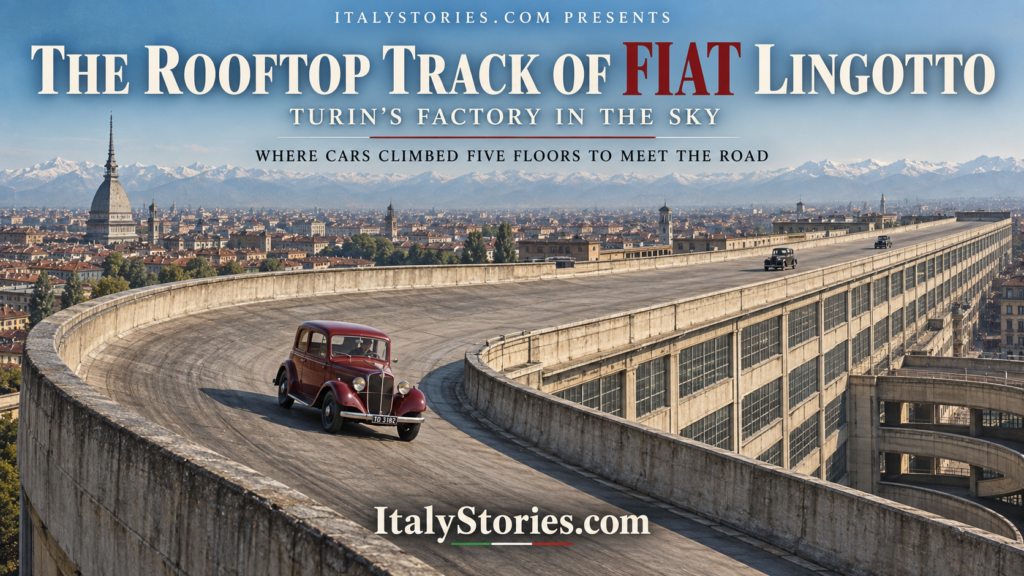
In the history of automobile manufacturing, factories usually end with a gate. At Fiat’s Lingotto plant in Turin, they ended in the sky. A completed car travelled upward through five floors of workshops, reached the roof and emerged onto an oval test track suspended above the city. Before it could be delivered to a customer, it had to start, accelerate, brake and negotiate two steeply banked concrete curves while the rooftops of Turin and the Alps stretched beyond the barriers. It was not a fantasy imagined for a futuristic film. It was a working industrial system, conceived before the First World War and built at a scale that astonished architects, engineers and visitors from around the world.
The rooftop track of Fiat Lingotto became one of the most recognisable symbols of Italian industry because it joined architecture, manufacturing and movement in a single unforgettable idea. The building did not merely contain a factory. Its shape expressed the journey of the automobile from raw material to finished machine. Steel, engines, components and workers entered below; complete cars appeared above, where the roof itself became their first road.
For decades, engines echoed across a place where nobody would normally expect to hear them. Beneath the track, thousands of people produced the vehicles that helped transform Italy. Above them, test drivers accelerated toward the banking with the city spread below. The result was both practical and theatrical: a factory that turned production into an ascent.
Fiat Outgrows Its First Home
Fiat had been founded in Turin in 1899, when the automobile was still an expensive mechanical curiosity. The company’s name, Fabbrica Italiana Automobili Torino, made its connection with the city explicit. Turin already possessed strong traditions in mechanics, engineering and manufacturing, and Fiat quickly developed from a small enterprise into an increasingly important industrial organisation.
Its early workshops in Corso Dante could not accommodate the scale of production envisioned by the company’s leaders. Demand was expanding, automobiles were becoming more complex and modern manufacturing required a more rational relationship between materials, machines, departments and workers. Fiat needed a plant capable of representing not only its existing production but also its ambitions.
The area chosen lay south of central Turin in the Lingotto district, near railway infrastructure that could deliver raw materials and carry away components and finished goods. At the time, this was not the dense urban environment visitors see today. The arrival of the factory would alter the district, attracting workers, housing, transport and commercial activity.
The project was entrusted principally to engineer Giacomo Mattè-Trucco. Design work began around 1915, and construction started in 1916, while Europe was consumed by war. Building continued in phases through a period of political tension, economic difficulty and technological change. The factory was officially inaugurated in May 1923 in the presence of King Victor Emmanuel III, although parts of the complex had already begun operating.
By the time the plant was complete, it was among the largest and most advanced automobile factories in Europe. Its sheer length was impressive, but its most revolutionary feature was the organisation of production in height.
A Factory Designed Like a Machine
Lingotto was built largely from reinforced concrete, a material that allowed the creation of extensive floors supported by a regular structural grid. Long rows of large windows brought daylight into the workshops, while the repeated columns, beams and openings gave the exterior a severe but elegant rhythm.
The principal production building stretched for approximately half a kilometre. Two long parallel blocks were linked by transverse sections containing services, circulation routes and connections between departments. Instead of hiding its industrial purpose behind a decorative façade, Lingotto displayed its logic openly. It looked like what it was: an enormous machine for making machines.
The reinforced-concrete construction was associated with the Italian development of the Hennebique structural system and the work of the Porcheddu company. The building had to support heavy machinery, moving components, stored materials and thousands of workers. The roof added an unusual challenge because it would carry not only weather and static loads but also moving automobiles, vibration and repeated braking forces.
The structure had to remain sufficiently rigid while allowing the internal spaces to adapt to changes in manufacturing. Automobile production evolves constantly. A building that could accommodate one model might become unsuitable when the next car required different machines, sequences or quantities. Lingotto’s modular concrete frame offered a degree of flexibility that was highly advanced for its time.
Yet the true originality of the plant lay in the connection between structure and production. Fiat adopted ideas inspired by American mass manufacturing, particularly the principles associated with Ford, but adapted them to a constrained urban site. Where American factories increasingly spread assembly across vast horizontal spaces, Lingotto moved upward.
Raw materials and components entered at the lower levels. As production progressed, engines, chassis, bodies and mechanical systems passed through specialised departments on successive floors. Assembly was intended to culminate near the top of the building. Once the automobile was complete, it continued toward the roof.
The finished car had climbed through the factory before travelling under its own power.
The Spiral Ramps
Moving cars and materials between floors required more than conventional lifts. At the ends of the Lingotto complex, Fiat constructed extraordinary helical ramps that remain among the building’s most admired engineering features.
The ramps rise through circular spaces supported by curving concrete ribs. Their geometry allowed vehicles to move gradually between levels without negotiating excessively steep gradients. Components could be transported upward during manufacturing, while finished cars could travel toward the test track or descend after inspection.
From the centre, the ramps resemble enormous mechanical spirals. Repeated beams and columns curve toward an opening above, creating a view that seems almost abstract. Their beauty comes directly from their purpose. Nothing is disguised: the concrete structure, turning radius and steady rise all express movement.
The ramps were completed as the complex continued to develop during the 1920s. They gave physical form to the idea behind Lingotto. Production did not occur within a collection of unrelated workshops. It followed a continuous ascent, and the building guided that ascent.
Driving upward must have been a memorable experience for the test drivers. The sound of the engine would rebound from concrete surfaces while daylight appeared through the openings. At the top, the enclosed spiral gave way to open sky and one of the most unusual test tracks ever constructed.
The Road on the Roof
The rooftop circuit followed the long rectangular shape of the factory. Two extended straights were connected by broad banked curves at the northern and southern ends. Depending on how the circuit and its access sections are measured, its total length is commonly described as approximately one and a half kilometres.
The curves were not simple semicircles laid flat on the roof. They rose steeply toward their outside edges, creating a parabolic profile that helped support the car during cornering. At speed, the banking reduced the lateral force the tyres had to provide and allowed drivers to maintain a smoother line.
This was not intended to be a racing circuit. There were no public grandstands, scheduled Grands Prix or cheering crowds. Its purpose was industrial testing. Every car needed to demonstrate that its major systems operated correctly before leaving the factory.
A driver could listen for unusual mechanical noises, test the response of the engine, examine the operation of the gearbox and steering, and verify that the brakes worked. The long straights allowed acceleration, while the curves placed the car under sustained load. Problems discovered on the roof could send the vehicle back for adjustment.
Testing conditions changed with the weather. In summer, the concrete absorbed heat beneath the Turin sun. In winter, cold air descended from the Alps, and snow or ice could make the roof a very different environment. Rain tested drainage, tyre grip and the courage of anyone approaching a banked curve without modern electronic assistance.
The track had to be maintained like any road, but it sat above an active factory. Waterproofing, cracking and the effects of repeated vehicle loads required attention. The engineers had created a piece of transport infrastructure on top of a manufacturing building decades before rooftop mobility became a fashionable architectural idea.
The Men Who Drove Above Turin
The image of a lone car on the banked curve can make the test track appear romantic. For the drivers, however, it was a workplace. Their task was not to pose for photographs but to identify problems quickly and consistently.
A production car was expected to behave within defined limits. A vibration, hesitation, weak brake or abnormal noise could indicate an assembly defect. The driver needed mechanical sensitivity, concentration and the ability to distinguish a genuine fault from the ordinary character of the model.
The track also hosted more unusual vehicles and experimental work. One of the most celebrated episodes occurred in 1954, when the extraordinary Fiat Turbina underwent an early test at Lingotto. The car was powered by a gas turbine rather than a conventional piston engine and represented Fiat’s exploration of a technology that seemed capable of defining the future.
With experienced test driver Carlo Salamano at the controls, the Turbina brought a completely different sound to the rooftop. Instead of the familiar pulse of cylinders, the engine produced the rising whistle of a turbine. The project never became a production car, but the sight of that futuristic machine on a track conceived before the First World War captured the continuing symbolic power of Lingotto.
The roof was a place where ordinary production and technological ambition met. Thousands of practical family cars passed over it, but so did prototypes created by engineers willing to imagine an automobile transformed by new forms of power.
The Cars Made at Lingotto
During its working life, Lingotto was associated with dozens of Fiat models. Early vehicles such as the Fiat 501 and 509 helped establish the company as a large-scale manufacturer. The Fiat 508 Balilla, introduced in the early 1930s, brought car ownership within reach of a broader, though still limited, section of the Italian population.
The Fiat 500 known as the Topolino became one of the most memorable cars of the pre-war and immediate post-war eras. Small, economical and cleverly packaged, it answered the need for transportation in a country where private motoring remained beyond the means of many families.
Later Fiat models reflected the rapid development of Italian society. Cars became more practical, more numerous and increasingly connected to everyday life. By the years of the economic miracle, the automobile was no longer only a symbol of wealth. It was becoming a tool that changed commuting, holidays, courtship, family relationships and the physical form of cities.
Not every famous Fiat was produced exclusively at Lingotto, and the company’s industrial centre progressively shifted toward Mirafiori and other plants. Yet Lingotto remained the architectural image of Fiat’s first great expansion. Even people who could not identify every model understood what the rooftop track represented: Turin’s confidence in machines and the belief that industry could construct the future.
A Factory and a City
Lingotto cannot be understood only through automobiles. It was also a place of labour. Thousands of men and women entered its gates, worked beside noisy machinery and followed production rhythms that increasingly demanded speed, precision and discipline.
For Turin, Fiat was never simply another employer. The company influenced housing, transport, politics, migration and the organisation of daily life. Factory shifts determined when trams were crowded and when entire neighbourhoods woke. Wages supported families, while industrial conflicts shaped national debates over labour and power.
The construction and expansion of Lingotto coincided with a turbulent period in Italian history. Turin experienced intense labour struggles after the First World War, including factory occupations during the Biennio Rosso. The automobile represented modernity and opportunity, but mass production also created repetitive work and strict hierarchies.
The splendour of the rooftop track therefore rested upon the labour taking place beneath it. Every vehicle that emerged into the sunlight contained thousands of actions performed inside the building: welding, machining, fitting, checking, carrying and adjusting.
Photographs often show the roof nearly empty, with a few elegant cars crossing the banking. The floors below would have presented a very different scene—crowded workshops, oil, heat, metal and relentless sound.
Lingotto was both monument and workplace, architectural masterpiece and instrument of industrial discipline. Its history contains pride and difficulty in equal measure.
The Factory That Fascinated Architects
Lingotto attracted the attention of architects because it appeared to solve the industrial building as a single continuous process. Its form did not merely shelter production; it made the production sequence visible.
Le Corbusier admired the building and included images of it in his discussion of modern architecture. To the architects of the period, the repeated concrete structure, long horizontal windows, ramps and roof track seemed to belong to a new age. The factory appeared more radical than many buildings officially described as art.
Its influence was partly visual. From the air, the oval track created an image of extraordinary clarity. From inside, the spiral ramps demonstrated that infrastructure could possess sculptural force. The entire complex expressed speed even when no car was moving.
There was also a contradiction. Lingotto looked like the ultimate factory of the future, but multi-storey automobile production would soon appear less efficient than the vast single-level plants being developed elsewhere. Vertical movement created logistical complications. Transporting components between floors required time, coordination and energy.
The factory was therefore futuristic in appearance while already approaching the limits of its manufacturing concept. This does not diminish its achievement. It makes Lingotto more fascinating: it captured a particular moment when architecture, engineering and industrial optimism briefly seemed to point in exactly the same direction.
Mirafiori and the Changing Logic of Production
Fiat continued to grow, and the company required facilities capable of producing automobiles in greater quantities. The Mirafiori plant, officially opened in 1939, represented a different generation of industrial planning. Its broad horizontal organisation was better suited to evolving assembly methods and large-scale production.
Lingotto remained active, but its limitations became increasingly clear. The automobile industry changed dramatically after the Second World War. Production volumes rose, model ranges expanded and manufacturing systems demanded spaces very different from those imagined in 1915.
During Italy’s economic miracle, Fiat became one of the central forces in the country’s transformation. Workers arrived in Turin from southern Italy and rural regions, the city expanded and models such as the new Fiat 500 and 600 placed private mobility within reach of millions.
Lingotto remained emotionally connected to this history, even as the main industrial action shifted elsewhere. It was the old cathedral of Fiat production: still impressive, still operating, but no longer the most efficient expression of the company’s future.
By the 1970s, the building had become increasingly unsuitable for modern automobile manufacturing. Production finally ended in 1982. After decades of movement, the rooftop track fell silent.
The Italian Job and a New Kind of Immortality
Before the factory closed, the rooftop track had already achieved cinematic immortality. In the 1969 film The Italian Job, three Mini Coopers flee through Turin in one of cinema’s most famous car-chase sequences. The cars enter the Lingotto roof and drive side by side around the banked track, pursued by police.
The scene lasted only a short time, but it introduced international audiences to a location so extraordinary that it required no film-set modification. The building already looked impossible.
The Minis were not being tested, and the sequence had nothing to do with Fiat production, yet it preserved the track at a moment when the factory was still operating. The film transformed industrial infrastructure into cinematic spectacle and helped ensure that Lingotto would remain familiar even to viewers who knew little about Turin.
For many enthusiasts outside Italy, the chase was their first encounter with the roof. Years later, arriving at Lingotto can produce the strange sensation of stepping into a film while discovering that the location’s real history is far more remarkable than the fiction.
Renzo Piano and the Reinvention of Lingotto
Closing the factory created an enormous problem. Lingotto was too important to demolish, too large to preserve as an empty monument and too specialised to convert easily. Turin needed to decide whether an industrial building could acquire a new life without losing the elements that made it unique.
In the 1980s, architect Renzo Piano was chosen to lead its transformation. His approach retained the monumental exterior, concrete structure and rooftop track while introducing a mixture of new functions. The former factory gradually became a complex containing exhibition and conference spaces, offices, hotels, commercial areas, an auditorium and cultural institutions.
The conversion did not attempt to return Lingotto to the appearance of 1923. Piano treated the building as a living part of the city, adding modern structures that openly belonged to another era.
Among the most recognisable additions is the Bolla, a glazed rooftop meeting room with a rounded form that appears to hover above the complex. It is sometimes mistaken in modern images for an original control tower connected with the test track, but it belongs to the later architectural transformation.
The Pinacoteca Giovanni e Marella Agnelli opened on the roof in 2002. Its elevated exhibition space, designed by Piano and often described as a treasure chest or Scrigno, introduced works of art into a place once dominated by engines and concrete.
The rooftop now connects automobile history, architecture, contemporary art and views across Turin. The machinery has gone, but movement remains part of the experience.
From Test Track to Pista 500
In 2021, another chapter began with the development of La Pista 500. The roof was transformed into a public garden and cultural route while the historic track remained recognisable.
Plants, trees and areas of vegetation now occupy spaces once defined by industrial surfaces. Contemporary artworks appear along the route, and visitors can walk where test drivers once accelerated new Fiats. The banked curves continue to rise dramatically at each end, preserving the physical sensation of the old circuit.
Casa 500, also opened as part of the renewed cultural programme, tells the story of the Fiat 500 and its relationship with Italian society. The choice is appropriate. Few cars have expressed Italy’s transition from post-war hardship to mass mobility as clearly as the 500.
The transformation does not erase the industrial past. Instead, it changes the meaning of the ascent. Cars once climbed through the factory to reach the roof; today visitors rise toward a landscape combining memory, art and nature.
A place created to test machines has become a place where the city tests a different relationship with its industrial heritage.
The Building That Refused to Become a Ruin
Industrial buildings are often abandoned when their original function ends. Machines are removed, windows break and enormous spaces become difficult to maintain. Eventually, demolition appears cheaper than imagination.
Lingotto followed another path. Its survival demonstrates the value of adaptive reuse: preserving a building not by freezing it but by allowing it to perform new work. The former factory remains economically and socially active because it contains offices, culture, hospitality and public space.
Not every intervention will satisfy every admirer of the original plant. The commercial transformation changed interiors, and the modern additions altered the roof. Yet without a viable new purpose, much more might have been lost.
The most important elements endure. The concrete frame continues its half-kilometre rhythm. The spiral ramps still turn upward. The banked curves remain suspended over Turin. A visitor can stand on the roof and understand immediately what made Lingotto revolutionary.
The factory no longer produces cars, but it still produces amazement.
Where Engineering Became Emotion
The rooftop track of Fiat Lingotto is memorable because it transforms a technical solution into an emotional experience. It is easy to admire the banking, the ramps and the reinforced-concrete structure as engineering. It is more difficult to stand there without imagining the first moment when a newly completed car emerged into the open air.
The engine started several floors below or near the final assembly area. A driver guided the vehicle upward, reached the roof and accelerated onto a road that seemed detached from the earth. Beneath the tyres stood an entire factory. Beyond the barriers lay Turin, a city whose future was becoming inseparable from the automobile.
Every lap carried a practical purpose, but the setting gave it symbolic force. The car had travelled from raw material to independent movement. The factory had not simply built it; the architecture had staged its birth.
That is why Lingotto remains more than an unusual old factory. It represents a moment when Italy believed engineering could be monumental, industry could be beautiful and even a roof could become a road.
The engines are quieter now. Trees and artworks occupy parts of the track, and the building serves a city very different from the Turin of 1923. Yet the banked curves still rise against the sky, waiting for anyone who looks at them to ask the same question: who could possibly have imagined building a test track there?
The answer is written in concrete, half a kilometre long, above one of Italy’s great industrial cities.
Follow ItalyStories.com to discover more extraordinary places, Italian engineering achievements and stories from the history of motoring.