

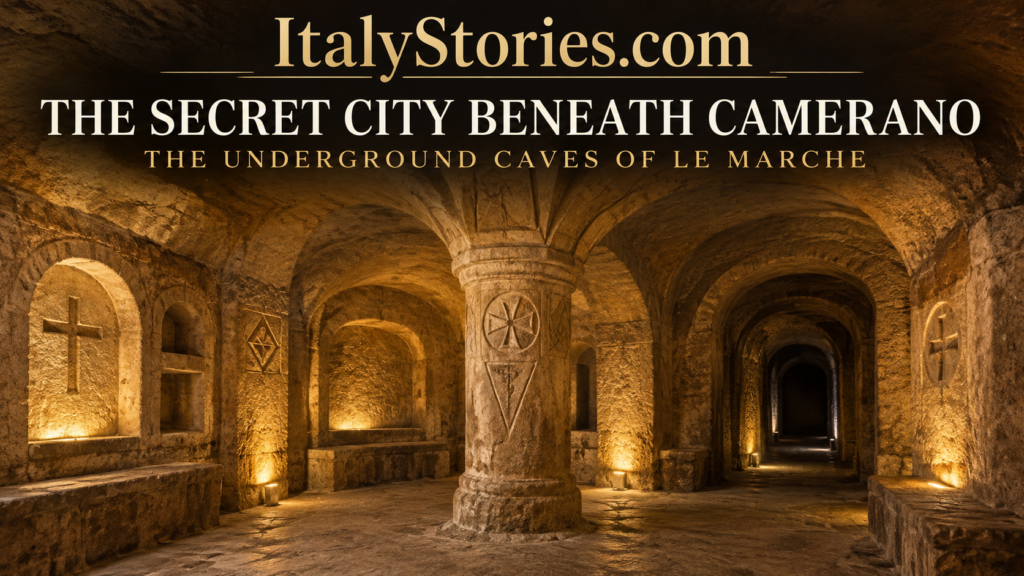
On the surface, Camerano appears to be a quiet hill town in the Marche, surrounded by vineyards and the green landscapes of Monte Conero. Its narrow streets, churches and old palaces seem to tell a familiar Italian story. Yet beneath the historic centre lies another town: darker, more mysterious and almost entirely invisible.
The Grotte di Camerano are not natural caves. They form an extraordinary network of chambers, corridors, stairways and vaulted rooms excavated by human hands in the sandstone beneath the town. Their full extent is still difficult to determine. Entrances once opened from private houses, cellars, religious buildings and aristocratic residences, while passages created connections between different parts of the underground world.
An old local saying claims that there is more of Camerano below ground than above it. Walking through the caves, that idea no longer seems impossible.
As soon as visitors descend beneath the streets, the atmosphere changes. The sounds of the town disappear, the temperature falls and the warm colour of the sandstone emerges under the soft lights. Passages lead into circular chambers, narrow tunnels open unexpectedly into larger halls, and carved pillars appear from the shadows.
Some rooms are simple and practical. Others are surprisingly elaborate.
There are barrel vaults, domed ceilings, wall niches, stone benches, decorative bands and symbols carved into the rock. Crosses and geometric figures appear in several chambers, while certain spaces seem to have been designed for gatherings rather than storage. Their careful proportions and unusual acoustics make them feel almost ceremonial.
This complexity is one of the reasons the caves continue to fascinate historians.
For a long time, they were described simply as ancient sandstone quarries or underground storerooms. Both explanations are probably part of the truth. The excavated stone could be used for construction, while the constant temperature made the underground chambers suitable for preserving food and wine. Some areas may also have been connected with water collection.
But practical needs alone do not explain every room.
Why create decorated vaults in a cellar? Why carve religious symbols into hidden walls? Why construct circular chambers and meeting spaces far below the town?
The honest answer is that nobody knows exactly when the first tunnels were excavated or who began the work. The underground network was probably not created during a single period. It appears to have been enlarged and transformed over many centuries, with each generation adapting older spaces to new purposes.
Local traditions sometimes connect the caves with the ancient Picenes, the Knights Templar, secret brotherhoods or Masonic lodges. These stories add to their appeal, but they remain theories rather than established historical facts. The caves preserve many clues, yet they do not offer a simple solution to their own mystery.
Four of the best-known underground complexes are associated with prominent Camerano families: the Corraducci, Mancinforte, Ricotti and Trionfi. The passages beneath their former residences contain some of the most distinctive rooms in the network. Here the division between a family cellar, a place of worship, a private meeting room and a refuge becomes difficult to define.
Perhaps these spaces served several functions at different times.
That possibility is essential to understanding Camerano. The caves are not the remains of a single lost civilization or one secret order. They are more like an underground archive, shaped by centuries of ordinary needs, religious devotion, fear, ingenuity and collective memory.
During periods of conflict, the labyrinth offered protection. Its concealed entrances and thick sandstone walls made it a natural refuge from raids and armed attacks. When danger approached, people could abandon the exposed streets and disappear beneath their homes.
The caves took on this role once again during the Second World War.
In July 1944, as the front moved through the area and Camerano was threatened by bombardment, residents sought shelter underground. Families entered the chambers carrying whatever they could manage. The elegant rooms and mysterious corridors became temporary living spaces where neighbours shared darkness, anxiety and the hope of returning safely to the surface.
This episode gives the caves a deeply human dimension. They are not merely an archaeological curiosity. They protected the community at one of the most dangerous moments in its modern history.
Imagine the silence between explosions above, children sleeping beside carved walls, and families gathered in spaces whose original purpose had already been forgotten. Centuries of history suddenly overlapped: ancient passages, medieval fears and modern warfare became part of the same story.
After the war, many entrances were closed, concealed or incorporated into private cellars. The underground network gradually returned to silence. Between 1976 and 1983, members of the Gruppo di Ricerca Storica del Conero explored and studied the caves, helping to reconstruct their connections and bring this hidden heritage back to public attention.
Today, guided visits allow travellers to enter part of the system and discover a Camerano that cannot be understood from its streets alone.
The most memorable aspect of the experience is not any single chamber. It is the constant feeling that the town has two identities. Above ground, there are sunlight, rooftops and views towards the Conero landscape. Below ground, there are cool sandstone walls, passages fading into darkness and symbols left by people whose intentions remain unknown.
Every staircase feels like a border between two different versions of Italy.
One is visible, photographed and mapped. The other survives beneath our feet, protected by darkness and by the questions that history has never answered.
The Grotte di Camerano remind us that Italy’s most remarkable places are not always monumental or famous. Sometimes they are hidden below an ordinary piazza, behind a cellar door or underneath a building passed every day without a second thought.
They also teach us to be cautious with legends. Mystery does not need to be exaggerated. The documented story of these caves—excavated and transformed over centuries, decorated with unexpected care and used to shelter a frightened community—is already extraordinary.
You enter looking for secret societies and ancient riddles. You leave thinking about the countless anonymous people who dug these passages, stored their provisions, gathered in hidden rooms and trusted the earth to protect them.
Camerano’s underground city still holds many secrets. Perhaps that is precisely why it remains so powerful: it allows history to be felt even where it cannot be completely explained.
Follow ItalyStories.com to discover more unusual places, forgotten histories and hidden corners of Italy.