

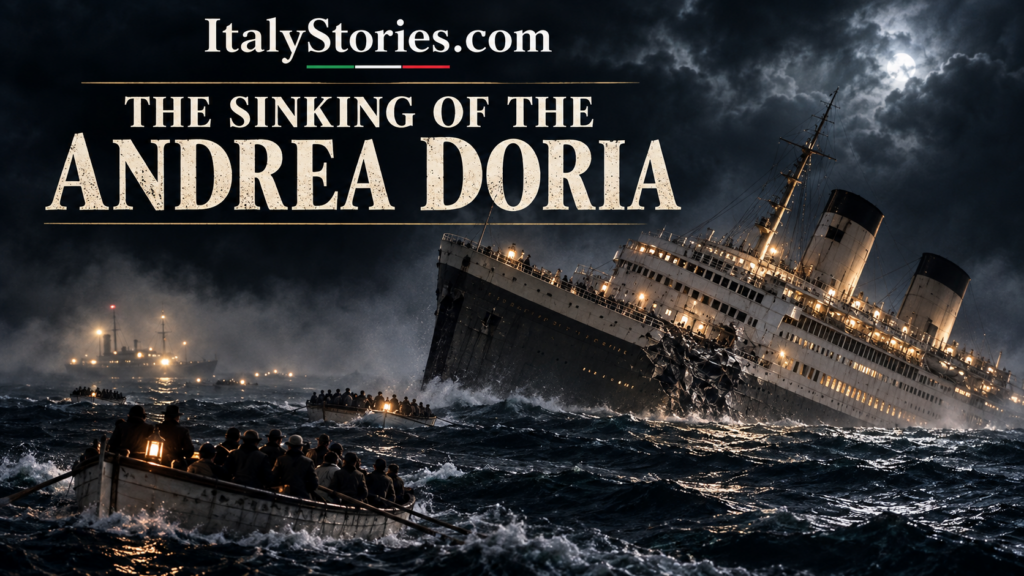
On the night of July 25, 1956, the North Atlantic was wrapped in a wall of fog. Somewhere south of Nantucket, less than a day from New York, the Italian ocean liner Andrea Doria was approaching the triumphant end of another transatlantic crossing. Her passengers were preparing for arrival: luggage had been packed, farewell dinners had been served, and relatives in America were already waiting at the pier. The ship was one of the finest expressions of post-war Italy—a floating palace designed to show the world that the country had recovered its confidence, creativity and technical ambition. Within a few hours, however, that symbol of national rebirth would be lying mortally wounded in the ocean, while hundreds of people descended from its dramatically tilted decks into small lifeboats surrounded by darkness and fog.
The loss of the Andrea Doria became one of the most famous maritime disasters of the twentieth century, but it was also the setting for one of the greatest rescue operations ever carried out at sea. The tragedy claimed 51 lives, yet approximately 1,660 passengers and crew members aboard the Italian liner survived. It was a disaster born from confusion, radar interpretation, speed, poor visibility and decisions made during a handful of irreversible minutes. It was also a story of courage, discipline and extraordinary cooperation between ships of different nations.
A Floating Symbol of Italy’s Rebirth
The Andrea Doria was named after the celebrated Genoese admiral and statesman who lived between the fifteenth and sixteenth centuries. Built by the Ansaldo shipyards at Sestri Ponente, near Genoa, the liner was launched on June 16, 1951, and entered service in January 1953. Italy was still emerging from the physical and psychological destruction of the Second World War, and the new ship carried a meaning far greater than her commercial purpose. She was proof that Italian industry could once again create something modern, beautiful and internationally admired.
Measuring approximately 213 metres in length and around 27 metres across the beam, the Andrea Doria had a gross tonnage of just over 29,000 tons. Her steam turbines drove two propellers and gave her a service speed of about 23 knots, with a maximum speed approaching 26 knots. She was not the largest liner on the Atlantic, nor the fastest, but she was widely regarded as one of the most elegant.
Italian style could be found throughout the vessel. Her public rooms contained paintings, sculptures, ceramics, tapestries and carefully selected furniture. The first-class areas offered the sophistication of a fashionable hotel, while even the less expensive accommodation was designed with unusual care. The ship had ten passenger decks and three outdoor swimming pools, one for each of the three passenger classes then used aboard transatlantic liners. It was an arrangement that seems strange today, but it reflected the rigid social divisions of ocean travel during the 1950s.
The Andrea Doria was built to carry roughly 1,200 passengers, supported by a crew of about 500. For emigrants, she represented the final chapter of an old life and the beginning of a new one in America. For tourists and wealthy travellers, she offered several days of Italian hospitality between Europe and New York. Her graceful profile, dark hull, white superstructure and two streamlined funnels made her instantly recognisable.
She was also considered a remarkably safe vessel. Her hull was divided into watertight compartments, and the ship was equipped with modern radar systems, an important innovation at a time when dense Atlantic fog still posed a serious threat. Many believed technology had made disasters on the scale of the Titanic almost impossible. The final voyage of the Andrea Doria would demonstrate that technology is only as effective as the information people obtain from it—and the decisions they make under pressure.
The Final Crossing
In July 1956, the Andrea Doria left Italy under the command of Captain Piero Calamai, one of the most experienced officers in the Italian Line. The voyage was her 101st Atlantic crossing. On board were 1,706 passengers and crew members, including tourists, businesspeople, families and emigrants travelling toward a new future in the United States.
By the evening of July 25, the ship was approaching the busy waters near Nantucket. Fog had settled over the sea, thick enough to hide ships from one another even when they were only a short distance apart. Captain Calamai reduced speed, posted additional lookouts and ordered fog signals to be sounded. However, the Andrea Doria was still moving quickly through water crossed by numerous vessels travelling in both directions.
Coming from New York on an eastbound course was the Stockholm, a Swedish passenger liner considerably smaller than the Andrea Doria. The Stockholm possessed one feature that would prove devastating: a strongly reinforced bow designed for navigation in icy northern waters. On its bridge that evening, the ship was being handled by Third Officer Johan-Ernst Carstens-Johannsen.
Both ships were equipped with radar. Both detected the other vessel. Yet the officers on the two bridges formed very different pictures of what was happening.
The Andrea Doria’s bridge believed the approaching ship would pass on one side; the Stockholm’s officer believed it would pass on the other. The radar displays of the period showed distance and direction, but they did not automatically calculate another vessel’s precise course and speed as modern systems can. Those conclusions had to be produced by repeated observations, plotting and human judgement. In darkness and fog, a small error in interpreting a radar echo could become a fatal misunderstanding.
As the ships continued to close the distance, each made a manoeuvre intended to increase the separation. Instead, their turns placed them directly in one another’s path. When the vessels finally emerged from the fog and became visible, there was almost no time left.
The Collision
At approximately 11:10 p.m., the officers on both bridges saw the lights of the other ship. Emergency manoeuvres were ordered immediately, but the momentum of two large passenger vessels could not be cancelled in a few seconds.
The reinforced bow of the Stockholm struck the starboard side of the Andrea Doria with tremendous force. It entered the Italian liner’s hull like a giant blade, crushing occupied cabins and penetrating deep into the vessel. For several seconds, the ships remained locked together. Then the Stockholm pulled free, leaving a vast opening in the side of the Andrea Doria.
The impact killed passengers in the collision zone and five crewmen aboard the Stockholm. Cabins were destroyed in an instant, corridors were twisted, and seawater rushed into the Italian ship. Some people were thrown from their beds. Others found themselves trapped in darkness as furniture, doors and broken metal blocked their escape.
Among the most extraordinary stories of the night was that of 14-year-old Linda Morgan. She had been sleeping aboard the Andrea Doria when the Stockholm’s bow tore through the cabin area. The violence of the collision carried her from the Italian liner onto the damaged bow of the Swedish ship. Crew members later found her alive on the Stockholm. She became known in newspapers as “the miracle girl,” although members of her family were killed or seriously injured.
The collision itself did not immediately send the Andrea Doria to the bottom. The fatal problem was the severe list that developed within minutes. Seawater flooded compartments and damaged tanks on the starboard side, causing the liner to lean heavily in that direction. The inclination rapidly reached approximately 18 to 20 degrees and continued to worsen.
A ship designed to survive flooding can remain afloat only if stability is preserved. In the case of the Andrea Doria, the growing imbalance became impossible to correct. Attempts were made to transfer liquids and restore equilibrium, but the flooding was too extensive and the list too severe. Water began to reach areas it was never intended to enter.
The angle of the vessel created another frightening difficulty: the lifeboats on the port side could no longer be lowered safely. They hung high above the water, unable to clear the side of the leaning ship. The starboard boats could be used, but their capacity was not sufficient for everyone aboard.
Captain Calamai now faced every commander’s nightmare. His ship was mortally damaged, hundreds of people were waiting for orders, and there were not enough usable lifeboats to evacuate them without outside assistance.
A Distress Call in the Darkness
The Andrea Doria transmitted urgent distress messages. The Stockholm, despite the destruction of its bow, remained afloat and also called for help. Radio signals spread across the Atlantic, reaching ships travelling through the surrounding waters.
Several vessels changed course and headed toward the disaster. Among them were the freighter Cape Ann, the United States Navy transport Private William H. Thomas and the destroyer escort Edward H. Allen. Even the badly damaged Stockholm began taking survivors aboard.
The most important response came from the French liner Île de France. She had already passed the Andrea Doria and was travelling toward Europe when her commander, Captain Raoul de Beaudéan, received news of the collision. Turning a large liner around at sea involved delay, fuel and risk, and the first radio reports did not yet reveal the full scale of the emergency. Nevertheless, Captain de Beaudéan decided to return.
That decision saved hundreds of lives.
As the Île de France approached, the fog began to lift. The French ship emerged from the darkness illuminated by her exterior lights, presenting a sight survivors would remember for the rest of their lives. To the frightened passengers waiting on the steeply angled decks of the Andrea Doria, she appeared almost like a brilliantly lit city arriving across the sea.
Captain de Beaudéan positioned his vessel to offer some protection from the wind and waves. The Île de France lowered its lifeboats, which began travelling repeatedly between the two liners. Crew members and passengers aboard the French ship prepared cabins, blankets, hot drinks and medical assistance. Many voluntarily gave their rooms to survivors who arrived wet, exhausted and in shock.
The rescue became an enormous international operation carried out in darkness, fog and rolling seas. Lifeboats from different vessels moved around the sinking liner. Passengers climbed down rope ladders or were lowered from openings in the side. Children were passed into the arms of sailors. Families became separated and did not know whether their relatives had survived.
The steep list made every movement difficult. Floors had become slopes, staircases were dangerous, and ordinary passageways seemed almost vertical. Nevertheless, panic never completely overcame the evacuation. Crew members continued directing passengers toward embarkation points while rescuers made journey after journey through the night.
The Île de France alone received more than 700 survivors. Other vessels, including the Stockholm, took hundreds more. The success of the operation depended on radio communication, the number of ships in the area, favourable changes in visibility and the willingness of their commanders to respond without hesitation.
Captain Calamai’s Final Hours Aboard
Captain Piero Calamai remained aboard the Andrea Doria while the evacuation continued. For a master who had spent his life at sea, abandoning such a ship was not simply a professional defeat; it was a deeply personal tragedy.
According to accounts from the rescue, Calamai initially appeared unwilling to leave. His officers understood that remaining aboard would achieve nothing and urged him to enter one of the last boats. Eventually, he left the ship with members of his command.
He survived, but the disaster remained with him. His seagoing career was effectively over. Calamai was not a reckless amateur but an experienced captain caught in a chain of errors, assumptions and circumstances that developed with terrible speed. The image of the Andrea Doria sinking became inseparable from his name, regardless of the complexities surrounding the collision.
Investigations began soon after the disaster, and the two shipping companies presented competing interpretations of the events. Questions concerned speed in fog, radar plotting, the courses selected by both ships, the absence or interpretation of fog signals and the final emergency turns. Before the hearings produced a definitive public assignment of responsibility, the Italian Line and Swedish American Line reached a financial settlement. Each company accepted its own losses, and the legal proceedings ended without the kind of final judgement that might have provided a simple answer.
The truth was less satisfying than a single guilty name. The collision was the result of two bridges forming incompatible interpretations of the same situation. Radar had detected the danger, but it had also given both sides confidence that they understood it. The disaster would later be studied as a warning about “radar-assisted collision,” in which technology contributes to overconfidence instead of preventing an accident.
The Final Descent
By dawn on July 26, the Andrea Doria was nearly empty. She remained afloat, but her list continued to increase. Aircraft circled overhead, photographers watched from nearby vessels, and the world began receiving images of the dying liner.
There was no realistic way to save her. The sea gradually climbed across the starboard side while the port side rose higher into the air. Loose objects slid through the interior. Water entered windows, doors and openings that had never been designed to remain watertight at such an extreme angle.
The once elegant swimming pools disappeared beneath the ocean. Lifeboats still attached to the raised side broke free and fell into the water. As the bow descended, the stern lifted enough for one of the propellers to become visible.
At approximately 10:09 on the morning of July 26, about eleven hours after the collision, the Andrea Doria rolled farther onto her starboard side and vanished beneath the Atlantic. Photographs of the final moments captured the death of a ship that had represented Italian beauty, engineering and optimism. Photographer Harry A. Trask’s dramatic sequence of the sinking later received the Pulitzer Prize.
The final death toll was 51: 46 people from the Andrea Doria and five crew members from the Stockholm. Considering the severe damage, the unusable lifeboats and the number of people aboard, the loss could easily have been far greater. Approximately 1,660 people from the Italian liner were saved.
The Ship That Refused to Disappear
The Andrea Doria now lies on her starboard side at a depth of roughly 75 metres. Strong currents, cold water, fishing nets, poor visibility and the gradual collapse of the structure make the site exceptionally dangerous. Divers have often described it as the “Mount Everest of wreck diving.” Numerous people have lost their lives attempting to explore it.
Over the decades, objects have been recovered from the wreck: china, bells, fittings, works of art and pieces of equipment that once belonged to one of Italy’s most celebrated ships. Yet the wreck is steadily deteriorating. Decks have collapsed, sections of the superstructure have disappeared, and the ocean continues to erase the shape recognised in photographs from the 1950s.
The Stockholm had a very different fate. Although her bow was crushed, she remained afloat and reached New York under her own power. After extensive repairs, she returned to service. Rebuilt and renamed several times, the vessel survived for decades—an astonishing contrast with the magnificent Italian liner she had accidentally destroyed.
The Andrea Doria was lost at a turning point in history. Commercial aviation was rapidly becoming faster, more practical and more affordable. Within a few years, aeroplanes would replace ocean liners as the principal means of passenger travel between Europe and North America. The great ships continued to sail, but their golden age was approaching its end.
That is one reason the Andrea Doria occupies such a powerful place in memory. She was not merely a vessel that sank; she belonged to the final generation of transatlantic liners that transformed an ocean crossing into a social ritual. Passengers dressed for dinner, walked along polished decks and spent days between continents. The voyage itself mattered as much as the destination.
Her loss also left an important lesson. The Andrea Doria had radar, watertight compartments, trained officers and modern radio equipment. Yet no single technological safeguard could prevent disaster when two ships misunderstood one another in conditions of limited visibility. At the same time, modern communications and disciplined rescue procedures prevented the collision from becoming another Titanic.
The story therefore contains two apparently opposite truths. It is the story of a catastrophic failure and an extraordinary success. A proud Italian liner was lost because danger was recognised too late, but nearly everyone aboard was saved because other ships answered immediately. The night destroyed one of the most beautiful vessels ever built in Italy, yet it also produced acts of seamanship, courage and solidarity that deserve to be remembered alongside the tragedy.
More than seventy years later, the Andrea Doria still rests in the darkness beneath the Atlantic. Her name survives in photographs, recovered objects and the memories passed down by survivors and their families. She remains a symbol of Italian elegance, human fallibility and the thin line separating an ordinary voyage from history.