

For more than forty years, one FIAT Fina tanker carried a man from Bari toward Bologna and carried the weight of an entire marriage, a changing country and a life spent on the road.
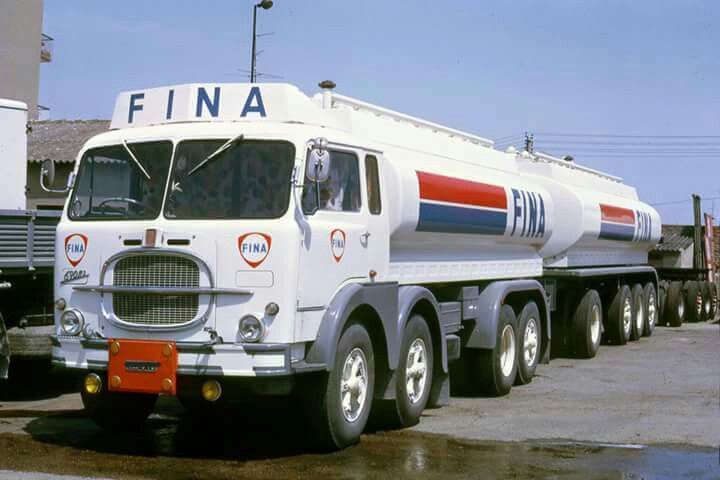
Look carefully at the photograph. The white tanker is spotless beneath a hard southern sky. FINA is written across the cab roof in tall blue letters; its round shields repeat along the bodywork; the tank runs behind the cab like a bright cylinder made to hold a dangerous, indispensable cargo. It is an imposing Italian working vehicle, all metal, wheels and purpose. Yet the most important thing about it cannot be seen in the photograph. It is the man who drove it.
His name was Alfredo. He lived in Bari, and for more than forty years this truck was not simply a truck to him. It was the place where he worked, ate hurriedly, listened to music, worried about weather, waited at toll booths, spoke with strangers who understood the same exhaustion, and measured the long distance between one evening at home and the next. When retirement finally came and the company was ready to settle the end of his career, Alfredo asked for something less conventional than money. He asked for the truck. He brought it back to Bari, placed it in the garden of his home, washed it, cared for it and kept it near him. After a lifetime together, he could not imagine leaving it behind.
That is the story held inside this photograph: not the story of a named model, because the exact designation is not the point and should not be guessed from one picture, but of a FIAT tanker and the Italian driver who gave it four decades of his life.
The Road Out of Bari
Alfredo’s working world began before dawn. Bari was still dark when a driver bound north checked the truck, climbed into the cab and faced the Adriatic route. The cargo was fuel. That fact changed everything. A fuel tanker was not a van with a delivery schedule; it demanded patience, care, clean habits and a constant awareness that the load behind the cab was both valuable and hazardous. The road to Bologna was long, and it was never the same road twice. Winter gave him rain, wind and the occasional hard cold that reached through metal and glass. Summer turned the cab into an enclosed room under the sun. Air conditioning belonged to another age, another kind of vehicle and another kind of money.
The country he crossed was changing while he drove through it. Postwar Italy had discovered movement with an intensity that is difficult to imagine now. Cars filled roads that had once belonged to bicycles, buses, carts and a fraction of the traffic. Factories needed fuel. Holiday traffic moved toward the coast. Families began to travel farther than their parents had ever travelled. The motorway network grew section by section, and the Adriatic corridor became one of the great north-south lines of the peninsula: Bari, the long coast, the Marches, Ancona, Romagna and Bologna.
For a driver, a line on a map was never a line. It was fuel stations, bridges, gradients, roadworks, weather systems and toll booths. It was the particular fatigue of watching the same ribbon of road become unfamiliar in darkness. Alfredo did not drive through an abstract Italy. He drove through the Italy of service roads, depots, ports, small towns, farms beyond the guardrails and lights reflected in wet asphalt.
There were mornings when the rain began before he had left Puglia. There were nights when it struck the windscreen so steadily that every headlamp seemed weaker than it should have been. The lights of that period were not the clean, wide beams modern drivers take for granted. A driver learned to read a road through glare, shadow and the thin pale line at its edge. With fuel behind him, Alfredo could not hurry simply because the sky had turned bad. He had to keep going carefully, with every sense occupied.
Sometimes, to keep the glass from clouding, a window had to remain slightly open. The mixture of air, road spray and diesel could settle on him. He would arrive dirty, smelling of work in a way that no office worker ever could. It was not cinematic at the time. It was simply the price of seeing the road well enough to keep moving.
A Cab as a Second Home
The photograph shows machinery, but Alfredo would have known the cab as a room. He knew which small movements meant the truck was behaving normally, which vibrations belonged to the road, which sounds required attention and which were simply part of a working vehicle carrying a heavy load. Drivers of that generation did not talk about a dashboard as an interface. They knew the wheel, mirrors, pedals, the heat coming through the floor and the engine’s mood.
He drove from the right-hand side. That detail seems small until a toll booth arrives. At the barrier, Alfredo often had to get down, go around or stretch the routine in a way a left-hand-drive car did not require. It was one more tiny effort repeated countless times over years. At times a colleague came with him. Sometimes the colleague drove a portion of the route; sometimes he was there for company, conversation and the relief of not being alone when the motorway seemed endless. Other days Alfredo had only the engine, the road and the radio.
And on that radio there was Peppino di Capri. The singer’s early success belonged to the same Italy that was discovering the motorway, the 45-rpm record and the idea that the country’s music could travel as freely as its people. In the cab, his songs did not need to become a concert. They could be a voice cutting through engine noise, a familiar phrase arriving after a toll gate, a fragment of home carried north through Ancona and beyond. Music can make an old road feel shorter. It can also make a distant house feel closer.
There is no reason to imagine every journey as lonely. Italian roads had their own social map. Drivers knew places where food was serious, where coffee arrived fast, where the parking was safe and where another trucker would understand the day without needing a long explanation. Alfredo stopped at a famous trattoria for truck drivers. There were plates of proper food, stories from the road, arguments about weather and traffic, news passed from one cab to another. A driver could learn which road was blocked, which depot was slow, which stretch was dangerous in rain. In an era before every delay appeared on a screen, conversation itself was a form of navigation.
Those trattorie were not mere pauses between kilometres. They were the informal parliament of working Italy. The people at the tables knew about freight, engines, loading yards, late payments, difficult customers and the strange intimacy of lives lived in transit. Alfredo belonged there, but he also belonged somewhere else: at home in Bari.
The Woman Watching the Rain
Every long-haul story has another side, and often it remains unspoken. Alfredo’s wife stayed at home. Sometimes he returned late. Sometimes the journey and the work meant that he slept away from home. Days could pass in which husband and wife were joined not by the ordinary rhythm of shared meals and evenings, but by the knowledge that one was working somewhere far up the road and the other was waiting.
When rain came over Bari, she could not see what rain was doing to the road near Ancona, or to a bend in the hills, or to the long wet approach to Bologna. She could only imagine it. She knew that the headlights of those years were limited, that trucks were heavy, that a fuel load did not forgive carelessness, and that a long day made every road more demanding. She knew her husband was capable. Love does not remove worry; it often gives worry more places to live.
This is why the story matters beyond transport history. A working vehicle can shape a marriage. It can determine when a man eats, sleeps, speaks and returns home. It can put a woman alone at a kitchen window when a storm begins, listening to the rain and calculating, without knowing the exact numbers, how many kilometres lie between her and the person she loves.
Alfredo’s return was never merely the end of a shift. It was the restoration of a small domestic order. The sound of the truck arriving, the knowledge that he had made it back, the smell of road and diesel on clothes, the tiredness that could not be explained away: these were the ordinary ceremonies of a life built around distance.
FIAT, Fina and the Working Italy Nobody Put on a Postcard
It would be easy to treat this tanker as a piece of nostalgic design. It is handsome, certainly. Its cab has the confident face of an Italian industrial vehicle from a time when commercial transport expressed its purpose openly. Its Fina livery is crisp and memorable. But its beauty comes from work. It belonged to an industrial landscape in which FIAT commercial vehicles, fuel companies, depots, mechanics and drivers helped keep a newly motorized country supplied.
The FIAT badge connects this truck naturally to a much wider Italian story. The same country that made compact family cars and put scooters into city streets also built the heavy vehicles that carried fuel, food, building materials and the unseen necessities of the economic miracle. A small Fiat could represent a family’s first real freedom. A tanker represented the infrastructure that made that freedom move at all.
Fina Italiana operated in the trade of petroleum products during the decades when petrol stations, industrial deliveries and road transport became central to modern Italian life. A Fina tanker was part of that system, but the system depended on people like Alfredo. The company’s logo may have been painted on steel; the human story took place behind the wheel.
The truck did not ask whether its driver was tired, whether his wife worried, whether the rain made the lights feel too weak or whether the trattoria had closed early. It asked for maintenance, concentration and another trip. Alfredo gave it those things for over forty years.
When the Road Finally Ended
There is a moment in every working life when the body begins to set a limit. Alfredo reached it gradually. His sight was no longer what it had been. The work had become harder. Retirement was not a sudden betrayal but a fact that had been approaching for years. For a man whose identity had been built around routes, schedules and the familiar weight of a steering wheel, retirement could feel less like rest than removal.
The company owed him the formal conclusion of a career. Alfredo had another idea. Give me my truck, he said.
It was a practical request, but it was also a declaration. He did not want a symbolic plaque to hang on a wall. He wanted the object that had witnessed the ordinary days of his life. The tanker came home to Bari and entered the garden. In that new setting it no longer had a consignment to deliver or a road ahead. It became still. Alfredo washed it. He kept it. He could walk outside and see the vehicle that had carried him through rain, heat, toll booths, long nights, bad visibility, songs on the radio and years of separation and return.
There are museums full of historic vehicles that have been restored because someone recognized their design or rarity. Alfredo’s truck carries another kind of value. It is valuable because it was loved by the person who had done the work. It held the memory of a job that was never glamorous and yet was never ordinary.
For someone in Tennessee, Toronto, London or Melbourne, this may seem like a very Italian story. A tanker in a Bari garden. A wife watching rain. A driver eating at a trattoria on the Adriatic route. Peppino di Capri singing through a crackling radio. But its feeling is universal. Every country has its roads, its working men and women, its people waiting by windows, its machines that eventually become containers for memory.
The extraordinary thing is that Alfredo did not leave the truck on the road after the road had finished with him. He took it home. And in that garden in Bari, a white Fina tanker ceased to be simply a vehicle and became the last faithful witness to a man’s life in motion.