

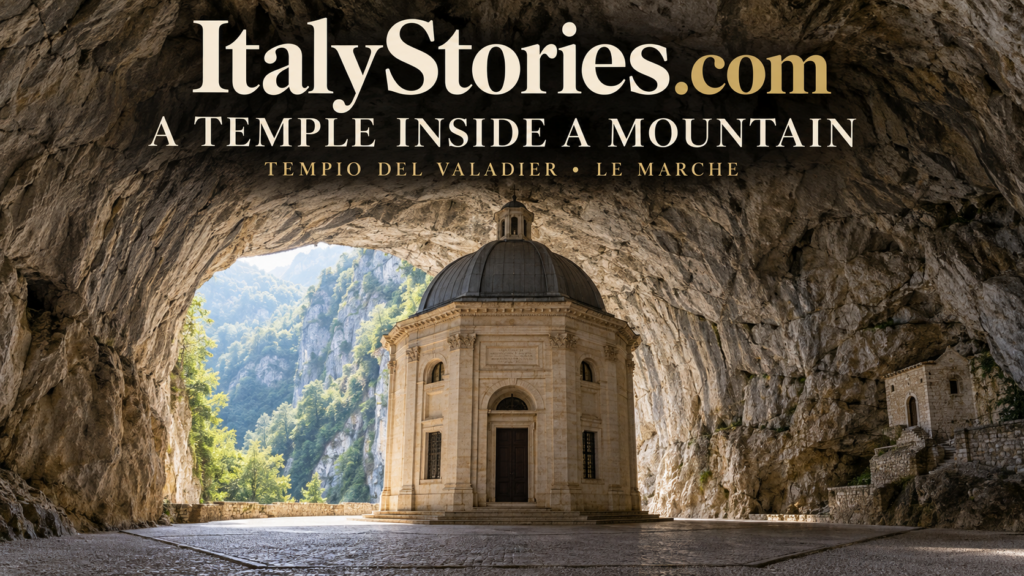
There are buildings designed to dominate the landscape, rising above cities and announcing their presence from miles away. The Tempio del Valadier does precisely the opposite. It hides inside a mountain, protected by an immense limestone cave in the wild landscape of the Frasassi Gorge. From the road below, there is little to suggest that such an elegant structure exists among the rocks. Only after climbing the steep path and passing through the entrance of the cavern does the temple suddenly appear: pale, symmetrical and almost impossibly graceful beneath a ceiling created by nature over millions of years.
The contrast is extraordinary. Around the building, the walls of the cave are rough, irregular and monumental. At its centre stands a small neoclassical sanctuary with an octagonal plan, carefully proportioned façades and a dark dome covered with lead. The stone seems to catch every ray of daylight entering through the vast mouth of the cavern. It looks less like a church constructed inside a cave than a perfectly cut jewel placed within an enormous stone box.
The Tempio del Valadier is located near Genga, in the Marche region of central Italy, not far from the famous Frasassi Caves. Yet despite its proximity to one of Italy’s best-known underground attractions, the sanctuary remains relatively unfamiliar to many international visitors. It belongs to a quieter Italy, one discovered by leaving the main road, following a path uphill and accepting that the most beautiful view will only be revealed at the end of the climb.
Its story begins long before the temple itself was built. Caves in the Frasassi Gorge were used by human beings from prehistoric times, first as shelters and later as places associated with burial, ritual and spiritual retreat. A cave offered protection, but it also created a natural separation from the everyday world. Entering one meant abandoning sunlight, noise and familiar surroundings. For hermits and religious communities, this isolation could transform a hostile environment into an ideal place for prayer.
A few metres from the Tempio del Valadier stands the much older hermitage of Santa Maria infra Saxa, a name that can be translated as “Saint Mary among the rocks.” Unlike the elegant nineteenth-century temple, the hermitage seems to grow directly from the cliff. It is a modest stone structure built against the cave wall and partly suspended above the steep drop below.
Documents dating from around the beginning of the second millennium mention the religious settlement, which was connected with a female monastic community. Benedictine nuns are believed to have come to this isolated cavern to pray and practise a life of contemplation. Reaching the sanctuary was never meant to be easy. Its remoteness was part of its meaning: the physical climb reflected the spiritual effort of leaving the ordinary world behind.
Centuries later, Cardinal Annibale della Genga decided to create a new sanctuary within the same cavern. Born in the nearby castle of Genga, he would become Pope Leo XII in 1823. The building was commissioned in 1819 and inaugurated in 1828, transforming the cave without overwhelming it.
The sanctuary is commonly known as the Tempio del Valadier because its design has traditionally been attributed to Giuseppe Valadier, one of the leading figures of Italian neoclassical architecture. Valadier had already reshaped important areas of Rome and was famous for combining classical balance with the demands of a modern city. More recent historical research, however, has made the story less straightforward, suggesting that other architects and technicians also played important roles in the project. The familiar name remains, but the precise authorship appears more complex than generations of guidebooks suggested.
This uncertainty does not diminish the building. If anything, it gives the temple another small mystery to preserve.
The sanctuary was constructed using local limestone extracted from a quarry above the cave. Its octagonal shape creates an impression of order and balance, while its dark lead-covered dome nearly touches the rock overhead. The architecture is refined but restrained. There is no attempt to compete with the cavern’s enormous dimensions, because such a contest would have been hopeless. Instead, the temple uses its simplicity to create a dialogue between human geometry and natural chaos.
The cave has no straight lines. The temple is made almost entirely from them.
The mountain is dark and ancient. The building is pale and comparatively young.
One represents the slow, unpredictable work of water and stone; the other reflects the human desire to measure space, establish proportion and impose a small area of harmony upon the wilderness.
Inside, the sanctuary is far more intimate than its spectacular setting might suggest. An altar made from local alabaster once held a white Carrara marble sculpture of the Virgin and Child attributed to the workshop of Antonio Canova. The original statue is now preserved in the Museum of Genga, while the temple retains the memory of the devotion for which it was created.
The real masterpiece, however, is the relationship between the building and the cave. Remove the cavern and the temple would be an elegant but relatively modest neoclassical chapel. Remove the temple and the cavern would remain a dramatic natural shelter. Together, they create something neither architecture nor geology could have achieved alone.
There is also a much older presence associated with this place. In 2008, a small prehistoric female figurine was discovered in the cave. Known as the Venus of Frasassi, it has been connected with the tradition of the so-called Gravettian Venuses of the Upper Palaeolithic. Long before the construction of the Christian sanctuaries, human beings had already recognised something powerful in this landscape.
We cannot know exactly what the cave represented to those distant communities. It may have been a refuge, a ritual place, a burial area or several of these things at different times. What is certain is that the site’s sacred atmosphere was not invented in the nineteenth century. The Tempio del Valadier is only the most visible chapter in a relationship between human beings and the mountain that began thousands of years earlier.
The walk to the temple contributes greatly to the experience. The path climbs steadily through the gorge, leaving the road and the modern world behind. At first, the destination remains hidden. Then the entrance to the cave grows larger, like an enormous stone mouth opening in the mountain.
When the temple finally appears, the effect is theatrical. There are no city buildings around it, no busy square and no conventional church façade facing a street. The cavern itself becomes the square, the roof and the monumental frame. Sounds echo differently, the air becomes cooler and the scale of the rock makes every visitor feel very small.
Despite the dramatic setting, the place does not feel frightening. Its dominant sensation is silence. Even when other visitors are present, the cavern seems capable of absorbing them. The temple stands in the middle of that silence as if it were waiting rather than displaying itself.
This may explain why photographs, however beautiful, never entirely capture the experience. A camera can record the architecture and the surrounding rock, but it cannot reproduce the sudden change in temperature, the echo of footsteps or the sensation of standing between a building created two centuries ago and a cave shaped across geological time.
During the Christmas season, the area has also become known for a living Nativity scene, a tradition that transforms the cavern into a natural stage. It is easy to understand why the location was chosen. Few constructed theatres could provide scenery as powerful as the walls of Frasassi.
The Tempio del Valadier is sometimes described as one of Italy’s most hidden churches, but “hidden” does not mean forgotten. It is a place that asks visitors to make an effort. The climb, the isolation and the delayed revelation are all part of its identity. If the sanctuary could be seen directly from a car park, much of its magic would disappear.
Italy is filled with magnificent churches, from enormous basilicas to tiny rural chapels. Yet few can create the same impression as this small octagonal building sheltered beneath a mountain. Its beauty does not come from size, wealth or elaborate decoration. It comes from placement: from the almost unbelievable decision to introduce the rational elegance of neoclassicism into one of nature’s most irregular spaces.
The older hermitage clinging to the rock and the nineteenth-century temple standing proudly at the centre of the cave tell two different stories of faith. One seeks protection by becoming almost indistinguishable from the mountain. The other establishes a perfect geometric form within it. Together, they reveal how different generations have approached the same mysterious landscape.
The Tempio del Valadier is not simply a church inside a cave. It is a meeting point between geology and architecture, pagan memory and Christian devotion, darkness and light. It reminds us that some buildings are not intended to conquer their surroundings. Their purpose is to make us see those surroundings differently.
And when you finally leave the cavern and begin walking back down towards the valley, the temple disappears almost as suddenly as it appeared. The mountain closes around it once more, guarding one of the most extraordinary and unexpected treasures of the Marche.
Follow ItalyStories.com to discover more hidden sanctuaries, forgotten histories and extraordinary places across Italy.