

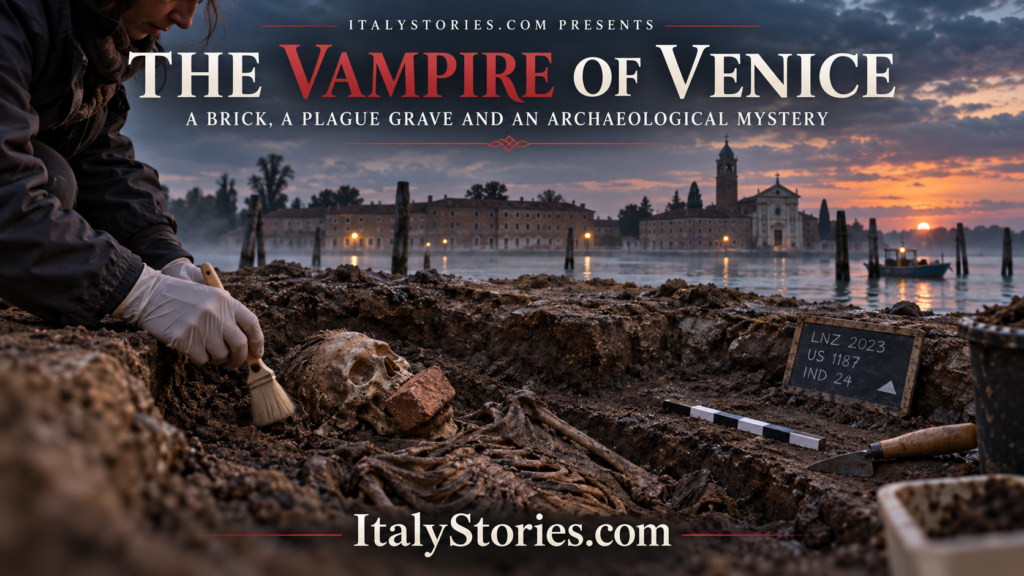
Beneath the quiet landscape of the Venetian Lagoon, far from the crowded bridges and illuminated palaces familiar to millions of visitors, archaeologists uncovered a mystery that seemed to belong to a Gothic novel. In a mass grave associated with the devastating plague epidemics that struck Venice between the sixteenth and seventeenth centuries, they found the skeleton of an elderly woman. Her body was lying among the remains of other victims, but one detail made her burial extraordinary: a large brick had been placed inside her mouth.
The discovery soon became known around the world as the case of the “Vampire of Venice.” Newspaper headlines, documentaries and online stories transformed the unknown woman into a supernatural figure. Some accounts presented her as a feared blood drinker, while others imagined that she had terrorized Venice during her lifetime. The real story, however, is very different. There is no evidence that she attacked anyone, drank blood or was considered dangerous while she was alive. She was not an eighteenth-century male predator, as some modern images suggest. She was a woman who died during the age of the Venetian plagues, and the strange treatment of her body may reveal something about the fears of those who encountered her remains after death.
What archaeologists discovered is not a vampire in the modern sense. It is evidence of how people attempted to understand disease, decomposition and unexplained death in a world without microbiology. It is also the story of Venice’s struggle against epidemics, of the birth of quarantine and of the fragile boundary between medical observation and supernatural belief.
The Island That Protected Venice
The skeleton was found on Lazzaretto Nuovo, a small island located in the northern part of the Venetian Lagoon near the entrance to the channel leading toward Venice. Today, its brick buildings, grassy spaces and surrounding waters appear peaceful. During the centuries of the Venetian Republic, however, the island was an essential part of one of Europe’s most advanced systems for controlling contagious disease.
Venice was particularly vulnerable to epidemics. It was a major international port connected to trading networks that extended across the Mediterranean, the Middle East and northern Europe. Ships arrived carrying spices, fabrics, grain, precious objects and passengers, but they could also bring rats, fleas and infectious diseases. The same commercial connections that created Venice’s wealth exposed the city to repeated outbreaks of plague.
The Venetian authorities responded with an increasingly organized public-health system. In 1423, the Republic established a permanent isolation hospital on an island later known as Lazzaretto Vecchio. In 1468, Lazzaretto Nuovo was designated as a preventive quarantine station. Ships, passengers and merchandise suspected of having been exposed to disease could be held there before being allowed to enter the city.
Cargo was unloaded, inspected, aired and treated inside large buildings such as the Teson Grande. Travellers might spend weeks under observation. During the terrible epidemic of 1576–1577, when tens of thousands of people died in Venice, Lazzaretto Nuovo also received individuals considered at risk of infection. Those who became visibly ill could be transferred to Lazzaretto Vecchio.
This system was not perfect, but it represented a remarkable institutional response to disease. The English word “quarantine” derives from the Italian quarantena, referring to a period of forty days. Long before anyone understood bacteria, Venetian officials recognized that isolating people and goods could interrupt the spread of an epidemic.
Yet practical public-health measures did not eliminate fear. When an outbreak overwhelmed the city and bodies accumulated faster than they could be buried, scientific observation, religious interpretation and popular superstition could exist side by side.
A Discovery Among the Plague Dead
Between 2006 and 2007, archaeological research on Lazzaretto Nuovo examined mass graves containing the fragmented and intermingled remains of people believed to have died during plague outbreaks between the sixteenth and seventeenth centuries.
These were not orderly cemeteries where every individual had a separate grave and marker. During an epidemic, burial workers had to deal with enormous numbers of bodies under dangerous conditions. Graves could be reopened to receive additional victims. Earlier remains might be moved, damaged or mixed with later burials. Soil, stones, pieces of brick and human bones could all be displaced in the process.
Among these remains, researchers encountered a partially preserved skeleton lying on its back. The upper part of the torso retained a degree of anatomical connection, and the arms appeared to follow the body. The dimensions of the bones and the shape of the skull suggested that the individual was female. Examination of her teeth indicated that she was an older adult, probably at least around sixty years of age—an unusually advanced age for someone living in that period.
Her identity is unknown. No surviving document connects a name, occupation or biography to the skeleton. She may have been wealthy or poor, Venetian-born or an immigrant, respected or socially isolated. The bones cannot answer those questions.
The most striking object was the brick found in the oral cavity, holding the jaws open. To the archaeologists who first studied the burial, its position did not appear random. They proposed that the brick had been deliberately inserted after the woman’s grave was reopened, possibly when her body was still partly held together by soft tissue or a burial shroud.
If that interpretation is correct, the act was probably performed not when the woman was initially buried, but later, when burial workers encountered her decomposing body while placing new plague victims in the same grave.
The Fear of the “Shroud-Eater”
To understand why anyone might have forced a brick into the mouth of a corpse, it is necessary to leave behind the elegant, aristocratic vampire of modern fiction.
The vampire imagined today—pale, seductive, immortal and dependent on human blood—was shaped largely by eighteenth- and nineteenth-century literature. The creature feared in early European communities was often different. It might be an ordinary dead person believed to remain active inside the grave, harming relatives or spreading sickness through invisible means.
One disturbing tradition concerned the so-called “shroud-eater,” sometimes associated with the German term Nachzehrer. According to versions of this belief, certain corpses could continue chewing their burial shrouds. As the dead person consumed the cloth, members of the community might weaken, fall ill and die. The corpse did not necessarily leave the grave. Its destructive power supposedly operated from beneath the ground.
This idea becomes more understandable when considered alongside the physical realities of decomposition. After death, gases accumulate inside the body. The abdomen may swell, fluids can emerge from the mouth and nose, and the skin may change colour. As tissues contract, hair and fingernails can appear to have continued growing. A burial shroud placed across the face may become stained by dark fluids or drawn toward the mouth.
To frightened witnesses, especially during an epidemic, such changes could suggest that the corpse was still alive. A stained shroud could look as though it had been soaked in blood. Fabric trapped between the teeth might appear to have been chewed. The movement and sounds caused by escaping gases could be interpreted as signs of supernatural activity.
Today these processes are familiar to forensic specialists. For a sixteenth-century gravedigger opening a plague grave, they could have been terrifying.
The brick may therefore have served as a protective or apotropaic object—something intended to stop the dead woman from chewing, returning or spreading death. Blocking the mouth would symbolically silence the dangerous corpse and interrupt whatever supernatural action people believed was taking place.
Was the Brick Really Placed There Deliberately?
The intentional-burial interpretation is compelling, but it is not universally accepted.
The researchers who originally studied the skeleton argued that the condition of the body and the position of the brick made an accidental explanation unlikely. Some anatomical connections were still preserved, suggesting that the woman had not been reduced to loose, scattered bones when the grave was disturbed. From this perspective, someone encountered the corpse, interpreted its appearance as dangerous and deliberately placed the brick in its mouth.
Other physical anthropologists have challenged that conclusion. A mass grave is a chaotic archaeological environment. When such a grave is reopened, bricks, roof tiles, stones, soil and human remains can shift. A skull whose lower jaw has fallen open can naturally trap an object as new material is thrown into the grave. Critics have therefore suggested that the brick may have entered the mouth accidentally.
They have also warned against connecting a Venetian burial too confidently with traditions documented more clearly in German-speaking areas. Folklore moved across borders, especially in a cosmopolitan trading centre such as Venice, but similarity does not automatically prove a direct connection.
This debate is important because archaeology rarely offers the certainty found in a fictional mystery. Researchers reconstruct past behaviour from the position of objects, the condition of bones, the layers of soil and the relationship between different materials. Once a grave has been disturbed repeatedly, every conclusion must account for numerous possible explanations.
The brick is real. The woman is real. The plague grave is real. The intention behind the brick remains a matter of interpretation.
That uncertainty does not weaken the story. It makes it more honest and, in many ways, more fascinating. We are not looking at proof that vampires existed. We are looking at a physical trace that may record the moment when fear, decomposition and folklore came together.
Venice Between Reason and Superstition
It would be easy to dismiss those who feared the dead as ignorant. That judgment would oversimplify the world in which they lived.
Venice developed quarantine stations, health magistracies, inspection systems and detailed regulations because its officials understood that disease could move through contact, travel and contaminated goods. These were rational observations made centuries before scientists identified the bacterium responsible for plague.
At the same time, people had no reliable explanation for why one person survived while an entire family died, why a healthy neighbourhood suddenly became infected or why an epidemic sometimes returned after appearing to disappear. They saw bodies change after death without understanding the biological processes involved. They lived with religious ideas about punishment, purification and the restless dead, as well as local stories passed between generations.
Institutional medicine and popular belief were not always separate worlds. A burial worker could follow official health regulations while still fearing that a particular corpse was dangerous. A family could accept quarantine and pray to a saint at the same time. In moments of extreme crisis, people used every available explanation and every possible form of protection.
The woman from Lazzaretto Nuovo may have become a victim of that fear after she had already died of disease. If the brick was intentionally inserted, those responsible may have believed that they were defending the living rather than punishing the dead.
Who Was the Woman?
The modern label “Vampire of Venice” risks reducing an unknown human being to a curiosity. Before she became a skeleton, she had a life. She experienced a city of markets, churches, workshops, canals and crowded houses. She may have watched ships enter the lagoon or heard news of disease moving through nearby districts. If she died during a plague outbreak, her final days may have unfolded amid isolation, panic and enormous loss.
Her age is particularly significant. Reaching approximately sixty years or more in early modern Venice suggests a long life by the standards of the period, although historical life expectancy figures are often distorted by high infant mortality. Her teeth and bones preserve biological information, but they do not reveal how others saw her.
There is no evidence that she was accused of witchcraft, feared as a vampire while alive or suspected of causing the epidemic. Those possibilities belong to speculation. Even if the brick was deliberately placed in her mouth, the decision may have been based entirely on the appearance of her decomposing body.
Modern reconstructions have sometimes given her the nickname “Carmilla,” borrowing the name of the vampire from Sheridan Le Fanu’s nineteenth-century novella. It is an evocative choice, but it is not her real name. Her identity remains lost.
Remembering this distinction matters. Archaeological remains are not stage decorations. They belonged to people who could never have imagined that their bodies would one day appear in museums, scientific studies and sensational headlines.
From Plague Grave to Vampire Legend
The expression “Vampire of Venice” is powerful because it connects a physical discovery with one of popular culture’s most enduring monsters. But the label can also mislead.
This woman was not Count Dracula, and her burial does not support tales of a man roaming Venice in the 1700s and drinking human blood. No genuine contemporary newspaper identifies such a Venetian predator in connection with this skeleton. Images presenting a male vampire, a dramatic arrest in 1725 or bloodstained newspaper reports are modern fictional compositions.
The authentic story is subtler. During a later phase of a mass burial, someone may have encountered the woman’s partially decomposed body. A shroud or bodily fluid around the mouth might have created the illusion that she had been chewing or feeding. A brick may then have been used to neutralize what appeared to be a dangerous corpse.
Alternatively, the brick may simply have fallen into an open jaw as the grave was disturbed and refilled. In that case, the vampire story would be a modern interpretation created from an accidental arrangement of objects.
Both possibilities tell us something important. The first would preserve evidence of early modern fear. The second would demonstrate how easily modern observers can impose an exciting narrative on incomplete archaeological evidence.
Why the Mystery Still Matters
The case of the Vampire of Venice sits at the intersection of archaeology, forensic science, folklore and the history of medicine. It shows how a single object can transform the meaning of a burial. Without the brick, the woman might have remained one anonymous plague victim among many. With it, she became part of an international debate about beliefs surrounding death.
The discovery also reminds us that the history of an epidemic is not written only in laws, medical reports and mortality statistics. It survives in the treatment of bodies, in emergency graves and in the actions of ordinary people forced to confront death on an unimaginable scale.
Venice is celebrated for its beauty, art and commercial power, but its history was also shaped by disease. The lazarets of the lagoon reveal a Republic attempting to protect itself through observation, isolation and administration. The plague graves reveal the human cost when those protections failed.
Somewhere within that history was an elderly woman whose name has disappeared. Whether the brick in her mouth was deliberately placed or accidentally deposited, her remains have become a powerful symbol of the questions people ask when science, fear and death meet.
The true Vampire of Venice never terrorized the canals. She did not hunt victims beneath the moon, and there is no evidence that she drank blood. The terror belonged to the living: to the gravediggers opening a crowded plague grave, to the families watching an invisible disease move through the city and to a society trying to make sense of death with the knowledge available to it.
The brick in her mouth cannot tell us exactly what happened. It can only preserve the final trace of an action—or an accident—that occurred centuries ago. That silence is what makes the discovery so haunting.
Follow ItalyStories.com to discover more true stories, hidden places, forgotten lives and extraordinary mysteries from Italy’s past.