

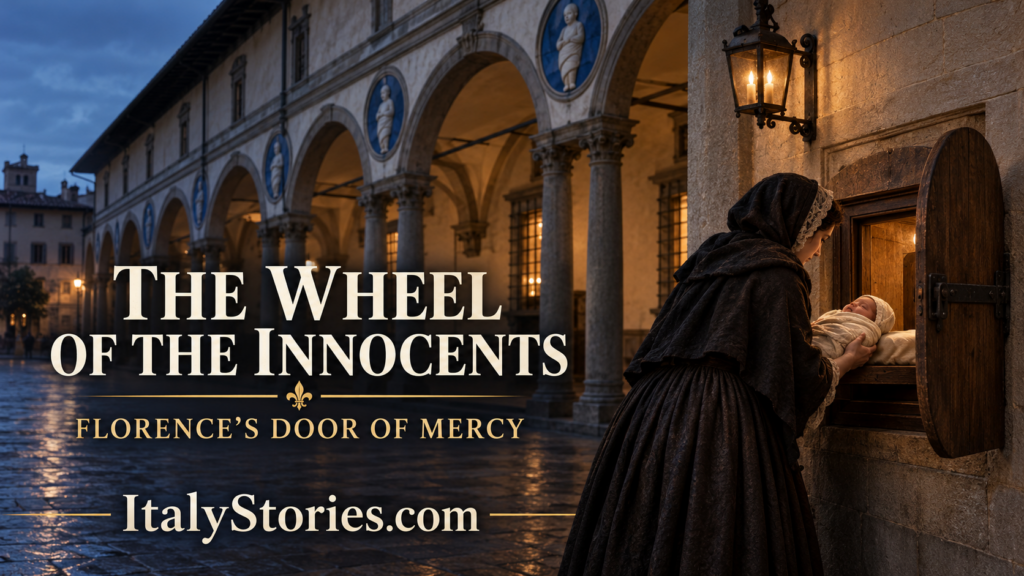
The Wheel of the Innocents tells one of Florence’s most moving and uncomfortable stories. It is not a tale of powerful bankers, ambitious princes or artists competing for eternal glory, but of mothers approaching a silent building at night, carrying newborn children they could not keep. Behind a small opening in the wall waited an institution created to receive those infants without demanding a name, an explanation or a public confession.
The rotating wheel allowed a baby to pass from one world into another. The person outside could remain unseen; the attendant inside could take the child into safety. The movement lasted only a few seconds, yet it separated families, concealed identities and began thousands of new lives.
This story belongs to the Ospedale degli Innocenti, the great Florentine institution facing Piazza della Santissima Annunziata. Designed by Filippo Brunelleschi and opened during the fifteenth century, it was one of Europe’s most important hospitals for abandoned children and one of the earliest architectural masterpieces of the Renaissance.
Its long portico, perfectly proportioned arches and blue-and-white images of swaddled infants appear peaceful and rational. Behind that harmony lies a vast human archive of poverty, secrecy, compassion, social prejudice and hope.
Florence Before the Wheel
The practice of abandoning infants was not unique to Florence. Throughout medieval and early modern Europe, newborn children were left outside churches, monasteries, convents and hospitals. Some were placed on steps or beneath porticoes where they might be found quickly. Others were abandoned in remote locations and did not survive.
The reasons were rarely simple. Extreme poverty could make another child impossible to feed. An unmarried woman faced severe social punishment and might lose her work, home and reputation if her pregnancy became known. Servants could be dismissed, widows might have no economic support, and women subjected to coercion or violence often had no institution willing to defend them.
Even married couples sometimes surrendered children during periods of famine, illness or financial collapse. Abandonment did not always mean an absence of affection. In many cases, it represented a desperate calculation: allowing an institution to raise the child might offer a better chance of survival than keeping the baby in a household without food, milk or protection.
Florence was wealthy, but its splendour was never shared equally. The city of merchants, silk manufacturers, goldsmiths and bankers also contained labourers, servants, migrants, widows and families living permanently close to disaster. A single illness or failed harvest could destroy the fragile balance of an ordinary household.
The city’s charitable institutions attempted to respond to these realities. Medieval hospitals were not limited to medical treatment in the modern sense. They offered shelter to travellers, food to the poor, assistance to pregnant women and protection for children. Care for the abandoned became both a Christian duty and a civic responsibility.
A Hospital Commissioned by the Silk Guild
The Ospedale degli Innocenti was created under the protection of the Arte della Seta, Florence’s powerful Silk Guild. The guild included merchants and craftsmen involved in one of the city’s most profitable industries, as well as goldsmiths and other highly skilled professions.
Florentine guilds did much more than regulate trade. They participated in government, commissioned religious art and supported charitable projects. Public generosity brought spiritual merit, social prestige and political influence, but it also responded to real needs within the city.
Funds associated with the charitable legacy of the wealthy merchant Francesco di Marco Datini helped make the project possible. In 1419, the Silk Guild entrusted the architectural design to Filippo Brunelleschi.
At that moment Brunelleschi had not yet completed the enormous dome that would make him one of the most famous architects in history. The Ospedale degli Innocenti became one of his first great opportunities to translate his study of ancient Roman architecture into a new and distinctly Florentine language.
The result was not a dark fortress separating unfortunate children from respectable society. Brunelleschi designed an open, luminous portico facing an important public square. Charity was given a visible architectural presence at the heart of the city.
Brunelleschi’s Architecture of Dignity
The façade of the Ospedale degli Innocenti is governed by clarity. A sequence of rounded arches rests on slender columns of grey pietra serena. The distance between the columns, the width of each arch and the height of the supporting elements follow a repeated proportional system.
Each bay beneath the portico can be understood as a measured spatial unit. The architecture creates rhythm without heaviness, order without intimidation. Light passes through the loggia, and the deep arches provide shelter while remaining connected to the square.
This was revolutionary. Medieval public buildings often communicated strength through thick walls and defensive mass. Brunelleschi proposed something different: an architecture based on human scale, geometry and visual calm.
The building’s purpose makes that choice especially meaningful. The children brought here had entered the world amid disorder. The façade offered an image of stability. They arrived without recognized social identities, but the institution that received them stood behind one of the most modern and dignified architectural faces in Florence.
Brunelleschi directed the work until 1427. Other architects subsequently completed and modified parts of the building, but the essential language of the portico remained his. Its influence extended far beyond Florence, helping establish the proportions, columns and semicircular arches associated with Renaissance architecture.
The famous glazed terracotta medallions between the arches were added later. Created by Andrea della Robbia’s workshop, they show infants tightly wrapped in swaddling bands against blue backgrounds. The white figures are beautiful, but they are also direct symbols of the building’s mission. The children who might otherwise have remained invisible were represented across one of Florence’s most elegant façades.
The First Child: Agata Smeralda
The hospital officially began receiving children in 1445. On February 5 of that year, only days after it opened, its first recorded infant arrived.
She was given the name Agata Smeralda.
“Agata” corresponded with the feast of Saint Agatha, celebrated on that date. “Smeralda,” meaning emerald, gave the unknown child the name of something precious. Whatever the exact intention behind the choice, it created an identity where none had been formally provided.
The surviving record of Agata’s arrival is brief. Like many children received by the institution, she entered history through an administrative document rather than through a family chronicle. We do not possess a loving letter describing her birth, the face of her mother or the circumstances that brought her to the hospital.
Yet her name has endured. Agata Smeralda became the first of tens of thousands of children whose lives would be recorded in the extraordinary archives of the Innocenti.
At the beginning, there was no wooden rotating wheel of the kind later associated with foundling hospitals. Babies were left in a stone basin or placed through an opening beneath the portico, where an attendant could receive them. The system offered some protection, but anonymity was not complete and the arrangement exposed children to possible delays and danger.
The true wheel came later.
How the Wheel of the Innocents Worked
In 1660, the earlier reception point was replaced by a rotating device designed to allow complete anonymity. The wheel was set into the wall at the sheltered end of the portico.
The word “wheel” can create the wrong mental image. This was not an enormous vertical wheel with spokes. It was closer to a wooden revolving drum, cradle or cylindrical compartment built into an opening. The person outside placed the swaddled infant into the padded space and rotated the mechanism. The baby disappeared from the street and emerged inside the hospital.
A bell or other signal alerted the attendant on duty. The parent had time to leave without being seen, while the child could be collected quickly.
The wall protected two identities at once. The mother or family remained concealed from the institution, and the attendant remained invisible to the person outside. There was no confrontation, interrogation or negotiation.
That anonymity was the essential purpose of the device. Authorities understood that fear of exposure might persuade a desperate mother to abandon her child in a more dangerous place or conceal a birth with tragic consequences. The wheel did not solve poverty, exploitation or social stigma, but it offered an alternative to death.
The moment of turning it must have been unbearable. A mother could still touch her child while the wooden compartment remained open. Once the mechanism moved, the baby passed beyond reach.
The same device that represented mercy also made separation brutally efficient.
The Objects Left With the Children
Many infants arrived with nothing but the cloth wrapped around them. Others carried small objects known as segni di riconoscimento—signs of recognition.
These could be ribbons, medals, crosses, coins, buttons, beads, prayer cards, fragments of fabric or scraps of paper bearing a few words. Sometimes an object was deliberately divided in two. One half remained with the child; the mother or family kept the other.
If circumstances improved, the matching pieces might prove a relationship and allow the child to be reclaimed. A broken medal or torn devotional image therefore represented a fragile promise: this separation may not be forever.
Some messages contained names or dates. Others asked that the child be baptized with a particular name. A mother might explain that the infant had already received baptism, describe a distinctive mark or request that a small object remain close to the baby. Many notes were written in uncertain handwriting, while others were probably dictated to someone able to write.
The institution carefully registered and preserved these objects. Thousands survived within its historical archive. Seen together, they form an extraordinary emotional record of people who often left no other trace in official history.
A ribbon has little monetary value, but for a mother walking away from her child it could contain everything she still hoped to recover.
A New Name and an Official Identity
Once received, each infant was examined, registered and baptized if there was no reliable evidence that baptism had already taken place. The child was assigned a number and given a name.
Names might reflect the saint celebrated on the day of arrival, a religious feast, a physical characteristic or the imagination of the administrator making the entry. Some foundlings received surnames connected to the institution, including Innocenti, Degli Innocenti and Nocentini.
Similar practices existed elsewhere in Italy. Names such as Esposito, Proietti, Trovato or Casadei could reveal, or at least suggest, an origin connected with abandonment or institutional care. What began as an administrative solution could become a lifelong social label passed to later generations.
For this reason, institutions gradually attempted to diversify the surnames assigned to children. A name was necessary for legal and religious recognition, but it could also expose a person’s origins to employers, marriage partners and entire communities.
The wheel protected the anonymity of the parents. It did not always protect the child from prejudice.
Nevertheless, registration meant that an abandoned infant became a recognized individual within the civic system. The hospital recorded arrivals, illnesses, wet nurses, transfers, apprenticeships, marriages and deaths with remarkable attention. Children who had entered without documents acquired an official history.
The Essential Role of the Wet Nurses
The most urgent problem was milk. Before modern infant formula, a newborn without a nursing mother faced an immediate threat to survival.
The Ospedale degli Innocenti relied on a vast network of wet nurses. Some worked within the institution, but many infants were sent to women living in the countryside or smaller communities outside Florence. These women breastfed the children, cared for them during their earliest years and received payment from the hospital.
The arrangement relieved overcrowding and placed infants in domestic environments. In some cases, strong emotional bonds formed between the children and their foster families. A nurse might care for the same child for years, and some families eventually kept or informally adopted children entrusted to them.
The system could also be abused. Records mention disputes over payment, inadequate care and infants transferred between different nurses. Poverty affected the women receiving the children as well as the families surrendering them.
Mortality remained tragically high. Epidemics, intestinal diseases, poor sanitation and malnutrition killed large numbers of infants throughout Europe, including those living with their biological families. Institutional children faced additional dangers because they might arrive premature, ill, underfed or weakened by the circumstances of birth and abandonment.
The Innocenti saved many lives, but it could not overcome the medical limitations of its time. Its beautiful architecture should never conceal that reality.
Were All the Mothers Poor?
Poverty was the most common force behind abandonment, but the surviving records reveal a more complicated social landscape.
Some children were born to unmarried women terrified of public disgrace. Others were the result of relationships between servants and employers, relationships in which genuine consent may have been absent. Widows and abandoned wives could suddenly find themselves unable to support a newborn. Prostituted women and migrants had few protections.
Children with disabilities or visible illnesses were also left because families lacked the resources required to care for them. During famine, war or disease, even households that had previously survived could collapse.
Not every child placed in institutional care came from the poorest class. Families sometimes attempted to conceal births that might damage inheritance arrangements, religious careers or social reputations. The wheel erased questions and therefore served many kinds of secrecy.
There were also mothers who tried to remain close. Some sought work as wet nurses and, in certain cases, may have ended up nursing their own children through the institution. Others followed a child’s progress indirectly or returned years later with a matching token.
Abandonment was an act, but it was not always an emotional conclusion. The archival objects show that many separations continued to exist as unfinished stories.
Growing Up Inside the System
The Ospedale degli Innocenti was intended to do more than keep babies alive. Its mission included preparing children to enter society.
Boys could be taught reading, writing and practical trades. Depending on their abilities and available opportunities, they might be apprenticed to artisans or placed in workshops. Florence’s economy depended upon skilled labour, and training offered a route toward independence.
Girls were commonly taught sewing, spinning, domestic work and other occupations considered suitable for women. Some entered service, some married and others joined religious communities. The institution could provide a dowry, since a young woman without family resources had little chance of arranging a socially acceptable marriage.
These opportunities should not be romanticized. Children remained vulnerable to exploitation, harsh labour and social discrimination. Their futures were shaped by gender, class and decisions made by administrators or employers. Individual happiness depended heavily on the household, workshop or marriage into which they were placed.
Yet the institution offered education and pathways that would have been unavailable to an infant abandoned in the street. Its purpose was not only preservation but reintegration.
The success of that mission varied from child to child. Behind every regulation stood a different life.
Overcrowding and the Price of Compassion
As the reputation of the Innocenti spread, the number of children arriving increased. The wheel’s anonymity saved infants from dangerous exposure, but it may also have encouraged families from outside Florence to use the institution.
The hospital frequently faced financial crisis. Feeding, clothing, housing and educating thousands of children required enormous resources. Payments had to be made to wet nurses, teachers, craftsmen, doctors and suppliers. Epidemics and rising food prices increased costs precisely when poverty produced more abandoned children.
Administrators attempted to control expenditure, investigate fraud and recover children who had been placed with unreliable nurses. Donations, property income and public support were never guaranteed to match the scale of the need.
At certain times, the institution became desperately overcrowded. The ideal expressed by Brunelleschi’s harmonious portico met a far more difficult reality inside.
This contradiction does not diminish the hospital’s importance. It reveals the enormous challenge of transforming compassion into an organized and lasting public service. Saving one child could be an individual act of charity. Caring for thousands across centuries required administration, money, records, buildings and an entire network of workers.
The Children on the Façade
The blue-and-white medallions above the portico became the most recognizable symbols of the Innocenti. Each shows a swaddled infant against an intense blue background.
The sculptures are traditionally associated with Andrea della Robbia and were installed after Brunelleschi’s original architectural phase. Their glazed terracotta surfaces resisted weather and retained their colours, making the infants visible across the piazza.
Swaddling bands wrapped newborns tightly according to a widespread historical practice. In the medallions, however, the children’s arms appear partly free, and their bodies seem to emerge from the binding cloth. They are not represented as anonymous bundles. Each has a face, gesture and individual presence.
The image eventually became an international symbol of child welfare and paediatrics. Few architectural decorations have remained so closely connected with the social purpose of the building they adorn.
The façade tells the city what exists behind it. These children belong to Florence, even when their parents cannot be named.
The End of the Wheel
The foundling wheel remained in operation until 1875. By the nineteenth century, attitudes toward abandonment, identity and public assistance were changing. Medical care had improved, bureaucratic systems were expanding and authorities increasingly questioned anonymous surrender.
The wheel protected mothers from exposure, but it also removed information essential to the child’s identity and medical history. Critics argued that it separated families too easily and allowed fathers, employers or relatives to force women into surrendering children without accountability.
New approaches sought to register births more accurately and offer assistance that might allow mothers to keep their babies. The closure of the wheel did not end infant abandonment, poverty or social judgement. It marked a shift toward different methods of confronting them.
The opening was sealed, but the records remained.
The Archive of Broken Promises
The historical archive of the Innocenti is among the institution’s greatest treasures. Its registers document centuries of childhood with a level of detail rarely preserved for poor and socially marginalized people.
Names, dates, illnesses, payments and placements appear beside intimate fragments of private grief. The recognition tokens are especially powerful because they were created for an imagined future reunion. Some fulfilled that purpose; many did not.
A coin cut in half suggests that someone kept the missing piece. A ribbon implies hands that selected and tied it. A note asking that a child retain a particular name preserves one final act of parental authority.
These objects challenge the old language of “unwanted children.” Some infants may indeed have been rejected, but many were surrendered precisely because they were wanted and their parents believed they could not keep them alive.
The difference matters. The wheel was used by people who lived within economic and social conditions that offered few acceptable choices.
From Renaissance Hospital to a Modern Institution
The Ospedale degli Innocenti has never become an empty monument. The historic complex continues to be associated with the protection and study of childhood, while its museum preserves artworks, documents and objects connected with its long history.
The building also contains important Renaissance works, including paintings associated with artists such as Domenico Ghirlandaio, Sandro Botticelli and Piero di Cosimo. Art, architecture and social history remain inseparable within its walls.
Brunelleschi’s portico is now celebrated as a foundation of Renaissance architecture. Visitors study its geometry and photograph its graceful arches. Yet its deepest meaning does not lie in proportion alone. The building demonstrates that architectural beauty can be designed around a public responsibility.
Florence did not place its abandoned children in an invisible structure beyond the city walls. It gave their institution a monumental façade on one of its great squares.
A Door of Mercy and a Door of Sorrow
It is tempting to describe the Wheel of the Innocents as a purely beautiful story of compassion. It was compassionate, but it was never beautiful for the person forced to use it.
The wheel saved lives. It also marked the beginning of separation. It protected anonymity but erased origins. It allowed mothers to avoid public punishment while permitting the society that judged them to leave its deeper inequalities largely unchanged.
Its history therefore resists easy moral conclusions. The families should not be condemned, and the institution should not be idealized. Both existed within a world where gender, poverty and reputation could determine whether a child remained with a parent.
The small wooden mechanism was not the solution to that world. It was an emergency passage through it.
Perhaps this is why its memory remains so powerful. The wheel asks us to imagine the few seconds before it turned: a mother’s hand on the wood, a child wrapped against the cold, an attendant waiting beyond the wall and a decision that could not easily be reversed.
Florence is famous for works created to defeat time. The dome, the palaces and the statues proclaim artistic genius and civic power. The Wheel of the Innocents preserves something quieter—the moment when a city attempted, imperfectly but persistently, to protect those who had no power at all.
Beneath Brunelleschi’s arches, mercy had a door. For thousands of children, that door became the entrance to an unknown life.
Follow ItalyStories.com to discover more forgotten histories, remarkable places and deeply human stories from across Italy.