

In Bologna, the past is part of everyday life. Students walk beneath historic porticoes, cross busy squares and disappear through doorways on their way to lectures. Their books and devices belong to the present, but the act of coming to this city to learn connects them to a tradition stretching back more than nine centuries. Bologna is home to the oldest university in the Western world, an institution whose beginnings helped shape the development of European higher education.
The date associated with its foundation is 1088. It appears alongside the university’s name, Alma Mater Studiorum, and has become a symbol of its extraordinary longevity. Yet that precise year requires an explanation. It is a conventional date, adopted retrospectively to represent the emergence of Bologna’s medieval Studium. The institution developed gradually through teaching and the gathering of students, rather than beginning with a single founding ceremony or an identifiable opening day.
That gradual beginning makes the story especially compelling. We tend to imagine a university starting with a charter, a building and an official decision. Bologna’s origins invite us to think first about people: those who possessed knowledge and those prepared to travel in order to acquire it. Before there was a grand institutional identity, there was a demand for learning strong enough to bring teachers and students together.
Law played a central role in this early development. Medieval Bologna became a major centre for the study of Roman legal texts, particularly the Corpus Iuris Civilis associated with Emperor Justinian. Among the important teachers was Irnerius, whose work helped establish the city’s reputation. The interpretation of these texts mattered far beyond the classroom. A changing society needed ways to understand authority, rights and obligations, and legal scholarship offered tools for addressing those questions.
For a student arriving from elsewhere, studying also meant finding accommodation, paying a teacher and navigating life in an unfamiliar city. These practical concerns helped encourage forms of association. Students grouped together for mutual support, initially through communities connected with their places of origin. Over time, larger organisations developed from these networks, giving students a collective voice.
One of the most striking features of medieval Bologna was the influence those students acquired. Their associations, known as universitates, elected rectors from among the students themselves and took part in the organisation of academic life. This was a particular historical arrangement, different from the structure of most universities today. It shows how closely the institution’s development was connected with the needs and decisions of the people who came to study.
Learning involved sustained engagement with texts. Reading and commentary were accompanied by further explanation, discussion and formal questions. The aim went beyond possessing a manuscript: students needed to interpret arguments and demonstrate their understanding. The setting was medieval, but the underlying challenge remains familiar to anyone who has struggled to understand a difficult passage or defend an idea in front of others.
The university’s relationship with Bologna was equally important. Students brought activity and income, while the city provided the spaces and services that made study possible. Teaching initially took place across different locations, including private houses and religious buildings. The early university therefore belonged to the fabric of the city, rather than to a single enclosed campus.
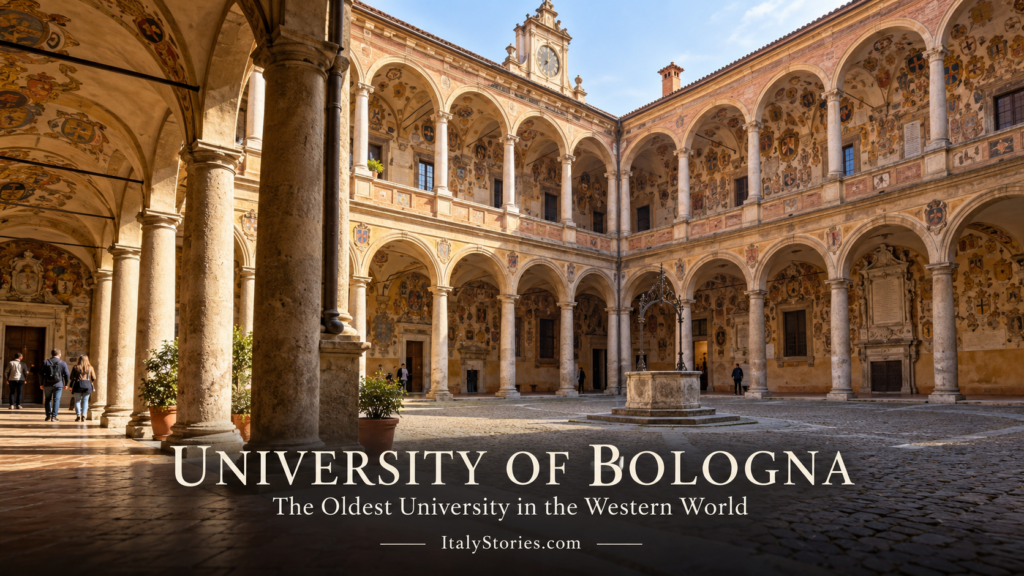
Centuries later, the Archiginnasio brought different schools together in one location during the sixteenth century. This distinction matters when looking at photographs of Bologna’s historic academic buildings: the Archiginnasio belongs to a later chapter, not to the university’s beginnings in 1088. Its architecture represents the institution’s long development, with each period leaving different traces.
The story also includes changes in authority and restrictions on independence. Student influence diminished, and civic and religious powers intervened in university affairs. Across the centuries, Bologna experienced periods of intellectual vitality as well as difficulty. Its longevity should not be mistaken for an unchanging structure. The institution survived through transformations in the way it was governed, the subjects it taught and its place in society.
That is what makes the university more interesting than its age alone. A foundation date provides a memorable starting point, but it cannot explain nine centuries of people reading, teaching, questioning and beginning again. The continuity lies partly in that repeated activity: each generation enters a world of knowledge it did not create, then contributes something to those who follow.
For a visitor, the most revealing image may be a simple one: students crossing a historic street on an ordinary morning. They are occupied with immediate concerns, perhaps an examination, a lecture or a conversation with a friend. Around them stands a city shaped by generations who once had their own versions of those concerns. The distance between medieval Bologna and the present is immense, yet the desire to learn provides a recognisable connection.
Bologna’s achievement is to have carried that connection through centuries of change. Its university gives the city a history that can be studied in books and an identity that continues to be lived every day.
Follow ItalyStories for more stories of the places, people and ideas that have shaped Italy and the wider world.