

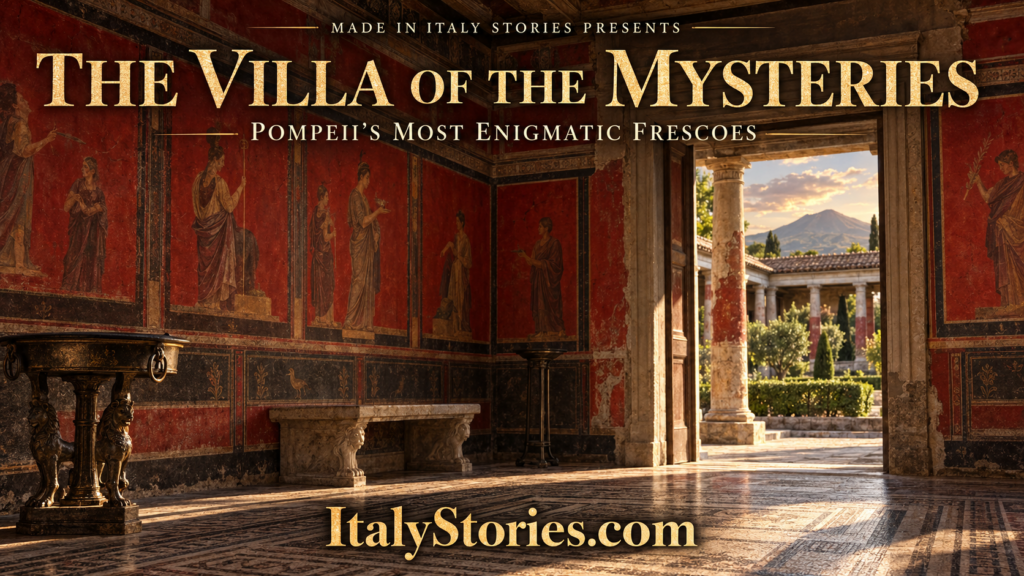
Just beyond the ancient walls of Pompeii, where the crowded streets once gave way to gardens, vineyards and country estates, stands a Roman villa whose most famous room has resisted every attempt to explain it completely. Its walls are covered with monumental figures set against an extraordinary field of deep red. Women prepare mysterious objects, mythological beings play music, a winged figure raises a whip and the god Dionysus appears to surrender himself to the embrace of a female companion. The images seem to form a story, yet no inscription tells us how that story should be read.
This is the Villa of the Mysteries, one of the most fascinating places in Campania and one of the greatest surviving treasures of Roman art. The name sounds like the invention of a novelist, but it was given to the building by modern archaeologists because of the mysterious frescoes discovered inside it. We do not know what the Romans called the villa, who commissioned its paintings or exactly what took place in the room they decorated. What remains is a sequence of gestures, expressions and symbols that has inspired archaeologists, historians, artists and travellers for more than a century.
The villa is not merely a beautiful archaeological monument. It is a place where several dimensions of the ancient world meet: the wealth of Pompeii’s elite, the agricultural traditions of the countryside around Mount Vesuvius, the influence of Greek mythology, the position of women in Roman society and the attraction of private religious experiences. It also reminds us that the people of ancient Pompeii were not silent figures trapped in stone. They celebrated, cultivated vineyards, commissioned fashionable art, observed rituals, negotiated social status and searched for meaning in a world that could be as uncertain as our own.
Beyond the Walls of Pompeii
The Villa of the Mysteries stands northwest of Pompeii, outside the city walls and not far from the Herculaneum Gate. In antiquity, this area marked a transition between the urban world and the productive landscape surrounding it. Leaving the gate, a traveller would have passed tombs, cultivated fields, farm buildings and elegant suburban residences positioned to enjoy fresh air and views across the countryside toward the Bay of Naples.
The villa’s location was carefully chosen. Built on a gentle slope, it offered its inhabitants a sense of space that was impossible to achieve in the crowded centre of Pompeii. From its terraces, the owners could look toward the sea while remaining close enough to participate in the commercial, political and social life of the city. Pompeii’s forum, temples, public baths, shops and theatres were within easy reach, but the villa possessed the atmosphere of a country retreat.
Its architecture developed over several phases. The oldest parts may reach back to the third or second century BC, during the Republican period, when Pompeii was still absorbing influences from the Greek cities of southern Italy and from the cultures of ancient Campania. Over time, the residence was enlarged, remodelled and adapted to new tastes. Rooms were reorganised, decorations were renewed and spaces devoted to agriculture became increasingly important.
Like many Roman villas around Pompeii, Boscoreale, Stabiae and Oplontis, the Villa of the Mysteries combined comfort with production. Its residential sector contained reception rooms, private apartments, courtyards and decorated spaces intended to impress visitors. Other areas supported the economic life of the estate. Archaeological evidence for wine production, storage and agricultural work suggests that vineyards were not simply part of the scenery. They were part of the villa’s wealth.
This combination of luxury and labour is essential to understanding Roman villas. Behind graceful colonnades and painted rooms stood a complex world of farmers, servants, craftspeople and enslaved workers. The beauty enjoyed by the owners depended on the work of many people whose names were rarely recorded. The Villa of the Mysteries therefore tells two intertwined stories: one about privilege, art and cultured leisure, and another about agriculture, commerce and the human labour that sustained them.
A Room Painted in Pompeian Red
The villa’s fame rests above all on a room conventionally identified as Room 5, often described as a dining or ceremonial reception room. Entering it is one of the most unforgettable experiences in Pompeii. The walls are dominated by a continuous painted composition populated by almost life-size figures. They appear to stand on a narrow platform against a brilliant red background, separated from the viewer by little more than an illusionistic ledge.
The colour commonly called Pompeian red gives the room much of its emotional power. It surrounds the figures with warmth and intensity, making their pale skin, flowing garments and carefully modelled faces appear almost sculptural. Although red walls can be seen in other Roman houses, the scale and coherence of this room are exceptional. The paintings do not feel like isolated panels. They envelop the spectator.
The decoration belongs to the artistic language known as the Roman Second Style, which flourished during the first century BC. Painters of this period experimented with perspective, architectural illusion and theatrical space. Walls were no longer treated only as flat surfaces. Through painted columns, platforms, openings and distant landscapes, they seemed to dissolve into imaginary worlds.
In the Villa of the Mysteries, however, architecture plays a restrained role. Human and mythological figures command the composition. Their bodies are carefully arranged, their garments fall in controlled folds and their expressions suggest concentration, fear, tenderness or expectation. The painter—or more probably a workshop of painters—used light, shadow and overlapping forms to give the figures a remarkable physical presence.
The fresco technique required speed and coordination. Pigments were generally applied to sections of fresh plaster so that the colour became bound to the wall as the surface dried. Fine details could then be added or adjusted. Preparing a room of this size demanded experienced artisans, specialised materials and a patron willing to pay for ambitious decoration. The frescoes were therefore not only works of art; they were declarations of taste, education and social standing.
Their precise date remains a matter of scholarly discussion, but they are generally placed in the first century BC, decades before the eruption of Mount Vesuvius. They belonged to a Pompeii that was changing politically and culturally, increasingly integrated into the Roman world while retaining memories of its Campanian and Greek past.
A Procession Without an Explanation
The painted sequence begins quietly, almost domestically. A young boy appears to read from a scroll while a woman carries a tray. Other female figures sit, stand or prepare objects. Their actions could belong to a household ceremony, a religious observance or a symbolic narrative. As the eye follows the walls, the atmosphere becomes progressively more charged.
Silenus, the elderly companion and teacher of Dionysus, can be recognised among the mythological figures. Satyrs and other members of the god’s retinue appear nearby. Music, masks and prophecy enter the composition. A woman recoils in alarm at something that may be revealed in a vessel or reflected from its surface. At the centre, Dionysus—or Bacchus, as the Romans called him—rests in the arms of a female figure traditionally identified as Ariadne, although other interpretations have also been proposed.
The god’s presence changes the meaning of everything around him. Dionysus was associated with wine, theatre, fertility, altered states of consciousness and the crossing of ordinary boundaries. His mythology was filled with journeys, transformations and moments in which social order gave way to divine ecstasy. His followers included maenads, satyrs and Silenus, figures who inhabited the border between civilisation and wilderness.
Elsewhere in the room, a winged female figure raises what appears to be a whip. A partially unclothed woman bends forward, seeking shelter in another woman’s lap. Nearby, a dancing figure holds objects associated with ecstatic ritual. The sequence eventually returns to a more composed world: a young woman prepares herself with the assistance of attendants, and an elegantly seated matron observes the scene.
Is this a single story unfolding from beginning to end? Is the same woman represented at different stages of an experience? Are we witnessing an initiation, a wedding, a theatrical performance or several symbolic moments joined together? The paintings invite these questions while refusing to settle them.
The Dionysian Initiation Theory
The most famous interpretation holds that the frescoes represent the initiation of a young woman into the mysteries of Dionysus. In the ancient Mediterranean world, mystery religions offered forms of spiritual experience distinct from the public ceremonies of the city. Their initiates participated in private rites and were often required to keep important elements secret.
Because secrecy was central to these cults, our knowledge of their rituals is incomplete. Ancient writers, inscriptions and artworks provide fragments, but rarely a clear guide. This makes the Villa of the Mysteries especially compelling—and especially dangerous for anyone seeking a simple explanation. The paintings may preserve visual references to ritual actions that were immediately recognisable to an initiated Roman observer but are obscure to us.
According to the initiation theory, the young woman moves through preparation, revelation, fear, symbolic suffering and transformation. The encounter with Dionysian figures represents entry into a sacred world. The raised whip could indicate ritual purification or an ordeal rather than literal punishment. The dance that follows might express liberation, divine possession or the joy of completing the ceremony.
The theory is persuasive because the room contains unmistakably Dionysian imagery and because the figures appear to participate in a sequence of emotionally charged actions. Yet it cannot be considered proven. No altar inscription identifies the room as a sanctuary, no ancient text explains its scenes and no document names the villa’s owners as members of a Dionysian cult.
Even the word “mysteries” must be used carefully. It derives from modern interpretation rather than an ancient label found inside the building. The villa received its current name because the frescoes seemed to evoke secret rites, but the name itself can influence how visitors see the paintings. Once we are told that this is a room of mysteries, every gesture begins to look ritualistic.
A Bride Preparing for Marriage?
Another influential interpretation connects the frescoes to marriage. In this reading, the young woman is not simply entering a religious cult; she is moving toward a new social identity as a Roman bride. The mythological scenes might express the fears, responsibilities and transformations associated with marriage, sexuality and adult life.
Religion and marriage were not mutually exclusive in the Roman world. A wealthy family could use Dionysian mythology to lend symbolic depth to an important domestic transition. Dionysus and Ariadne offered a particularly powerful model. According to myth, Ariadne was abandoned by Theseus before being discovered and loved by Dionysus. Her story moved from loss and isolation to divine union and immortality. For a bride leaving her childhood home and entering another household, such a transformation could carry profound emotional meaning.
The female figures at the end of the fresco cycle strengthen this interpretation. The young woman appears to receive assistance with her hair or clothing, while the seated matron may represent the mature status she is about to assume. The room itself could have been used during wedding preparations, family celebrations or banquets connected with marriage.
Yet this interpretation also leaves unanswered questions. Why do the satyrs, Silenus and the frightening winged figure play such prominent roles? Are they elements of a marriage allegory, references to an actual religious ceremony or parts of a theatrical composition designed primarily to provoke conversation?
The most honest answer is that the paintings may operate on several levels at once. Roman art often combined mythology, religion, family identity and social ambition. A room could be decorative and ceremonial, private and performative. The frescoes may have spoken differently to different viewers, depending on their education, gender, status and familiarity with Dionysian traditions.
Women, Religion and Private Space
The prominence of women in the frescoes has encouraged scholars to ask whether the room reflects a particularly female religious experience. Roman women participated in public and domestic worship, sponsored buildings, served as priestesses and played important roles in family rituals. Wealthy women could exercise influence through property, patronage and social networks even within a society structured by male political authority.
Pompeii offers many examples of women whose lives extended beyond the narrow stereotypes preserved in some ancient literature. Eumachia, one of the city’s best-known public figures, financed a monumental building in the forum. Priestesses and female patrons were commemorated through inscriptions and statues. Graffiti, electoral notices and domestic objects reveal women as property owners, workers, traders, worshippers and participants in the daily life of the city.
The Villa of the Mysteries belongs to this wider social landscape. Its frescoes do not provide a direct biography of a specific woman, but they place female experience at the centre of an elaborate visual programme. The women are not merely decorative companions to male heroes. They prepare, teach, react, endure, dance and observe. Their gestures carry the narrative.
It is possible that the patron was a woman, that the room was intended for female ceremonies or that the imagery celebrated the passage from girlhood to marriage. It is equally possible that the images were chosen by a household seeking fashionable Dionysian decoration. Without the names of the owners or a written explanation, these possibilities must remain open.
That uncertainty is not a failure of archaeology. It is part of what makes the villa so valuable. The room allows us to explore how religion, mythology, gender and domestic life could overlap in ancient Italy without forcing the past into a single modern category.
Wine, Dionysus and the Economy of the Villa
The presence of Dionysus was especially appropriate in a villa connected with wine production. The volcanic soils around Vesuvius supported vineyards long before the modern wines of Campania became known around the world. Amphorae found at Pompeii show that local wine circulated through commercial networks connecting Italian ports with other parts of the Mediterranean.
Wine was an agricultural product, a source of wealth, a daily drink and a sacred substance. It appeared at banquets, religious offerings, funerary ceremonies and public festivals. The god of wine therefore belonged both to the working landscape and to the imaginative world of the Roman elite.
This connection helps bridge the villa’s apparently different identities. In its productive rooms, grapes could be pressed, wine stored and the estate’s resources managed. In its decorated residential spaces, the owners could transform that agricultural wealth into hospitality, art and cultural prestige. Dionysus united the two worlds.
By the final years of Pompeii, parts of the villa appear to have been reorganised in ways that gave greater importance to agricultural activity. The earthquake of AD 62 or 63 had damaged many buildings in the region, and repairs were still underway when Vesuvius erupted in AD 79. The villa may have been adapting to economic changes or recovering from earlier destruction. As in many Pompeian houses, the final arrangement visible today represents only the last moment of a much longer architectural history.
Buried by Vesuvius, Recovered by Archaeology
In AD 79, the eruption of Mount Vesuvius buried Pompeii, Herculaneum and numerous villas across the surrounding landscape. The Villa of the Mysteries disappeared beneath volcanic material, sealed together with its rooms, paintings and traces of daily activity.
Its rediscovery began in the early twentieth century. Private excavations took place in 1909–1910, followed by more systematic work under the influential archaeologist Amedeo Maiuri between 1929 and 1931. Maiuri played a decisive role in shaping the modern presentation of Pompeii and in bringing the villa to international attention.
Early excavation and restoration saved extraordinary works, but historical conservation methods could also introduce new problems. Frescoes exposed after centuries underground suddenly faced changes in temperature, humidity, light and air. Protective substances applied in the past sometimes darkened or altered painted surfaces. Water infiltration, biological growth, unstable plaster and the constant pressure of tourism created additional challenges.
Modern conservation is therefore a continuous process rather than a single intervention. Specialists study pigments, plaster, previous treatments and environmental conditions before deciding how to clean or stabilise a surface. The goal is not to make the paintings look newly completed. It is to protect the surviving ancient material while preserving the evidence of its history.
Recent investigations around the villa have also shown that archaeology at Pompeii is far from finished. Work beyond the previously known perimeter has revealed additional structures and traces of clandestine tunnels dug by looters. These discoveries demonstrate that the Villa of the Mysteries was part of a larger suburban landscape that has not yet surrendered all its secrets.
The Enduring Power of an Unsolved Image
Many ancient monuments impress us through size. The Colosseum embodies the spectacle of imperial Rome; the Forum preserves the language of politics and public memory; the villas of Stabiae and Oplontis reveal aristocratic luxury. The Villa of the Mysteries achieves something different. It creates intimacy on a monumental scale.
Standing within the painted room, the visitor is surrounded by figures who seem absorbed in an event just beyond comprehension. Their eyes rarely meet ours directly. They look toward one another, toward sacred objects or toward something outside the surviving image. We have entered their space, but we have not been given the key to it.
Perhaps that is why the frescoes remain so compelling. A definitive explanation might reduce them to an illustrated ritual manual or a scene from domestic life. Uncertainty keeps their possibilities alive. They can be read as a story of initiation, marriage, fear, revelation, female identity, theatrical performance or mystical transformation. Each interpretation illuminates part of the composition, but none possesses it completely.
The villa also changes how we imagine Pompeii. The ancient city is sometimes presented only as a place frozen by catastrophe, filled with casts of victims and streets interrupted by disaster. The Villa of the Mysteries reminds us to look beyond the final day. Its inhabitants belonged to a living landscape of cities, farms, religious traditions, commercial routes and cultural exchange. They knew the mythology of Greece, cultivated the land of Campania, decorated their homes according to Roman fashion and created rooms capable of challenging observers two thousand years later.
The eruption preserved the frescoes, but it did not preserve their explanation. That silence is now part of their beauty. Against the deep red walls, the figures continue their procession, forever approaching a revelation that remains hidden from us.
Follow ItalyStories.com to discover more remarkable places, forgotten traditions, influential people and hidden stories from Pompeii, Naples, Rome and every corner of Italy.