

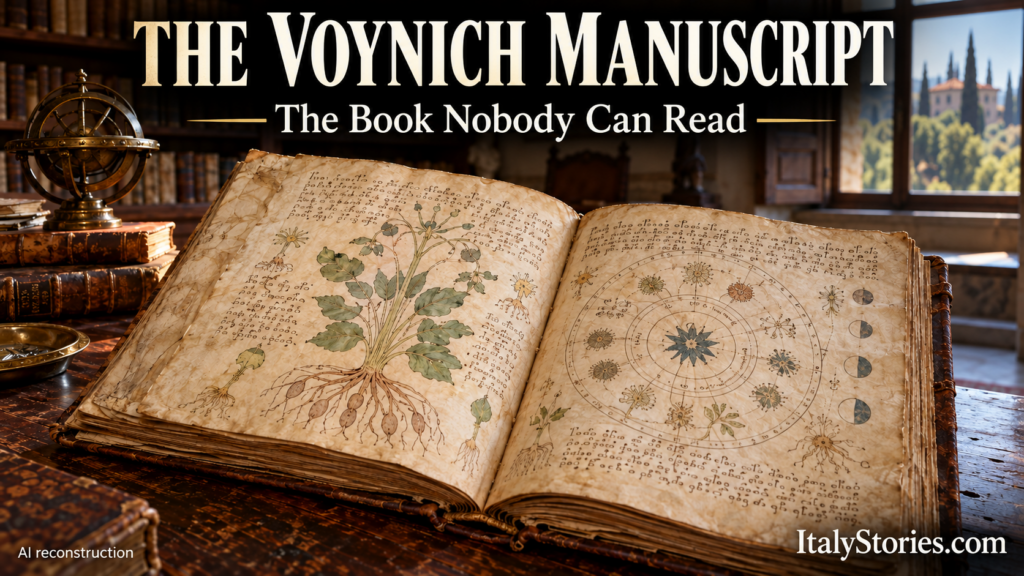
Imagine holding a book filled with carefully written symbols, strange botanical drawings and elaborate circular diagrams. You can examine every page, follow every line and study every illustration, yet the words remain beyond your understanding. The Voynich manuscript presents exactly this challenge. It is a real historical object, and one of the most important chapters in its modern story began in the hills outside Rome.
In 1912, rare-book dealer Wilfrid Voynich purchased the volume from the Jesuits at Villa Mondragone, in Monte Porzio Catone, near Frascati. The setting belongs to the landscape of Lazio’s historic villas, where imposing residences preserve traces of the people and institutions that occupied them. Among the manuscripts acquired by Voynich was a book that would eventually carry his name and attract attention far beyond the world of collectors.
Calling this a rediscovery is important. Voynich had not found a newly created work, and he was not its first reader or owner. The manuscript already had a history. What changed in 1912 was its entry into a new period of examination, speculation and international fascination. Its association with Italy is firmly documented, although that connection does not prove that the book was originally written there.
The illustrations are part of what makes it so difficult to put aside. Botanical forms occupy some pages, while others contain astronomical or astrological imagery, bathing figures and intricate circular arrangements. Drawings of roots and containers suggest connections with medicinal preparations. These visual clues encourage the reader to search for a familiar subject, perhaps a practical handbook or a collection of specialised knowledge. But recognising a possible theme is very different from understanding the text.
That gap between appearance and meaning creates the manuscript’s particular fascination. A plant drawing seems to offer a starting point. A diagram appears to organise information. The writing looks as though it ought to explain what we are seeing. Yet the explanation remains inaccessible. Every apparent clue raises further questions about the relationship between the images and the words surrounding them.
One of the people drawn into this challenge was William F. Friedman, a leading American cryptanalyst. He devoted several periods of study to the manuscript and explored approaches that included early computer-assisted text analysis. Despite his experience with secret writing systems, he did not achieve an accepted decipherment. He eventually suggested that the text might represent an artificially constructed language, but that remained a hypothesis rather than a demonstrated reading.
His experience reveals a central difficulty. Before a code can be broken, it helps to know what kind of system produced it. With the Voynich manuscript, even that starting point remains uncertain. Are its symbols concealing a familiar language? Do they belong to a writing system whose conventions have been lost? Could the underlying process be something different from what readers expect? Each possibility demands its own evidence.
This is also why a convincing solution requires more than a few apparently meaningful words. A method must work consistently, explaining difficult passages as well as convenient ones. Other researchers need to be able to apply the same rules and obtain comparable results. An interpretation that changes its assumptions from one page to the next may produce an attractive story without establishing what the manuscript actually says.
Perhaps the most interesting possibility is that its contents would not have seemed extraordinary to its original users. What looks deeply mysterious today could once have served an ordinary purpose within a particular community. A practical text can become almost impenetrable when the knowledge needed to interpret it disappears. The thought of recovering that missing context is as compelling as the prospect of uncovering a deliberately guarded secret.
The original manuscript is now preserved at Yale University’s Beinecke Rare Book and Manuscript Library, catalogued as MS 408. Bookseller H. P. Kraus donated it in 1969. High-resolution digital images make its pages available to readers around the world, although access to the fragile original is restricted. Its physical survival allows an extraordinary encounter: people separated by centuries can look at the same marks without necessarily sharing the understanding those marks once carried.
The Italian chapter has continued in another form. In 2019, the University of Rome Tor Vergata announced the presentation of an exact facsimile at Villa Mondragone, donated by Yale. The original remained in the United States, but a reproduction returned its pages to the villa associated with Voynich’s acquisition. That event renewed the connection between a local place in Lazio and a mystery studied internationally.
There is something quietly powerful about this story. The manuscript does not need an invented curse or a supernatural explanation to hold our attention. Its appeal comes from a real and persistent limitation in our knowledge. We can study the object, examine its illustrations and reconstruct parts of its journey, while still being unable to give its writing a generally accepted reading.
Somewhere between the visible symbols and the meaning we hope to recover lies the reason people keep returning to it. The next explanation must face the same patient test as every earlier one: does it truly help us read the book?
What do you think the Voynich manuscript was intended to preserve? Practical knowledge, a private system of communication, or something we have not yet recognised?
Share your thoughts in the comments and follow Italy Stories for more documented mysteries, remarkable discoveries and forgotten stories connected with Italy.