

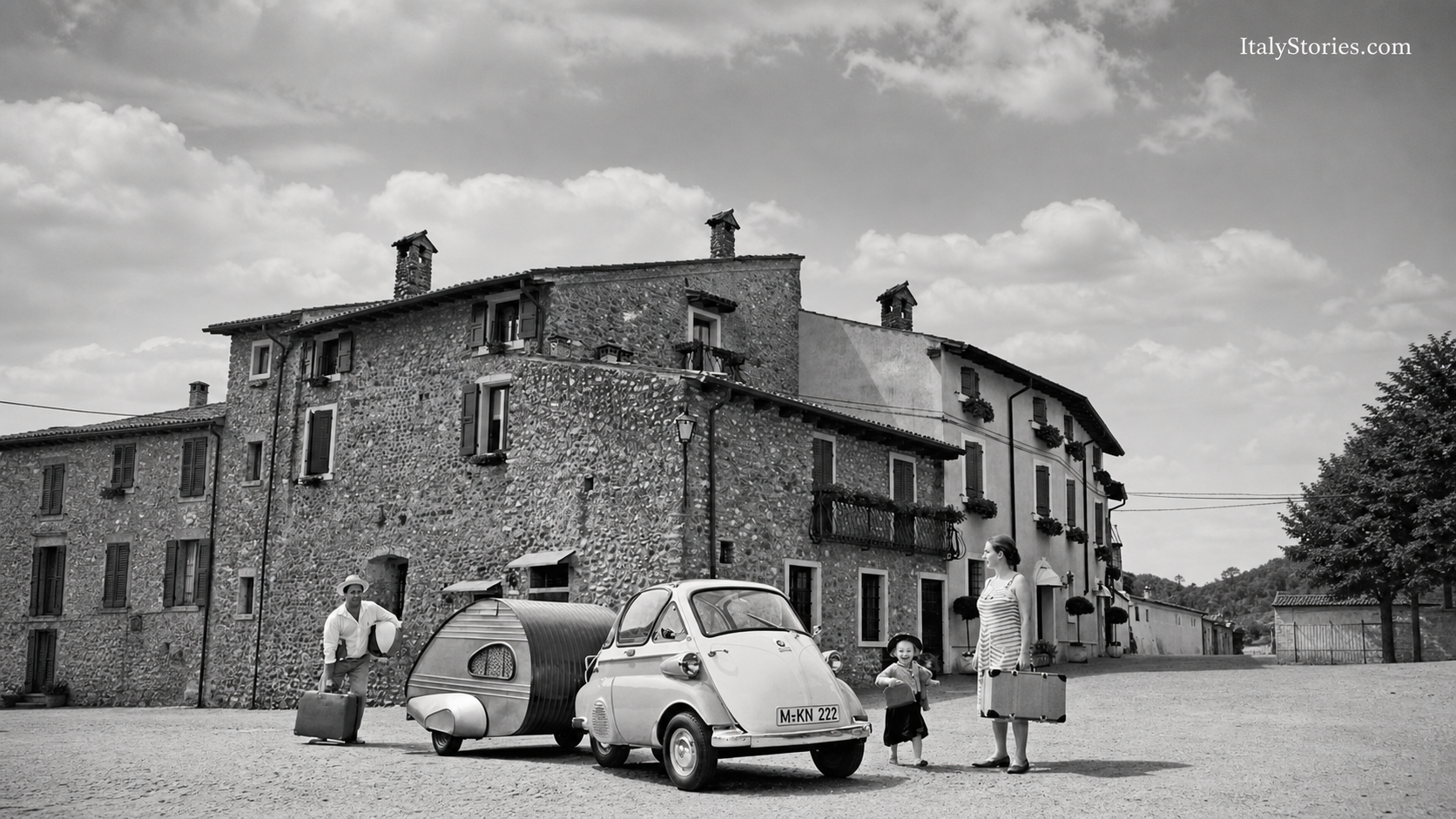
Look carefully at the photograph. There is almost an entire generation inside it. A tiny automobile stands in front of old stone houses, pulling a caravan whose dimensions seem optimistic even by the standards of an age accustomed to doing a great deal with very little. A man carries a suitcase. A woman waits beside another. A small child appears ready to follow the adults wherever this strange little travelling machine is about to take them. Nobody in the picture looks wealthy. Nothing is luxurious. The car itself seems barely large enough to contain the people, never mind the luggage, and yet the image possesses a feeling that is difficult to manufacture today. Something is about to happen. They are leaving.
For millions of European families around the turn of the 1960s, those two words were still extraordinary.
They are leaving.
Not emigrating. Not going to war. Not moving because work demands it. Not boarding a train to visit relatives because there is no alternative. They are leaving for pleasure. For the sea. For the mountains. For a campsite. For several days during which the principal purpose of movement is not survival, employment or duty, but happiness.
It is almost impossible now to understand how revolutionary the ordinary family holiday once was.
Today we discuss vacations as though they are a permanent human institution. We complain about airport queues, compare hotels on phones, choose between twenty flights and become irritated if the room does not resemble the photographs. A European family can wake in Manchester, Munich or Milan and be eating dinner hundreds or thousands of kilometres away before nightfall.
The families in the photograph belonged to another world. The memory of war was close enough to touch. Many parents had known rationing. Some had known bombing. Some had walked through destroyed cities. Millions lived in houses that contained few of the objects a modern family regards as automatic. A refrigerator could still represent prosperity. A television could draw neighbours into the same room. A telephone was not necessarily present. An automobile was not something every adult simply expected to own.
When Europe Began Acquiring Wheels
Then, during the 1950s, Europe began acquiring wheels.
And summer changed forever.
Postwar Western Europe did not recover evenly, and there was no single European experience, but a broad transformation was unmistakable. Industrial production grew, incomes rose and private automobile ownership expanded dramatically. Studies of European transport describe the decades after 1950 as the age of mass motorization, with affordable models such as Italy’s Fiat 500, France’s Citroën 2CV and Germany’s Volkswagen Beetle playing central roles in bringing cars within reach of ordinary households.
The Ordinary Family Takes the Wheel
The key word is ordinary.
Europe had possessed magnificent automobiles before the war. Bugattis, Delahayes, Alfa Romeos, Bentleys, Mercedes-Benzes, Lancias and Hispano-Suizas had already proved that Europeans could build some of the greatest machines on Earth. But those cars belonged to another social universe. The revolution did not happen when another wealthy man acquired a beautiful automobile. It happened when a factory worker could begin seriously imagining one.
A car transformed the radius of an ordinary person’s life. The village where your grandmother lived was no longer determined by the railway timetable. The seaside was no longer an annual logistical campaign. A picnic could happen forty kilometres from home. A Sunday afternoon could suddenly include a lake, a mountain road or another town.
And once the possibility existed, Europeans began doing something their parents had often been unable to do.
They packed.
Badly, excessively and wonderfully.
A suitcase went into the little luggage compartment. Another suitcase discovered that there was no little luggage compartment left. Bags were pushed behind seats. Blankets were folded around objects. Roof racks appeared. Beach umbrellas were tied wherever optimistic fathers believed beach umbrellas could safely be tied. Children were inserted into the remaining spaces.
Then the family looked at the car.
Surely this cannot work.
It worked.
Somehow it always worked.
Nowhere was this transformation more emotionally visible than in Italy. The country’s postwar economic miracle created not merely new factories and products but an entirely different rhythm of ordinary life. The Fiat 500, introduced in Turin on July 4, 1957, became one of the defining objects of that transformation. Fiat itself later described it as an icon of the postwar rebirth, while the Triennale Milano has recalled the particular image created at the end of the 1950s and beginning of the 1960s: lines of small cars overloaded with luggage heading toward the coast when offices and factories closed for the August holiday.
That image may tell us more about modern Italy than many political speeches.
A Fiat 500 on a Monday morning meant work.
A Fiat 500 with suitcases on the roof in August meant something else entirely.
Freedom had acquired a luggage rack.
Families left Turin and Milan.
Rome emptied.
Bologna became a corridor toward the Adriatic.
Workers who spent eleven months surrounded by machines drove toward the sea.
People who lived in apartment blocks suddenly slept beneath pine trees.
Children discovered campsites.
Mothers discovered that packing for a family holiday could apparently require transporting most of the kitchen.
Fathers discovered that a 15-horsepower engine took hills personally.
The roads filled.
There were breakdowns.
There were queues.
There were arguments.
There were overheated engines and hot children and sandwiches wrapped in paper.
And there was joy.
The destination might be Rimini, Riccione, Viareggio, Liguria, Lake Garda or some much smaller place whose name never appeared in an international guidebook. The precise destination mattered less than what the journey represented.
For one or two or three weeks, the family had another life.
The factory whistle belonged to somebody else.
The apartment remained closed.
The children did not have school.
The adults did not have work tomorrow morning.
The calendar had opened a door.
Italy stepped through it.
To understand why the photograph feels so striking to an American viewer, put it mentally beside an American family vacation photograph taken at approximately the same time.
The contrast is almost comic.
In Europe: perhaps a Fiat 500, Volkswagen Beetle, Renault Dauphine, Citroën 2CV, BMW Isetta or, after 1959, a Mini.
In America: a Chevrolet, Buick, Oldsmobile, Ford, Chrysler or Cadillac that appears to occupy roughly the same amount of land as the European family’s house.
This difference was not simply automotive fashion.
It was geography, economics, history and culture turned into metal.
America had space.
European cities often had streets created before anybody had imagined internal combustion.
America had large distances between cities and an abundant domestic petroleum economy.
Europe had fuel costs and taxation that made economy considerably more important.
America was building suburbs in which parking space could be incorporated into the architecture.
Europe was asking automobiles to fit into towns where a horse cart had once been considered significant traffic.
America’s postwar automobile became larger, lower, wider and increasingly expressive. Chrome multiplied. Engines grew. Automatic transmissions became common. Styling departments looked toward aircraft, rockets and the future. By 1959 the tailfin of a Cadillac Eldorado Biarritz had become one of the most extreme expressions of America’s jet-age optimism; the Smithsonian notes that Cadillac’s tailfins had grown from modest postwar details into space-age forms by the end of the 1950s and that manufacturers deliberately used dramatic annual styling changes to stimulate demand for new cars.
Europe looked at the same future and produced the Isetta.
This is wonderful.
It tells us that optimism does not have one shape.
America said, “We survived the war and now look how much we can have.”
Europe often said, “We survived the war and finally ordinary people can have something.”
Both were dreams.
One measured possibility in cubic inches.
The other sometimes measured it in cubic centimetres.
The American family car of the late 1950s was increasingly capable of becoming an extension of the home. Wide bench seats allowed passengers to spread out. Large trunks consumed luggage that would have required advanced mathematics to place inside a Fiat. Station wagons became magnificent instruments of family travel. Large engines made sustained highway speed effortless compared with Europe’s tiny economy cars. Air conditioning, although still far from universal, was becoming available in a way that would have seemed fantastically luxurious to many European motorists.
And America was constructing a road system equal to the scale of those machines. President Dwight D. Eisenhower signed the Federal-Aid Highway Act on June 29, 1956, authorizing a 41,000-mile Interstate system and launching one of the greatest infrastructure projects in American history.
Think about what those roads meant.
An American family could point a Chevrolet toward an enormous horizon and imagine travelling for days without leaving its own country.
Yellowstone.
Florida.
California.
The Grand Canyon.
The Atlantic.
The Pacific.
Motels, diners, service stations and roadside attractions grew around the automotive journey.
The great American road trip became a cultural institution.
The Different Scale of the American Journey
The car needed to be comfortable because America was enormous.
Small Roads, Sudden Worlds
Europe’s journey had different dimensions.
In a single day a European traveller could cross cultural boundaries that America might require thousands of miles to equal.
A family leaving southern Germany could cross the Alps and arrive in Italy.
A Dutch family could descend through Belgium and France.
A British family taking a ferry could suddenly find itself driving on the other side of the road through a language it did not speak.
The distances were shorter.
The transitions were sharper.
The vacation was not simply movement through space.
It was movement through worlds.
That is what makes the automobile in the photograph so perfect.
The BMW Isetta had Italian blood.
The original Isetta was conceived by Renzo Rivolta’s Iso company in Italy. BMW encountered the design in the 1950s, purchased the licence and adapted the tiny bubble car around its own motorcycle-derived engine. The German-built Isetta became an important postwar product for BMW, inexpensive to buy and operate and extraordinarily easy to park. BMW’s own historical account specifically remembers the Isetta as a common sight into the 1960s and says it helped fuel the growing holiday traffic, with its roughly 85 km/h maximum speed perhaps best enjoyed crossing the Alps toward Italy — the design’s country of birth.
There is something gloriously courageous about imagining an Alpine holiday in an Isetta.
Modern motorists discuss whether 150 horsepower is sufficient.
An Isetta family discussed gradients.
The little engine would work.
And work.
And work.
A faster car appeared behind.
It passed.
Another passed.
The mountain remained.
The engine continued.
Perhaps the driver occasionally wished BMW had installed another cylinder.
But eventually the road crested.
Then came the descent.
Then, somewhere below, Italy.
This is one of the great differences between old travel and modern travel.
Arrival had to be earned.
Today inconvenience is treated as a failure of the service provider. In 1960 inconvenience was frequently part of the story.
The car was hot.
The road was slow.
A child felt sick.
Someone had forgotten something.
The map was wrong.
A border official appeared humorless.
The hotel could not find the reservation.
The caravan refused to sit level.
And somehow, years later, these were the details everyone remembered with affection.
Because perfection produces remarkably few stories.
Across France another remarkable machine was performing the same democratic miracle.
Citroën’s 2CV had been conceived before the war around a famously utilitarian brief: create a simple, inexpensive, dependable car capable of moving rural people and goods across difficult terrain. Presented to the public in 1948, it ultimately became far more than an agricultural tool. Citroën itself describes the 2CV as a car that became a work vehicle, travelling companion and even a kind of mobile love nest while eventually exceeding five million examples when derivatives are included.
A 2CV did not impress anybody by traditional American standards.
Its body rolled dramatically.
Its engine was modest.
Its construction was almost aggressively rational.
But it could cross terrible roads, consume relatively little fuel, carry people and possessions and be maintained without a doctoral degree in electronics.
More importantly, it gave the French countryside mobility.
Then it gave young people freedom.
Then it gave travellers personality.
A car can begin as an economic solution and end as a cultural identity.
Europe did this repeatedly.
Germany’s postwar Volkswagen Type 1 followed another path toward the same destination. After the catastrophe of the Nazi period and wartime production, the British authorities restarted automobile manufacture at Wolfsburg in late 1945. The Beetle and, from 1950, the Transporter became major symbols of West Germany’s economic recovery and export success.
Soon Beetles were everywhere.
German families drove south.
The Alps became the great gateway.
Italy waited beyond them with something northern Europeans had turned into almost a mythology: sun.
Real sun.
Mediterranean sun.
A coastline where summer appeared more reliable than at home.
Italian beaches heard German, Dutch, French and English.
Campsites acquired international neighborhoods.
A Volkswagen parked beside a Fiat.
A 2CV beside a caravan.
Children discovered that playing together required surprisingly little vocabulary.
Adults discovered that pointing at food worked reasonably well too.
Tourism was doing something Europe desperately needed after two wars.
People were crossing borders for pleasure.
Then Britain produced the Mini.
Again, look at the year.
1959.
Cadillac’s tailfins had reached extraordinary height across the Atlantic.
In Britain, Alec Issigonis and the British Motor Corporation were attempting to make a car use as little exterior space as possible while giving as much of it as possible to passengers. Transverse engine, front-wheel drive, wheels pushed outward, astonishing packaging efficiency: the Mini became one of the most brilliant responses ever given to the problem of affordable motoring.
Europe and America were effectively asking opposite questions.
America asked:
How much car can prosperity give us?
Europe asked:
How much life can we fit into a small car?
Both produced icons.
This is why judging one culture’s automobiles by the other’s standards makes little sense.
A 1959 Cadillac Eldorado Biarritz and a 1959 Mini are not merely cars of different sizes.
They are philosophies parked beside one another.
One celebrates abundance.
The other celebrates ingenuity.
And then there was the Fiat 500.
Less than three metres long.
A tiny two-cylinder engine at the rear.
A folding fabric roof.
Four seats, provided the four people involved were prepared to negotiate.
Introduced in 1957, the 500 became inseparable from the new Italian mobility. The Triennale Milano describes it explicitly as the car associated with the Italian vacation exodus of the end of the 1950s and beginning of the 1960s, when compact cars piled with luggage made their way toward the coast.
This is what Americans sometimes misunderstand about the Cinquecento.
Its greatness is not that Italians made an excellent tiny car.
Its greatness is what became possible because the car was tiny and inexpensive enough to exist in ordinary lives.
A Ferrari allowed the world to dream about Italy.
The Fiat 500 allowed Italians to dream about Sunday.
That may be the greater social achievement.
Imagine a factory worker in Turin. For most of the week the 500 takes him to work. Then August arrives. A roof rack is fitted. Suitcases appear. His wife packs food. Children are somehow accommodated.
The same machine that carried him to the factory now carries him away from it.
That transformation is freedom in its most human form.
Italy was simultaneously transforming the road beneath these cars. Construction of the Autostrada del Sole began in 1956. Sections opened progressively: the Milan–Bologna route, the extraordinary Apennine stretch toward Florence and other sections became part of the national imagination before the full Milan–Naples A1 was inaugurated in 1964. Autostrade per l’Italia’s historical archive records the Bologna–Florence opening in 1960 and the completed Milan–Naples route in 1964.
Europe’s motorway development was highly uneven. In 1960, figures compiled for the future EU-15 countries show roughly 2,671 kilometres of motorway in West Germany and 1,065 in Italy, compared with about 202 in the United Kingdom and 174 in France.
For Italians, the Autostrada del Sole was more than concrete.
It shortened psychology.
Milan and Rome became conceptually closer.
North and south could be imagined as belonging to one continuous modern road.
And for the holiday family, the motorway offered another possibility.
The sea could begin after breakfast.
Here the similarities between America and Europe return.
Family packing is universal.
The only variable is available volume.
The American father opened the enormous trunk of the family sedan and began filling it.
The European father opened the Fiat.
Then paused.
There was already something in there.
Probably the engine if he had opened the wrong end.
The process became engineering.
Shoes went inside bags.
Bags fitted around other bags.
Food occupied spaces engineers had intended for unrelated mechanical purposes.
Coats became padding.
A beach umbrella was secured above everyone’s head.
The child’s toy eventually travelled on the child’s lap because the child had foolishly insisted on bringing it.
The luggage rack became a second floor.
Then came one final object.
“There is no room.”
“There is.”
“There isn’t.”
“There is.”
The object went in.
There was always room.
This was perhaps the true Italian economic miracle.
Nostalgia is often air-conditioned.
Reality was not.
Drive a modern car across Europe in July and the cabin can remain at 21 degrees while the temperature outside passes 35.
In 1960 you opened windows.
If the roof folded back, you opened that too.
You sweated.
Children stuck to seats.
The sun heated metal dashboards and steering wheels.
Traffic jams became communal suffering.
Petrol stations were not simply somewhere to buy fuel. They were interruption, relief and information.
Perhaps there was a café.
Perhaps a map.
Perhaps someone could explain the road.
Drivers actually asked strangers for directions.
This created interactions we have largely designed out of travel.
Today satellite navigation prevents us from becoming lost.
It also prevents us from needing another human being.
Efficiency has consequences.
A European holiday carried another excitement largely absent inside American domestic travel.
The border.
Passports.
Customs posts.
Uniforms.
Currency changing.
Languages changing.
Road signs changing.
Food changing.
Sometimes the driving rules seemed to change.
A child in the back of a Volkswagen could physically see the moment the family entered another country.
There was ceremony to it.
A queue.
Documents handed through a window.
An adult behaving slightly more seriously than usual.
Then the barrier opened.
France.
Italy.
Germany.
Austria.
Switzerland.
Another country existed immediately on the other side.
For postwar Europeans, this growing normality of peaceful cross-border travel was extraordinary even when nobody described it in grand historical terms.
Parents who remembered soldiers crossing borders were now crossing them with deckchairs.
That may be one of the most beautiful transformations Europe ever achieved.
For northern European travellers, Italy acquired almost mythical status during these years.
The Alps made the arrival theatrical.
You climbed toward them.
The car worked harder.
Mountains surrounded the road.
Perhaps snow remained visible even in summer.
Then came tunnels or passes.
Gradually the landscape changed.
The air changed.
Architecture changed.
Vegetation changed.
Language changed.
And somewhere ahead existed a country associated with warmth, food, art and a kind of public life that seemed gloriously different from northern restraint.
German families came down toward Lake Garda and the Adriatic.
British travellers headed through France and across the mountains.
Dutch families became familiar sights in campsites.
Italy became not only a destination but a feeling.
The coffee was stronger.
Dinner was later.
People spoke louder.
Children appeared to remain awake indefinitely.
Vespas were everywhere.
Small Fiats behaved as though lane markings were general suggestions.
For a British family arriving from a grey summer at home, the experience could feel like crossing into colour.
The caravan in the photograph matters almost as much as the car.
Because some travellers wanted adventure without abandoning all domestic certainty.
The caravan offered the perfect compromise.
Your bed travelled with you.
Your cups travelled with you.
Your blankets travelled with you.
The little rituals of home could be rebuilt beneath completely different skies.
For a European family of the era, the space did not need to be enormous because expectations were different. Children already shared rooms at home. Bathrooms were often smaller. People did not demand king-size beds and individual entertainment systems.
A folding table was enough.
An awning created another room.
A campsite provided showers.
A gas burner cooked dinner.
The holiday did not need to impersonate a hotel.
That was precisely the point.
The family had escaped the normal world.
Perhaps the most important luxury arrived the following morning.
Someone opened the caravan door.
Outside was Italy.
A lake.
Or pine trees.
Or the Adriatic.
Coffee was prepared.
For the Italian family it was naturally espresso from a moka or something equally uncompromising. A German family might approach breakfast differently. A British family differently again.
But everybody eventually sat outside.
That small act may explain the entire attraction of camping.
At home, breakfast is preparation for something else.
Work.
School.
Appointments.
On holiday, breakfast can be the event.
The table is slightly unstable.
Someone passes bread.
A child has already disappeared toward another pitch.
There is no urgency.
The car is parked nearby, dusty from yesterday’s journey.
For perhaps the first time in months, nobody needs it.
The family has arrived.
Again the difference in geography produced a difference in culture.
The American road trip developed around motels, motor courts, diners and roadside services. The family automobile was large enough to contain people comfortably during enormous drives, while accommodation could be found along the highway.
Europe’s campsite culture developed another relationship with the road. Tent, caravan and small car could transform a destination into temporary community.
Families stayed longer.
Children formed friendships.
Neighbors shared food.
Everyone knew what everyone else was cooking because camping offers privacy mainly as an intellectual concept.
The campsite became a village of people who had deliberately left their villages.
A Dutch caravan beside a German tent beside an Italian family beside a French 2CV.
Perhaps nobody spoke the same language properly.
The children solved the problem within an hour.
Adults took slightly longer.
Wine helped.
Then there was the beach.
For generations raised after cheap aviation, the emotional power of simply reaching the sea can be difficult to recover.
The sea was the destination.
You did not need a schedule of twelve attractions.
There was water.
Sand.
Sun.
That was enough.
An Italian child could spend three weeks on substantially the same fifty metres of beach and consider the holiday an unquestionable success.
Parents rented umbrellas.
Families brought food.
Lunch occurred.
Then came the great tyranny of Italian childhood.
You may not swim immediately after eating.
Whether the required waiting period was two hours, three hours or until adulthood depended on the grandmother present.
Children protested.
Adults remained unmoved.
Eventually permission arrived.
Everyone returned to the water.
Tomorrow they would do almost exactly the same thing.
This repetition would be considered inefficient by modern tourism.
It was magnificent.
Across the Atlantic, another holiday mythology was developing.
The American road encouraged the traveller onward.
See another state.
Another national park.
Another city.
Another roadside attraction.
The scale of the country made movement itself spectacular.
A V8 cruising down a broad highway represented effortless command over distance.
The car was built for this landscape.
Long wheelbase.
Soft suspension.
Automatic transmission.
Large engine turning lazily.
Space for children to fight without necessarily touching.
The family could carry suitcases, coolers, blankets, cameras and half the contents of the house.
The European motorist looked at photographs of these machines with amazement.
How much petrol does it use?
How would you park it?
Where would you put it in Rome?
These were reasonable questions.
The American response might reasonably have been:
Why would we want to park it in Rome?
Different worlds.
This difference is perhaps clearest in Italy.
A large American sedan asserts itself against space.
A European city car negotiates.
Florence does not care about your wheelbase.
Rome will not widen a medieval street because you bought a Buick.
A Tuscan village built on a hill centuries before Columbus crossed the Atlantic has no moral obligation to provide parking for a Cadillac.
So European cars became narrow.
Compact.
Maneuverable.
They folded people inward.
They used every centimetre.
They turned scarcity into cleverness.
A Fiat 500 does not dominate a street in Rome.
It fits into the sentence.
That is one of the reasons it appears so natural there.
And something interesting happened.
The small European automobile eventually became desirable in America precisely because it represented the opposite of American excess.
The Volkswagen Beetle developed an enormous American following.
The Mini became design royalty.
The Fiat 500 became charming in a country where almost nothing else on four wheels was comparable in size.
The Smithsonian’s history of American automobile marketing notes that by the early 1960s Volkswagen advertising could deliberately use the Beetle’s resistance to annual styling changes as a criticism of the planned obsolescence associated with domestic manufacturers.
European economy became counterculture.
What had begun as necessity could become sophistication.
A small car said something.
Perhaps I do not need what everyone else needs.
That idea is very powerful in a society built on abundance.
Then somebody produced a camera.
Usually one.
Photographs were rationed by economics and technology rather than storage capacity.
Film had a finite number of frames.
Development cost money.
Therefore not everything was photographed.
This made photographs strangely powerful.
A family might return from a two-week holiday with thirty-six images.
Some were blurred.
Someone had closed their eyes.
One horizon was mysteriously tilted.
A stranger’s elbow occupied part of another.
Nobody deleted anything.
The bad photographs remained.
Decades later they became treasures.
Today a family can take two thousand photographs during a week and forget almost all of them.
The family in 1961 may have taken twenty.
They remember every one.
This photograph of the little car and caravan has survived because somebody thought departure was worth recording.
They were correct.
Look at the child.
This is perhaps where the story becomes emotional.
That child, if still alive today, would be an elderly person.
Think about that.
In the photograph, the world is beginning.
The adults carry suitcases.
The car waits.
Perhaps the child is excited about the journey.
Perhaps too young to understand it.
The houses behind them look permanent.
The parents look permanent.
Childhood always believes this.
The car will always be there.
The village will always be there.
Mother will always look like that.
Father will always carry the suitcase.
There will always be another summer.
Then sixty years happen.
The car becomes a collectible.
The caravan becomes vintage.
The houses remain but the people change.
The child grows.
Perhaps emigrates.
Perhaps has children.
Perhaps grandchildren.
One day somebody shows them this photograph.
The astonishing thing will not be the automobile.
It will be the adults.
“My mother was so young.”
That sentence contains an entire universe.
This is why old motoring photographs have particular power for Italians abroad.
Millions of Italians built lives elsewhere.
Britain.
America.
Canada.
Australia.
Germany.
Switzerland.
Belgium.
Argentina.
France.
Some left before the great mass-motoring age had fully transformed their hometowns. Others left precisely during it.
They carried an Italy inside them that time gradually stopped updating.
Their Italy may contain a Fiat 600.
A Vespa.
A petrol station with an Agip sign.
A father in a white undershirt washing the family car on Sunday.
A mother carrying food downstairs before a journey.
A suitcase tied to a roof rack.
For their children born abroad, these objects can seem picturesque.
For the person who left, they are coordinates.
A photograph becomes a map back to a country that no longer exists.
Every vacation contains a cruel asymmetry.
Departure is anticipation.
Return is mathematics.
How many hours?
How many kilometres?
How long until work?
The same little car that had carried hope toward the sea now carried damp swimsuits, sand and resignation home.
Children slept.
Adults drove.
The holiday landscape gradually disappeared.
The familiar city returned.
Apartment buildings.
Traffic.
The parking place.
Then luggage came out.
The car became ordinary again.
Tomorrow it might go to work.
This is perhaps why people loved those cars so deeply.
They were witnesses to both worlds.
Monday morning and August.
Duty and escape.
The same steering wheel belonged to both.
It is important not to turn nostalgia into dishonesty.
Modern family travel is better in countless ways.
Cars are vastly safer.
Air conditioning prevents dangerous heat.
Children sit in proper restraints.
Navigation prevents families from spending an afternoon arguing over a paper map.
Engines are enormously more reliable.
Tyres are better.
Brakes are better.
Motorways are safer.
Breakdown services are easier to summon.
Hotels can be found instantly.
Border crossings within much of Europe have become remarkably simple.
Information is available everywhere.
A modern family can cross Europe with a level of safety and certainty that their grandparents would have considered science fiction.
We should be grateful.
But better does not always mean more memorable.
Old journeys contained empty spaces.
You did not know exactly what the hotel looked like.
You did not know what restaurant was best.
You did not know precisely how long the road would take.
You did not know whether the campsite had space until somebody told you.
You asked.
You discovered.
You adapted.
Sometimes you were disappointed.
Sometimes the place found by accident became the memory of the holiday.
Modern technology protects us from bad surprises.
It also has the capacity to protect us from good ones.
The family in the photograph had very little information.
They had a car.
A caravan.
Suitcases.
A road.
That was enough to begin.
Perhaps this is the most beautiful part of the story.
The motoring holiday did more than democratize leisure.
It changed how Europeans encountered one another.
A German family could sit beside an Italian family at Lake Garda.
French children could meet Dutch children at a campsite.
British tourists could discover that Italians did not actually live inside opera houses.
It was mundane diplomacy.
Coffee.
Beer.
Beach balls.
Camping chairs.
Broken starter motors.
Children becoming friends.
Europe’s history had been filled with people crossing frontiers carrying weapons.
Now families crossed them carrying inflatable mattresses.
That deserves more emotional weight than we usually give it.
So which car was better?
The European miniature or the American giant?
The question is meaningless.
Each expressed the world that created it.
A Cadillac Eldorado with immense tailfins under an American sky was magnificent because it reflected a country intoxicated by technology, prosperity, space and the future.
A Fiat 500 loaded with luggage on the Via Aurelia was magnificent because it reflected a country discovering that ordinary people could finally afford to move.
The Cadillac said:
Look how far we have come.
The Fiat said:
Look where we can finally go.
An Isetta towing a tiny caravan seems almost comical beside a huge American station wagon.
Until you understand what is inside it.
A family’s first real holiday.
Then it becomes enormous.
Imagine Europe in the summer of 1960.
Not forever.
One morning.
The sun has just risen.
A stone village is waking.
Windows open.
Somewhere coffee is being made.
There is a tiny car outside the house.
A caravan behind it.
A man carries the final suitcase.
His wife tells him there is still another bag.
He looks at the car.
Of course there is.
The child is excited.
Perhaps they are driving toward Italy.
Perhaps they are already there and heading toward the coast.
The route is drawn on a paper map.
They will get lost once.
The engine will become hot.
Someone will complain.
Lunch will be eaten beside the road.
There will be no photograph of lunch because nobody believes lunch is important enough to photograph.
They are wrong.
Years later it will be the lunch they remember.
The sandwiches.
The warm bottle of water.
The father studying the map.
Mother laughing about something nobody can reconstruct.
The tiny car parked beneath a tree.
Nothing important happened.
And therefore everything was important.
Look one final time at the photograph.
The old houses behind the family belong to Europe before mass mobility.
The little automobile belongs to the Europe that is arriving.
The caravan is a promise.
The suitcases are evidence that someone believes another life exists beyond the edge of the picture.
This is why old vacation photographs can make us strangely emotional.
They capture people at the exact moment before memory begins.
Nobody in the photograph knows they are living in “the late 1950s” or “the early 1960s.” People never experience historical periods by their future names.
They are simply alive.
The child does not know that the car will one day be rare.
The mother does not know that her dress will one day look vintage.
The father does not know that the suitcase will one day seem charming.
They are going on holiday.
That is all.
And perhaps that is exactly why the image matters.
Europe had spent the first half of the twentieth century learning terrible lessons about movement. Refugees moved. Soldiers moved. Borders moved. Families were separated. Cities were destroyed.
Then came another kind of movement.
A family car.
A road map.
A little caravan.
The sea.
For once, people were leaving because they wanted to.
America celebrated freedom with V8 engines, vast highways and automobiles that seemed capable of carrying a living room across a continent. Europe discovered its own version with two cylinders, four modest seats and suitcases strapped wherever physics allowed.
The machines looked completely different.
The emotion was the same.
We can go.
Perhaps that is the sentence hidden inside every great automobile story.
Not horsepower.
Not styling.
Not top speed.
Go.
The 1959 Cadillac said it.
The Volkswagen Beetle said it.
The Citroën 2CV said it.
The Mini said it.
The Isetta whispered it through one cylinder.
And the Fiat 500, carrying an Italian family toward the Mediterranean with fifteen horsepower and absolutely no understanding that it was supposed to be too small, said it perhaps most beautifully of all.
We can go.
The road is open.
The children are inside.
The luggage is tied down.
Summer is ahead.
And for a generation that had grown up with war, scarcity and borders, there may have been no more beautiful definition of prosperity.
Today we travel farther, faster and more comfortably. We know exactly where we are, exactly when we will arrive and, thanks to the photographs online, often exactly what the destination will look like before we see it.
They knew much less.
But perhaps they felt departure more.
The engine started.
The house became smaller in the mirror.
The road opened.
Nobody checked a phone.
Nobody knew what waited around the next corner.
And an ordinary European family, packed into an impossibly small automobile, suddenly possessed something that only a few years earlier might have seemed like the privilege of the rich.
A holiday.
A journey.
A choice.
A little piece of the future.
Those tiny cars never had enough room for all the luggage European families tried to put inside them, but somehow they had enough room for something much larger: the first summers of freedom an entire generation would spend the rest of its life trying to remember.
European Road Holidays in the 1950s and 1960s: When Small Cars Carried Big Dreams
Discover the emotional story of European family holidays in the late 1950s and early 1960s, from Fiat 500s and BMW Isettas to caravans, Italian beaches and America’s enormous V8 road-trip culture.
In the late 1950s and early 1960s, Europe’s new generation of small cars changed summer forever. Fiat 500s, BMW Isettas, Citroën 2CVs, Beetles and Minis carried ordinary families toward beaches, mountains and campsites, while across the Atlantic America travelled in enormous V8-powered cars. Two automotive worlds, united by the same dream: freedom.
A family, a tiny European car, a caravan and a handful of suitcases: an image that captures the birth of mass motoring holidays in Europe around the turn of the 1960s.
European family leaving for holiday with vintage microcar and caravan in the late 1950s