

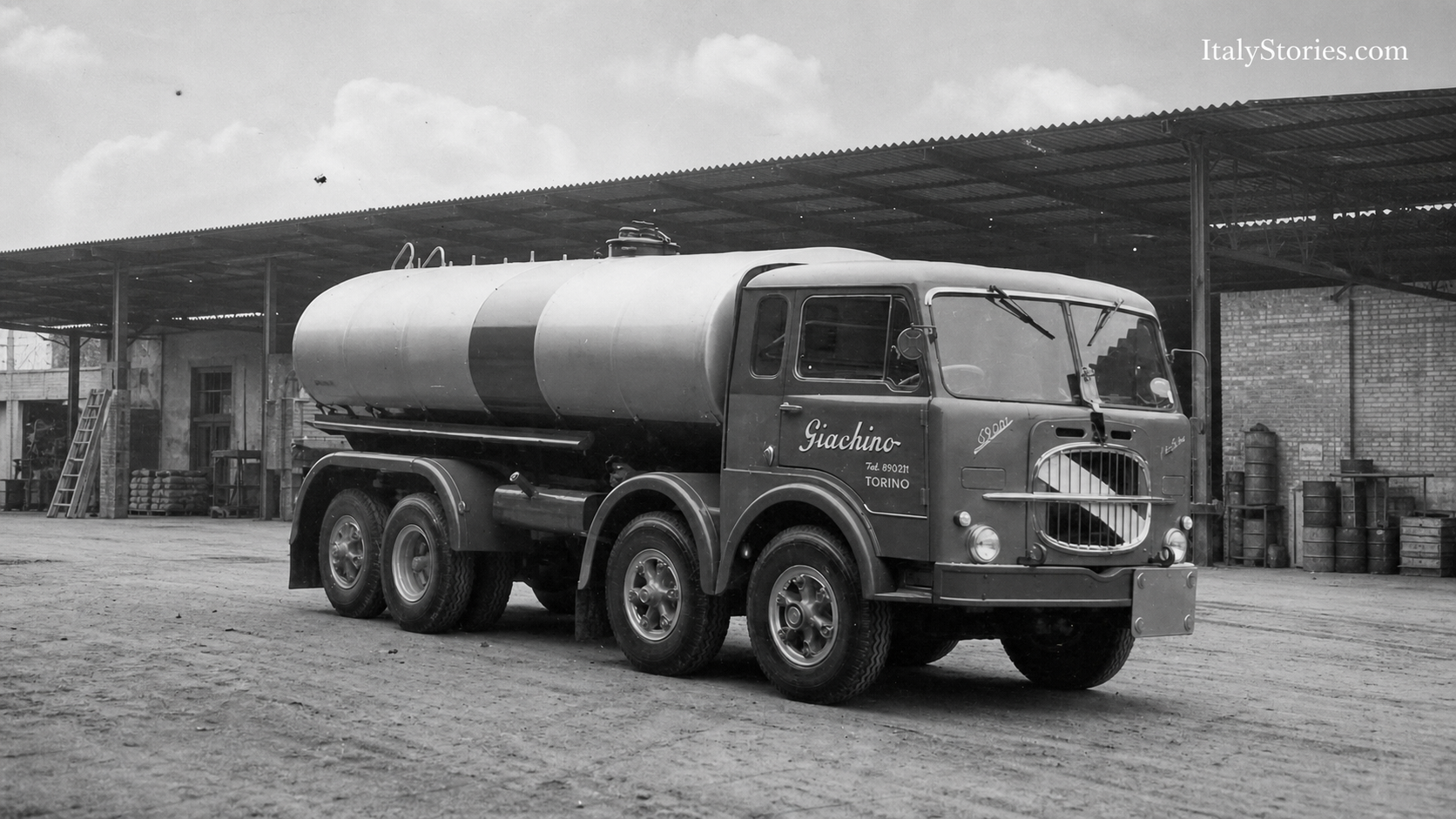
### *Fiat 682, Fiat 690, OM Titano, Lancia Esadelta and the magnificent heavy trucks of 1960s Italy: machines that rebuilt a country, crossed deserts, powered industries and became part of the childhood memories of a generation.*
Look at the truck in the photograph for a few moments before thinking about horsepower, payload or model numbers. Look at the four axles, the enormous cylindrical tanker, the rounded cab pushed forward over the road, the little windscreen, the mirrors that seem absurdly modest for something so large, and above all that unmistakable Italian face on the front, the oval grille and chrome “moustache” that once appeared in the mirrors of thousands of motorists. On the door is the name of a Turin operator. This was not a truck conceived as a lifestyle object. Nobody designed it so that seventy years later enthusiasts would admire it on computer screens. It existed because something heavy had to be moved from one place to another, on roads that were often poor, over mountains that did not care how tired the driver was, in summer heat and winter fog, with schedules that had to be respected and loads that could not complain when the journey became difficult. Yet there is something almost noble about it today. It has the physical dignity of a machine that was built with one clear purpose and expected to keep doing that job for a very long time.
For Italians who were children in the late 1950s and 1960s, particularly those who grew up near a state road, a factory, a quarry, a port or one of the great northern industrial cities, these trucks were not historical vehicles. They were enormous living creatures. You heard them before you saw them. A deep diesel note would arrive from behind the houses, then the truck would appear slowly, perhaps carrying steel, marble, fuel, machinery, timber or crates of agricultural produce. The engine did not sound hurried. It sounded determined. On a hill the driver might work through the gearbox patiently while the diesel settled into that low, hard rhythm older men still remember instinctively. There was smoke, heat, the smell of fuel and oil, the metallic sound of a heavy chassis flexing over imperfect roads. Then it passed and disappeared, leaving the street strangely quiet again.
Many of the Italians who remember those sounds no longer live in Italy. They left for Britain, the United States, Canada, Australia, Germany, Switzerland, Belgium, Argentina and elsewhere. They built different lives, raised children who spoke another language and learned to measure distances in miles rather than kilometres. Yet show one of those men an old photograph of a Fiat 682 or 690 and something curious can happen. He may suddenly no longer be seventy-five years old. He may be nine. His father is still alive. The house in the village is still there. Somewhere a radio is playing. His mother is calling from a window. A heavy Fiat is climbing the road below, slowly enough that the boy has time to run to the wall and watch it pass.
That is why this is not simply a story about trucks. It is a story about the machines that moved through Italy while modern Italy itself was being assembled.
A Country Under Construction
The Italy of the early 1960s was moving with astonishing energy. The war had ended less than two decades earlier, and memories of destruction, scarcity and displacement had by no means disappeared. Yet factories were producing at extraordinary rates, families were leaving agricultural communities for industrial cities, apartment blocks were rising around Milan, Turin and Rome, motorways were cutting across landscapes that had previously been joined by much slower roads, and consumer goods were entering homes that only a generation before had possessed very little. The famous *miracolo economico*, the Italian economic miracle, was transforming daily life. Fiat 500s and 600s were giving ordinary families mobility, Vespa and Lambretta scooters were filling city streets, refrigerators and televisions were becoming symbols of a new domestic prosperity, but none of this could happen without another class of machine working almost invisibly behind it all.
The truck.
Every factory needed raw materials and had finished products to send away. Construction sites needed cement, steel and machinery. Petrol stations required tankers. Ports had to communicate with inland industry. The marble of Carrara had to descend from mountains. Food grown in the south had to reach urban markets in the north. The enormous industrial complex developing around Turin had to be supplied continuously, while exports increasingly connected Italian production with the rest of Europe and the Mediterranean.
The heavy truck became one of the circulatory systems of the economic miracle.
Those numbers require historical imagination. One hundred and seventy-seven horsepower does not sound remarkable in an age when a modern European tractor unit can comfortably produce 500 or 600 horsepower. But that comparison misunderstands the machine. These engines were not designed to produce spectacular acceleration. They were enormous, slow-turning diesels designed to work. Power arrived with heavy torque at modest engine speed. Gear ratios, axle ratios and driver technique transformed those numbers into the ability to move extraordinary loads through terrain where momentum mattered.
Power, in that era, did not necessarily mean going fast.
Power meant not stopping.
The Fiat “Baffo”: A Face Every Italian Knew
Few truck cabs have possessed as much personality as the Fiat heavy trucks with the celebrated *baffo* front. The word means “moustache,” and one glance explains the nickname. A chrome strip divided the broad oval grille, creating an expression that was somehow stern and friendly at once. Fiat used the design across a family of heavy vehicles, and over the years it became one of the recognizable faces of Italian postwar transport.
Among them, the Fiat 682 became a legend.
The 682 had actually appeared in 1952, but its long development meant that it remained central to Italian heavy transport deep into the 1960s and beyond. Early versions experienced their share of development problems, but Fiat rapidly strengthened and improved the design. The N2 series established the reputation that would make the truck famous, and in 1962 the N3 arrived with the 11,548 cc six-cylinder engine, around 180 horsepower and enormous low-speed pulling ability. Further development produced the N4 later in the decade. The truck’s mechanical simplicity, durability and adaptability ultimately gave it one of the longest working lives in European commercial-vehicle history. ([marcoappugliese][3])
Its nickname tells the rest of the story.
Re d’Africa. The King of Africa.
That nickname was not invented decades later by nostalgic collectors. The 682’s reputation abroad became part of the machine’s identity. It was sold and eventually produced outside Italy, and its career continued on the African continent long after newer trucks had replaced it on European roads. IVECO’s own historical material still describes the old Fiat 682 as the “King” or “Lion of Africa” and credits it with playing a role both in postwar Italian reconstruction and in developing transport in African countries. ([Iveco][4])
Production history almost seems impossible by modern standards. Different versions of the 682 remained alive for decades, with production and assembly continuing in Africa long after its original Italian career. Sources documenting the model record local production in Nigeria into the late 1980s, and IVECO’s recent account of its Ethiopian industrial partnership specifically names the 682N3 among vehicles assembled there. ([marcoappugliese][3])
Imagine telling an engineer designing an ordinary commercial vehicle today that versions of his truck might still be manufactured more than three decades after its introduction.
The reason was not sophistication.
It was almost the opposite.
The truck could be understood.
Mechanical systems could be repaired. The large diesel was not dependent on a laptop, a network connection or an electronic control unit that a mechanic hundreds of kilometres from a dealer could not interrogate. Components were heavy because weight reduction was not pursued with the intensity it is today. Engines operated at relatively low specific outputs. Structures were engineered for punishment because road transport itself was punishing.
None of this means they never broke. Of course they broke. Gearboxes failed. Engines wore. Bearings needed replacement. Pumps required rebuilding. Tyres suffered. Brakes required attention. A romantic history that pretends old machinery was infallible does it no service.
The remarkable thing is what happened after it broke.
It was repaired.
Again.
And again.
And again.
A crankshaft could be measured. A cylinder head could be removed. A pump specialist could rebuild an injection pump. A mechanic who understood diesel engines could diagnose a problem with his ears before touching a tool. Parts that were unavailable might be machined, adapted or recovered from another truck. The vehicle did not cease existing simply because a warning lamp demanded a proprietary diagnostic procedure.
That quality would become enormously important when Italian trucks began living their second, third and sometimes fourth lives far from Italy.
If the 682 became the King of Africa, the 690 became one of the great symbols of Italy itself.
Photographs of Italian roads in the 1960s show configurations that can look almost exotic to foreign truck enthusiasts. Long rigid vehicles with four axles, sometimes pulling four-axle trailers, seemed to contain wheels everywhere. The appearance came partly from Italian weight regulations and partly from the creativity of specialist vehicle builders. Companies such as Viberti, Perlini, Fresia and others became part of an ecosystem in which a basic factory truck could be adapted into something specifically suited to the realities of Italian haulage.
The 690 N1 entered the 1960s with a large Fiat 203-series six-cylinder diesel of roughly 11.5 litres and around 177 horsepower, and its four-axle conversions became iconic. At the time, the 22-tonne four-axle rigid could be paired with a suitable trailer of similar legal weight, creating the famous 44-tonne eight-axle combination. ([Informati Sardegna][5])
To a British truck enthusiast, this is where the story becomes particularly interesting. British heavy haulage developed its own wonderful engineering traditions through AEC, Leyland, ERF, Foden, Scammell and others, but the Italian approach could look strikingly different. Italian operators were often asking relatively modest horsepower to move very substantial gross weights through mountain country. The skill was in gearing, torque, mechanical strength and — something specifications cannot adequately describe — the driver.
You did not simply place one of these trucks in top gear and let electronics decide the rest.
You drove it.
You learned the engine’s useful range. You listened to it. You learned when a hill demanded another gear before the engine was already defeated. You learned to preserve brakes on descents. You understood your load. You knew the road ahead because a wrong decision made ten seconds earlier could leave twenty or forty tonnes moving in a direction you no longer controlled.
That experience produced a generation of professional drivers with an almost physical relationship with machinery.
Many began astonishingly young. A boy might accompany his father or uncle on local trips, sitting high in the cab while a world normally seen from pavement level suddenly appeared far below. He smelled diesel, tobacco, leather, hot metal and perhaps yesterday’s coffee. He watched enormous hands work the steering wheel and gear lever. He learned that a driver greeted another driver with a gesture visible through windscreens. He knew which roadside bar served coffee before dawn and which mechanic could be trusted with an injection pump.
Later, after emigrating to Birmingham, Toronto, Melbourne or New York, he might forget hundreds of things about Italy.
He would not forget the sound of that gearbox.
OM Titano: When 230 Horsepower Really Meant Something
Fiat dominated much of the story, but it was by no means alone. Italian heavy-truck engineering in the early 1960s included magnificent competition from OM and Lancia, along with other manufacturers and specialist builders.
One of the most impressive machines was the OM Titano.
Officine Meccaniche of Brescia had a long industrial history, and the Titano introduced in 1961 was a serious answer to Fiat and Lancia in the heavy sector. Contemporary British reporting is particularly revealing because it allows us to see the vehicle not through nostalgic Italian eyes but as foreign professionals saw it at the time. In November 1961, *The Commercial Motor* described the Titano’s 10.3-litre direct-injection six-cylinder diesel in both naturally aspirated and mechanically supercharged form, producing approximately 185 and 230 bhp respectively. The stronger version could be rated for gross train weights up to 56 tons in the applications being discussed. ([archive.commercialmotor.com][6])
Two hundred and thirty horsepower in 1961 was serious.
More interesting still was the supercharging system. Rather than relying on the exhaust-driven turbocharging familiar to modern drivers, the Titano could use an OM helical-lobe mechanical supercharger that the driver could engage as required. It was engineering with a certain muscular directness: when the engine needed additional air and power, machinery physically supplied it.
There is something almost poetic about an OM Titano carrying marble.
An Italian machine carrying the Italian stone from which Michelangelo’s world had been carved.
But the driver would probably have found that description irritating.
To him it was a load.
It had to come down the mountain safely.
Romance belongs to people standing beside the road. Work belongs to the man holding the wheel.
Lancia Before Lancia Meant Only Beautiful Cars
Modern enthusiasts, particularly outside Italy, often associate Lancia with cars: Aurelia, Flaminia, Fulvia, Stratos, Delta Integrale. But Lancia also built serious commercial vehicles, and its heavy trucks possessed exactly the sort of engineering individuality one would expect from the company.
An old Italian driver discussing Fiat, OM and Lancia heavy vehicles can sound remarkably like enthusiasts arguing today about Ferrari, Porsche and McLaren. Everyone had a preference. One engine pulled better. Another gearbox was superior. One cab was more comfortable. Another truck survived abuse that should have killed it. Every workshop had stories. Every transport company accumulated opinions that hardened into family doctrine.
“My father would only buy Fiat.”
“My uncle said the Lancia was better.”
“The Titano could pull a house down.”
The arguments survive even after most of the trucks have vanished.
This is one of the lovely things about mechanical memory. The machine disappears but the argument remains.
They Were Powerful Because They Were Never Allowed to Rest
Calling these old trucks powerful requires understanding what power meant to the men who used them. A modern tractor with 500 horsepower may carry 40 tonnes while maintaining motorway speeds that would have been unimaginable to a driver in 1963. Contemporary transmissions provide twelve or sixteen ratios automatically. Engine-management systems maintain torque. Retarders protect the service brakes. Air suspension isolates cargo and driver. Navigation warns of gradients. Fleet systems can tell an office hundreds of kilometres away almost everything happening to the vehicle.
The 1960s truck had a different relationship with strength.
Its strength was revealed through endurance.
A big six-cylinder diesel might spend hour after hour pulling near maximum load. The engine was expected to produce useful torque at low speed, tolerate heat, tolerate imperfect conditions and remain repairable after enormous mileage. The chassis was expected to survive roads that transmitted every impact directly into steel, springs and driver alike. Drum brakes had to manage mountain descents. Steering systems demanded strength, especially on machines before power assistance became universal.
And then there was overload.
Nobody should romanticize unsafe overloading, but historical road transport frequently operated in a reality somewhat more creative than the numbers printed in official documents. In construction, quarrying and transport far from strict enforcement, old trucks were often asked to carry far beyond the polite intentions of their designers. That some survived this treatment helped create the myths surrounding them.
The real test of a 682 was not whether it looked perfect in a showroom.
The test was whether it could spend twenty years working in Italy, be sold to another owner, cross the Mediterranean, spend another decade on roads that might barely deserve the word, receive fuel of inconsistent quality, be repaired with ingenuity instead of factory equipment and start again the following morning.
That is a different measure of engineering success.
The Engine That Could Leave the Truck Behind
One of the most fascinating parts of this period — and one of the reasons the reputation of Italian industrial diesels became larger than road transport itself — is that the engineering developed for trucks did not remain confined to trucks.
This needs one clarification because the truth is more interesting than the legend. It would be inaccurate to imagine workers simply removing the engine from a Fiat 690, putting it on a ship and connecting a generator. Marine and stationary engines require different cooling systems, governor characteristics, exhaust arrangements, ratings and operating profiles. An engine expected to maintain constant generator speed for hours is asked to live a different life from an engine accelerating and decelerating in a truck.
But the family relationship was absolutely real.
Fiat-OM industrial architecture was adapted for those jobs, and there are examples of AIFO marine engines specifically described as derivatives of Fiat/OM truck production. One historical account of Italian boatbuilder Giambattista Frare, for example, describes the adoption of AIFO-marinized diesel units derived from OM truck-engine production. ([Nautipedia][9])
The tradition continued for decades. A technical study of an Italian ferry describes an AIFO 8210M diesel generator providing the vessel’s electrical power supply. ([Unige Iris][10])
Think about what that means emotionally if you are an old mechanic.
You learned the personality of these Italian diesels on the road, perhaps beneath a truck covered in dust. Then you entered a fishing harbour or the engine room of a workboat and heard a related mechanical language. The same Italian engineering culture that hauled steel through the Apennines could be adapted to push boats through water, operate pumps or turn a generator hour after hour so that lights, radios and equipment remained alive aboard a vessel.
A good diesel engine was not simply an engine.
It was an industrial tool.
And Italians became extraordinarily good at building them.
Inside the Cab: The Country Seen Through a Windscreen
The great danger of talking about old trucks is concentrating so heavily on the machine that the man inside disappears.
Those drivers deserve to be put back into the story.
Imagine leaving Turin before sunrise in 1964. The city is cold and still dark. Factory lights shine against the sky. Your truck is already loaded. You climb into the cab carrying a jacket, cigarettes and perhaps food wrapped by your wife the evening before. There is no smartphone. Nobody can see your location on a screen. Once you leave the depot, much of the job belongs to you.
The diesel requires its morning ritual.
The engine catches.
The cab begins vibrating.
You wait.
Then first gear.
The truck moves.
By the time ordinary people are drinking their first coffee, you may already be far from the city. You stop at a bar used by drivers. The owner knows you. There is espresso, perhaps a brioche, perhaps a sandwich for later. Other drivers discuss weather, police checks, road conditions, mechanical trouble and who has bought a new truck.
These places formed an invisible national network.
Long before digital social networks, road transport had one.
Bars.
Fuel stations.
Workshops.
Lay-bys.
Customs posts.
Ports.
Drivers passed information person to person. Which road was blocked? Where was fog thick? Which hill had ice? Where was the police patrol? Which workshop stayed open late? Which company paid badly? Who needed another driver?
Then you returned to the cab.
Some trips took you through industrial northern Italy. Others crossed the Apennines. Others led south. International operators crossed Alpine borders and entered France, Switzerland, Austria or Germany. Mediterranean freight headed toward ports.
The driver watched Italy changing through a windscreen.
Fields disappeared beneath factories.
New motorway viaducts rose.
Small towns expanded.
The number of private cars exploded.
Petrol stations appeared.
Tourism filled summer roads.
The driver did not need an economist to explain the Italian economic miracle.
He was carrying it on the back of his truck.
The Sound Children Remembered
Ask people about childhood and they rarely remember what adults assume they should remember.
They remember sound.
A factory siren.
Church bells.
A particular radio programme.
Their mother’s voice from another room.
A Vespa climbing the street.
And, for thousands of Italian boys, trucks.
There was something irresistible about them.
A Fiat 500 belonged to the scale of family life. A truck belonged to another species.
A child stood beside a Fiat 690 and the wheel seemed almost as tall as he was. The cab sat impossibly high. A driver descending from it seemed to have returned from somewhere important even if he had merely delivered cement twenty kilometres away.
Perhaps an uncle drove one.
That made him heroic.
He knew roads.
He knew cities.
Sometimes he had travelled abroad.
There might be small flags on the windscreen. A saint’s image on the dashboard. Photographs of children. A rosary. A cushion. Stickers from places the boy had never seen.
The truck contained geography.
For children who would later emigrate, that detail can become unexpectedly painful. Many left Italy before they understood what they were leaving. A family moved to Britain because there was work. Another crossed the Atlantic for Canada. Another sailed toward Australia. A boy learned English. School replaced his dialect. He grew up, found employment, married, bought a house and became, outwardly at least, a citizen of another country.
Then fifty years pass.
Someone shows him an old photograph.
There is the *baffo*.
There is the Fiat.
And suddenly he remembers his uncle coming home.
Not the man as he looked when he became old.
The man when he was thirty-five.
Sleeves rolled up.
Hands dark with work.
The truck outside.
Memory does not care that a diesel engine is only metal.
Memory puts people back inside it.
When the Trucks Left Italy
By the late 1960s and 1970s European transport was evolving quickly. New cab designs arrived. Engines became more powerful. International regulations changed. Motorways demanded better cruising performance. Drivers increasingly expected more comfort. Eventually Fiat’s heavy-vehicle operations, together with OM, Lancia’s commercial heritage, Unic and Magirus-Deutz, would become part of the new IVECO structure established in 1975.
Old trucks began disappearing from Italian front-line transport.
But disappearing from Italy did not mean disappearing from life.
This is where the story turns south and east.
Many used European commercial vehicles have historically migrated toward markets where a truck’s economic life is determined not by age but by whether it can still work. Italian machines were particularly suited to this afterlife because their mechanical simplicity and structural strength made them repairable.
The Fiat 682 became the supreme example. Its reputation in Africa grew so strong that the nickname “King of Africa” became inseparable from it. The machine was not merely exported second-hand: versions were assembled and manufactured locally. IVECO records the 682N3 among vehicles assembled in Ethiopia, while other accounts document 682 production in Nigeria into the late 1980s. ([Iveco][11])
The Middle East also knew the 682. A history of IVECO’s presence in the region traces the company’s heavy-vehicle activity there back to Fiat 682 trucks in the early 1960s and specifically associates the model with reliability and quality. ([PlantAndEquipment.com][12])
This is why old photographs appear from places thousands of kilometres from Turin: a Fiat tanker under African sun; a battered tipper carrying a load that seems physically unreasonable; a former European truck repainted three or four times, with the original Italian bodywork still visible beneath new colours.
Some survived into the twenty-first century. Modern enthusiast footage continues to show old 682s working in places such as Somalia, while period and historical vehicle sources describe surviving vehicles in African service decades after European fleets had retired them. ([YouTube][13])
The phrase “still running” sounds almost comic until you calculate the time.
A truck built when John F. Kennedy was alive.
A truck built before the Beatles had finished their career.
A truck built when most homes did not contain a computer because a home computer did not yet meaningfully exist.
Still carrying something.
Why Africa Loved Them
The qualities demanded by developing road networks were the same qualities that old Italian heavy trucks possessed in abundance.
Strength.
Simplicity.
Repairability.
Low-speed torque.
Mechanical tolerance.
A truck operating hundreds of kilometres from the nearest sophisticated dealer cannot afford to be merely technically impressive. It must be understandable by the people who have to keep it alive.
The old Fiat’s greatest advantage was not that it never failed.
Its advantage was that failure often did not mean death.
You could rebuild it.
A workshop without a polished floor could keep it moving.
A mechanic could learn its injection system.
Parts could be reused.
Components could be fabricated.
Engines were not protected from unauthorized thought by encrypted software.
There is a reason the modern IVECO organization resurrected the 682 name for later vehicles aimed at African and Middle Eastern markets. Even decades later, the company was willing to refer explicitly to the historical model as the “King of Africa.” A name survives commercially only when people still remember what it once meant. ([Iveco][14])
The old 682 had become something larger than Fiat.
It had become shorthand for toughness.
The Life of a Truck After Europe Has Finished With It
There is something strangely moving about an old commercial vehicle surviving in another country.
A collector’s Ferrari is preserved because everybody agrees it is valuable.
A working truck survives for the opposite reason.
It is valuable because it refuses to stop being useful.
Imagine a Fiat built in Turin in the 1960s. Its first owner may have been an Italian haulier. It carried goods between cities while the Autostrada del Sole was still young. Its driver listened to Italian radio. It passed Fiat 500s carrying families to the sea. It stopped at bars where coffee cost almost nothing.
Years later it is sold.
Perhaps it changes body.
Perhaps a tanker becomes something else.
Perhaps a cab is repaired after an accident.
Perhaps a replacement engine is fitted.
Eventually the truck leaves Europe.
Now the driver’s language changes.
The road changes.
The climate changes.
The paint changes.
The load changes.
But the chassis does not know that it has emigrated.
Steel has no nationality.
The engine only understands fuel, air, compression and load.
It starts.
That continuity is beautiful.
Humans draw borders.
Machines, if properly maintained, cross them.
The Truck and the Italian Emigrant
There is another reason these machines deserve a place on ItalyStories.com.
They tell the story of emigration in a way that monuments cannot.
The Italians who left in the 1950s and 1960s often carried an image of Italy frozen at the moment of departure. This happens to emigrants everywhere. The homeland continues changing after they leave, but part of it remains preserved in memory exactly as it was.
A man who left Calabria in 1965 may return decades later and discover that the village has new buildings, new roads and cars he never imagined. The old bar has closed. People he knew have died. The dialect remains but fewer young people speak it in the same way.
Yet his internal Italy has not changed.
It is still 1965 somewhere.
The buses look a certain way.
The policeman wears a certain uniform.
The television has a certain shape.
His mother has dark hair.
His father’s hands are strong.
And the trucks have moustaches.
This is why mechanical history can be emotional history.
Show him the grille of a Fiat 682 and you may unlock things he has not consciously remembered in fifty years.
Perhaps his father worked in road construction and a 682 delivered gravel.
Perhaps a neighbor drove an OM.
Perhaps the boy’s family lived near the main road, and heavy trucks climbing toward the mountains forced drivers to change gear outside the bedroom window.
Perhaps the village petrol station employed a mechanic who always wore the same blue overalls.
Perhaps he remembers the drivers stopping for lunch and washing their hands at an outside tap.
None of these memories will appear in an official history of Italian industrial production.
But together they are Italy.
The enormous history of a country is built from millions of tiny private histories that nobody records.
An old truck photograph can recover one.
The British Italian Who Sees His Father’s Road Again
Imagine a man in Bedford, Birmingham or Glasgow today. He was born in Italy but has lived in Britain for most of his life. His English is perfect. Perhaps his children speak only a little Italian. His grandchildren may associate Italy mainly with holidays.
Then his son sends him a photograph on a phone.
“Dad, did you have these in Italy?”
He looks.
A Fiat 690.
For a second he does not answer.
He remembers a road outside his town. It is summer. Dust lies on the edges. He is standing with other boys. A loaded truck approaches slowly. The driver sounds the horn because the children are too close to the road.
They wave.
The driver waves back.
The boy has no idea that within a few years his family will leave.
He does not know that England exists in his future.
He does not know that one day Italy will become the place he calls “home” even though he has spent far more of his life somewhere else.
All he knows is that the truck is magnificent.
Now the old man zooms into the photograph with his fingers.
“Yes,” he says.
“We had those.”
Four words.
An entire childhood inside them.
The American Italian and the Difference in Scale
For Italian Americans, these trucks can create another kind of fascination. American trucking history is full of its own giants: Mack, Kenworth, Peterbilt, International, White, Autocar. The American highway truck evolved in a world of enormous distances, long straight roads and very different axle regulations. The classic bonneted American tractor looks as though it intends to cross a continent.
The Italian heavy truck of 1962 looks as though it intends to climb through a medieval town carrying twenty tonnes while leaving enough space for a Vespa to pass.
Different geography created different beauty.
The compact forward-control cab maximized load length within strict overall dimensions. Multi-axle configurations spread legal weight. Engines emphasized usable pulling ability. Drivers operated machines on roads filled with gradients, hairpins and settlements.
Neither tradition needs to defeat the other.
They are two answers to two landscapes.
An American enthusiast used to enormous chrome grilles may initially see a Fiat 682 as quaint. Then he discovers what the truck carried, how long versions remained in production and what conditions they endured.
The smile disappears.
Respect arrives.
The British Test: Would It Work?
British enthusiasts have traditionally possessed a useful immunity to excessive automotive romance. A machine ultimately has to work.
This is perhaps why the OM Titano’s 1961 appearance in the British commercial-vehicle press remains so interesting. Contemporary observers were not admiring an antique. They were examining a competitor. A 10.3-litre direct-injection diesel with a mechanically driven supercharger and as much as 230 bhp was serious equipment in the early 1960s. ([archive.commercialmotor.com][6])
The Italians did not possess a monopoly on robust trucks. Britain produced magnificent heavy commercial vehicles. Germany and Sweden were already developing formidable diesel technology. France had its own tradition. America built extraordinary working machines.
What distinguished Italian heavy trucks was the combination of engineering, regulatory adaptation and geography that created uniquely Italian forms.
A four-axle Fiat tanker with that moustache grille could not easily be mistaken for anything else.
Industrial equipment had acquired national character.
No Computers, No Electronics — But Do Not Call Them Primitive
There is a temptation to look at old engineering and call it simple in a dismissive way.
That would be a mistake.
A mechanical fuel-injection system is not primitive because it contains no software. Designing a diesel engine to endure huge thermal and mechanical loads with the metallurgy, lubricants and manufacturing tolerances available sixty years ago required enormous expertise.
Likewise, creating a chassis that could tolerate repeated high loads on rough roads was not crude engineering.
It was engineering optimized for different requirements.
The engineers designing these trucks could not rely on electronic stability control to correct a driver’s mistake. They could not use computer-controlled braking to balance every wheel. They could not expect a sensor to compensate for poor technique.
Mechanical margins mattered.
Driver skill mattered.
Maintenance mattered.
That is why old drivers often speak about trucks almost as though they had personalities. One engine liked a particular rpm. One gearbox needed a pause during a shift. One truck pulled slightly differently when fully loaded. A good driver learned those things in the same way a horseman learns an animal.
Modern trucks are objectively better in almost every measurable way.
Safer.
Quieter.
More powerful.
Cleaner.
Faster.
More comfortable.
More efficient.
Nobody who spent twelve hours fighting an unassisted steering wheel needs to be told that the old days were perfect.
But perfection is not the source of nostalgia.
Relationship is.
The old driver felt he was operating the machine.
Modern drivers sometimes feel they are supervising one.
That difference may explain why retired truckers can become emotional in front of machinery that once exhausted them.
The Workshop at Night
Perhaps the most forgotten heroes of this story were mechanics.
A truck that worked hard needed people who could keep it working hard.
Italian workshops of the period were places of astonishing practical knowledge. Engines were opened rather than replaced. Components were rebuilt rather than discarded. A diesel pump specialist could possess knowledge so specific that transport companies dozens of kilometres away knew his name.
Imagine an old 682 arriving after dark.
The driver reports a noise.
The mechanic listens.
Not with a diagnostic scanner.
With his head tilted.
He asks the driver to increase engine speed.
He listens again.
Then he says what he thinks is wrong.
Perhaps he is correct.
There is something deeply human about mechanical diagnosis performed this way. Experience enters through the ears and hands.
The truck may leave the following morning.
This relationship between repairability and endurance later became crucial in Africa and the Middle East. A machine that can be understood locally can remain economically alive long after a machine dependent on unavailable specialist infrastructure has become useless.
That is one reason old industrial diesels acquired such fierce loyalty.
The best machine was not always the one that never broke.
It was the one that could always be brought back.
From a Road in Piedmont to an Engine Room at Sea
Return once more to the industrial engine itself.
This is where Italian manufacturing culture becomes almost astonishingly broad.
There is a beautiful symmetry here.
On land, a diesel might move the truck carrying fuel.
At sea, a related industrial diesel might turn a generator providing electricity aboard a vessel.
Different work.
The same philosophy.
Run at modest speed.
Produce torque.
Remain running for hours.
Make it possible to repair the machine.
Keep the lights on.
A passenger aboard a ship rarely thinks about the generator below deck. He sees illuminated cabins, navigation equipment and electrical systems and assumes electricity simply exists.
The engineer knows differently.
Somewhere beneath him a diesel is working.
That diesel’s greatest achievement is to be forgotten.
Reliability often looks like nothing happening.
The lights simply stay on.
The truck simply arrives.
The pump simply continues.
Industry is built from millions of successful non-events.
Why Some Are Still Alive
It is tempting to call a sixty-year-old working truck a miracle.
It is not.
It is engineering plus maintenance plus economic necessity.
No machine survives six decades without human beings deciding repeatedly that it deserves another repair.
That is the real compliment.
Somewhere, somebody looked at an old Fiat and said: rebuild it.
Again.
Another clutch.
Another set of bearings.
Another repair to the body.
Another engine overhaul.
Another paint job.
Another driver.
The vehicle became a mechanical Ship of Theseus, parts replaced over time while the identity somehow remained.
A truck does not reach old age through indestructibility.
It reaches old age through reparability.
That distinction may be the greatest lesson modern manufacturing could learn from it.
What We Lost When the Old Trucks Disappeared
We gained much more than we lost.
It is important to say that.
Modern truck drivers deserve safer cabs, proper seats, effective brakes, cleaner engines and air conditioning. Society benefits from dramatically reduced emissions. Other motorists benefit from better visibility, stability systems and braking performance. Freight moves more efficiently.
Nobody should ask working drivers to return to 1963.
But we did lose something less measurable.
Individual sound.
A Fiat did not sound like an OM.
An OM did not feel like a Lancia.
Truck cabs had recognizable faces.
Engines had voices.
A vehicle coming around the corner could be identified by someone who knew trucks before the badge was readable.
Modern aerodynamic requirements have made heavy vehicles more efficient but also more visually similar.
The old vehicles looked engineered by companies with personalities.
A Fiat wore its moustache.
An OM looked like an OM.
A Lancia carried the strange dignity of a company that could never quite resist doing things its own way.
The road was less efficient.
But perhaps it contained more characters.
The Last Fiat on the Hill
Imagine that somewhere in Africa, after all these years, one old Italian truck remains.
Perhaps not literally this morning. It does not matter.
The image is true enough.
The paint is faded beyond anything its first owner would recognize. One door is a different shade from the other. The upholstery is gone. The chrome disappeared decades ago. A local mechanic has modified things that a Turin engineer never imagined.
The engine turns slowly.
Then fires.
Smoke rises.
The truck begins climbing.
Nobody nearby considers this romantic.
It has work to do.
That is what makes the scene beautiful.
If the truck were in a museum, its survival would be understandable.
Climate control.
Polished floor.
Information board.
Please do not touch.
Instead it survives because someone still needs it.
The steering wheel turns.
The gears engage.
A machine created by Italian workers more than half a century ago moves another load.
Perhaps the people who assembled it in Turin are gone.
The first driver may be gone.
The second driver may be gone.
The transport company whose name originally appeared on the door may no longer exist.
Fiat Veicoli Industriali itself became part of another industrial history.
But the truck moves.
If machinery could remember, what would it remember?
Italian rain.
Alpine cold.
Summer heat.
A driver singing.
A mechanic swearing.
A ferry.
A port.
A new country.
Dust.
Another driver.
Another engine rebuild.
Another million turns of the crankshaft.
Machines do not remember.
So we have to remember for them.
For the Italians Who Left
Perhaps this article is really for the boy who left Italy.
He may have left from Naples.
Palermo.
Genoa.
A railway station in Turin.
Perhaps his parents told him they were going away only temporarily.
Many emigrant families told themselves that.
One year.
Two years.
Earn some money.
Then home.
Life rarely follows the agreement.
The boy became British, American, Canadian, Australian, Swiss or German without ever completely ceasing to be Italian.
He learned another language.
Another climate.
Another working life.
His parents became old.
The Italy they had promised to return to became a country visited in summer.
And years later, strange objects hurt more than expected.
A moka.
An old telephone.
A 500.
A Vespa.
A road sign.
A truck.
Not because the object itself is sad.
Because it has remained young.
Look at the photograph at the top of this story. The truck has not aged inside the image. It is still working. The driver, somewhere inside that cab, is still the age he was when the shutter opened.
Behind the truck may be a world that has almost disappeared.
But while we look at it, the world exists again.
That is the strange bargain photography makes with time.
The man who emigrated may be eighty now.
But the truck is still on the road.
And somewhere, just outside the photograph, perhaps there is a boy watching it pass.
He has no idea that one day he will miss the noise.
Why These Trucks Matter
The Fiat 682 matters because it was not only a truck. It became one of those machines through which a country demonstrated that it could build industrial equipment capable of surviving the world’s hardest working conditions.
The Fiat 690 matters because the extraordinary multi-axle configurations of Italian haulage tell us about an industry adapting ingeniously to its laws and landscape.
The OM Titano matters because it reminds us that Brescia could build a heavy truck with technology and performance that attracted serious international attention in 1961.
The Lancia Esadelta matters because Lancia’s engineering culture extended far beyond beautiful automobiles.
AIFO matters because those same traditions of diesel engineering escaped the road and entered factories, pumps, boats and generating sets.
But none of those things is the real reason we remember them.
We remember because people touched them.
People worked in them.
People earned their living with them.
Children waited for fathers to return in them.
Mechanics stayed late repairing them.
Transport companies were born around them.
Italy rebuilt itself while they were moving.
Then many of those machines followed Italians’ own historical instinct.
They emigrated.
They crossed the Mediterranean.
They began another life.
Perhaps that is why the Fiat 682 deserves its famous African title more than any marketing department could have planned.
A king is not the thing that arrives shining.
A king is the thing that remains.
One Final Morning
Let us return to Italy, perhaps 1965.
It is five in the morning.
The village is still dark.
A woman in an upstairs apartment is already awake because her husband is leaving for work.
Below, a diesel engine turns over.
Once.
Twice.
Then catches.
The windows vibrate slightly.
A boy wakes in the next room.
He recognizes the sound before he opens his eyes.
His father.
He climbs out of bed and goes to the window.
The truck’s lights illuminate the road.
His father is already inside the cab.
For a moment the boy considers running downstairs, but it is cold and his mother would stop him.
So he watches from behind the glass.
The truck begins moving.
Slowly.
The driver changes gear.
The diesel note deepens.
Then the vehicle disappears around the corner.
The boy returns to bed.
Nothing important has happened.
His father has gone to work.
He will come back.
Tomorrow the same thing will happen again.
Years later that boy will understand how precious ordinary mornings are.
Perhaps he will live in London.
Perhaps Toronto.
Perhaps Melbourne.
His father will be gone.
The old house may belong to somebody else.
The road will be wider.
The truck will have vanished decades before.
Then one evening somebody will show him a photograph of a Fiat with a moustache grille.
And for a few seconds, without warning, he will hear that morning again.
That is the real power of these trucks.
Not 177 horsepower.
Not 230.
Not eleven litres of displacement.
Not forty-four tonnes.
Memory.
The ability of cold steel, decades later, to return warmth to a human being.
We call the Fiat 682 the King of Africa. We admire the Fiat 690’s extraordinary axle arrangements, the OM Titano’s mechanical strength and the Lancia Esadelta’s engineering. We marvel that Italian diesel families were robust enough to be adapted for marine and stationary work and that descendants of that industrial tradition supplied electricity aboard vessels as well as torque on the road. We look at photographs of old trucks still working far from the factories that built them and speak of legendary reliability.
But perhaps their greatest achievement cannot be measured on a dynamometer.
These machines carried Italy while Italy was becoming the country millions of emigrants would spend the rest of their lives remembering.
They carried cement for new homes, machinery for new factories, fuel for new cars and goods for a new consumer society. They climbed mountains, crossed borders and waited at ports. Then, when richer countries considered them old, many continued working somewhere else.
They were used up.
Rebuilt.
Used again.
Painted.
Exported.
Modified.
Loved.
Cursed.
And somehow remembered.
Today a modern truck can cross Italy faster, cleaner, quieter and more safely than any 682, 690, Titano or Esadelta could ever have dreamed.
That is progress, and progress should be celebrated.
But when an old Italian diesel starts and that deep mechanical rhythm fills the air, statistics suddenly become irrelevant.
An old man turns his head.
For one second he is a boy again.
There is his father’s truck.
There is the old road.
There is Italy.
And nobody has left yet.
Those great Italian trucks of the 1960s were built to carry enormous loads, but nobody who designed them could have imagined the heaviest cargo they would still be carrying sixty years later: the memories of an entire generation.
—