

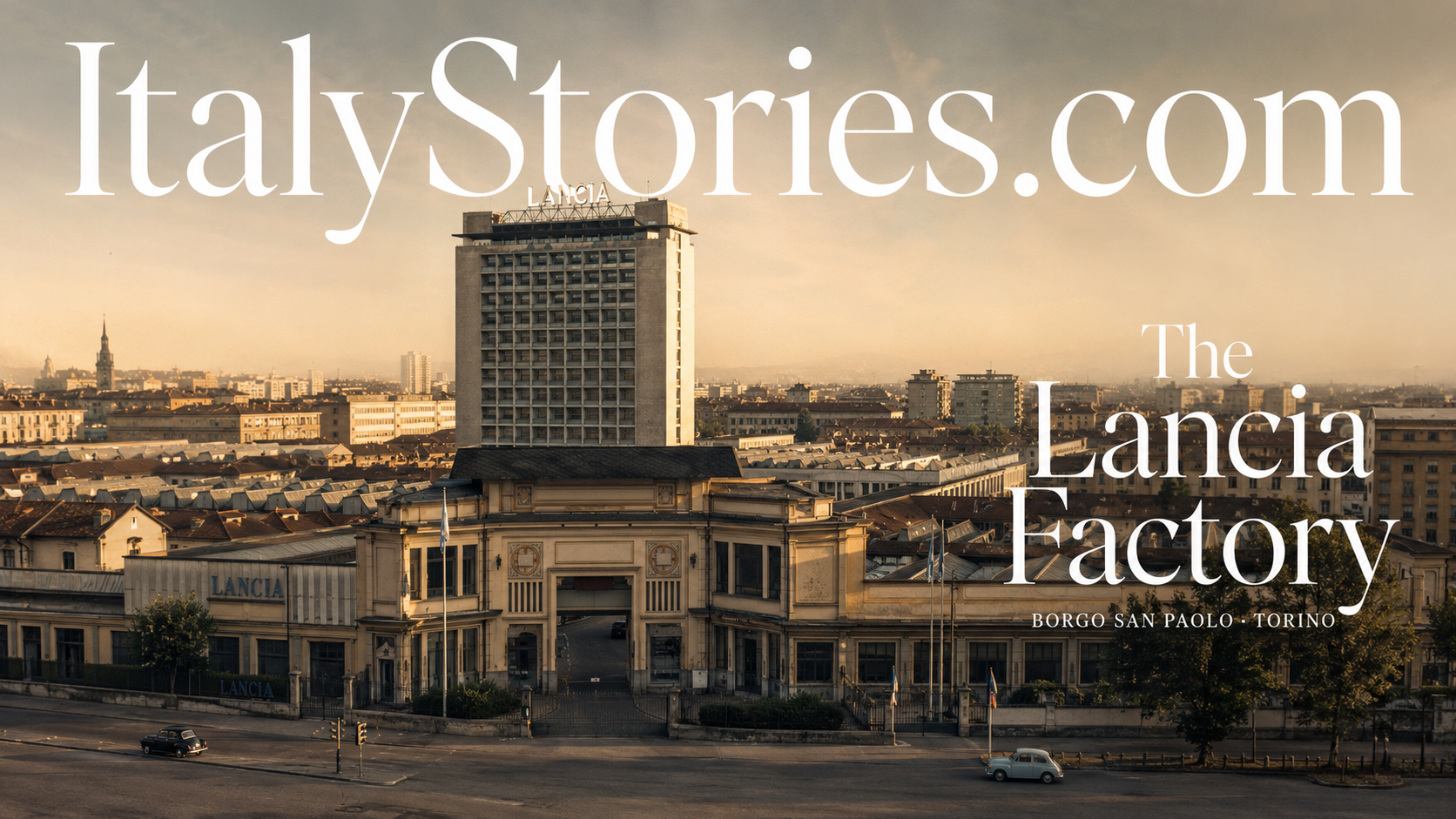
On a Turin street in the first years of the twentieth century, Vincenzo Lancia began with an idea that sounded almost stubborn: an automobile could be quick, technically advanced and genuinely civilised at the same time. Italy already knew how to make speed spectacular, but Lancia’s lasting distinction was different. Its cars pursued lightness rather than excess, mechanical intelligence rather than ornament, and a kind of quiet confidence that made engineering feel like culture.
That instinct produced one of the most singular names in automotive history. Lancia built racing machines, family saloons, elegant coupés and rally legends, yet the thread connecting them was unusually clear: an insistence that a car should move with grace. From the first workshop in Turin to the roughest stages of the World Rally Championship, Lancia repeatedly treated innovation as something a driver could feel through the steering wheel, the bodywork and the road.
When Turin Was Learning to Build the Future
Lancia was founded in Turin in 1906 by Vincenzo Lancia and Claudio Fogolin. Turin was already becoming the industrial capital of a newly unified Italy: a city of engineers, machine shops, cyclists, carriage builders and ambitious manufacturers. Cars were still rare, roads were inconsistent and ownership remained the privilege of a small public. Yet the city had the technical talent to imagine a home-grown motor industry capable of competing with France, Britain and Germany.
Vincenzo Lancia was not an abstract businessman. Before becoming a manufacturer, he had been a gifted driver and a FIAT test driver, respected for speed, stamina and mechanical sensitivity. That background mattered. He understood that a fast car was not simply an engine with a large number attached to it. It was an entire system: weight, balance, responsiveness, cooling, reliability and the confidence it gave its driver. The company bearing his name began from that practical understanding.
Its early premises in Via Ormea were modest by later industrial standards, but the ambition was not. The first Lancia, the 1907 12 HP, was soon known as the Alpha. It was light, quick and unusually advanced for its time. Lancia’s early model names adopted the Greek alphabet, a small sign of a firm that wanted its cars to stand apart from anonymous machinery. As production grew, the company moved its main works to Borgo San Paolo, an area that would become one of Turin’s great industrial districts.
Vincenzo Lancia and the Refusal to Stand Still
The founder’s instinct was always to question convention. In the 1910s Lancia developed cars that were fast by the standards of their day, but it also learned the hard discipline of manufacturing during a period shaped by war and economic uncertainty. Like many Italian factories, Lancia contributed to wartime production; afterwards, it faced a market in which a young company had to make its ideas pay their way.
The answer arrived in 1922 with the Lambda. It remains one of the defining automobiles of the twentieth century, not because it was merely fashionable, but because it changed the structural logic of the road car. Its steel body incorporated a load-bearing structure rather than sitting as a separate shell on a traditional heavy ladder frame. This monocoque principle helped create a lower, lighter and more rigid car. The Lambda also used independent front suspension, which gave it a level of composure and road holding that many rivals could not match.
These decisions were not technical tricks for brochures. They altered the driver’s experience. A lower centre of gravity helped stability; greater stiffness allowed the body to react more precisely; independent suspension let the front wheels deal with uneven roads without forcing every disturbance through the entire chassis. In an Italy where surfaces could change abruptly beyond the city limits, that was a profound advantage. The Lambda made engineering feel effortless, which would become a Lancia hallmark.
Elegance as a Mechanical Discipline
By the 1930s Lancia had become a manufacturer with its own language. Its cars were not always the simplest or cheapest route to a market. They were designed for people who valued sophistication: owners who noticed a compact engine layout, a refined gearbox or the way a saloon remained settled at speed. The Aprilia, introduced in 1937, carried this thinking into a more aerodynamic age. Its clean form and advanced construction anticipated the post-war European saloon long before that market fully existed.
Vincenzo Lancia did not live to see the Aprilia’s full career; he died in 1937. His absence could have reduced the company to a conventional manufacturer. Instead, the firm continued to carry his appetite for unconventional solutions. That continuity was never automatic. Lancia faced the destruction and disruption of the Second World War, the difficulty of restarting production, and the challenge of finding customers in a country rebuilding its homes, roads and industries. But the post-war years also created the conditions for some of the company’s greatest work.
The Aurelia and a New Idea of the Grand Tourer
In 1950, Lancia introduced the Aurelia, a car that expressed the company’s post-war confidence with remarkable clarity. It is widely regarded as the first production automobile to use a V6 engine. The compact sixty-degree unit was developed under the technical direction of Vittorio Jano, with a major contribution from engineer Francesco De Virgilio. Its importance lay not only in being first. The V6 offered a useful balance of compact dimensions, smoothness and performance, making it especially suited to a refined fast car.
The Aurelia’s mechanical architecture was equally thoughtful. Its rear transaxle grouped gearbox, clutch and differential at the back of the car, helping distribute weight more evenly between the axles. Independent rear suspension and advanced braking arrangements reinforced the sense that Lancia was designing an integrated machine, not merely adding prestige equipment. The B20 GT coupé made these ideas emotionally persuasive. It could travel quickly over long distances, carry its occupants in comfort and still feel alive on a mountain road. In that combination of performance, elegance and endurance, the modern Italian gran turismo found one of its clearest early expressions.
The Aurelia also showed that Lancia’s sophistication could be competitive. The model achieved important results in road racing, including the Mille Miglia, and its success strengthened the company’s international reputation. Overseas buyers encountered an Italian manufacturer whose cars could be technically original without becoming theatrical. That reputation attracted engineers, designers and enthusiasts who saw Lancia as a maker of automobiles with a point of view.
Flavia, Fulvia and the Road to Rallying
The 1960s brought a new Lancia response to changing Europe. The Flavia adopted front-wheel drive and a boxer engine, another willingness to depart from the safer conventions of the market. Front-wheel drive could offer efficient packaging and confident traction, while the low, horizontally opposed engine helped reduce the height of the powertrain. It was a sophisticated answer to the modern saloon and coupé market, even if its complexity asked more of both the factory and the owner.
Then came the Fulvia, a car with crisp proportions, compact dimensions and a character that made it feel instantly purposeful. The Fulvia Coupé became one of the era’s most loved Italian sporting cars, while the HF competition versions turned it into a serious rally weapon. Its narrow-angle V4 engine, front-wheel-drive layout and sharp chassis were not an obvious recipe for glamour, but on demanding roads the car’s balance and precision mattered more than a simple power figure. In 1972, the Fulvia gave Lancia its first International Championship for Manufacturers title, a landmark that announced a new identity for the brand.
That period was also difficult commercially. Advanced engineering is expensive, and Lancia’s small-scale, often intricate approach struggled against the economics of mass production. FIAT acquired control of Lancia in 1969, a change that gave the marque a stronger industrial base but also placed its independent culture inside a much larger group. The tension between freedom and scale would shape much of Lancia’s later story.
Stratos: The Shape of a Rally Revolution
If the Fulvia proved that Lancia could win rallies, the Stratos rewrote what a rally car could be. Developed specifically for the sport, the Stratos was not a conventional road model adapted for competition. Its short wheelbase, mid-mounted Ferrari-derived V6 and dramatic Bertone bodywork were conceived around rally stages. The design, associated with Marcello Gandini, looked like a wedge dropped from another decade; its purpose was just as radical. It concentrated mass near the centre, made the car agile in tight corners and gave the works team a focused competition tool.
The Stratos won the World Rally Championship for Manufacturers three years in a row, from 1974 to 1976. Its achievements were inseparable from the drivers, engineers and team organisation behind it, but the car’s architecture was the essential statement. Lancia had created a machine for a specific job and made it instantly mythical. Its angular silhouette, wide stance and towering reputation brought Italian design and rallying together in a way few cars have managed since.
037 and Delta: Winning Against the Era
The 1980s produced two further Lancia legends. The Rally 037, developed with Abarth and built around a rear-wheel-drive layout and supercharged four-cylinder engine, became the last rear-wheel-drive car to win the World Rally Championship for Manufacturers, taking the title in 1983. It succeeded in an era increasingly defined by four-wheel drive because it was light, responsive and developed with extraordinary focus. On the right surface and in the right hands, its directness could still defeat newer ideas.
The Delta then carried Lancia into the four-wheel-drive age. The Delta HF 4WD, Integrale and Evoluzione versions transformed a practical hatchback shape into the foundation of a rally dynasty. Turbocharged power, four-wheel drive and steadily widened, reinforced bodywork created a car that could use its performance on loose, wet and changing surfaces. Lancia won six consecutive World Rally Championship constructors’ titles from 1987 to 1992. The achievement made the Delta Integrale a cultural object as much as a competition car: it was a family hatchback silhouette carrying the authority of a world champion.
What connected the Stratos, 037 and Delta was not a single mechanical formula. The Stratos placed a V6 behind the driver, the 037 used supercharging and rear-wheel drive, and the Delta used turbocharging and four-wheel drive. The shared principle was clarity of purpose. Each was engineered around the conditions it had to conquer. That is why Lancia’s competition history feels broader than a list of trophies; it is a record of different solutions applied brilliantly to changing problems.
The Cost of Being Different
Lancia’s most attractive qualities have always carried costs. Sophisticated engines, complex structures and limited production volumes could make the cars expensive to build and demanding to maintain. Some models acquired reputations for corrosion, intricate electrical systems or the need for specialist care. A Lancia was often not the rational choice for an owner who wanted the simplest possible life. But that was part of the bargain. The brand asked its public to value character, originality and feel.
Later decades brought uneven fortunes, reduced model ranges and changing corporate priorities. Yet even when its line-up narrowed, the name retained a rare emotional charge. A Lancia badge evokes not a single type of car but a way of thinking: the Lambda’s engineering audacity, the Aurelia’s cultured speed, the Fulvia’s precision, the Stratos’s visual shock and the Delta’s rally-bred determination.
Why Lancia Still Matters
Lancia matters because it proves that automotive history is not written only by the largest manufacturers or the most expensive sports cars. Its greatest achievements came from treating technical decisions as human decisions. A lower floor changed the way passengers sat. Independent suspension changed confidence on poor roads. A compact V6 changed the idea of a fast touring car. Four-wheel drive and turbocharging changed the way a hatchback could attack a rally stage.
The company’s story is inseparable from FIAT’s industrial history, from the competitive imagination of Alfa Romeo, and from the rally heritage of the Lancia Delta HF Integrale. Yet Lancia’s identity remains its own. It is the identity of a factory that made elegance active rather than decorative, and audacity useful rather than loud.
Thank you for sharing this journey through one of Italy’s most original automotive stories. Discover more machines, makers and roads in ITALIAN MOTORS at ItalyStories.com.
[…] *Fiat 682, Fiat 690, OM Titano, Lancia Esadelta and the magnificent heavy trucks of 1960s Italy: machines that rebuilt a country, crossed deserts, […]
[…] engineering, design and daring. Continue with Alfa Romeo – La Fabbrica del Cuore Sportivo, Lancia: The Factory of Elegance and Audacity, and FIAT: La Fabbrica Che Costruì l’Italia. For another great road-race legend, read Porsche at […]
[…] and won. Maserati fought on those roads. Ferrari made the Targa part of its sports-car mythology. Lancia would later bring its own combination of Italian engineering and competitive […]